

Why Kuwait Hotel and Resort Plants Cannot Use Generic Sizing
Hotel and resort wastewater treatment in Kuwait must be designed for high per-capita water use, strong seasonal and occupancy-driven peaks, and a Gulf climate that pushes biological kinetics and evaporation. Local monitoring at Kuwait City's Ardiya catchment recorded 446 L/c/d of water use in 2020 against a five-year average of 436 L/c/d, and a corresponding rise in wastewater generation to about 253 L/c/d, alongside shifts in chemical load from sanitisers and detergents (Journal of Environmental Engineering and Landscape Management, 2022). For a 2026 Kuwait hotel or resort, the practical question is therefore not "which plant" but "which effluent quality" — sewer discharge to a municipal line, or on-site reuse for landscape irrigation, cooling or toilet flushing, with an MBR- or package-STP-based train sized to per-room loadings and peak occupancy.
The Ardiya dataset is the rare Kuwait-specific anchor that exists in the public domain. A 2015–2020 average of 436 L/c/d puts Kuwaiti residential water use at the upper end of the global per-capita band, and the 2020 jump to 446 L/c/d confirms that the curve is still moving. Hotel and resort projects sit on top of that high base because guest rooms add laundry, kitchen and pool backwash flows that a domestic catchment does not capture. Treating the project as a "generic hotel" with a vendor's per-room curve therefore underestimates hydraulic load from day one.
The same Ardiya study attributes the post-2020 wastewater quality shift to elevated cleaning agents, sanitisers and disinfectants — exactly the chemical profile that a guest-room housekeeping operation, on-site laundry and F&B outlet produce year-round. In a bufferless package plant, those surfactant peaks strip oxygen demand and upset the biological stage within hours, which is why the screening, FOG and equalization stages described later in this article are not optional. The take-away is that Kuwait climate and operations move the design point, and a vendor's standard curve is a starting point only.
What Effluent Quality Does the Project Actually Need in 2026
The first engineering decision on a Kuwait hospitality project is whether the plant discharges to the municipal sewer or pursues on-site reuse, because each path sets a different biological and disinfection target. Sewer discharge is governed by the local utility's trade-effluent envelope and can be met by a packaged anoxic/aerobic plant sized to BOD, COD and TSS alone. Reuse for landscape irrigation, cooling-tower make-up or toilet flushing introduces pathogen, salinity and residual-disinfectant limits that a basic STP cannot meet without a polishing step.
For on-site reuse in Gulf hospitality, three sub-targets drive the downstream train: landscape irrigation (tight pathogen and salinity limits), cooling-tower make-up (scaling and silica control) and toilet flushing (lower bar but still microbiological). A polishing step such as ultrafiltration or RO is normally required after biological treatment for any of these, because BOD and COD are not the limiting parameters once the water leaves the biology tank. Engineers sometimes skip this step when the brief is set to "irrigation reuse" but the local salinity limit is not confirmed — a mistake that surfaces during commissioning.
If the only target is sewer discharge, the train can stay simpler. Equalization, screening and a packaged biological stage sized to the utility envelope are usually sufficient, with chlorine or UV as the terminal step. The screening and equalization stages, however, must still match Kuwait's peaking behaviour; a 12–24 h buffer is the cheapest insurance against banquet, conference and seasonal spikes. The reuse-versus-discharge decision must be confirmed per site against current Kuwait authority requirements, not assumed from a generic brief. Where reuse is selected, the MBR membrane bioreactor system is the most common fit-for-purpose biological stage in the GCC because it delivers low and stable suspended solids in a compact footprint.
The Process Train That Works for a Kuwait Hotel or Resort
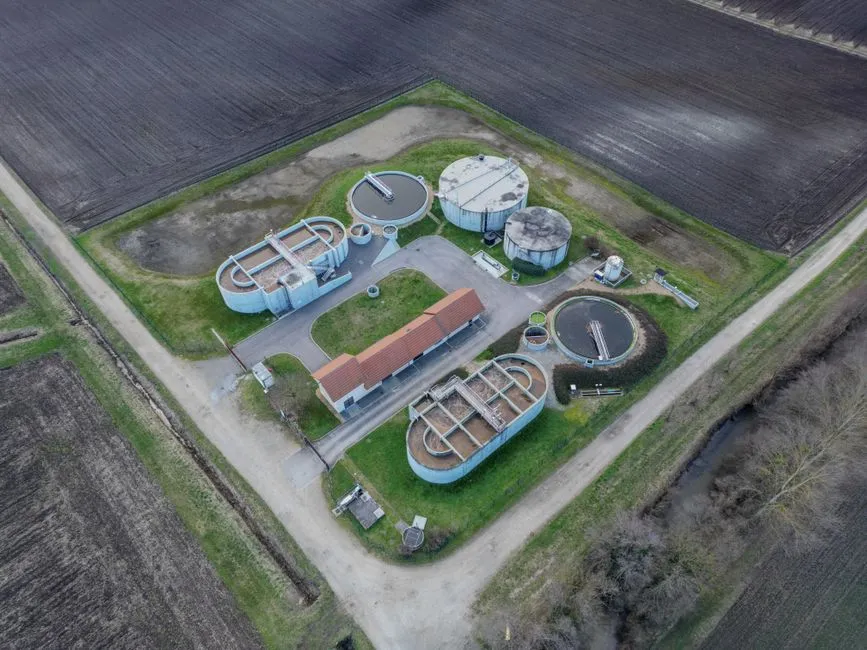
A defensible Kuwait hotel or resort train runs in this order: coarse screening → grit removal → FOG removal (DAF) → equalization → biological (package STP or MBR) → polishing (clarifier or UF/RO) → disinfection. Each stage exists because of a specific operational risk in a Gulf hospitality context, and removing any one of them transfers the load downstream.
Coarse screening and grit removal are not optional. Laundry lint, food solids from kitchens and beach or pool-debris from a resort will blind fine screens and overload biological tanks within days. A rotary mechanical bar screen at the head of the plant is the standard solution at this duty and is sized to the peak hotel flow rather than the daily average. A dissolved air flotation system follows as the FOG and surfactant stage, removing fats, oils and grease from kitchens and handling the elevated surfactant load the Ardiya study flags as a 2020 phenomenon (doi:10.3846/jeelm.2022.17634). Skipping DAF in a kitchen-heavy resort means free oil coats the biology tank surface and reduces oxygen transfer.
Equalization is critical. Hotels and resorts have occupancy-driven peaks — weekend occupancy, banquets, conferences, Ramadan and Eid seasonality — that can swing loads well above the daily average for sustained periods. A 12–24 h buffer tank between the DAF and the biological stage is the cheapest way to keep the biology within residual design margins. The biological stage itself can be either a packaged anoxic/aerobic plant for small resorts discharging to sewer, or an MBR for projects where reuse-quality effluent in a compact footprint is required — both are fit-for-purpose for hotels and are documented as options in the HydropureWater product range. Disinfection closes the train: a UV sterilizer suits reuse loops where chlorine-resistant organisms are a concern and no residual is needed, while a chlorine dioxide generator gives a measurable residual for long distribution lines to irrigation or cooling. For a deeper read on MBR versus moving-bed biology, the MBR vs MBBR comparison lays out the trade-offs; for the compliance and discharge side, this effluent treatment plant compliance guide covers the documentation set a Kuwait EPC contractor should expect to produce.
Parameter Table: Selecting the Right Biological Stage for a Kuwait Hotel
The table below matches process to project without over- or under-specifying. Use it after the reuse-versus-discharge decision has been made; the numbers in the first column come from product specifications, while reuse limits must be confirmed with the local Kuwaiti authority before sizing.
| Process option | Indicative capacity range | Footprint note | Best-fit project | Required follow-up |
|---|---|---|---|---|
| Underground package STP (WSZ series) | 1–80 m³/h per unit | Buried or trailer-mounted, single integrated skid | Sewer-discharge projects with stable loadings and no reuse target | Confirm utility trade-effluent envelope; UV or chlorine for disinfection |
| MBR membrane bioreactor | Project-specific, modular | Typically 60% smaller than conventional activated sludge at the same load | Reuse in scope, constrained footprint, effluent TSS target below 1 mg/L | Confirm reuse limits (pathogen, salinity) with local authority |
| Lamella clarifier (polishing) | Project-specific | Small footprint vs. conventional settler | Conventional activated sludge plants not pursuing full reuse | Pair with UV or chlorine dioxide downstream |
| UV sterilizer | Project-specific | Skid-mounted | Reuse loops where chlorine-resistant organisms matter and no residual is required | Verify dose against target log-reduction |
| Chlorine dioxide generator | Project-specific | Skid-mounted with precursor feed | Long distribution lines to irrigation or cooling where a measurable residual is required | Confirm by-product limits with authority |
| RO / UF polishing | Project-specific | Adds a membrane hall and reject handling | Cooling-tower make-up, irrigation with tight salinity, or indirect potable reuse | Confirm salinity and pathogen limits with receiving authority before sizing |
Two qualifications apply to the table. First, the reuse limits for irrigation, cooling and toilet flushing are authority-specific and the research supplied does not contain numeric values for Kuwait; the engineer must request these from the receiving authority before sizing. Second, the 60% footprint figure for MBR versus conventional activated sludge is a relative indicator used in product literature and should be confirmed against the specific module arrangement at the design stage. The underground package sewage treatment plant covers the sewer-discharge default; the MBR row covers any project with reuse in scope.
Sizing a Hotel or Resort Plant in 2026: Inputs You Must Confirm Per Site
The research does not provide per-room wastewater generation values for Kuwaiti hotels, so the sizing approach below is built as a checklist of inputs the engineer must confirm per site rather than as a single fictitious number. Working through the checklist is the difference between a defensible design and a redesign after commissioning.
| Input | What the engineer must confirm | Why it matters in Kuwait |
|---|---|---|
| Per-capita water use | Use Kuwait-specific data: Ardiya catchment recorded 446 L/c/d in 2020 against a 436 L/c/d 2015–2020 average (doi:10.3846/jeelm.2022.17634) | Design base sits at the high end of the global per-capita band, not the middle |
| Per-room occupancy factor | Project-specific occupancy schedule: single vs. double, suite mix, serviced apartments, long-stay vs. transient | Vendor per-room curves cannot replace a real occupancy profile |
| Peaking factor | Apply a peak factor for banquets, conferences, weekends, Ramadan and Eid | Without it, the plant operates outside design conditions for several days each month |
| Influent concentrations | Site-specific composite sample for BOD, COD, TSS, FOG and surfactants over at least one week | The Ardiya study shows cleaning-chemical loadings are a moving target, not stable year to year |
| Effluent requirement | Confirm with the local Kuwaiti authority whether the target is sewer discharge, irrigation, cooling or toilet flushing | Wrong target forces a redesign of the entire downstream train |
Convert the per-capita flow to a per-room flow by multiplying by the project's actual occupancy factor, not a global rule of thumb. Apply the peaking factor to the resulting daily average to size the screening, DAF and equalization stages; the biological stage is then sized on a 24-hour averaged basis with the peak handled by the buffer. Influent concentrations must be sampled on site over at least one full week that includes a high-occupancy day, because a single grab sample during a low-occupancy weekday will undersize the FOG and surfactant loads. The effluent requirement has to be locked with the Kuwait authority before the biological stage is finalized — switching from sewer discharge to irrigation reuse after procurement is the most expensive late change on this type of project.
Frequently Asked Questions
What is the right process train for a hotel or resort wastewater treatment plant in Kuwait?
A defensible Kuwait hotel or resort train runs coarse screening → grit removal → DAF for FOG → equalization → biological (package STP or MBR) → polishing (clarifier or UF/RO) → disinfection. The biological stage is selected after the reuse-versus-discharge decision is made, and reuse targets require UF or RO polishing because BOD and COD alone are not the limiting parameters for irrigation or cooling reuse.
How much does a hotel or resort wastewater treatment system cost in Kuwait in 2026?
The supplied research does not contain a per-m³ or per-room cost figure for a Kuwait hotel STP in 2026. A defensible budget request should specify the design flow in m³/day, the peak hourly flow, the target effluent quality (sewer envelope or reuse sub-target) and the influent concentrations from a site-specific composite sample; without those four inputs, any quotation is a placeholder rather than a budgeted price.
How do I choose between a package STP and an MBR for a Kuwait hospitality project?
Choose a package STP when the project discharges to sewer, loadings are stable and reuse is not in scope. Choose an MBR when reuse is in scope, footprint is constrained, or the effluent TSS target sits below 1 mg/L. The decision should be made after the reuse-versus-discharge brief is locked with the local Kuwaiti authority, not before.
What is the typical lead time and compliance risk for a Kuwait hotel STP in 2026?
Lead time depends on the unit size, containerization and the scope of civil works, none of which the supplied research quantifies. The compliance risk to manage is the reuse limit: if irrigation, cooling or toilet-flushing reuse is in scope, the engineer must confirm the salinity and pathogen limits with the receiving Kuwait authority before the biological stage is sized, because a late change of reuse target forces a redesign of the downstream train.