

Why Calgary-area housing is choosing packaged sewage treatment
Airdrie is already using about 97% of the water and wastewater capacity Calgary has allocated to it for 2026, with a $114M Airdrie–Calgary pipeline expansion under way to support up to 45,000 new homes, according to a 2025 Yahoo Finance Canada report on Canada's housing-infrastructure gap citing the 2025 National Infrastructure Assessment. That report also found more than 11% of Canada's water and wastewater infrastructure was in poor or very poor condition in 2022, with roughly $107B in replacement value, and quoted Federation of Canadian Municipalities (FCM) president Tim Tierney saying water and wastewater is the top obstacle to building more homes.
A Calgary-area packaged sewage treatment plant is a hedge against trunk-sewer timing and a way to phase a subdivision into service while Calgary's three WWTPs (which together serve more than one million Calgarians and discharge to the Bow River, per the City of Calgary wastewater page) absorb the next tranche of growth.
For a developer or civil consultant, the challenge is determining when each subdivision can physically connect to a receiving system. Until the regional trunk is in the ground, a package plant can carry the load, then be repurposed for lift-station duty, satellite reuse, or decommissioned when the municipal connection comes live. The City of Calgary describes three wastewater treatment facilities with effluent to the Bow River and a Biosolids Management Program covering Shepard Lagoons, Calgro agricultural reuse, and Category A composting, so any interim package plant must be designed to feed a downstream path that the region already accepts. Local packaged-plant supply exists as a category in this market: a Calgary-area vendor listing explicitly markets packaged treatment plants and septic systems to Alberta buyers.
For background on how the same engineering question plays out in another capacity-constrained city, see this packaged STP sizing walkthrough for housing developments in other capacity-constrained cities.
Sizing a packaged plant for a Calgary housing development
Packaged-plant selection begins with the receiving system, not the reactor. Before quoting a flow, the developer needs four documents from the municipality and the regulator: a capacity allocation letter, the tie-in date for the regional trunk, the Alberta Environment discharge criteria that will apply in the interim, and a footprint envelope on the lot that fits a buried or skid-mounted unit. Once those are in hand, sizing collapses to a per-capita calculation with a peaking factor that converts average day flow into the design flow the supplier sizes to.
The inputs the engineer must assemble, and that the supplier will need to confirm in writing, are population served (units × persons per household), average per-capita flow (L/person·day), peaking factor (typically diurnal and seasonal), and influent loadings — BOD (g/person·day), TSS (mg/L), TKN (mg/L), and temperature. Alberta-specific design numbers are not in the supplied research, so the buyer should request the municipality's design guidelines and the supplier's referenced design basis rather than assume a published figure. The design flow in m³/day is then converted to m³/h, which is the band the supplier will quote against — for a residential community, this typically lands in the 1–80 m³/h A/O underground range rather than the larger MBR range, unless near-reuse quality or a tight footprint pushes the selection upward.
The budget envelope comes from the FCM 2023 estimate cited in the Yahoo Finance report: roughly $107,000 in total municipally owned capital per new home, of which about $39,000 is the water and wastewater share. That figure is the trunk, treatment, and storage behind every new connection, not the package-plant line item. Treat the package plant as one component inside the $39,000 wastewater share, sized to a flow band the supplier can document, and resist any quote that does not tie the price back to a stated population, peaking factor, and effluent target.
A/O, MBR and SBR: which packaged technology fits
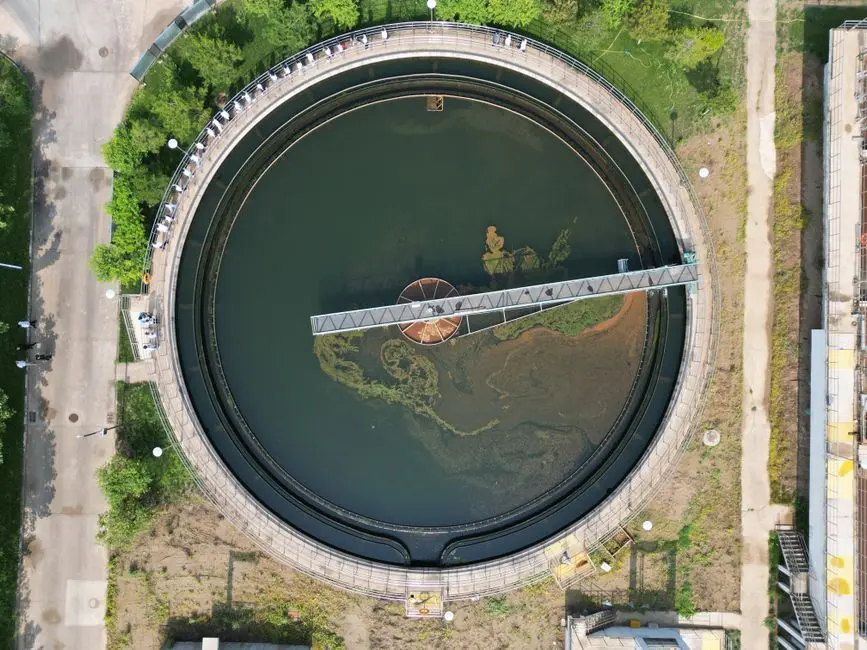
Three packaged configurations cover the realistic shortlist for a Calgary-area residential subdivision. Each is judged on capacity band, footprint, effluent quality, automation, and whether the downstream path is the municipal WWTP network or a standalone discharge.
| Parameter | A/O biological contact oxidation (WSZ underground) | MBR membrane bioreactor | SBR sequencing batch reactor |
|---|---|---|---|
| Capacity band (per supplied catalog) | 1–80 m³/h | 10–2,000 m³/day | Discussed qualitatively in this article; no catalog figure supplied |
| Typical installation | Buried, no operator required, installable below grade or on a trailer | Compact skid or container; near-reuse quality | Batch basin, suited to small communities with intermittent flow |
| Effluent quality indicator | Secondary biological effluent suitable for municipal tie-in | Filtrate below 1 μm with the catalog-stated footprint reduction of roughly 60% versus conventional activated sludge | Secondary effluent, dependent on decant and sludge age |
| Automation | Fully automated, unattended per catalog | Membrane cleaning cycles and SCADA monitoring required | Batch-cycle PLC, moderate complexity |
| Best-fit use case | Buried low-operator residential community, eventual municipal tie-in | Stringent discharge, water reuse, tight footprint, satellite discharge | Small community or phased development with variable loading |
The WSZ underground A/O unit is the default for buried residential-community duty where the eventual path is Calgary's three-WWTP network; the catalog describes it as fully automated with no operator required and installable below grade or on a trailer, which keeps the lot usable. The MBR membrane bioreactor is the choice when effluent must approach reuse quality, footprint is constrained, or a standalone Alberta Environment discharge approval is the path. Compare configurations against the WSZ underground A/O packaged sewage treatment plant and the MBR membrane bioreactor packaged system using the parameters above, then shortlist to one before approaching the regulator.
The technology choice must follow the discharge path. A development that will tie into Calgary's WWTP network can accept conventional secondary effluent because the downstream plant polishes it. A satellite package plant that must meet standalone Alberta Environment criteria, or that targets reuse for irrigation, needs the tighter filtrate quality an MBR delivers. SBR is a viable third option for phased subdivisions where loading is intermittent and an operator can supervise the batch cycles.
Headworks, disinfection and sludge: the supporting equipment a packaged plant still needs
A bioreactor module is not a complete plant. Any packaged bid must be read against a scope list that includes screening, clarification if fats/oils or industrial inputs are present, disinfection, and sludge dewatering. A purely residential subdivision usually does not need a DAF unit, but the moment a commercial kitchen, light industrial tenant, or institutional user is in the mix, dissolved-air flotation enters the scope. Screening is non-negotiable — a rotary mechanical bar screen protects the membrane or media downstream and should be confirmed in the bid, not assumed.
Disinfection closes the loop before discharge. For a Calgary-area residential plant, either a UV sterilizer for packaged-plant effluent or chlorine dioxide is typical, with UV favoured where there is no residual-chlorine contact time available and where downstream reuse or a tight receiving-water target applies. Sludge handling is the line item most often undersized at the quote stage. A plate and frame filter press for packaged-plant sludge brings the cake to a transportable solids content, after which the developer's sludge-handling path must be compatible with regional expectations — the City of Calgary's Biosolids Management Program moves material through Shepard Lagoons, Calgro, and Category A composting, so dewatered cake from a satellite plant should be haulable to a similarly permitted receiver, not landfilled as wet sludge.
Confirm before comparing bids whether the supplier is quoting the bioreactor only or a full headworks-plus-disinfection-plus-sludge package. Two quotes on the same capacity band can differ by 30–50% once ancillaries are normalised, and that gap is almost always scope, not hardware quality.
Cost, lead time and regulatory checklist for Calgary housing

The FCM 2023 estimate of roughly $39,000 in water-and-wastewater capital per new home, and about $107,000 in total municipally owned capital per home, is the budget envelope a packaged plant must fit inside. A residential-scale WSZ A/O or MBR module sits as a line item within that envelope, alongside the downstream trunk, the lift station, and the development's own building services. Request a quote that names a stated population, peaking factor, and effluent target so the comparison across vendors is honest.
The approvals path for 2026 is a sequence. First, secure the municipal capacity allocation letter — for an Airdrie-adjacent project this is the document the city now uses to rank housing third behind schools, health care, and industrial users, per the Yahoo Finance report. Second, confirm the tie-in date for the regional trunk, since the $114M Airdrie–Calgary pipeline is the kind of project that determines whether a package plant is a 2-year interim measure or a 10-year satellite. Third, secure an Alberta Environment discharge approval for the interim operating window, or written confirmation that municipal tie-in removes that requirement. Without those three documents, the package plant selection is premature. For a structured walk through provider evaluation, this wastewater solutions provider evaluation framework and this package wastewater treatment plant cost and compliance framework lay out the same logic for parallel markets.
Pre-purchase checklist: tie-in date, capacity allocation letter, Alberta Environment discharge criteria, footprint available on lot, automation and maintenance plan, sludge destination, and a clear scope split between bioreactor and ancillaries.
Frequently Asked Questions
What flow does a packaged STP need for a Calgary housing development?
Start with population served (units × persons per household), multiply by the municipality's referenced per-capita flow in L/person·day, apply the diurnal and seasonal peaking factor, and convert the result to m³/h. The supplier then quotes against a capacity band — for a residential community this typically lands in the 1–80 m³/h range covered by the WSZ underground A/O unit, or in the 10–2,000 m³/day MBR range if reuse or compact footprint apply. Alberta-specific design numbers are not given in the research, so the buyer must request the municipality's design guidelines and the supplier's stated design basis in writing.
Which fits Calgary housing better — A/O or MBR?
If the development will tie into Calgary's three-WWTP network, a buried low-operator A/O unit such as the WSZ is usually the right fit because the receiving plant polishes the secondary effluent. If the development must operate as a satellite under standalone Alberta Environment criteria, or if near-reuse quality and a compact footprint are required, the MBR membrane bioreactor is the right fit. The decision is driven by the discharge path, not the reactor brand.
How much of the per-home infrastructure cost goes to the package plant?
The FCM 2023 estimate cited in the Yahoo Finance report puts total municipally owned capital per new home at about $107,000, of which roughly $39,000 is the water-and-wastewater share. The package plant is one component of that $39,000 envelope, alongside trunk sewer, lift stations, and treatment capacity at the receiving plant. A specific package-plant line-item price was not given in the research, so the buyer must request a quote tied to a stated population, peaking factor, and effluent target rather than rely on a generic per-home figure.
How long does a packaged plant take in Alberta in 2026?
Lead time depends on municipal capacity allocation (Airdrie is already at about 97% of its 2026 Calgary allocation per the Yahoo Finance report), Alberta Environment discharge approval for the interim operating window, and the regional trunk-construction timeline (the $114