

What the EPA and the Local POTW Actually Require
Textile and dye-house discharges into the Scottsboro Sewer Board system are governed by two overlapping U.S. frameworks: the General Pretreatment Regulations at 40 CFR Part 403, and the Categorical Standards for the Textile Processing Industry at 40 CFR Part 410. Part 410 establishes technology- and water-quality-based effluent limits organized by subpart (e.g., woven, knit, carpet, and stock/yarn finishing) and by individual regulated parameter, while Part 403 imposes the broader duties—baseline monitoring reports, slug-control plans, self-monitoring, and categorical vs. local-limit compliance—on every Significant Industrial User. The research supplied does not quote numeric Part 410 limits, so any specific daily-maximum or monthly-average value must be confirmed against the current Code of Federal Regulations before a design basis is locked in.
The Scottsboro Sewer Board operates an approved Industrial Pretreatment Program with site-specific local limits for pH, TSS, BOD, COD, ammonia, color, sulfides, and metals; these local limits are at least as stringent as EPA's categorical standards. For design purposes, the engineer sizes to the most restrictive of the two for each parameter—categorical or local—not the looser one. The POTW's program also requires flow equalization and access for sampling, so the equalization basin functions as a regulated unit operation, not just a buffer tank.
A facility's first compliance step is a baseline monitoring report and a slug-control plan, followed by a self-monitoring program that feeds the POTW's periodic inspection. Because textile flows swing sharply batch-to-batch, documentation should treat the equalization basin and its instrumentation as a compliance component, with PLC logging of pH, conductivity, and flow that the regulator can review on request.
What's Actually in Dye-House Wastewater
A typical dye-house stream is the sum of four wet-process unit operations. Fabric preparation generates high-pH effluent with significant TSS and trace H₂O₂ from bleaching. Dyeing produces the most heavily contaminated stream: intense color from dye leaching, high salinity, high COD, fluctuating pH, plus dispersants, fixatives, and sometimes trace metals. Printing adds pigments, thickeners, binders, and solvents that are difficult to degrade biologically. Finishing contributes resins, softeners, silicones, waterproofing agents, residual color, and high COD from synthetic organics and trace catalysts (sigmadafclarifiers.com, 2026).
Reactive-dye loss to the dye bath is about 10–40% for cellulosic fibers (Durban University of Technology, 2026), so color load is a direct function of dye-class choice and fixation efficiency. Salt load and hydrolysis rate are the two parameters most likely to put a facility out of compliance when the train lacks biological and tertiary capacity. Water intensity is 80–150 L per kilogram of processed fabric, varying with fiber type and machinery (sigmadafclarifiers.com, 2026), so plant size in m³/day—not fabric weight—drives equipment sizing.
Receiving-water impacts include oxygen depletion from hydrosulfides, light blockage from color, and toxicity to aquatic life from dye auxiliaries (Azanaw et al., Case Studies in Chemical and Environmental Engineering, Dec 2022). These impacts explain why color, sulfide, and BOD are weighted heavily in the local limits.
| Process unit | Dominant parameters in raw effluent | Notes for the design basis |
|---|---|---|
| Fabric preparation | High pH, TSS, trace H₂O₂ | Source-segregate bleach rinse; neutralize before DAF |
| Dyeing | Color, salinity, COD, fluctuating pH, dispersants, fixatives, trace metals | Reactive-dye hydrolysis 10–40% (DUT, 2026) sets color load |
| Printing | Pigments, thickeners, binders, solvents | Hard to biodegrade; needs AOP or UF/RO polishing |
| Finishing | Resins, softeners, silicones, residual color, high COD | Often segregated as a low-volume, high-COD stream |
Pretreatment Building Blocks for a Scottsboro Dye House
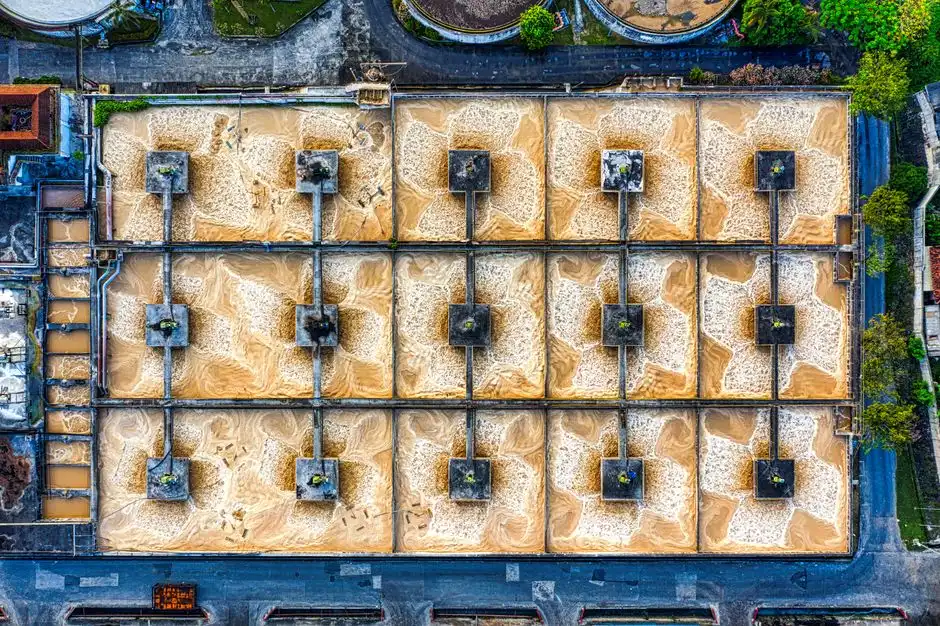
The standard train runs equalization → physicochemical → biological → tertiary → sludge handling, and each stage removes a specific set of parameters. Equalization and pH adjustment smooth flow and chemistry swings before any downstream process; chemical dosing is PLC-controlled for coagulant, flocculant, acid/caustic, and specialty reagents. Size the dosing skid to the peak daily load, not the average—under-sized dosing is the most common reason a DAF upstream of an MBR fails to protect the membranes.
DAF removes suspended solids, fats/oils/greases, and the color colloids that survive equalization; a DAF sized on peak hydraulic load is the typical first solids step in textile pretreatment. A factory-built industrial DAF system with PLC-controlled hydraulics and a top-and-bottom skimmer is the most defensible choice for a Scottsboro dye house running two or three shifts.
Biological treatment handles BOD, COD, and ammonia. Conventional activated sludge works but eats floor space; an MBR with submerged PVDF membranes is the usual retrofit answer for tight sites and produces near-reuse-quality effluent at sub-micron filtration. A packaged MBR membrane bioreactor typically delivers a 60% footprint reduction versus conventional activated sludge, which matters in a Scottsboro facility where production expansion usually claims the available bay space. A PLC-controlled chemical dosing skid tied to in-line pH and conductivity probes is what makes the equalization stage regulator-defensible.
Tertiary treatment polishes color, salts, and residual metals when local limits are tight or water reuse is desired. UF, RO, ozone, Fenton, and electrochemical oxidation each remove a different fraction of the load: Fenton (Fe(II) + H₂O₂) removes >96% color and 40% TOC, ozone-based AOP removes 65–100% color and 60% TOC, and electrochemical oxidation removes >95% color and >95% COD (sigmadafclarifiers.com, 2026). Sludge from primary and biological steps is dewatered in a filter press for sludge dewatering to cut transport and landfill cost.
| Stage | Equipment | Parameters targeted | Reported removal (cited source) |
|---|---|---|---|
| Equalization + pH correction | EQ basin, chemical dosing skid | Flow/chemistry swings, pH | — (regulatory, not removal) |
| Physicochemical | DAF | TSS, FOG, color colloids | Site-specific; protects downstream biology |
| Biological | MBR (anoxic–aerobic) | BOD, COD, ammonia, residual TSS to <1 μm | TSS/color to near-reuse quality (sigmadafclarifiers.com, 2026) |
| Tertiary — Fenton | Fe(II) + H₂O₂ | Recalcitrant color, TOC | >96% color; 40% TOC (sigmadafclarifiers.com, 2026) |
| Tertiary — Ozone AOP | O₃ ± H₂O₂/catalyst | Color, COD | 65–100% color; 60% TOC (sigmadafclarifiers.com, 2026) |
| Tertiary — Electrochemical | Electrolytic cell | Color, COD | >95% color; >95% COD (sigmadafclarifiers.com, 2026) |
| Sludge handling | Filter press | Volume reduction | Transport/landfill cost cut (sigmadafclarifiers.com, 2026) |
Choosing the Right Train for Your Plant
The right train is a function of plant flow and local limits for color, salts, and metals. Three plant-size tiers cover most Scottsboro-area dye houses.
For a small dye house below 200 m³/day discharging to the POTW under standard categorical color and metal limits, an equalization–DAF–MBR–sludge-dewatering train typically clears both 40 CFR Part 410 categorical and Scottsboro local limits without tertiary oxidation. The capital case is straightforward: DAF plus MBR plus a filter press for sludge.
For mid-size plants in the 200–1,000 m³/day range targeting partial reuse or stricter local color/salt limits, add a UF step with 0.03 μm PVDF membranes for colloidal and bacterial barrier protection upstream of any RO. A packaged PVDF ultrafiltration system with 2,000–40,000 L/h capacity covers the range without oversizing. Adding UF also lets the MBR run at a higher mixed-liquor concentration, which trims the biological tank volume.
For large plants or those near discharge-capacity limits, the path is DAF + MBR + UF + RO with an upstream AOP—Fenton, ozone, or electrochemical oxidation—where reactive-dye color persists. A brackish or high-recovery RO system at this scale is also where partial permeate reuse starts to make financial sense. Across all three tiers, a control philosophy that automates chemical dosing, pH correction, DAF sludge handling, and membrane CIP cycles is non-negotiable; PLC-controlled dosing and remote monitoring reduce compliance risk.
| Plant size / driver | Recommended train | Tertiary step | Selection check |
|---|---|---|---|
| <200 m³/day, categorical color/metal limits | EQ + DAF + MBR + filter press | None typically required | Confirm Scottsboro local limit stringency for color/salts |
| 200–1,000 m³/day, partial reuse or strict color/salt | EQ + DAF + MBR + UF | UF (0.03 μm PVDF) for colloidal/bacterial barrier | Match UF skid flow to MBR peak, not average |
| >1,000 m³/day or near discharge-capacity ceiling | EQ + DAF + MBR + UF + RO + AOP | Fenton, ozone, or electrochemical where reactive-dye color persists | Verify AOP >95% color removal claim on-site (sigmadafclarifiers.com, 2026) |
Frequently Asked Questions
How do I size a pretreatment system for a Scottsboro dye house?
Use the 80–150 L/kg water-consumption range and the 10–40% reactive-dye loss as your design drivers (sigmadafclarifiers.com, 2026; DUT, 2026). Ask any vendor for a written water balance based on your batch volumes, dye-class mix, and salt load before they quote a train; plants that skip this step usually end up with under-sized equalization or a DAF that cannot protect the downstream MBR.
What budget should I plan for a DAF plus MBR plus UF plus RO system?
Total cost is a function of train scope, sludge handling, site work, and instrumentation. Ask each bidder for a line-item quote that separates equipment, installation, and lifecycle (membrane replacement, chemical consumption, sludge hauling) so you can compare like-for-like across at least three suppliers.
How do I pick the right pretreatment equipment supplier?
Prioritize suppliers who can document prior work under 40 CFR Part 410 and the local POTW's Industrial Pretreatment Program, and who factory-test skids before shipment. A useful sanity check is to ask for the supplier's reference list on Tennessee Valley dye houses and to verify that they understand the slug-control plan and baseline monitoring report workflow. For a peer reference on what a defensible compliance program looks like in another sector, see this food and beverage pretreatment compliance guide.
Which parameters are most likely to put my facility out of compliance?
Reactive-dye hydrolysis color and salt load are the two parameters that most often trip a textile discharger, as they are not fully removed by DAF and conventional activated sludge alone (DUT, 20