Why Santiago de los Caballeros Changes the Blowdown Equation
A data center in Santiago de los Caballeros cannot be designed with a generic blowdown primer, because the Cibao / Yaque del Norte basin and Caribbean intake conditions re-write the trade-offs. Cooling is the dominant water consumer in any data center, and S3 reports that cooling accounts for 80–90% of total site water demand; S5 adds that a 100 MW facility can reach ~2 million liters of water use per day.
That same load, applied to a basin where agricultural, industrial and urban users compete for the Yaque del Norte allocation, is exactly what turns blowdown recovery from a sustainability project into a permitting and continuity issue. The supplied research does not quantify local basin scarcity, so the site assessment must confirm current allocation status and any seasonal restrictions before the train is sized. Caribbean intake water is also warm and frequently elevated in TDS and hardness, but the supplied research gives no Dominican feed-water figures, so baseline conductivity, hardness and silica must be measured on site before the RO recovery ceiling is locked in. Finally, Dominican concentrate disposal options are narrower than in the U.S. Southwest — sewer, evaporation pond, deep well, hauling or controlled precipitation each require different approvals — and the supplied research does not list permitted routes, so sewer, groundwater and solid-handling options must be validated with local authorities before any discharge assumption is built into the design basis.
What Comes Out of a Cooling Tower: Blowdown Characteristics You Must Design Around
Blowdown forms when dissolved solids, corrosion byproducts and biological growth force a purge, and S2 reports blowdown volume is 25–30% of makeup water at 4 cycles of concentration, or 2.5–3 million gallons per month for a facility using 10 million gallons per month. S2 also reports blowdown TDS of 1,200–6,000 mg/L, typically 4–8× the makeup water, depending on cycles and source quality. Scaling minerals — calcium, magnesium, silica and alkalinity — concentrate in the blowdown and define the RO recovery ceiling, which is why the same source flags scaling chemistry as the primary design constraint. Suspended solids of 10–50 mg/L from corrosion products, biofilm fragments and airborne dust arrive at the membrane train, alongside planktonic bacteria, algae and biofilm-formers that must be addressed before the water can be polished for reuse. Treatment chemicals — biocides, corrosion and scale inhibitors, dispersants, and any legacy chromate or high-phosphate residues — accumulate in the blowdown and constrain downstream reuse or discharge. The table below summarizes the envelope a Santiago train must accept.
| Parameter | Typical CTBD range (S2) | Design implication |
|---|---|---|
| TDS | 1,200–6,000 mg/L | Sets RO feed osmotic pressure and pump energy |
| Hardness (Ca, Mg) as CaCO₃ | Concentrated 4–8× makeup | Defines scaling risk and antiscalant dose |
| Silica | Concentrated with cycles | Caps conventional BWRO recovery at 75–80% (S5) |
| Suspended solids | 10–50 mg/L | Forces UF or tight multimedia ahead of RO |
| Biological content | Planktonic bacteria, algae, biofilm | Requires disinfection compatible with membranes |
| Treatment chemicals | Biocides, inhibitors, dispersants; legacy chromate/phosphate | Constrains reuse and discharge chemistry |
Cooling-Tower Makeup Targets: What the Recovered Water Must Look Like
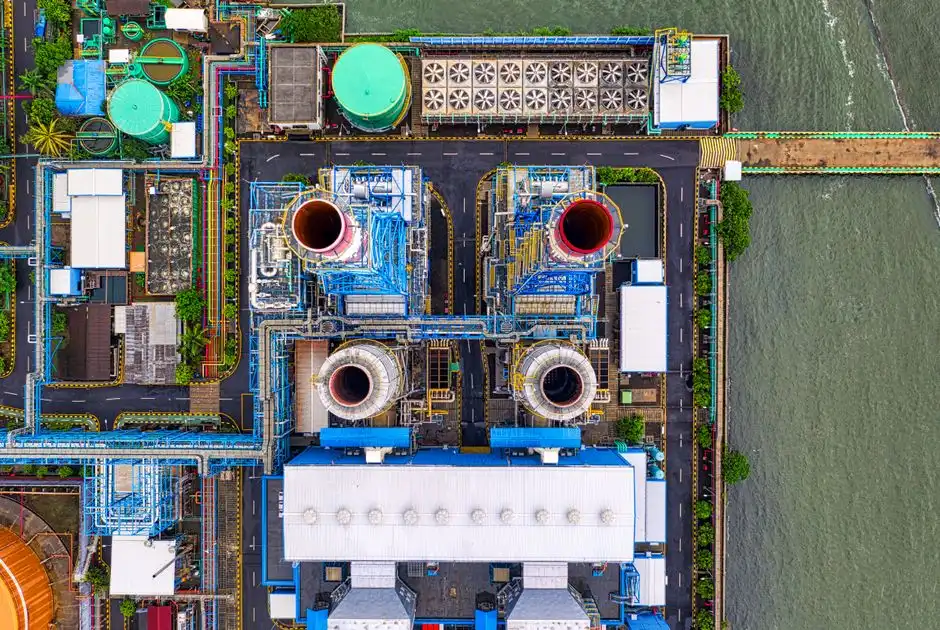
The reuse envelope is what justifies the train, and S3 reports the cooling-tower makeup targets any recovered water has to land inside: TDS 500–1,500 mg/L, hardness below 200–400 mg/L as CaCO₃, suspended solids 10–25 mg/L, bacterial counts below 10,000 CFU/mL, pH 6.5–8.5, and alkalinity 50–200 mg/L as CaCO₃. These targets map directly onto a side-stream-plus-membrane train: a multi-media filter as side-stream pretreatment drops suspended solids to the RO feed spec, a hollow-fiber UF pretreatment for the RO train delivers the SDI and biological barrier, and a BWRO unit for cooling-tower makeup recovery takes care of TDS, hardness and silica in one stage. Hardness compliance is the choice point between NF (selective divalent removal at lower pressure) and full RO, and that choice should be driven by the local feed analysis, not by catalogue claims. S3 also notes that tertiary-treated municipal wastewater typically lands at 600–1,200 mg/L TDS, already inside the cooling-tower envelope — a useful anchor when arguing that stabilized Caribbean municipal effluent, where available, can serve as makeup.
The Treatment Train That Fits a Santiago Data Center
A defensible Caribbean train scales the same three-stage architecture: side-stream filtration, UF, then BWRO, with a concentrate management step sized to the site's discharge envelope. S2 recommends side-stream filtration at 1–5% of total circulation flow as the foundation for higher cycles and cleaner blowdown; CAPEX sits in the $50,000–$200,000 range with minimal OPEX, and spiral or self-cleaning units remove 10–25 micron solids continuously without backwash downtime. UF at 0.01–0.1 micron then removes suspended solids, bacteria, viruses and high-MW organics at 90–95% recovery and 10–30 psi, giving the downstream RO a stable feed. BWRO is the workhorse: S2 reports 95–99% dissolved-solids removal, permeate at 10–50 mg/L TDS, 50–85% recovery, and 150–400 psi operating pressure; S5 cautions that conventional BWRO stalls near 75–80% recovery before scaling becomes unmanageable. Where higher recovery is required, S5 documents a controlled-precipitation plus dynamic-RO architecture operating at ~95% recovery with permeate silica ~1 mg/L, by removing calcium carbonate, calcium sulfate and silica as dense solids before they reach the membrane. Concentrate management options per S2: MVC at 95–98% recovery with distillate below 10 mg/L TDS and 20–30% solids brine; brine concentrators with waste-heat integration; evaporation ponds where land and climate allow; and full ZLD combining RO, evaporation and crystallization at 95–99% overall recovery for sites with no discharge pathway.
| Stage | Function | Key performance (S2 / S5) | Notes for Santiago design |
|---|---|---|---|
| Side-stream filtration | Cuts suspended solids, enables higher cycles | 1–5% of circulation flow; 10–25 micron; CAPEX $50k–$200k | Reduces biofouling load on downstream membranes |
| Ultrafiltration | SDI/biological barrier ahead of RO | 0.01–0.1 micron; 90–95% recovery; 10–30 psi | Permeate backwash; chemical clean every 1–3 months |
| BWRO | Dissolved-solids and hardness removal | 95–99% rejection; 10–50 mg/L permeate TDS; 50–85% recovery | 75–80% recovery ceiling with conventional antiscalant (S5) |
| Controlled precipitation + dynamic RO (high-recovery path) | Removes CaCO₃, CaSO₄, silica as solids | ~95% overall recovery; permeate silica ~1 mg/L (S5) | Use where 75–80% BWRO recovery is not enough |
| Concentrate management (MVC, brine concentrator, pond, ZLD) | Reduces liquid waste to solid or near-zero | MVC 95–98% recovery, distillate <10 mg/L TDS; ZLD 95–99% overall | Select by local discharge rules and waste-heat availability |
Chemistry Compatibility: Why the Cooling-Water Program Has to Change with Reuse
Adding a membrane train without re-engineering the chemistry program will quietly destroy the membranes, and S2 is explicit that traditional liquid chemicals — biocides, corrosion inhibitors, scale inhibitors, dispersants — concentrate in the blowdown and can foul membranes or trigger discharge-permit issues; chromate and high-phosphate legacy chemistries are particularly problematic. Tablet-based, non-phosphate, low-toxicity programs are presented in S2 as a way to keep chemistry compatible with downstream RO while still delivering microbiological control, scale inhibition and corrosion protection. The supplied research does not name a single Dominican-approved biocide, so any local selection must be cross-checked against Ministerio de Medio Ambiente and INDRHI requirements before procurement, and an PLC-controlled antiscalant and pH dosing skid should be specified with the same Dominican-approved chemistry list. If biological control is the limiting step, an on-site chlorine dioxide generator for biological control is a membrane-compatible alternative to oxidizing biocides that would damage thin-film composite elements.
CAPEX, OPEX and the Payoff of Reuse vs Discharge
The economic case is what carries the design through a CFO or board review, and S2 cost benchmarks are the only quoted figures in the supplied research: a 50,000 GPD blowdown RO at $250,000–$500,000 installed with OPEX of $1.50–$3.00 per 1,000 gallons; MVC at $1–3 million for 10,000–30,000 GPD and 15–25 kWh per 1,000 gallons; side-stream filtration at $50,000–$200,000; full ZLD at $3–8 million with OPEX of $5–$15 per 1,000 gallons. S3 reports a hyperscale Texas site recovering 2.5 million gallons monthly from on-site blowdown treatment, cutting municipal water use by 35% and eliminating blowdown discharge fees — the closest published analogue to a Caribbean reuse case. S2 and S3 both note discharge fees in water-stressed regions now run $5–$15 per 1,000 gallons and some jurisdictions cap TDS below 1,500 mg/L, so reuse economics improve as local tariff and discharge rules tighten. The supplied research does not quote Dominican electricity, water or discharge tariffs, so local figures must be substituted when sizing payback. The cost table below maps each stage to the dollar envelope the engineering team can carry into a Santiago EPC conversation.
| Asset | Capacity reference | CAPEX range (S2) | OPEX reference (S2) |
|---|---|---|---|
| Side-stream filtration | Data-center scale, 1–5% of circulation | $50,000–$200,000 | Minimal; solids disposal |
| UF | Hollow-fiber, 90–95% recovery | Site-specific | Membrane replacement, periodic CIP |
| BWRO | 50,000 GPD blowdown | $250,000–$500,000 | $1.50–$3.00 per 1,000 gal |
| MVC | 10,000–30,000 GPD | $1,000,000–$3,000,000 | 15–25 kWh per 1,000 gal distillate |
| Full ZLD | RO + evaporation + crystallization | $3,000,000–$8,000,000 | $5–$15 per 1,000 gal |
| Discharge fees (water-stressed regions, S2) | Per 1,000 gallons | — | $5–$15 |
Site-Assessment Checklist Before You Finalize the Train
Before any equipment is ordered, the Santiago site assessment has to lock down the data the design basis is built on, and the supplied research is explicit about which inputs are non-negotiable. Confirm baseline makeup-water quality — conductivity/TDS, hardness as CaCO₃, silica, chloride, iron, manganese and any free chlorine — because these set the RO recovery ceiling and the antiscalant program (S2, S3). Confirm the local climate envelope — ambient wet-bulb temperature, humidity and rainfall — because Caribbean wet-bulb temperatures directly change cooling-tower cycles and blowdown volume, even though the supplied research gives no Dominican-specific figure. Confirm power cost, reliability and any on-site waste-heat source, since RO, MVC and any thermal stage are energy-intensive (S2). Finally, confirm Dominican regulatory items the supplied research does not cover: discharge permit pathway through Ministerio de Medio Ambiente, concentrate disposal options (sewer, evaporation pond, hauling, controlled-precipitation solids), and any reclaimed-water quality requirements for non-cooling end uses such as landscape irrigation or washdown. These are the inputs the EPC conversation in Santiago will be built on, and the engineering team should not commit to equipment selection until each line is signed off.
Frequently Asked Questions
What treatment train is best for cooling-tower blowdown in Santiago?
The defensible baseline for a Caribbean data center is side-stream filtration at 1–5% of circulation flow, followed by UF at 0.01–0.1 micron, then BWRO at 75–80% recovery (S2, S5). Where the BWRO recovery ceiling is not enough, S5 documents a controlled-precipitation plus dynamic-RO architecture operating at ~95% overall recovery with permeate silica ~1 mg/L.
What does blowdown recovery actually save?
S3 reports a hyperscale Texas site recovering 2.5 million gallons monthly, cutting municipal water use by 35% and eliminating blowdown discharge fees. S2 quotes blowdown RO OPEX of $1.50–$3.00 per 1,000 gallons and discharge fees of $5–$15 per 1,000 gallons in water-stressed regions; the supplied research does not quote Dominican tariffs, so the buyer must request local electricity, water and discharge figures before sizing payback.
What Dominican permits and feed-water data do I need before selecting equipment?
The supplied research does not list Dominican discharge or concentrate disposal rules, so the buyer must confirm the Ministerio de Medio Ambiente permit pathway, the available concentrate disposal route (sewer, evaporation pond, hauling, controlled-precipitation solids) and basin allocation status with INDRHI. Baseline makeup-water conductivity, hardness, silica, chloride, iron, manganese and free chlorine must be measured on site, because the supplied research gives no Dominican feed-water figures.
How do I reduce supplier-selection risk on a Caribbean project?
Require each bidder to document membrane compatibility with the site's actual feed-water analysis and to name the antiscalant and biocide chemistries on their schedule, cross-checked against Ministerio de Medio Ambiente and INDRHI requirements, because the supplied research does not list Dominican-approved chemistries. Also require reference projects of comparable Caribbean or tropical MW load, since S3 notes hyperscale reuse cases in Texas and S5 cites a 95%-recovery industrial deployment, and ask for guaranteed recovery, permeate silica and energy consumption at the proposed recovery, not at catalogue-best conditions.
Related Equipment
- BWRO unit for cooling-tower makeup recovery — specifications, capacity range, and technical data