What Material Compatibility Testing Actually Solves in a UPW Loop
Material compatibility testing in a semiconductor ultrapure water (UPW) loop is a documented qualification program, not a datasheet review. The question it answers is binary: will this wetted fitting, diaphragm, membrane, or housing release ionic, organic, particulate, or gaseous contaminants above the acceptance band of SEMI F63 and ASTM D5127 when exposed to hot, ozonated, recirculating 18.2 MΩ·cm water for the life of the tool?
That question is separate from the chemical-compatibility question — does the UPW, ozone, or H2O2 degrade the part over time? Both must be qualified, because the Wikipedia UPW contaminant taxonomy spans five axes (particles, ions, organics, bacteria, and dissolved gases) and any one of them crossing the limit can scrap wafers. A TOC-driven production halt at a sub-7 nm fab can cost up to $125,000 per hour according to AllanChem (2025-10), and AXEON's table shows next-generation 2 nm and 1 nm nodes target TOC below 0.5 ppb — well below the current <1 ppb acceptance band. Treat every candidate fitting as a potential yield event and qualify it before installation, the same way a fab treats backup-fab readiness as a pre-disruption activity rather than a procurement checkbox, as the supply-chain paper by the International Journal of Research and Scientific Innovation frames it. Practical wetted-material selection also feeds directly into the broader III-V semiconductor wet processing equipment spec guide and the wafer fab wastewater treatment design guide, which assume the upstream materials have already passed leach testing.
The Specs a Material Must Not Break: SEMI F63 and ASTM D5127 Limits
Every compatibility decision downstream is gated by the SEMI F63 / ASTM D5127 acceptance band. Reproduce the AXEON parameter table verbatim into your qualification plan and treat every row as a pass/fail threshold at 25°C:
| Parameter | Specification | Measurement Method |
|---|---|---|
| Resistivity | >18.2 MΩ·cm at 25°C | Inline conductivity meter |
| TOC | <1 ppb | UV-persulfate oxidation |
| Silica (dissolved) | 0.2–1.0 ppb | ICP-MS |
| Silica (colloidal) | 0.3–2.0 ppb | ICP-MS |
| Particles (>0.05 µm) | <0.3 particles/mL | Laser particle counter |
| Bacteria | <1 CFU/100 mL | Membrane filtration |
Two sensitivities make this band brutal. First, per Wikipedia's UPW article, 0.1 ppb of sodium chloride already drops loop resistivity to 18.11 MΩ·cm, so any fitting that leaches a fraction of a ppb of an ion will be visible on the conductivity probe. Second, advanced microelectronics rinse requires dissolved oxygen below 10 µg/L per Wikipedia, which means elastomers and the degassing membranes adjacent to them must both be qualified against that ceiling, not just the ionic and TOC limits. Reclaimed feedstocks also bring urea and other small-molecule organics that conventional RO, ion exchange, and UV do not fully strip, per Wikipedia, so advanced oxidation processes (UV-AOP and sulfate-radical) must sit on the qualification scope for any sub-7 nm fab running on reclaimed feed. If a candidate component cannot be tied to a measurement on this table, it has not been qualified.
Step 1 — Pre-Qualification Documentation and Risk Tiering
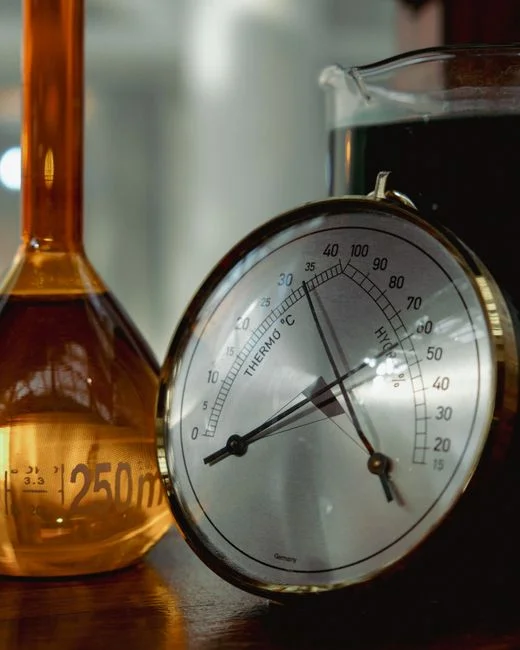
Cut the candidate set on paper before you spend on lab work. Require every vendor to provide an extractables statement, lot-level trace-metals certificates, post-cured versus as-polymerized data, and any prior UPW or semiconductor service history. Vendors that will not publish this are themselves a signal — escalate them to the high-risk tier or drop them. Tier the survivors by risk before any coupon is cut:
- Low risk: virgin PVDF, virgin PFA/PTFE, electropolished 316L with documented Ra roughness and passivation data.
- Medium risk: pigmented or recycled polymers, EPDM/PDM diaphragms, FRP pressure vessels.
- High risk: stainless with unknown surface finish, any part with painted or coated exterior wetted regions, anything sourced without lot traceability.
Cross-check each candidate against the five-axis Wikipedia contaminant list (ions, particles, organics, bacteria, dissolved gases) so the test matrix explicitly covers every class, not just the one the vendor's data sheet mentions. Position the candidate in the treatment train before you accept its data — AllanChem notes that RO, ion exchange, EDI, UV oxidation, and sub-micron filtration each remove a specific class of contaminant, so a part downstream of polishing sees far less margin than a part upstream of RO. Match the material to its position, and use EDI polishing modules and RO and UF membrane elements as your reference points for what the upstream and downstream stages can and cannot clean up.
Step 2 — Static Extractables and Dynamic Leach Testing
Two protocols have to run. The static extractables test screens chemistry; the dynamic leach test screens real-loop behavior under thermal, flow, and oxidative stress. Run both before any candidate is installed in a production loop.
| Test | Conditions | Sampling | Pass/Fail Trigger |
|---|---|---|---|
| Static extractables | 18.2 MΩ·cm UPW, 25°C / 40°C / 60°C, 7 / 14 / 28 days | TOC (UV-persulfate), trace metals (ICP-MS), anions, total silica at each interval | Any species exceeding SEMI F63 limits, reported per unit wetted surface area |
| Dynamic leach | Side-stream at 1.2–1.5× design flow, max rated temperature, ≥30 days | Online resistivity, TOC, DO, particle counters | Resistivity <18.2 MΩ·cm or TOC >1 ppb per AXEON |
| Ozone / H2O2 stress cycle | 0.05–0.5 ppm ozone and 0.1–1% H2O2, repeated cycles, then re-run static extractables | TOC, metals, particle counts pre- and post-cycle | Post-stress extractables exceed pre-stress baseline or SEMI F63 limits |
| Particle shedding | Pre-conditioned coupon, hot UPW rinse, then flow transients | TSI Nano LPM 10 nm detection per AllanChem | Nanoparticle counts exceed control loop by statistically significant margin |
For the dynamic leach test, build a small UPW loop with the candidate parts installed in parallel side-streams so a single failing component can be isolated without scrapping the rest of the matrix. ICP-MS is the reference technique for sub-ppb work per AllanChem. For the ozone and H2O2 stress cycle, recognize that many elastomers pass pure-water tests and fail after oxidative aging — this is the step that catches EPDM. For particle shedding, AllanChem notes the TSI Nano LPM system has been validated at semiconductor facilities for 10 nm detection, and the S2 critical-particle-size rule means even sub-feature-size particles matter at sub-7 nm. Use ultrafiltration systems and multi-media polishing filters to control the background count in your test loop so the candidate's own shedding signature is the signal, not the loop's.
Step 3 — On-Line Monitoring Architecture During Production Ramp
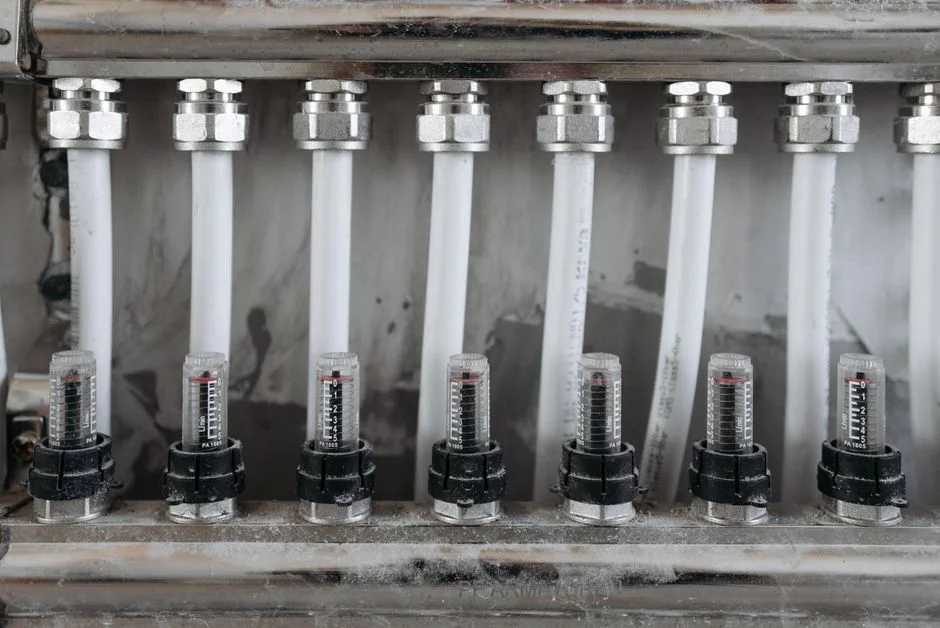
Compatibility has to be re-verified once the loop is live, not just at commissioning. The on-line monitoring architecture should treat every new component as a leading indicator, not a settled fact. Place TSI-class particle counters and LAR QuickTOCtrace-style TOC analyzers at fab supply headers, return piping, and critical tool locations, following the placement guidance in AllanChem. Set statistical control limits at 80% of the SEMI F63 acceptance values — alarm at 0.8 ppb TOC, trip at 1.0 ppb TOC — so a degrading fitting or membrane triggers action before yield impact. Monitor dissolved oxygen with optical fluorescence sensors per Wikipedia's UPW article, and hold the loop below 10 µg/L to confirm that degassing membranes and the candidate materials around them are not introducing O2 back into the loop. Track resistivity continuously: the Wikipedia figure that 0.1 ppb NaCl drops resistivity to 18.11 MΩ·cm makes resistivity a leading indicator of ionic leaching from a newly installed component, which is exactly what you want when a brand-new fitting goes into service. Wire the monitoring output into the same SCADA layer as your UV sterilizer controls so a TOC excursion automatically pauses sanitization cycles that could amplify organic carryover.
How Material Choices Pass and Fail the Test
The pre-screen pattern that holds up under extractables, dynamic leach, and ozone stress is consistent enough:
| Material | Typical Result | Failure Mode to Watch |
|---|---|---|
| Virgin PVDF, PFA, PTFE | Passes extractables and TOC; lowest baseline leaching | Lot-to-lot variability in recycled grades |
| EPDM and other elastomers | Higher-risk for TOC and particle shedding, especially under ozone | Organic and bacteria contribution per Wikipedia S2 |
| Electropolished 316L stainless | Passes ionic and DO tests with documented Ra and passivation | Particle failures if not pre-rinsed; pre-conditioning is non-optional |
| Reclaimed-water service | Requires AOP qualification on top of wetted materials | Urea and small organics survive RO/IX/UV per Wikipedia |
Virgin fluoropolymers are the safest baseline. AllanChem notes PFA, PTFE, and HDPE are the conventional wetted polymers in UPW service, and AXEON lists UF membranes in the same low-leaching class. EPDM and other elastomers are higher-risk for TOC and particle shedding, especially under ozone sanitization — Wikipedia notes that organics and bacteria are the most obstinate classes to control and elastomers contribute both. Electropolished 316L stainless with documented roughness and passivation passes ionic and DO tests but can fail particle tests if not properly pre-rinsed, so pre-conditioning and online verification are non-optional. Reclaimed-water compatibility requires qualifying AOPs (UV-AOP, sulfate-radical) on top of the wetted materials, because urea and small organics survive conventional RO, ion exchange, and UV per Wikipedia. Compare candidate materials against the same EDI polishing modules and RO and UF membrane elements benchmarks used in Step 1 to keep the position-in-train logic consistent across the qualification.
Frequently Asked Questions
What does a semiconductor UPW material compatibility qualification program actually cost in 2026?
The research provided does not publish a current program-level price for a full extractables-plus-dynamic-leach qualification. Instead, anchor the spend to a known floor: a TOC-driven production halt can cost up to $125,000 per hour per AllanChem (2025-10), which is the economic floor a qualification budget has to clear. The inputs a buyer should request from a candidate lab are: number of candidate parts in the matrix, whether ozone and H2O2 stress cycles are included, the duration of the dynamic leach side-stream run, and whether ICP-MS sub-ppb trace-metals reporting is bundled.
Which suppliers should be on the short list for wetted-materials qualification at sub-7 nm?
Pre-screen suppliers on documentation depth, not on price. Require lot-level trace-metals certificates, post-cured versus as-polymerized data, and prior semiconductor UPW service history; vendors that will not publish this should be escalated to the high-risk
Frequently Asked Questions
What test data should we require from a UPW fitting or tubing supplier before installation?
Suppliers must provide certified extractables data based on ASTM F1394 or SEMI F57 standards, specifically detailing Total Organic Carbon (TOC) contributions after 24-hour static soak tests. You should require a Certificate of Analysis (CoA) demonstrating metallic impurity levels below 10 parts-per-trillion (ppt) for critical elements like Fe, Ni, Cr, and Cu, measured via ICP-MS after a high-purity rinse-down protocol.
Additionally, request documentation of particle shedding profiles verified through laser particle counter testing at 0.05 micron thresholds. Suppliers must also provide documentation confirming the material is free of silicone-based mold release agents and satisfies the SEMI F57 requirement for surface roughness (Ra) values below 0.25 micrometers for wetted surfaces.
How long does a typical UPW material qualification take, and what does it cost?
A comprehensive material qualification protocol typically requires 12 to 16 weeks to account for multi-stage rinse-down cycles and long-term analytical testing. This timeline includes 4 weeks for initial material characterization, 6 weeks for dynamic loop testing to reach baseline stability, and 4 weeks for final analytical verification of trace contaminants.
Costs for a full-scale qualification campaign range from $25,000 to $60,000 per material type depending on the complexity of the analytical suite. This budget covers independent laboratory fees for ICP-MS and TOC analysis, as well as the internal labor costs associated with maintaining a dedicated test-loop environment under controlled cleanroom conditions.
Which wetted materials most commonly fail extractables testing in semiconductor UPW loops?
Elastomeric seals, particularly EPDM and low-grade Fluoroelastomers (FKM), are the most frequent sources of failure due to the leaching of curing agents, accelerators, and plasticizers. These materials often exhibit significant TOC spikes, sometimes exceeding 50 ppb during the initial 48-hour soak period, which can violate stringent fab-wide TOC specifications.
Polyvinylidene fluoride (PVDF) components that have undergone improper thermal processing or those containing internal regrind material also frequently fail. These components often shed sub-micron particles and exhibit inconsistent ionic leaching profiles when exposed to the aggressive solvent-like nature of 18.2 MΩ-cm ultrapure water.
How do we qualify materials when our fab is using reclaimed municipal or industrial wastewater as UPW feedstock?
When using reclaimed water, you must increase the duration of dynamic soak testing to 30 days to account for the potential synergistic effects between residual disinfection byproducts and material-specific extractables. Testing protocols must be expanded to include specific screenings for Nitrogen-containing compounds and dissolved organic nitrogen (DON), which can accelerate the degradation of fluoropolymer surfaces.
Qualification requires a localized pilot-scale loop that mirrors the actual reclaimed water chemistry, including the presence of any residual ozone or UV-treated species. Materials must be validated for resistance to potential long-term oxidative stress, ensuring that the polymer matrix does not undergo chain scission, which could lead to an increase in nanoparticle generation over the material's service life.
What on-line monitoring should we install to catch a material-related contamination event before yield loss?
Install high-sensitivity, real-time TOC analyzers capable of detecting excursions down to 0.5 ppb with a response time of less than 15 minutes. These should be placed at the point-of-use (POU) and at the return header to isolate the source of organic spikes immediately following any maintenance or component replacement activity.
In addition to TOC, implement on-line laser particle counters (LPC) calibrated for 0.05-micron sensitivity to detect spikes in particulate matter, which serve as a leading indicator of mechanical degradation or improper installation of fittings. Differential pressure monitoring across filter housings and critical valves provides a secondary, non-analytical method to detect early-stage material swelling or blockages caused by incompatible chemical exposure.