The Real Decision Facing a Bremen, US Mining or Metals Factory in 2026
For Bremen, US mining and metals factories choosing a primary solids-removal step in 2026, a dissolved air flotation (DAF) unit and a conventional clarifier are not interchangeable — they target different particle populations. DAF uses 30–50 micron microbubbles (per SigmaDAF USA / Clearwater Industries) to lift fine suspended solids, oils, and metal-hydroxide flocs to the surface for skimming, and is classified as an "Adaptive Use" physical/chemical process in EPA 832-R-12-011. Conventional clarifiers rely on gravity settling and work best on denser, coarser settleable solids. The right answer for a given site depends on the wastewater's settleable-vs-floatable split, metals content, flow rate, and Bremen, US discharge or reuse targets — not on the equipment category alone.
The 2026 capex decision is more than a vendor selection. Both technologies are proven in industrial settings — Kemco Systems markets DAF for metal finishing and heavy industrial streams, and SigmaDAF USA / Clearwater Industries ships DAF skids into the North American market (S2, S5) — so the buyer's risk is choosing the wrong mechanism, not buying an unproven box. A conventional clarifier, including inclined-plate (lamella) designs, remains the workhorse for coarse primary slurries in many mining and metal-finishing operations.
What is changing in 2026 is the pressure around the unit operation. Tighter effluent expectations for heavy metals and total suspended solids (TSS) at POTW pretreatment, combined with growing pressure to reuse process water, mean the primary solids-removal step now has to hit a tighter floor and feed downstream polishing (filtration, precipitation, ion exchange) reliably. The 2026 industrial effluent discharge guidelines are the reference frame a Bremen, US buyer should be reading in parallel with vendor quotes. Because the supplied research does not contain specific Bremen, US numerical limits, those local numbers are an input to pull from the sewer authority before signing a purchase order.
The recommendation that follows is built on one principle: match the equipment to the wastewater's settleable-vs-floatable particle distribution, the flow envelope, and the chemistry — not to the loudest vendor pitch. A 304SS DAF skid is the right answer in some Bremen, US plants and a waste of capex in others, and a lamella clarifier is exactly the reverse.
How a DAF System Actually Separates Solids
A dissolved air flotation (DAF) unit clarifies wastewater by attaching micro-scale air bubbles to suspended particles and floating the resulting agglomerate to the surface, where a skimmer removes it. The mechanism is straightforward enough to evaluate on a P&ID. Pressurized water is saturated with air in a saturator vessel, then released at atmospheric pressure into a flotation tank; the pressure drop nucleates a cloud of fine bubbles that contact conditioned solids and lift them (Kemco Systems, S2). The floated mat is scraped off, and the clarified underflow exits the bottom of the tank.
The bubble size band is the engineering variable that determines what the system can actually lift. SigmaDAF USA / Clearwater Industries publishes a 30–50 micron microbubble range for its industrial DAF systems (S5). That window is small enough to maximize surface-area-to-volume for particle attachment and large enough to retain buoyancy against turbulence, which is why DAF outperforms plain sedimentation on fine TSS, emulsified oils and greases, and light metal-hydroxide flocs. Heavier particles that do not attach simply drop into the collection zone and are augered out the bottom (S5), which is why DAF can also handle some grit loading.
What the vendor community treats as standard around the flotation cell matters as much as the cell itself. Coarse filtration — a hydrocyclone for high-density solids such as sand and gravel, or a shaker screen for multi-stage fines removal — sits upstream of the DAF (S2). pH adjustment and chemical coagulation/flocculation condition the stream so the microbubbles have something to attach to; without proper flocculation, the bubbles have no target and removal collapses (S2, S5). The chemistry is supplied either by serpentine flocculator mix tubes or by chemical mix tanks, both of which SigmaDAF USA packages with its Compact DAF skid (S5). The HydropureWater DAF system follows the same train — coarse removal, pH control, coagulant/flocculant dosing, flotation, skimming, sludge handling — and the buyer should expect each stage to be priced and warranted separately.
From a regulatory-status standpoint, DAF is not an experimental technology. EPA's "Emerging Technologies for Wastewater Treatment and In-Plant Wet Weather Management" (EPA 832-R-12-011, March 2013) classifies DAF-style flotation processes within the physical/chemical "Adaptive Use" category — i.e., a mainstream, deployed technology — alongside other adaptive-use physical/chemical processes such as the Actiflo and DensaDeg (S1). For a 2026 capex committee, that classification is the single most useful sentence in the EPA document: DAF is a defensible, well-characterized unit operation, not a pilot project.
How a Conventional Clarifier Separates Solids
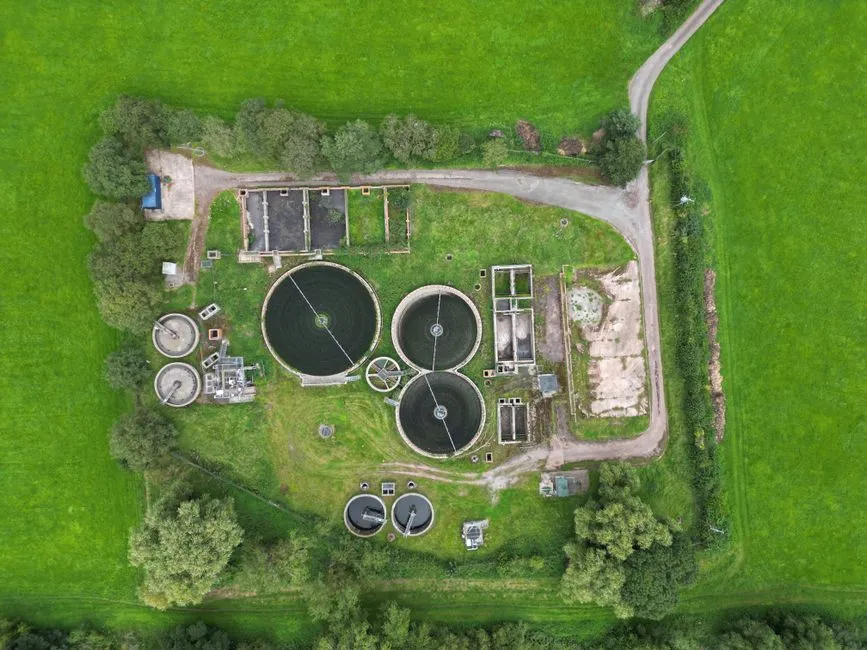
A conventional clarifier separates solids by gravity. Wastewater enters a quiescent tank, suspended particles settle through the water column to a sludge bed on the floor, clarified overflow travels over a weir at the opposite end, and the accumulated sludge is withdrawn periodically — typically by a rotating scraper mechanism or a hopper-and-eductor arrangement. There is no air, no bubbles, and no skimmer. The driving force is the density difference between the particle and the surrounding water, and the engineering task is to give the particle enough residence time at low enough velocity to reach the floor before it exits the tank.
That mechanism is well-matched to a specific particle population: relatively coarse, high-density, readily settleable inorganic solids. In a mining/metals context, that means primary slurries, mill scale, gross settleable grit from machining and grinding washdown, and many metal-finishing rinse streams when chemistry is controlled to grow dense floc. For those feeds, a clarifier is simple, robust, and low-chemical — the unit operation the industry has run for decades.
The mechanism is poorly matched to a different population. Fine colloids, emulsified oils and greases, light or low-density metal-hydroxide flocs, and any particle whose settling velocity is exceeded by upward or lateral turbulence will simply ride the current over the weir. A clarifier does not have a mechanism to capture floatables — anything that should be skimmed has to be netted out by a separate scum baffle, and even then, the residence time needed to settle fine metal-hydroxide floc often forces a clarifier to be sized larger than a DAF for the same removal target. Inclined-plate (lamella) designs shrink that footprint by using stacked parallel plates to multiply the effective settling area inside a smaller tank; the HydropureWater lamella clarifier is one example. Lamella clarifiers still rely on gravity, so they share the same particle-population strengths and weaknesses as a conventional clarifier — they just do it in less floor space.
DAF vs Clarifier: Head-to-Head for Mining and Metals Streams
The comparison below frames the head-to-head on the variables that actually move a 2026 capex decision for a mining/metals plant. Numbers come from the supplied research (S2, S5) and from SigmaDAF USA / Clearwater Industries product data; anything the research does not quantify is flagged as an input to request from the bidder.
| Parameter | DAF (dissolved air flotation) | Conventional / Lamella Clarifier |
|---|---|---|
| Primary separation force | Buoyancy from 30–50 µm microbubbles attaching to particles (S5) | Gravity settling in a quiescent tank |
| Target contaminant — floatable FOG, light metal-hydroxide floc, fine TSS | Strong fit; surface-skimmed (S2, S5) | Weak fit; passes to overflow or scum baffle |
| Target contaminant — coarse settleable grit, primary slurry solids | Acceptable; heavier particles drop to collection zone and auger out (S5) | Strong fit; sludge bed, periodic withdrawal |
| Flow-rate posture (SigmaDAF Compact DAF) | ≤66 GPM single skid; >66 GPM two-skid modular (S5) | Vendor-specific; lamella designs extend the upper end |
| Footprint vs duty | Typically shallower tank, higher hydraulic loading rate; exact m³/m²·h not given in supplied research — request from each bidder | Larger footprint for fine-particle duty; lamella reduces this |
| Chemical conditioning dependency | High; coagulant/flocculant dosing is required for the microbubbles to attach (S2, S5) | Moderate; floc strength and settling velocity matter |
| Standard materials of construction | 304SS standard, 316SS and polypropylene on request (S5) — meaningful for chloride/acid-exposed mining streams | Commonly carbon steel with coating, 304SS, or FRP; vendor-dependent |
| Regulatory status (EPA 832-R-12-011) | "Adaptive Use" physical/chemical process (S1) | Long-established conventional unit operation |
| Oil and grease (FOG) handling | Specifically targeted — Kemco lists FOG as a primary DAF use case (S2) | Limited; requires scum removal and is not the design target |
Two practical observations fall out of that table. First, SigmaDAF's flow split at 66 GPM (S5) is a real engineering breakpoint — the same chemistry train and skimmer work on a single skid at lower flows, and a modular two-skid layout at higher flows — so a Bremen, US buyer should not assume a linear scale-up from a pilot. Second, the "DAF needs chemicals" line is not a footnote. Chemical conditioning is required for the microbubbles to find something to attach to (S2, S5), which means coagulant and flocculant OPEX is a separate operating line item the buyer should model, not bundle into the equipment quote. An automatic chemical dosing system is typically sold alongside the flotation cell, and the right architecture is to size the dosing system against the same influent variability the flotation cell is sized against.
Choosing the Right Path for a Bremen, US Operation in 2026
The Monday-morning framework is an influent checklist, not a vendor brochure. Before talking to bidders, run the wastewater stream through the items below and put numbers on each one:
- Settleable vs floatable solids fraction — measured by settleometer (Imhoff cone) and by a bench DAF jar test on the same sample.
- Oil and grease presence — quantified, not assumed, especially if equipment washdown or cutting fluids enter the stream.
- Metals of concern — at minimum the suite on the local sewer authority's discharge permit, plus any reuse target.
- Peak vs average flow — peak-to-average ratio drives equalization and skid sizing.
- Chloride, pH, and temperature envelope — sets the materials of construction question and the chemical conditioning window.
- Reuse target percentage — drives the downstream polishing train (filtration, ion exchange, RO) the primary step has to feed.
That checklist maps to a routing decision. If the dominant population is floatables and fines — emulsified oils, light metal flocs, fine TSS — DAF is the correct primary step. If the dominant population is coarse settleables and grit from a primary slurry, a clarifier (conventional or lamella) is the correct primary step. If the stream is genuinely mixed — common in metal-finishing washdown combined with process rinses — a hybrid train is the realistic answer: a lamella clarifier ahead of DAF for grit and load reduction, or DAF as the primary polishing step ahead of a clarifier polishing stage. The scalable digital-twin providers for water, wastewater, energy, and manufacturing are a separate decision, but they are the right tools to validate whichever configuration the checklist points to before capex is committed.
Three inputs the supplied research does not let us quantify are also the three items most often missing at the proposal stage, and they are the ones a 2026 capex defense lives or dies on: Bremen, US local discharge limits for heavy metals and TSS, equipment-level capex dollars, and energy draw in kWh/m³ at the design loading. The first belongs to the local sewer authority; the second and third belong to each shortlisted vendor, asked in the same units and against the same influent envelope so the answers are comparable. Anything else is a sales number, not a process number.
Frequently Asked Questions
For a mining or metals plant with mostly oily washdown and fine TSS, is DAF the right primary step?
Yes, on the data the supplied research supports. DAF specifically targets oils, greases, and suspended solids; Kemco Systems lists FOG and suspended solids as primary DAF use cases (S2), and SigmaDAF USA / Clearwater Industries markets DAF to industrial wastewater streams where microbubble-floated removal of fines is the design point (S5). Pair the cell with proper coagulant/flocculation conditioning, because the microbubbles need conditioned floc to attach to (S2, S5).
When does a conventional clarifier still win over a DAF in 2026?
When the dominant stream is coarse, dense, readily settleable solids — primary mining slurries, gross grit from grinding washdown, and many metal-finishing rinses where chemistry produces a heavy floc. Gravity settling in a quiescent tank — including a lamella clarifier in a smaller footprint — handles that particle population directly, with lower chemical dependency than DAF. For floatables, fine TSS, and light metal-hydroxide floc, a clarifier is the wrong tool, which is why many plants end up running both in series.
How should a Bremen, US buyer compare DAF and clarifier bids on cost in 2026?
Build a like-for-like comparison sheet that prices the same four blocks on each side: equipment, civil works, chemical conditioning, and lifecycle OPEX (coagulant, flocculant, energy, sludge handling). Ask each bidder for unit cost in the same units against the same influent envelope, including the chemical OPEX line as a separate number rather than bundled in. For flow above SigmaDAF's 66 GPM single-skid breakpoint (S5), request modular pricing explicitly; do not assume linear scale-up. Specific 2026 capex dollars and energy kWh/m³ values are not in the supplied research, so the right procurement move is to make each bidder submit those numbers in writing.
What supplier-selection criteria matter most for a 2026 DAF or clarifier purchase in Bremen, US?
Materials of construction, regulatory status, and documented experience in metal-finishing or heavy industrial streams. On materials, SigmaDAF USA / Clearwater Industries lists 304SS standard with 316SS and polypropylene available on request (S5); for chloride- or acid-exposed mining streams, 316SS or a non-metallic option is not an upgrade — it is a baseline. On regulatory status, EPA 832-R-12-011 classifies flotation processes as "Adaptive Use" physical/chemical treatment (S1), which is a useful line item in the capex defense. On experience, ask for a list of installed units in metal finishing or heavy industrial service and verify at least one site visit reference. Lead time, sizing, and compliance risk are part of the same evaluation: a vendor that cannot document those four items in writing is not a 2026-capex-ready vendor.