A DAF clarifier for industrial wastewater treatment floats oils, greases, and fine suspended solids instead of waiting for them to sink. TSS reduction reaches 90–98% on compact systems as small as 4 m³/h when FOG > 50 mg/L. Gravity tanks remain the fit once TSS > 500 mg/L and the solids are dense. Bubble size on this duty is 20 to 80 µm at a saturation pressure of 4–6 bar.
What Is a DAF Clarifier for Industrial Wastewater Treatment?
Saturation pressure in a DAF clarifier is 4–6 bar, and the release at atmospheric pressure forms bubbles of 20 to 80 µm. Those bubbles lift coagulated solids in 15–30 minutes at a surface loading of 5–20 m³/m²·h. Most plants we size for oily food waste hold saturation near 4 bar when influent TSS is 50–200 mg/L.
Dissolved air enters a recycle stream at 4–6 bar and leaves solution when that stream hits atmospheric pressure in the flotation tank. The release makes the milky-water cloud of bubbles from 20 to 80 µm cited in HydropureWater field data, 2025. Particles that would sink slowly, or not at all, ride those bubbles to a skimmer. The logic is the reverse of a gravity tank.
Coagulants cancel particle charge, and flocculants bind the solids into flocs the bubbles can lift. The DAF system for industrial wastewater doses those chemicals ahead of the float cell. Hardware details for that duty sit on the Dissolved Air Flotation (DAF) System page, including the skid range used later in this guide. A mechanical skimmer then pulls the thickened float off the surface.
DAF units operate at hydraulic loading rates of 5–20 m³/m²·h, which is higher than a gravity basin because the bubble-floc rise rate beats the settling rate of the same solids. That rate is why the hydraulic retention time (HRT) is only 15–30 minutes, compared with the hours a traditional tank needs. FOG and colloidal matter that stay suspended in a gravity-fed system are the fraction this rate is built to catch. Most plants we size for food waste sit toward the lower half of 5–20 m³/m²·h when the floc is fragile.
Dissolved Air Flotation vs Sedimentation Tank Efficiency
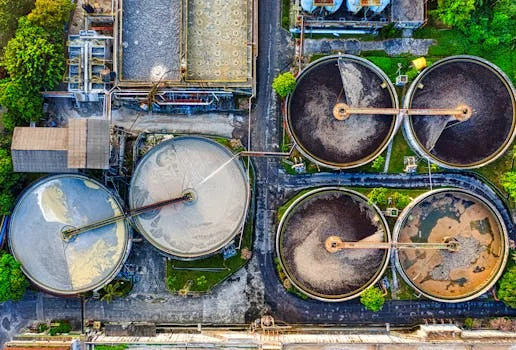
Dissolved air flotation vs sedimentation tank efficiency favors flotation when solids are light: DAF reaches 90–98% TSS removal against 60–80% for a conventional clarifier at 50–200 mg/L TSS. Lamella units in the same head-to-head band land at 70–85% TSS. The FOG gap is wider: DAF systems routinely remove 95%+ of free oils, whereas gravity systems often remove less than 50% without additional flotation equipment. Those percentages apply at the 50–200 mg/L TSS window stated above, not as a blanket claim for every industrial sewer.
Conventional sedimentation tanks rely on gravity and the density gap between the solid and the water. Stokes' Law puts settling velocity on the square of particle radius and on that density gap. Tanks of this type suit heavy, dense solids (TSS > 500 mg/L) but need a large footprint and long retention, often between 2 to 4 hours. Light oil never builds that settling velocity, which is why the hour-scale tank still fails the FOG test.
Footprint at 100 m³/h
Footprint at 100 m³/h is the cleanest way to see the area gap. A DAF system handling 100 m³/h can often be installed in a 20 m² area, whereas a lamella clarifier would require approximately 35 m², and a conventional tank would exceed 100 m². That 100 m³/h equals 2,400 m³/d. Indoor bays are where the 20 m² number decides the layout before the power bill does.
Float solids from the DAF system for industrial wastewater land around 3–5% solids in operating notes, against 1–2% solids from gravity settlers. The comparison table lists a wider DAF band of 3% – 6%, so use the table when you are scoring options and the 3–5% note when you are sizing a dewatering press. Thicker float cuts the volume sent to a guide to sludge dewatering after clarification. Haul tickets we compare move more than the power bill once float solids stay at 3–5%.
According to Shammas (2010), as indexed by US EPA HERO (record updated January 23, 2026), high-rate DAF with 3–5 min of detention can replace sedimentation with 2–3 h of detention. The same summary reports hydraulic loading rising from 1 to 2.5 L/m2/s, and to 7.5 L/m2/s on a triple-stacked unit, while detention fell from 30 to 3 min. Air dissolution in that account needs only 10 s in a dissolving tube, versus the previous 60 s. The table below keeps 15–30 min and 5–20 m³/m²·h for the packaged units in this guide, at the slow end of that published span.
| Parameter | DAF Clarifier | Lamella Clarifier | Conventional Sedimentation |
|---|---|---|---|
| TSS Removal Efficiency | 90% – 98% | 70% – 85% | 60% – 80% |
| FOG Removal Efficiency | 95% – 99% | 20% – 40% | < 20% |
| Hydraulic Retention Time | 15 – 30 min | 45 – 90 min | 2 – 4 hours |
| Surface Loading Rate | 5 – 20 m³/m²·h | 20 – 40 m/h (effective) | 0.5 – 1.5 m/h |
| Sludge Concentration | 3% – 6% | 1% – 3% | 0.5% – 2% |
| Footprint Requirement | Low (Very Compact) | Medium | High |
Short retention is the trade for that footprint. A DAF tank holds less buffer volume than a large sedimentation tank, so a slug reaches the effluent inside the same 15–30 minutes. Air-to-solids ratio and chemical dose have to move in that window. On dairy and slaughter jobs we lay out, equalization sits ahead of the cell when the hourly peak is sharp, because the float tank will not store it.
DAF vs Lamella Clarifier for FOG Removal
DAF vs lamella clarifier for FOG removal follows the oil, not the plate area. Table FOG removal is 95% – 99% for DAF, 20% – 40% for plates, and < 20% for plain sedimentation. Plates help dense solids by shortening the fall, and they do not capture emulsified oil. Specific gravity near 1.0 shows up as jar scum on rendering jobs we review, before anyone calculates plate area.
Inclined plates, usually tilted 55° to 60°, raise effective settling area and can cut footprint by up to 60% versus a conventional sedimentation tank for dense solids. Engineers comparing catalog units often start with a lamella clarifier with 20–40 m/h loading rates. That 20–40 m/h figure is an effective rate on the projected plate area, not the same basis as the DAF 5–20 m³/m²·h tank surface rate. Read the two loadings as different denominators before you rank them.
Plate spacing, angle, and the effective-rate basis are tabulated in Lamella Clarifier Specifications: 2026 Engineering Data, Des. Use that sheet when the solids sink and grease is low. It is the wrong sheet when the jar test floats.
Where solids are dense and oil is genuinely low, a lamella clarifier is the gravity tool to specify, not a second float tank. Food plants, metalworking lines, and laundries often miss that test because specific gravity sits close to or less than 1.0. Those streams are the gap flotation was built to close. Bridging between plates is the maintenance cost you accept only after the jar test sinks.
Compact DAF System for Food Processing Wastewater
A compact DAF system for food processing wastewater is the usual pick once FOG concentrations exceed 50 mg/L, which is common in dairy, meat rendering, and similar protein plants. Gravity settling cannot capture the buoyant share of that load. Petrochemical waste with the same oil cut follows the same rule. A cook-line survey we run usually shows the float forming before a settle cone builds a blanket.
What Does 40 CFR Part 432 Still Require?
According to US EPA (page updated August 19, 2026), the Administrator signed a withdrawal on August 28, 2025. That 2024 proposal would have revised meat and poultry effluent limitations and set new pretreatment standards. The Federal Register notice of the withdrawal is dated September 3, 2025. Direct dischargers remain under the 2004 amendment of 40 CFR Part 432, first promulgated in 1974.
As of the September 22, 2026 eCFR, simple slaughterhouses at or below 50 million lb/year LWK have a BPT daily maximum of 0.12 lb oil and grease per 1000 lb LWK for on-site wastewater. The monthly average for that oil and grease limit is 0.06 lb/1000 lb LWK, and TSS limits are 0.40 and 0.20 lb/1000 lb LWK. Any BPT, BCT, or NSPS discharge under this part must hold pH between 6 and 9. Pretreatment standards for existing sources in that subpart remain reserved, with no Part 432 text change shown after January 3, 2017, so a city sewer limit can still be the binding number.
EPA's existing direct-discharge coverage still includes every meat slaughterhouse, meat further processors above 6,000 pounds per day of finished product, and renderers above 10 million pounds per year of raw material. Poultry first processors above 100 million pounds per year are in that direct-discharge list too. The same float cell also treats paper-mill white water, textile dye solids, and algae-laden surface water when the solids are light. Those three are colloidal problems, not a change to the meat-rule numbers above.
Packaged skids in this series run from 4 m³/h to 4–300 m³/h and ship as a pre-integrated unit. The 4 m³/h end covers a pilot or a specialty line. Plant headers use the upper part of 4–300 m³/h only after measured flow, not nameplate hope. Single-room installs we lay out start at 4 m³/h (96 m³/d) so the saturator can be tuned before the factory tie-in.
Industrial DAF System Retrofit Capacity Upgrade
An industrial DAF system retrofit capacity upgrade is how plants add flow without a new concrete basin. Several real-world DAF performance in industrial settings showed plants upgraded their capacity by 40% within the same physical footprint. The skid has to pass the door and the saturator has to reach 4–6 bar on the existing power feed. Door width and the recycle pump, not tank volume, are what limit the retrofits we lay out.
Use the floor test before the brochure test. If FOG > 50 mg/L or the solids are light, and available floor is less than 30 m² per 100 m³/h of flow, a DAF skid is the unit that fits. A conventional tank at that flow wants on the order of the 100 m² cited above, which many existing rooms do not have. The 4–300 m³/h skid range is what makes the drop-in possible.
Variable daytime load is the other retrofit case. Select a DAF system equipped with an automatic chemical dosing system when the hourly swing would otherwise outrun a fixed dose. The short 15–30 minutes of retention leaves little time for a manual bucket test. Two-shift plants we commission tie that dose to flow, not to a clock.
DAF Clarifier Operational Cost and Maintenance
DAF clarifier operational cost and maintenance starts with power, not with the tank steel. A typical DAF unit consumes between 0.3 and 0.6 kWh/m³ of treated water, mostly in the saturation pump and the recycle loop. A lamella clarifier needs only 0.1 to 0.2 kWh/m³ because the plates themselves do not compress air. On two-shift food duty we cost, polymer often exceeds the power gap once the float is thick.
Daily checks cover the skimmer and the air-to-solids ratio. Weekly checks cover the saturator and recycle lines for scale that would coarsen the bubbles. Plate units fail differently: fibrous or sticky solids bridge the gaps, and the plates need pressure washing or manual cleaning about quarterly. An industrial DAF maintenance checklist keeps the saturator and recycle pump on that weekly cadence for hard-to-treat streams.
Chemical dose is a large OPEX line for both DAF and plate systems, and DAF often reaches clearer effluent at a similar dose. In an industrial wastewater clarification cost breakdown, the thicker DAF sludge reduces hauling and disposal enough to offset the higher electricity over a 5-to-10-year period. That offset assumes the float stays in the 3–5% solids band, not a watery skim. Track hauled mass, not just the power meter, or the comparison lies.
- Saturation and recycle power between 0.3 and 0.6 kWh/m³ of treated water.
- Coagulant and flocculant dose, often similar to a plate unit at higher clarity.
- Hauled sludge mass, lower when float is 3–5% solids instead of 1–2% solids.
- Weekly labor on the saturator, recycle lines, and skimmer.
- Quarterly plate washing if inclined plates stay in the same train.
- Downstream dewatering of the thicker float.
Decision Checks Before You Buy
Match the clarifier to the solids and to the pad you actually have. A jar test that floats is a flotation problem even if a gravity tank is already on the plot. Engineers who skip that test buy extra chemical and still miss the permit. The four cases below are the sort we use on a first call.
- Scenario A: Scenario A applies when FOG > 50 mg/L or the solids are light and colloidal, as in food processing or oil & gas. It also applies when floor space is less than 30 m² per 100 m³/h of flow. Select a DAF system.
- Scenario B: Scenario B applies when solids are dense (Specific Gravity > 1.1), non-oily, and outdoor space is ample. Select a conventional sedimentation tank.
- Scenario C: Scenario C applies when solids are dense, space is limited, and grease is relatively low. Select a lamella clarifier.
- Scenario D: Scenario D applies when the load swings through the day and surge loads would outrun a fixed dose. Select a DAF system equipped with an automatic chemical dosing system so the dose follows the flow. The dose change is what holds effluent quality when flow moves.
Following this order avoids treating a float problem with a gravity tank, which burns chemical and still leaves oil in the effluent. DAF needs more active control and more kilowatt-hours than plates. It also takes the oily and colloidal loads that plates and plain tanks miss, in a much smaller pad. That trade is the reason to pick it, and the reason to refuse it when the solids sink cleanly.
Specify DAF when the jar test floats, FOG is above 50 mg/L, or the room cannot hold a tank near 100 m² for a 100 m³/h line. Look elsewhere when solids are dense, specific gravity is above 1.1, oil is low, and outdoor space is available: that is a sedimentation tank. Look to plates when those dense solids must fit a smaller pad and grease is low. Next step: send flow, FOG, TSS, and a jar-test note with the plant data sheet for a DAF sizing check.
Frequently Asked Questions
What is the difference between DAF and clarifier?
A DAF system uses micro-bubbles to float contaminants for skimming, while a standard clarifier uses gravity to settle solids to the tank floor. On the units compared here, flotation runs 15–30 minutes at 4–6 bar and bubbles of 20 to 80 µm. A conventional tank needs 2 to 4 hours when the solids are dense enough to sink. Pick flotation when FOG is high, and settling when specific gravity is above 1.1 and oil is scarce.
How often should a DAF be drained and cleaned?
Inspect the saturator and recycle lines weekly, and drain the tank for a deep clean every 6 to 12 months. Daily work is the skimmer plus the air-to-solids ratio, not an empty tank. Scale on the recycle line is what pulls bubble size outside 20 to 80 µm. Fibrous wastewater pushes that deep clean toward 6 months, while stable 4–6 bar oily duty often reaches 12 months.
Are clarifier and sedimentation tank the same?
Yes, a clarifier and a sedimentation tank are the same gravity step under two names. Sedimentation tank is the process term, and clarifier is the equipment term used on most bid sheets. Neither machine dissolves air or skims a float. Retention is 2 to 4 hours at about 0.5 – 1.5 m/h, against 15 – 30 min in the comparison table.
What is the smallest DAF system available?
HydropureWater's DAF line includes compact, skid-mounted units starting at a capacity of 4 m³/h. The same series is quoted up to 4–300 m³/h for larger headers. A single process line or a pilot usually stays at 4 m³/h until a week of flow data is in hand. Most plants we size for a first installation pick that small skid so operators can learn the 4–6 bar saturator before the building header is cut over.
Where does flotation beat plate settling on oil?
DAF offers 20–30% higher removal efficiency than plates for oils, greases, and other light solids. The comparison table lists FOG removal of 95% – 99% for DAF, 20% – 40% for plates, and under 20% for plain sedimentation. DAF also takes 95%+ of free oils in head-to-head checks, while gravity systems often remove less than 50% without a float step. Keep plates when the solids are dense and grease is low.