
Why University Campuses Need a DAF-First Treatment Train
A university campus sewer is a multi-source composite: residential halls discharge shower, laundry and food-grinder flow; academic blocks contribute restroom and classroom sink waste; central dining halls add fats, oils and grease (FOG) at meal peaks; and research or veterinary buildings contribute pH-adjusted streams, glassware rinse, and intermittent chemical waste. None of these streams alone resembles a refinery or slaughterhouse influent, but the blended campus flow is highly variable in both flow and load, which is exactly the regime where dissolved air flotation (DAF) performs better than primary sedimentation.
According to the EOLSS reference on industrial DAF (Srinivasan and Viraraghavan), DAF is "considered as one of the most powerful tools to remove light and difficult-to-treat colloidal suspensions, precipitates or fine dispersions" — a description that fits the low-density FOG, surfactant and colloidal fraction of a campus stream more naturally than the high-TSS load of a meat-processing plant. DAF offers rapid startup, higher rates of operation, thicker sludge, and a smaller footprint than sedimentation, all of which matter on campuses with tight utility rooms and seasonal occupancy swings. EOLSS also states that "DAF should not be considered as a separate process, but integrated into design and operation of the overall treatment system," which is the right framing for a campus project that must demonstrate compliance to a municipal sewer district. For a more detailed design walkthrough, see the DAF engineering specifications guide.
The standard equipment envelope used on campuses, 4–300 m³/h across 13 standard models (HydropureWater verified product catalog), maps cleanly onto a single building, a faculty cluster, or a whole-campus envelope depending on tank count.
Campus Wastewater Characteristics That Drive DAF Design
Four parameters govern DAF response: influent feed characteristics, air-to-solids ratio (A/S), hydraulic loading rate, and solids loading rate. On a campus, the first parameter is the one that changes most across the day.
Campus effluent is typically low-to-moderate in total suspended solids but intermittent in FOG, with sharp peaks at lunch and dinner service, and chemically variable due to lab pH adjustment streams that arrive in slug discharges rather than steady flow. That variability pushes the critical design decision away from hydraulic sizing alone and toward A/S ratio and flocculation chemistry — how much air the saturator must dissolve per kilogram of incoming solids, and whether coagulant dosing is sized to handle a surfactant spike from a single laundry room or a half-drained acid bath from a teaching lab. Bratby and Marais (cited in the Universiti Sains Malaysia chapter) show that full saturation is difficult to achieve below 350 kPa saturator pressure, which sets a floor for the pressurization system. EOLSS distinguishes saturator efficiency by packing: a packed saturator achieves f ≈ 0.9, while an unpacked unit typically delivers f ≈ 0.6–0.7, so a campus designer choosing between retrofitting an existing steel tank and buying a packaged unit should expect measurably different dissolved-air performance at the same set pressure.
The supplied research does not give campus-specific pollutant concentrations; the engineer must commission a 7-day composite sampling campaign covering weekdays, weekends, exam weeks, and semester breaks before finalizing the design. For a procurement-side view of how those numbers feed into equipment selection, the best DAF unit decision framework covers the trade-offs.
DAF Design Parameters and Sizing Equations for Campus Projects
EOLSS defines a three-configuration menu that doubles as a decision tree for campus designers. Full-flow pressurization suits raw streams above 800 mg/L TSS — uncommon on a campus sewer. Partial-flow without recycle (30–50% pressurized) suits low-concentration streams that do not need flocculation. Recycle-flow pressure flotation, where 15–50% of treated effluent is repressurized and returned to the flotation chamber, is the configuration normally used when coagulation and flocculation are part of the system, which is the typical campus case because chemical conditioning is the cleanest way to handle variable surfactant and FOG loads.
The saturator operating envelope is fixed by the same EOLSS reference: influent pressurization between 172–620 kPa, retention time 0.5–30 min, and a microbubble vertical rise rate of 0.152–0.061 m/min once the pressure is released. The flotation chamber area is set by surface loading rate using A = Q / SLR, where Q is the peak flow and SLR is taken from the generation table. The first-generation DAF tanks used in early plants operated at 2–3 m/h and not higher than 5 m/h; second-generation units (the workhorse of municipal water treatment) operate below 5–7 m/h with flocculation times up to 45 min; third-generation units such as DAFRapide, AquaDAF and CoCoDAFF reach surface loading rates up to 40 m/h.
For a rectangular chamber, the USM chapter gives the working geometry: AC = W × D, and the length L is set from the hydraulic constraint, with the ratio D/W usually held between 0.3 and 0.5 to keep cross-sectional velocity and horizontal velocity within workable bounds. The supplied USM text provides the underlying relations for cross-sectional and horizontal velocity; the campus designer should re-derive these against the actual peak flow rather than copy a textbook value.
| Parameter | Range / equation | Source |
|---|---|---|
| Pressurization | 172–620 kPa | EOLSS (S4) |
| Saturator retention | 0.5–30 min | EOLSS (S4) |
| Packed saturator efficiency f | ≈ 0.9 | EOLSS (S4) |
| Unpacked saturator efficiency f | 0.6–0.7 | EOLSS (S4) |
| Full saturation threshold | ≥ 350 kPa | Bratby & Marais, via USM (S5) |
| Bubble rise rate | 0.152–0.061 m/min | EOLSS (S4) |
| SLR, 1st generation | 2–3 m/h, max 5 m/h | EOLSS (S4) |
| SLR, 2nd generation | <5–7 m/h, flocculation up to 45 min | EOLSS (S4) |
| SLR, 3rd generation (DAFRapide, AquaDAF, CoCoDAFF) | up to 40 m/h | EOLSS (S4) |
| Chamber geometry constraint | D/W between 0.3 and 0.5 | USM (S5) |
| Area | A = Q / SLR | Derived from EOLSS SLR table |
For a refresher on the full design walkthrough, the DAF engineering specifications guide expands each of these parameters with worked examples.
Matching DAF Generation to Campus Footprint and Peak Factor
The three DAF generations are footprint trades, not performance grades. First-generation tanks at 2–3 m/h are obsolete for new builds but still common on campuses that inherited legacy concrete tanks from a 1970s central utility; they can be retrofitted as second-generation units by adding a saturator, a recycle pump, and a skimmer, typically holding SLR below 5–7 m/h. Third-generation high-rate units (DAFRapide, AquaDAF, CoCoDAFF) are the answer where the utility room is in a deep basement or a tight central plant room, because they push SLR up to 40 m/h and shrink the flotation chamber area proportionally.
The binding variable on a campus is peak factor, not average flow. Residential halls can produce 3–4× the average night-time flow at semester start and at the morning shower peak, and central dining halls can spike FOG by an order of magnitude around meal service. EOLSS is explicit that the third-generation high-rate units are designed for these peaky streams, which is why they dominate new campus installations. EOLSS also notes that DAF is suitable for installations of 10–20 m³/h up to multi-hundred m³/h, and that envelope matches the standard 4–300 m³/h product band used on campuses today.
| Generation | SLR (m/h) | Flocculation | Best fit on campus |
|---|---|---|---|
| 1st generation | 2–3, max 5 | None built in | Legacy concrete tank retrofits |
| 2nd generation | <5–7 | Up to 45 min | Existing-tank retrofits with added saturator |
| 3rd generation (DAFRapide, AquaDAF, CoCoDAFF) | Up to 40 | Reduced | Deep-basement or compact utility-room new builds |
Integrating DAF With Downstream Biology on a Campus Site
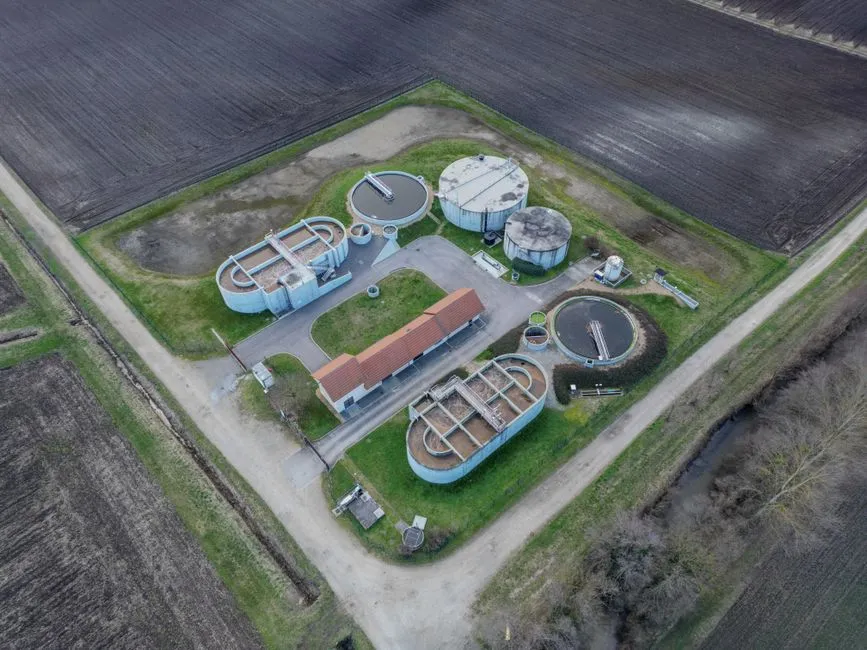
On a campus, DAF is almost never the only unit operation. The DAF outlet feeds either an on-site biological polishing step (MBR, SBR, or a constructed wetland) or, more commonly in urban campuses, a municipal sewer under a pretreatment permit. Each downstream option needs a different DAF outlet profile: an MBR needs low SS and FOG to keep the membrane from fouling, an SBR needs low scum-overflow risk so the decant phase stays clear, and a constructed wetland needs a low risk of ammonia spikes caused by broken emulsions or pH excursions passing through the chemical stage.
Recycle-flow DAF with coagulant dosing is the recommended default, as the chemical stage handles the variable surfactant load from laundry, showers and lab glassware rinse. The supplied research does not specify a numeric effluent quality target for campus sewer discharge; the designer must obtain the local sewer district's limits on BOD, TSS, FOG, pH, and sometimes ammonia before specifying. Equipment sizing for that role is covered in the HydropureWater DAF system product specification.
Buyer-Decision Checklist for Campus DAF Procurement
A campus DAF purchase is decided on the basis of seven inputs and six unit-level questions. Get the inputs wrong and no amount of equipment selection will save the project; get them right and the standard 4–300 m³/h range usually fits without custom engineering.
The inputs a campus DAF supplier should be asked to size against are: average flow, peak flow, peak-to-average ratio, FOG concentration, surfactant load, lab neutralization stream frequency, and target effluent quality. The unit-level questions a buyer should ask any vendor are: saturator pressure band, pressurized recycle fraction, surface loading rate at design peak, skimmer type, PLC scope, and material of construction for FOG-laden streams. The standard 13-model, 4–300 m³/h range is the sizing envelope a campus can usually fit into, but the buyer should request a site-specific A/S and hydraulic loading justification rather than accepting a generic capacity number. Specifications and model coverage for that envelope are documented on the HydropureWater DAF system product page.
| Decision input | What the buyer should provide | Why it matters |
|---|---|---|
| Average flow (m³/h) | 7-day composite from sampling campaign | Sets baseline chamber area |
| Peak flow (m³/h) | Diurnal max from same campaign | Drives chamber area via A = Q / SLR |
| Peak-to-average ratio | Derived from same campaign | Selects 2nd- vs 3rd-generation DAF |
| FOG concentration | Grab samples at meal service | Sets coagulant dose and skimmer sizing |
| Surfactant load | Laundry + shower audit | Drives A/S ratio |
| Lab neutralization frequency | EHS log of discharges | Determines equalization need upstream of DAF |
| Target effluent quality | Sewer district permit limits | Defines chemical conditioning target |
Frequently Asked Questions
What flow rate should a university campus size a DAF system for — average or peak daily flow?
A DAF system must be sized for peak hourly flow rather than average daily flow to ensure effective hydraulic retention and prevent solids carryover during high-load periods. For university campuses, peak flows often occur during morning and evening hours, frequently reaching 2.5 to 3.0 times the average daily flow, which requires sizing the hydraulic loading rate within the typical range of 2.0 to 6.0 meters per hour to maintain system stability.
Which DAF configuration is best for a campus with a central dining hall and residential halls?
A circular or rectangular DAF unit with an integrated grease and oil separation stage is the optimal configuration for campuses with high-volume dining facilities. Given the presence of residential halls, the system should incorporate automated chemical dosing for coagulation and flocculation to handle the high Fats, Oils, and Grease (FOG) loading, which often exceeds 150-300 mg/L in university kitchen effluents, ensuring the downstream biological process is not inhibited.
How much floor space does a DAF unit need for a 5,000-student campus?
For a campus population of 5,000 students, assuming a wastewater generation rate of 25-30 gallons per student per day, a system handling a peak flow of approximately 150,000 to 200,000 gallons per day typically requires a footprint of 250 to 400 square feet. This space allocation includes the primary DAF tank, the air saturation system, and essential maintenance clearances, though it excludes the separate footprint required for sludge dewatering or chemical storage tanks.
What effluent quality can a campus expect from DAF before biological polishing?
When optimized with proper coagulant and flocculant injection, a DAF system can achieve Total Suspended Solids (TSS) removal efficiencies of 80% to 95% and FOG removal efficiencies of 85% to 98%. This typically results in an effluent quality of 50-100 mg/L TSS and 20-50 mg/L FOG, providing a consistent, low-strength influent that significantly reduces the organic loading stress on downstream secondary biological treatment processes like Membrane Bioreactors (MBR) or Moving Bed Biofilm Reactors (MBBR).
Does a DAF system on a campus require a special permit from the local sewer district?
Yes, installing a DAF system typically requires an industrial or commercial wastewater discharge permit from the local municipal sewer authority, as it changes the character of the discharge from standard domestic sewage to pre-treated industrial wastewater. The permit will mandate compliance with specific local limits for pH, temperature, and residual concentrations of pollutants, and will often require the installation of an effluent sampling manhole for periodic compliance monitoring by the district.