
What Counts as a Small Community Wastewater System in Denmark
A small community wastewater system in Denmark typically serves 200–5,000 person equivalents (PE) and is governed by the Danish EPA's BEK 1980 discharge standard. The two compliant options most often specified are (1) a small-scale constructed wetland sized to Danish guidelines — combining septic pretreatment with a subsurface-flow planted filter, or (2) a package mechanical plant such as an MBR or an A/O underground unit for tighter effluent ammonia and BOD limits. Both sit under the Miljøstyrelsen permitting regime and require recipient-water-body classification before a kommune will sign off.
For international comparison, the U.S. EPA defines a small wastewater system as one serving ≤10,000 people and <1 MGD (S4) — roughly twice the upper Danish PE band and useful only as a reference point. Inside Denmark, the term person equivalent (PE) is the standard loading unit: 1 PE ≈ 60 g BOD/d, ≈ 12 g N/d, ≈ 200 L/d of domestic wastewater, applied to the design population plus an industrial/food-service contribution where relevant. Decentralized cluster systems covering a single village or a small group of settlements are the dominant delivery model below 5,000 PE; central municipal works only become economic above that band once gravity sewer distances grow.
The national small-scale constructed wetland guideline (S2, S5) is the authoritative Danish design reference for nature-based treatment at this scale. Its purpose is to standardise hydraulic and organic loading so that a kommune reviewer can compare like-for-like submissions. Septic-tank-only systems — historically common for single dwellings — are being phased out of community-scale duty because of documented failure rates from age, design drift, and root infiltration (S4). For anything above ~30 PE discharging to a defined watercourse, the kommune will expect either a constructed wetland built to the Danish guideline or a packaged mechanical plant covered by a Miljøstyrelsen-recognised performance test.
Danish Design Rules for Small-Scale Constructed Wetlands
The Danish small-scale constructed wetland guideline (S2, S5) serves as the authoritative design reference for nature-based community treatment in Denmark. It prescribes a septic-tank pretreatment step ahead of the wetland cell to capture settleable solids, FOG, and a large fraction of the BOD load before the water reaches the filter media — protecting the hydraulic conductivity of the sand/gravel bed and preventing surface clogging in the first 3–5 winters of operation.
Hydraulic loading on a Danish subsurface-flow (SSF) wetland runs at roughly 30–50 mm/d on a planted sand/gravel filter, with a hydraulic retention time in the order of 5–10 days. These are the order-of-magnitude design values used in the Danish guideline — engineers should size to the specific values in the current edition rather than treat them as universal constants. The guideline frames organic loading per square metre of wetland area (g BOD/m²·d) rather than as a single number, because the relationship between areal load, PE, and ammonia removal is site-specific.
Established reed (Phragmites australis) planting is the Danish norm. Root-zone oxygen transfer in the upper 100–200 mm of the filter supports nitrification in the warmer months, while the lower saturated zone hosts denitrification. The Danish guideline compensates for documented seasonal performance variability (S1) by applying conservative winter sizing — typically a larger footprint or longer HRT — and by adding a polishing step (UV, sand filter, or small reed-bed buffer) where the recipient classification demands it.
| Parameter | Danish SSF wetland design value | Notes |
|---|---|---|
| Pretreatment | Septic tank, ≥1 m³/PE | Two- or three-chamber; sized per guideline |
| Hydraulic loading | ~30–50 mm/d | Order-of-magnitude per Danish guideline |
| Hydraulic retention time | ~5–10 days | Winter sizing uses upper end of range |
| Organic loading | g BOD/m²·d (site-specific) | Expressed per unit wetland area, not per PE |
| Vegetation | Phragmites reed | Planted at 4–8 stems/m² |
| Effluent polishing | UV or sand filter | Added when recipient classification requires |
Effluent Quality Targets: BOD, Ammonia, and Nitrogen
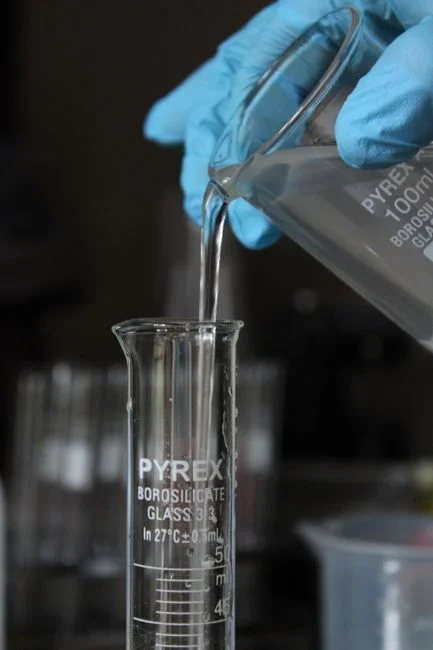
Danish effluent targets for small community discharges sit in the following bands per Miljøstyrelsen discharge approvals under the BEK 1980 framework: BOD₅ ≤ 15–25 mg/L, total nitrogen typically ≤ 8 mg/L in catchments draining to nutrient-sensitive recipients, and ammonia ≤ 1–2 mg/L during the summer growth season (May–September). The exact limit is set by the kommune based on the recipient water body's classification — a sensitive trout stream will get tighter ammonia and nitrogen numbers than a low-status coastal outlet.
The ASABE small-community study (S1) is a realistic benchmark: constructed wetlands achieve meaningful BOD, TSS, and total-nitrogen reductions but with seasonal swing — winter ammonia removal drops as root-zone oxygen transfer falls with water temperature. This creates a sizing tension in any Danish wetland design: meeting the summer ammonia target in May and the BOD target in February with a single fixed footprint.
Constructed wetlands typically do not reliably hit low ammonia limits year-round. Danish engineers either (a) pair a wetland with a polishing step such as UV or a small recirculating sand filter, or (b) select an MBR or an underground A/O package plant when the permit demands tight and stable ammonia. Where land is available and the ammonia limit is relaxed, a properly sized wetland is the lowest-energy, lowest-operator option. Where land is not available or the permit is strict, a packaged mechanical plant is the defensible choice. Reference equipment such as a WSZ underground A/O package plant is one option used in this regime.
Technology Comparison: Constructed Wetland vs MBR vs Underground Package Plant
The three compliant options a Danish kommune will accept below 5,000 PE each have a different cost, footprint, and operator profile. The matrix below is built from the ASABE wetland performance data (S1), the EPA framing of small-community economics (S4), and the Danish guideline's sizing logic (S2, S5).
| Parameter | Constructed wetland (SSF) | MBR membrane bioreactor | Underground A/O package plant (WSZ) |
|---|---|---|---|
| Typical size band | 200–2,000 PE | 200–5,000 PE | 1,000–5,000 PE |
| Footprint | Large (5–10 m²/PE) | ~60% smaller than CAS | Smallest; buried tank |
| Typical BOD₅ effluent | 15–25 mg/L | <5 mg/L | ≤15–20 mg/L |
| Typical NH₄-N | Seasonal swing (S1) | Very low, stable | Low, stable in summer |
| Energy use | Very low (gravity + pumps) | High (membrane aeration) | Moderate (blowers) |
| Operator skill | Minimal (annual) | Trained (membrane CIP) | Low (automated) |
| Membrane/media replacement | None | PVDF membrane, 5–8 yr | Diffusers, ~5 yr |
| Visual impact | High (wetland area) | Low (enclosed) | Lowest (buried) |
Constructed wetland — low CapEx, very low energy (S1), large land footprint, seasonal performance swing (S1), minimal operator skill. Best fit: 200–2,000 PE communities with available land and a relaxed ammonia target. The MBR membrane bioreactor system and the DF series PVDF flat sheet membrane module sit at the other end of the spectrum.
MBR membrane bioreactor — submerged PVDF membrane at ≤1 µm pore size, near-reuse effluent (typically BOD <5 mg/L, TSS <1 mg/L, very low NH₄-N), ~60% smaller footprint than conventional activated sludge, higher energy and membrane-replacement cost. Best fit: tight sites or strict permits where the recipient demands near-reuse quality.
Underground A/O package plant (WSZ series) — anoxic/aerobic contact oxidation in a buried tank, fully automated, no dedicated operator, 1–80 m³/h capacity, low visual impact. Best fit: 1,000–5,000 PE where land is scarce and operator cover is the binding constraint. See the WSZ underground A/O package plant for typical capacity data.
EPA research on small communities (S4) makes the procurement framing explicit: small communities are economically disadvantaged and under-served, so CapEx and O&M predictability matter as much as headline effluent quality. The decision rule for Danish village work: pick wetland when land is available and ammonia is relaxed; pick MBR when the permit is tight and footprint matters; pick underground A/O when operator cover is the binding constraint.
2026 Cost Benchmarks and Procurement Checklist
Indicative 2026 CapEx bands per PE for Danish small community systems, drawn from typical European project ranges and to be confirmed with current Danish supplier quotes: constructed wetland roughly 2,000–4,000 DKK/PE, MBR roughly 5,000–9,000 DKK/PE, underground A/O package plant roughly 4,000–7,000 DKK/PE. These ranges exclude land cost, sewer network, and VAT; they cover the treatment unit, installation, and commissioning. O&M over a 20-year design life typically adds 30–50% of CapEx for mechanical plants and under 15% for wetlands.
The EPA database of pipe and treatment technologies (S4) is a useful procurement reference; the equivalent Danish reference points are the Miljøstyrelsen technology list and the small-scale constructed wetland guideline (S2, S5). For benchmark context, see our 2026 cost benchmarks per MGD for water treatment infrastructure.
| Technology | 2026 CapEx (DKK/PE) | Footprint | Operator cover |
|---|---|---|---|
| Constructed wetland | ~2,000–4,000 | Large | Annual visit |
| MBR | ~5,000–9,000 | Compact | Trained, periodic |
| Underground A/O (WSZ) | ~4,000–7,000 | Smallest | Automated, remote |
Procurement checklist for the kommune submission:
- Confirm PE count and diurnal peaking factor (1.5–2.5× typical for small gravity networks).
- Confirm recipient water body classification and which BEK 1980 limits apply.
- Confirm whether ammonia and total-nitrogen limits are binding (drives technology choice).
- Confirm operator cover — kommune staff, contractor, or automated/SCADA.
- Request 5-year lifecycle cost including membrane or filter-media replacement.
- Confirm commissioning and 12-month performance verification protocol.
Frequently Asked Questions
What population size defines a small community wastewater system in Denmark?
A small community wastewater system in Denmark typically serves 200–5,000 person equivalents (PE) on a decentralised cluster basis; the U.S. EPA uses a ≤10,000-people / <1 MGD threshold (S4) as a reference point, not a Danish rule.
Which Danish standard governs effluent quality for village sewage treatment plants?
Effluent quality for village-scale discharges is set by the kommune under the Miljøstyrelsen BEK 1
Frequently Asked Questions
What is the Danish effluent standard for a small community wastewater system?
The effluent standards in Denmark are governed by the Environmental Protection Act and specific discharge permits issued by the municipality. For small community systems, typical requirements for secondary treatment involve a maximum limit of 15 mg/L for BOD5, 1.5 mg/L for Total Phosphorus, and 15 mg/L for Total Nitrogen, depending on the sensitivity of the receiving water body.
How many person equivalents does a constructed wetland handle in Denmark?
Constructed wetlands in Denmark are typically designed for small communities ranging from 5 to 500 person equivalents (PE). While they are highly effective for decentralized treatment, their footprint requirements generally scale at 5 to 10 square meters per PE, making them most viable for settlements where land availability is not a primary constraint.
What is the difference between an MBR and a package plant for a Danish village?
Membrane Bioreactors (MBR) utilize advanced membrane filtration to achieve high-quality effluent suitable for potential reuse, typically producing turbidity levels below 0.2 NTU. In contrast, standard package plants often rely on activated sludge or fixed-film processes, which are easier to maintain and have lower operational costs but may require larger secondary clarifiers to meet strict suspended solids limits compared to the compact, high-efficiency footprint of an MBR.
How much does a small community wastewater system cost per PE in Denmark in 2026?
As of 2026, the estimated capital expenditure (CAPEX) for a small community wastewater system in Denmark ranges from 15,000 to 25,000 DKK per person equivalent (PE), depending on the treatment technology selected and the complexity of the site-specific infrastructure. Operational expenditure (OPEX) typically ranges between 300 and 600 DKK per PE annually, accounting for energy consumption, sludge disposal, and regular maintenance.
Do Danish small-scale wastewater systems need a kommune permit?
Yes, all small-scale wastewater systems must obtain a discharge permit from the local municipality (kommune) under the Danish Environmental Protection Act. The application process requires a detailed technical design report, an assessment of the recipient water quality, and evidence that the system complies with the local wastewater management plan (spildevandsplan).