
Why Small Community Wastewater Systems in Peru Need a Different Playbook
Peru's rural sanitation gap leaves roughly 35% of the population without safe water or basic sanitation, with poverty rates near 70% in Andean and Amazonian districts where Quechua, Aymara, and Ashaninka communities are concentrated (WEFTA, Peru country page). A packaged treatment plant for a 5,000-person Andean town cannot be specified the same way as a 50,000-person coastal WWTP: the operator pool is thin, grid power is intermittent, and influent temperatures drop into single digits overnight at 3,500 m elevation. Empirical evidence shows that the Midkiff (2016) study of two installed plants at Leymebamba and Palmira graded their maintenance practices at 35% and 22% of possible points, with the author identifying outside supervision and administrative support as key factors for success (Midkiff, Michigan Tech, 2016). Technology choice accounts for 35% of the answer; the other 65% is supervision, training, and indigenous-language documentation that most generic plant suppliers do not deliver. The 2026 IDB-Spain $90 million program targeting 380 rural communities and small towns in Apurímac, Ayacucho, Cusco, Huancavelica, and Puno — with a 2,000-15,000 population scope and explicit "strengthening of service providers" co-financing — provides the funding backdrop that makes the technology decisions below actionable (IDB project PE-X1004).
Influent Characteristics for a Typical Small Peruvian Town
Design influent for a small Peruvian town typically runs BOD 200-400 mg/L and TSS 200-350 mg/L, with peak-to-average diurnal ratios of 2-3x common below 15,000 population. The Midkiff (2016) measurements at the Leymebamba and Palmira Imhoff-based plants showed BOD and TSS removals within the band expected for low-maintenance primary systems, but a BioWin simulation performed more than one standard deviation below the plant's average BOD removal — an indication that conventional activated-sludge models under-predict the variability of small-community Imhoff-fed systems in the Andes. Temperature is the load-bearing parameter: at 2,000-4,000 m elevation, wastewater holds at 8-15°C for much of the year, and nitrification rates drop by roughly 50% versus the 20°C design point that most vendor curves assume. Enclosed basins, buried package plants, and MBRs are favored over open earthen lagoons in highland towns because they retain biological heat and protect biomass from cold diurnal swings. Intermittent rural electricity also rules out large blower-driven systems; a packaged 50-500 m³/day plant in this class typically draws under 5 kW and runs on a single-phase supply with battery-backed controls.
| Parameter | Typical Range (Small Peruvian Town) | Design Implication |
|---|---|---|
| Average daily flow | 50-500 m³/day (2,000-15,000 PE) | Package plant size class, not municipal activated sludge |
| BOD5 (influent) | 200-400 mg/L | Secondary biological stage required to hit LGA VMA BOD limits |
| TSS (influent) | 200-350 mg/L | Primary settling or membrane filtration needed |
| Wastewater temperature | 8-15°C (highland); 18-24°C (jungle) | Enclosed basins or MBR to retain heat and protect nitrification |
| Peak diurnal flow factor | 2-3x ADWF | Equalization built into package, not retrofitted |
| Site altitude | 200-4,000 m | Aerator BHP derating, blower selection at altitude |
| Grid reliability | Often 8-16 hours/day in rural districts | Low kW draw, single-phase, battery-backed controls |
Three Packaged Technology Options for 50-500 m³/day
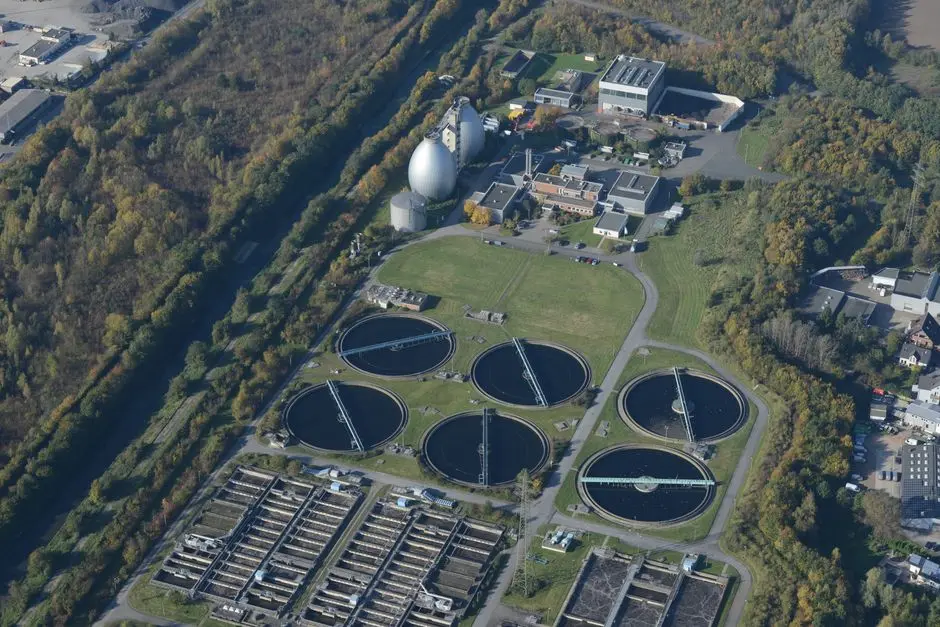
Three packaged architectures are realistic for the 50-500 m³/day flow band in Peru today. Option A pairs a two-chamber Imhoff tank with a subsurface-flow constructed wetland downstream; the wetland provides 70-85% BOD removal at 5-10 m² per person equivalent of land, and operating energy collapses to gravity-driven flow (Ogden, ASABE 2013). While the footprint rules this out in dense Andean town centers, it fits peri-urban and Amazonian lowland sites with land available. Option B is a buried anoxic/aerobic package plant in the 1-80 m³/h class, such as the buried A/O package sewage treatment plant typically installed below a plaza or parking lot; the unit combines anoxic contact, aerobic contact oxidation, sedimentation, and chlorine contact in a single buried skid, delivers BOD <30 mg/L and TSS <30 mg/L effluent, and runs automatically without a full-time operator on site. Option C is a submerged MBR with PVDF membranes at 0.1 μm pore size — a submerged MBR membrane bioreactor system that delivers near-reuse effluent at roughly 60% of the footprint of an equivalent A/O plant, with higher CAPEX offset by the value of reuse water for irrigation or toilet flushing. Site-specific constraints, rather than vendor marketing, should dictate the selection between these three approaches.
| Criterion | Imhoff + Constructed Wetland | Buried A/O Package Plant | Submerged MBR |
|---|---|---|---|
| Flow range | 20-500 m³/day | 1-80 m³/h (24-1,920 m³/day) | 10-2,000 m³/day |
| Typical BOD removal | 70-85% | 90-95% (effluent <30 mg/L) | 95-99% (effluent <10 mg/L) |
| Typical TSS removal | 80-90% | 90-95% (effluent <30 mg/L) | >99% (effluent <1 mg/L) |
| Footprint (relative) | Large (5-10 m²/PE) | Compact (buried) | Compact (~40% of A/O) |
| CAPEX band (USD/m³/day) | 120-220 | 250-450 | 500-900 |
| OPEX (USD/m³ treated) | 0.04-0.08 | 0.10-0.18 | 0.20-0.35 |
| Operator skill required | Low (monthly checks) | Low (automatic) | Moderate (membrane care) |
| Altitude tolerance | High (no aerators) | High (enclosed basin) | High (enclosed, heated options) |
| Effluent reuse-ready | Limited | With disinfection | Yes, near-reuse quality |
CAPEX and OPEX Bands for 2026 Peruvian Small-Town Projects
The IDB-Spain $90M, 380-community program serves 206,000 beneficiaries at an average grant intensity of roughly $437 per beneficiary, of which a substantial share is allocated to sanitation infrastructure (IDB project PE-X1004, 2026 scope). For an Andean town of 5,000 people generating ~250 m³/day, that works out to an indicative per-m³/day CAPEX ceiling of $700-1,200 when matched with MVCS and municipal contributions. The 2026 indicative bands below are order-of-magnitude engineering estimates, not vendor quotes, and should be re-baselined against site geotechnics, influent characterization, and effluent reuse requirements:
| Cost Item | Imhoff + Wetland | Buried A/O Package | Submerged MBR |
|---|---|---|---|
| CAPEX (USD per m³/day installed) | 120-220 | 250-450 | 500-900 |
| OPEX (USD per m³ treated) | 0.04-0.08 | 0.10-0.18 | 0.20-0.35 |
| Dominant OPEX driver | Wetland vegetation, desludging | Blower kWh, sludge haul | Membrane replacement (5-7 yr), air scour kWh |
| Typical energy use | <0.1 kWh/m³ | 0.3-0.6 kWh/m³ | 0.6-1.2 kWh/m³ |
| Eligible under IDB co-finance | Yes (incl. land) | Yes (hardware + O&M) | Yes (hardware + service provider strengthening) |
The IDB scope explicitly funds "strengthening of service providers" alongside hardware, meaning OPEX support, operator training, and remote telemetry are eligible line items. Furthermore, the Spanish Cooperation Fund grant of $72M (with $18M counterpart from Peru) represents the fifth such water-sanitation grant in less than a year, indicating active pipeline turnover through 2026-2027.
Disinfection, Effluent Reuse, and Antimicrobial Resistance
Disinfection is a mandatory requirement in Peruvian small-town effluent. The January 2026 genomic surveillance study at a Lima paediatric hospital found multidrug-resistant E. coli and Klebsiella prevalence of 73.5% in wastewater isolates versus 56.8% in clinical isolates (P=0.014), with carbapenemase-producing isolates detected only in wastewater (Access Microbiology, January 2026). For a small Peruvian town discharging to a river that downstream communities use for bathing and laundry, validated disinfection downstream of the biological stage is required to interrupt that resistance reservoir. For a 50-500 m³/day community, two disinfection technologies dominate: an on-site chlorine dioxide generator producing 50-20,000 g/h of ClO₂ is robust against organic loading and stores as precursor chemicals, while a pipeline UV sterilizer for effluent disinfection avoids residual oxidant and is preferred when chlorinated effluent would constrain downstream drip irrigation of fodder crops or school toilet flushing. For a town with intermittent power, specify UV as duty with ClO₂ trim to ensure the disinfection barrier remains intact when the grid drops.
Operator, Maintenance, and Monitoring — the 35% Gap
The headline lesson from Midkiff (2016) is that installed hardware in Leymebamba and Palmira was not the binding constraint on effluent quality; maintenance and operator support were. Maintenance practices at the two plants were graded at 35% and 22% of possible points, confirming that outside supervision and an administration-supported operator are the two factors that move the needle. A defensible O&M scope for a 2026 IDB-funded package plant should bundle the following line items: one trained operator per shift with formal certification, monthly BOD/TSS measurement with a portable photometer, quarterly influent and effluent characterization by an accredited lab, and a remote alarm on blower, pump, or membrane-transmembrane-pressure excursion. Specify Spanish- and Quechua-language O&M manuals from the supplier, a one-year on-site supervision contract with monthly visits, and remote telemetry (cellular or LoRaWAN) reporting to a regional service provider. Because the IDB program explicitly funds "strengthening of service providers," these O&M and supervision line items are eligible for grant co-financing.
Frequently Asked Questions
What flow range and population does a small community wastewater system in Peru typically serve?
A small community wastewater system in Peru is sized for 2,000-15,000 people at 50-500 m³/day average dry weather flow, which matches the population band targeted by the 2026 IDB-Spain $90M program covering 380 communities in Apurímac, Ayacucho, Cusco, Huancavelica, and Puno (IDB project PE-X1004). Below 2,000 people
Frequently Asked Questions
What is the best wastewater treatment system for a small town in Peru?
For small Peruvian communities, particularly in the Andean and rural regions, Anaerobic Baffled Reactors (ABR) paired with Constructed Wetlands (CW) are considered the most appropriate technology. This combination provides high removal efficiency for organic matter without the need for complex electromechanical equipment, which is often difficult to maintain in remote areas.
When terrain permits, Waste Stabilization Ponds (WSP) are also highly recommended due to their low operational costs and ability to handle variable hydraulic loads. Systems must comply with the Maximum Permissible Limits (LMP) established in D.S. N° 003-2010-MINAM to ensure effluent safety for agricultural reuse or discharge into water bodies.
How much does a small community wastewater treatment plant cost in Peru in 2026?
As of 2026, the construction cost for a small community wastewater treatment plant in Peru typically ranges from $1,500 to $3,500 USD per cubic meter of installed capacity, depending on the complexity of the treatment train and local topography. These estimates account for current inflation in construction materials and the logistical challenges of transporting equipment to isolated areas.
Total project costs, including feasibility studies, environmental impact assessments (EIA), and civil works, generally scale based on population density. Small systems serving 500 to 2,000 inhabitants often require an initial capital investment between $400,000 and $1.2 million USD, excluding long-term operational and maintenance (O&M) expenditures.
Which Peruvian regions are eligible for IDB-Spain wastewater funding in 2026?
In 2026, funding from the Inter-American Development Bank (IDB) and the Spanish Cooperation Fund for Water and Sanitation (FCAS) prioritizes regions with high poverty indices and low sanitation coverage. Eligible areas primarily include the rural highlands (Sierra) of Puno, Cusco, and Huancavelica, as well as Amazonian regions (Selva) like Loreto and Ucayali.
Proposals must align with the National Sanitation Plan (PNS) and demonstrate institutional capacity for long-term management. Priority is given to projects that integrate water supply with sanitation improvements in communities with fewer than 5,000 inhabitants that demonstrate a clear vulnerability to climate-related water stress.
Do small Peruvian wastewater systems need disinfection for antibiotic-resistant bacteria?
Yes, disinfection is mandatory for all wastewater systems in Peru, especially if the effluent is destined for agricultural irrigation or discharge into public water sources. While current regulations focus on total coliforms and thermotolerant coliforms, the increasing prevalence of antibiotic-resistant bacteria necessitates secondary and tertiary treatment barriers.
For small systems, chlorination remains the standard, but UV irradiation is increasingly recommended to mitigate the risks of chemical byproducts and the survival of resistant pathogens. Designers should aim for a log reduction value (LRV) that meets the standards set by the National Water Authority (ANA) for the specific classification of the receiving water body.
What influent BOD and TSS should a small Peruvian town WWTP be designed for?
A typical small town WWTP in Peru should be designed for an influent Biochemical Oxygen Demand (BOD5) ranging from 250 mg/L to 400 mg/L. Due to the lower water consumption rates in many rural areas, wastewater is often more concentrated, requiring engineers to account for higher organic loading rates in the primary treatment stage.
Total Suspended Solids (TSS) influent concentrations should be designed for a range of 200 mg/L to 450 mg/L. It is critical to perform localized sampling or use the Peruvian National Sanitation Service (SUNASS) guidelines for per-capita contribution rates, as variations in greywater dilution and local industrial discharge can significantly impact these design parameters.