
What 'Domestic Sewage Treatment' Actually Means in Nottingham in 2026
Domestic sewage in this context is foul water from kitchens, bathrooms and laundries in a single dwelling or small cluster. Standard UK design assumptions are 150–200 L per person per day, a raw BOD of 250–400 mg/L after primary settlement, and a target effluent BOD of <20 mg/L for discharge to ground under the General Binding Rules. A small sewage treatment plant in the UK is a packaged biological reactor that takes raw sewage to that consent standard in one buried unit; it is not the same as a septic tank, which only settles solids, nor a cesspool, which stores but does not treat. Off-mains sites across suburban infill plots, rural commuter villages such as Bingham, Ruddington, Keyworth and Selston, and small commercial premises (pubs, B&Bs, farm diversification) routinely fall outside Severn Trent's sewerage zone and need their own plant. International benchmarks remain useful for sizing: developing-area cities generate 30–70 m³ of wastewater per person per year (S2, InTech), and even a single off-mains household sits at 55–73 m³/person/year under that same band.
UK Discharge Rules: General Binding Rules vs Environment Agency Permit
The Environment Agency's General Binding Rules (GBRs) cover small sewage discharges of up to 5 m³/day to ground via a drainage field, with no bespoke permit required, provided the package plant is CE-marked to BS EN 12566-3 and the siting rules (distance from wells, buildings, watercourses) are satisfied. Any discharge to surface water, any discharge above 5 m³/day, or any discharge within a groundwater Source Protection Zone 1 triggers a bespoke EA discharge permit, which adds 8–12 weeks to programme and an annual subsistence charge. A Building Regulations Part G (G2) approval is also required for any new or replacement treatment system, separate from and parallel to the EA route. Before any equipment is specified, the developer should request Severn Trent's sewer maps (free, 2026) to confirm the property is genuinely off-mains: a requisitioned mains connection is sometimes cheaper than a treatment plant, often not, and only the map resolves it.
| Route | Daily flow limit | Discharge destination | Approval needed | Typical lead time (2026) |
|---|---|---|---|---|
| General Binding Rules | ≤ 5 m³/day | Ground (drainage field / soakaway) | Building Regs Part G only | 2–4 weeks |
| EA bespoke permit | Any flow above 5 m³/day, or any flow to surface water | Surface water or ground in SPZ1 | EA permit + Building Regs Part G | 8–12 weeks |
| Mains requisition (Severn Trent) | No limit, but distance-dependent cost | Mains sewer | S.98 requisition under Water Industry Act | 12–26 weeks |
The Three Equipment Families: Buried Package, MBR, and Containerised Plants
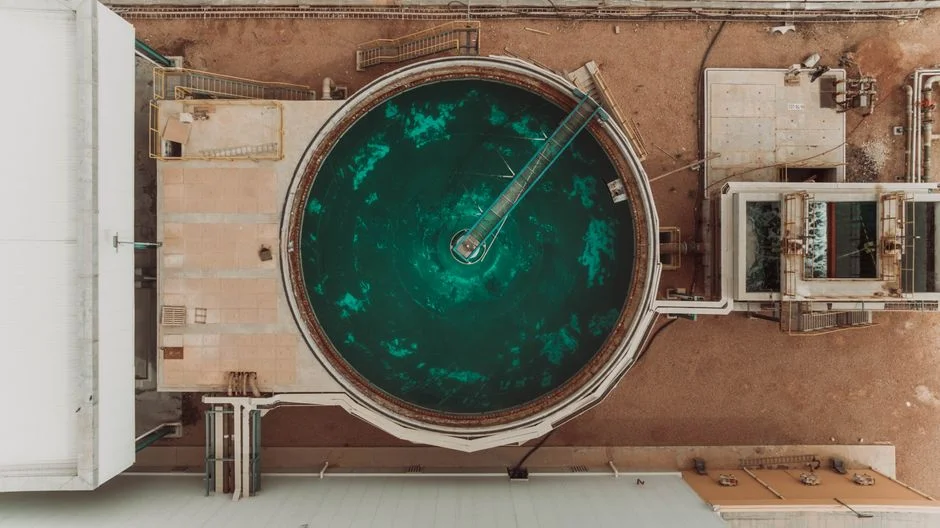
Three equipment families cover almost every domestic and small-commercial site in the 1–50 m³/day range. The first is the buried package plant running an anoxic/aerobic (A/O) biological contact oxidation process; the WSZ series is the reference design in this category, handling 1–80 m³/h in a single FRP tank with no daily operator and a typical effluent of BOD <20 mg/L and SS <30 mg/L (HydropureWater catalog, S6). The second is the membrane bioreactor (MBR), which adds submerged PVDF membranes at sub-micron pore size to the activated-sludge stage, cuts footprint by roughly 60% versus conventional activated sludge, and produces near-reuse quality effluent (BOD typically <5 mg/L) at 10–2,000 m³/day. The third is the DF-series flat sheet MBR module, a 0.1 µm PVDF unit rated at 32–135 m³/day per cassette, with replaceable elements and 10–20× lower energy draw than external cross-flow designs, which makes it the right pick for retrofits into existing concrete tanks. A fourth option, the containerised or skid-mounted plant, packages the same internals for sites where ground conditions rule out burial or where the install is temporary. Selecting the right technology depends on discharge consent and site constraints. For a domestic site in the 1–5 m³/day band a WSZ buried package sewage treatment plant will usually satisfy the GBR route; for sites with a surface-water permit or a reuse requirement, an MBR membrane bioreactor system or DF-series flat sheet MBR modules is the appropriate step up.
| Family | Process core | Flow range | Effluent BOD | Effluent SS | Footprint vs CAS | Best fit |
|---|---|---|---|---|---|---|
| WSZ buried A/O package | Anoxic + aerobic contact oxidation, sedimentation, disinfection | 1–80 m³/h (≈ 5–1,500 m³/day at 8 h HRT) | <20 mg/L | <30 mg/L | Comparable | Single homes, small clusters, discharge to ground under GBRs |
| MBR (submerged) | Activated sludge + PVDF membrane <1 µm | 10–2,000 m³/day | <5 mg/L | <1 mg/L | ~40% of CAS | Surface-water permits, reuse, tight sites |
| DF flat sheet module | Activated sludge + 0.1 µm flat sheet PVDF | 32–135 m³/day per unit | <5 mg/L | <1 mg/L | ~40% of CAS | Retrofit into existing concrete tanks |
| Containerised / skid | Any of above in ISO frame | Matched to process | Per process | Per process | Per process | Temporary sites, construction camps, bad ground |
Nottinghamshire Site Conditions That Drive Equipment Choice
Trent valley alluvium and the Mercia Mudstone clay subsoils across much of Nottinghamshire limit the percolation rate of any drainage field; a BRE 365 percolation test is mandatory before any GBR claim will survive a planning challenge. A high winter water table in Beeston, Long Eaton and along the Leen valley pushes the only viable discharge toward a surface-water body, which forces an EA permit and usually a tertiary-treated MBR rather than a basic A/O package. Seasonal BOD peaks from holiday-let, glamping and small-brewery sites on the Nottinghamshire/Leicestershire border are real: an assumed peak factor of 1.5–2× the average daily flow should be applied before sizing, otherwise the unit will short-circuit under load. Cold-month operating temperature in an uninsulated buried tank can drop to 3–5°C; both A/O and MBR remain viable but need insulated covers and a reduced F/M loading rate, so the minimum design temperature for any buried plant in this region should be stated as 5°C in the contractor's spec. Sites inside the Severn Trent sewerage coverage zone should always be costed against a mains connection before any treatment plant order is placed.
Capex and Opex Envelope for a Nottingham Domestic Installation
For a single home at 1–2 m³/day, a WSZ buried package sewage treatment plant sits in the low five figures GBP for equipment supply, with turnkey install typically 1.5–2.5× that once excavation, drainage field, electrical and commissioning are added. For a 20–50 m³/day site (small hotel, rural housing cluster, school) an MBR system lands in the mid-to-high five figures, with full install 30–60% above a comparable A/O plant once membrane skids, blowers and control panels are in the bill. Annual service contracts typically run 8–12% of capex per year for package plants and noticeably more for MBR because of membrane life (typically 8–12 years for PVDF) and aeration system maintenance. A 15-year whole-life view is the only defensible basis for comparing options; for international sanity-checking, US on-lot replacement costs are reported at $15,000–$20,000 (S3, wnt-gov.org), broadly equivalent to a UK off-mains replacement once currency and scope are normalised. The ranges below are 2026 UK market bands, not list prices, and exclude the EA permit fee where applicable.
| Installation | Daily flow | Equipment capex (GBP, 2026) | Turnkey install multiplier | Annual service (% of capex) | Whole-life (15 yr) capex + opex band |
|---|---|---|---|---|---|
| Single home, A/O package | 1–2 m³/day | £8,000–£18,000 | 1.5–2.5× | 8–10% | £40,000–£80,000 |
| Small cluster (5–10 homes), A/O | 5–10 m³/day | £20,000–£45,000 | 1.5–2.0× | 8–10% | £90,000–£180,000 |
| Hotel / school / rural cluster, MBR | 20–50 m³/day | £50,000–£150,000 | 1.3–1.6× | 10–12% | £200,000–£500,000 |
| Containerised / skid (temporary) | Matched | +20–30% vs buried equivalent | Lower (no excavation) | Per process | Per process |
Five-Step Procurement Checklist Before You Sign
- Confirm off-mains status. Request Severn Trent's sewer map for the postcode and check distance to the nearest public sewer; a S.98 requisition quote is the baseline against which any treatment plant must compete.
- Test the ground. Commission a BRE 365 percolation test if discharge is to ground; identify the nearest surface water body and its classification if not.
- Pick the regulatory route. Confirm whether the site falls under the General Binding Rules (≤5 m³/day to ground) or needs an EA bespoke permit, and budget the 8–12 week lead time accordingly.
- Shortlist two or three equipment families. Match the flow band, effluent target and footprint envelope to a WSZ buried package sewage treatment plant or an MBR membrane bioreactor system; do not shortlist on headline price alone.
- Request whole-life costs over 15 years. Ask each supplier for capex, install, annual service, membrane or media replacement, energy and decommissioning in a single table; reject any quote that gives only the year-one figure.
Frequently Asked Questions
Do I need planning permission for a small sewage treatment plant in Nottingham?
Building Regulations Part G (G2) approval is required for any new or replacement treatment system, and that is the controlling consent for most domestic off-mains installations. Planning permission is only triggered if the system is within the curtilage of a listed building, in a conservation area with visible above-ground hardware, or if the discharge route affects a protected habitat; in those cases a full planning application runs in parallel with the Building Regs submission.
What is the difference between a septic tank and a sewage treatment plant?
A septic tank provides primary settlement only and discharges liquor that is typically 150–200 mg/L BOD, which no longer meets the Environment Agency's standard for new discharges to ground. A packaged sewage treatment plant adds a full biological process (A/O contact oxidation, or MBR) and disinfection, producing an effluent below 20 mg/L BOD for the GBR route or below 5 mg/L BOD for an MBR.
How do I know whether the General Binding Rules or an EA permit applies?
Three checks settle it: daily flow must be 5 m³/day or less, the discharge must go to ground (not surface water), and the discharge point must sit outside a groundwater Source Protection Zone 1. Fail any one of