
Why Eastford Transportation Equipment Plants Cannot Ignore POTW Pretreatment
Federal pretreatment law applies to a transportation equipment shop in Eastford, Pomfret, or Woodstock long before CT DEEP hands you a piece of paper. Under 40 CFR 403.3(p), a pass-through is "a discharge that exits the POTW into waters of the United States in quantities or concentrations that, alone or in conjunction with a discharge or discharges from other sources, is a cause of a violation of any requirement of the POTW's NPDES permit" (per EPA, 2026). Under 40 CFR 403.3(k), interference is a discharge that "inhibits or disrupts the POTW, its treatment processes or operations, or its sludge processes, use, or disposal; and therefore is a cause of a violation" (per EPA, 2026). The refinery-source warning that there is no "silent" exemption because the local control authority has not yet issued a permit applies equally to a CT parts plant: 40 CFR 403.5(a) imposes the general prohibitions whether or not the local control mechanism has been issued.
Most small Connecticut POTWs serving towns like Eastford fall in the 1–5 MGD design-flow band — comparable to the Sanford Sewerage District's 4.4 MGD cited in the 2025 commercial source on small-POTW pretreatment programs. A single slug of metalworking fluid or alkaline cleaner from one Tier-2/Tier-3 shop can knock the receiving biobasin off its perch. Many small CT POTWs do not even have an EPA-approved pretreatment program, so the discharge falls back to CT DEEP's state-level control mechanism (the Industrial Discharge Permit), and CT DEEP will hold the industrial user to whatever local limits the receiving POTW files through DEEP.
Two numeric limits sit on top of the prohibitions: federal categorical standards (40 CFR Parts 405–471 — for the transportation equipment sector the analogous metal-finishing category is 40 CFR Part 433) and the POTW's site-specific local limits. The plant must clear whichever bar is lower. The 2026 enforcement reality: EPA civil penalty cap is $64,230 per violation per day under the 2022 inflation adjustment (87 FR 1675, Jan 11, 2022, applicable 2026); criminal exposure under 33 U.S.C. § 1319(c) reaches $250,000 and 3 years for knowing violations.
What Comes Out of a Transportation Equipment Plant in Eastford
Five process streams dominate the flowsheet at any SIC 3711/3714/3721/3799 plant, and each one is a different compliance risk:
- Parts-wash oily water. Free and emulsified oil, typically 200–1,000 mg/L oil & grease. This is the stream that drives the 50–100 mg/L POTW oil & grease ceiling (per 2025 refinery-pretreatment guidance, used here as an analogous band — confirm against the actual receiving POTW).
- Metalworking fluid rejects. High COD (often 5,000–30,000 mg/L), biocide residues (triazine, formaldehyde releasers), tramp oil. COD survives the front of the train and is the long-tail parameter the POTW checks.
- Phosphate/nitrite rinse from pre-treatment. Zinc, iron, and low-pH carryover from the conversion-coating stage. Nitrite is the classic pass-through risk because of downstream fish toxicity.
- E-coat paint drag-out. High COD, color, and trace metals (Pb, Cr) from the electrodeposition tank overflow. Color excursions alone can trigger a POTW violation letter.
- Alkaline cleaner rinse. pH 10–13, surfactants, oils emulsified at high pH. An alkaline slug is the textbook interference trigger because a pH swing kills nitrifiers in the receiving biobasin.
Combined process flow at a Tier-2/Tier-3 CT plant typically runs 5–80 m³/day, which is the sizing window the rest of this article uses for unit operations. The parameter set the local POTW will monitor is fairly stable across CT industrial users: oil & grease, TSS, pH, total metals (Zn, Ni, Cr, Pb, Cu), ammonia, COD, and in some permits BTEX or hexavalent chromium (per 2025 refinery-pretreatment guidance). The bands below (50–100 mg/L O&G, 1–10 mg/L sulfides, 0.5–5 mg/L phenols, metals often 1–3 mg/L, pH 6–9) are illustrative engineering bands; the actual number lives in your SIU permit or CT DEEP control mechanism.
The 2026 Treatment Train: Equalization → DAF → Biological → MBR Polish
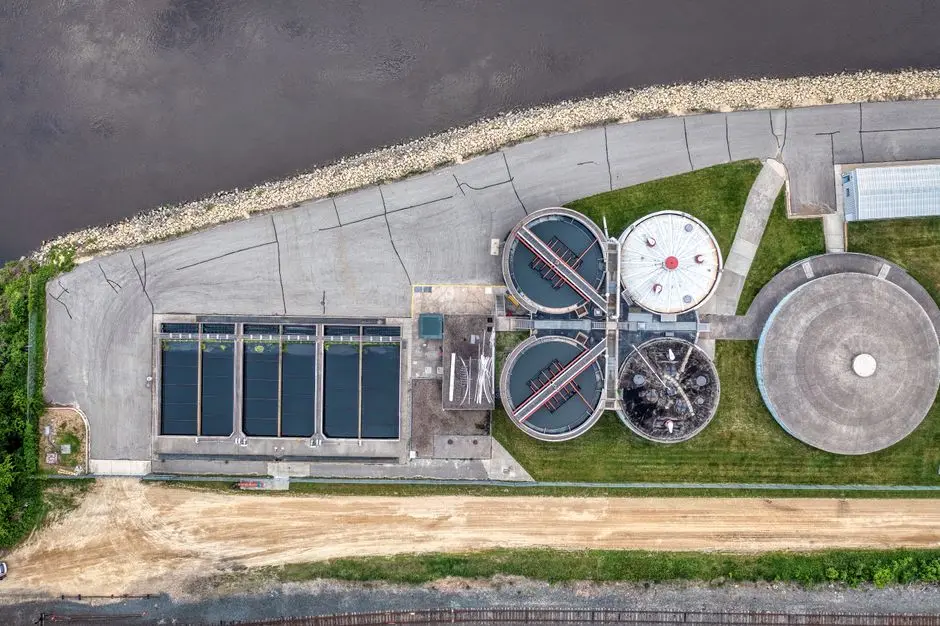
For a transportation equipment plant near Eastford, the five-stage train runs EQ → pH trim → DAF → biological → MBR polish, with online monitoring on the final effluent. Each stage has a defensible numeric envelope:
| Stage | Unit Operation | Key Parameters | Effluent Band |
|---|---|---|---|
| 1 | Equalization + pH trim | 8–24 h HRT, pH 6–9 | Flow/pH swing smoothed |
| 2 | DAF (micro-bubble flotation) | A/S 0.02–0.06, HRT 15–30 min, saturator recycle 20–50% | O&G 15–30 mg/L |
| 3 | Biological (MBBR or MBR) | MLSS 8,000–12,000 mg/L (MBR) | COD reduced 60–90% |
| 4 | MBR flat-sheet module (0.1 μm PVDF) | 80–225 m² element configurations | TSS <5 mg/L, turbidity <1 NTU |
| 5 | Multimedia filter + online monitoring | Oil-in-water alarm 10–20 mg/L; pH/conductivity | Permit-ready effluent |
Stage 1 — Equalization & pH trim. The EQ basin is sized for 8–24 hours of hydraulic retention; pH is adjusted to 6–9 before the DAF or biological stage. This is the single most important control point for preventing interference events — a 200-gallon dump of alkaline cleaner at pH 12 will pass through the DAF untouched and head straight for the receiving biobasin if it is not neutralized here first (per 2025 refinery-pretreatment guidance).
Stage 2 — DAF. Micro-bubble flotation strips the emulsified oil, FOG, and colloidal TSS that gravity separation cannot catch, and brings oil & grease from 100–200 mg/L down to 15–30 mg/L. Operating air-to-solids ratios sit in the 0.02–0.06 range, hydraulic retention is 15–30 minutes, and saturator recycle runs 20–50% of forward flow. The HydropureWater dissolved air flotation system is specified in the 4–300 m³/h capacity range, which covers the 5–80 m³/d CT plant with turndown headroom and skid-mounts into a single weekend tie-in. The DAF outlet has to clear the 50–100 mg/L POTW oil & grease ceiling on its own, with margin, before any biological polishing is asked to clean up oil.
Stage 3 — Biological polishing. An MBBR or MBR reduces the COD, ammonia, and any biodegradable organics surviving the front of the train. MBBRs tolerate the 200–800 mg/L COD coming off the DAF and handle load swings without washing out. MBR is the 2026 default for space-constrained CT retrofits because it holds biomass at 8,000–12,000 mg/L and produces <5 mg/L TSS, <1 NTU turbidity in roughly 60% of the footprint of an equivalent CAS basin (per 2025 refinery-pretreatment guidance).
Stage 4 — MBR flat-sheet module. The HydropureWater DF series 0.1 μm PVDF MBR flat-sheet module is used as the final polishing barrier before the sewer, not as a free-standing biological stage. Individually replaceable elements, 80–225 m² configurations, 10–20× lower energy than external cross-flow. For tight-footprint Eastford retrofits, the HydropureWater integrated MBR wastewater treatment system combines the aeration basin, the membrane cassette, and the backflush/CIP systems into a single skid sized 10–2,000 m³/day.
Stage 5 — Polishing & monitoring. A HydropureWater multi-media filter catches any TSS breakthrough. An online oil-in-water analyzer (typically fluorescence-based on the final effluent line) alarms at a 10–20 mg/L setpoint, and pH/conductivity probes feed the control room. The oil-in-water analyzer is the alarm of record because oil & grease is the parameter most often cited in CT POTW violation letters.
Mapping Each POTW Parameter to the Unit Operation That Clears It
This is the table an engineer can lift directly into the basis-of-design memo and walk into a Monday-morning meeting with. All influent and limit bands below are illustrative engineering bands; the specific number lives in the receiving POTW's SIU permit or the CT DEEP control mechanism. Confirm against current permit language before issuing a purchase order.
| Pollutant | Typical Eastford Influent | Typical CT POTW Local Limit | Primary Removal Stage | Polishing / Backup |
|---|---|---|---|---|
| Oil & grease | 200–1,000 mg/L | 50–100 mg/L | DAF (micro-bubble flotation) | Multimedia filter; oil-in-water analyzer |
| TSS | 100–500 mg/L | 30–50 mg/L | DAF + MBR flat-sheet (0.1 μm) | MBR or multimedia filter |
| pH | 4–13 (slug range) | 6–9 | EQ basin + online pH trim | pH probe with sewer shutoff interlock |
| Zinc | 5–50 mg/L | 1–3 mg/L | pH adjustment + hydroxide precipitation | MBR; quarterly metals sampling |
| Total metals (Ni, Cr, Pb, Cu) | 1–25 mg/L | 1–3 mg/L | Precipitation + DAF sludge | Sand/multimedia filter; quarterly sampling |
| COD | 1,000–8,000 mg/L | 300–600 mg/L | MBBR or MBR biological | MBR polish; activated carbon if required |
| Ammonia (if applicable) | 10–50 mg/L | 10–20 mg/L (seasonal) | Nitrification in MBBR/MBR | MBR flat-sheet; online NH₃ probe |
Two parameters are worth flagging as the most common "interference" triggers in CT POTW enforcement: sulfides and phenols, both toxic to nitrifying bacteria and to the heterotrophs running a receiving biobasin. A slug of either can knock a small municipal biobasin off its perch in hours (per 2025 refinery-pretreatment guidance). The oil-in-water online analyzer at a 10–20 mg/L setpoint is the alarm of record for a CT plant because it is the parameter most often cited in POTW violation letters.
The 2026 Compliance Documentation Ladder

The treatment train is the engineering side; the documentation ladder is the part that survives an EPA or CT DEEP inspection. Five repeatable steps hold up under cross-examination:
- Apply for SIU classification and obtain the CT DEEP Industrial Discharge Permit / control mechanism. The permit lists the numerical limits, monitoring schedule, and reporting cadence the plant will be judged against. Until that document is in hand, the plant is still on the hook under 40 CFR 403.5(a), but without a defined sampling schedule.
- Self-monitoring. 24-hour flow-weighted composite sampling, typically monthly for O&G, TSS, pH, total metals, COD; quarterly for hexavalent chromium and BTEX where applicable. Results on a Discharge Monitoring Report (DMR) or local equivalent. Exceedances trigger accelerated monitoring.
- Slug-control plan. Written, current, trained out, covering parts-wash dumps, tank transitions, and batch discharges. Must define what counts as a slug, the containment action, and the notification path to the POTW (40 CFR 403.8(b)(4)). Any discharge that could cause interference must be reported within 24 hours.
- Accidental-discharge reporting. Notify the POTW and CT DEEP within the EPA-prescribed window and follow up with a written cause/corrective-action/prevention report. Slug plans that exist on paper but were not followed are the most common root cause in consent decrees.
- Maintain auditable records. BMPs, chemical inventory (the SIU permit lists restricted chemicals), operator training, chain of custody for every composite sample, calibration logs for online analyzers, training records for operators who run the DAF, EQ basin, and biotreater. The paper trail is what turns a "no pass-through" claim into a defensible one. For CT-specific hydraulic context, see the Connecticut municipal sewage treatment plants 2026 engineering guide.
Frequently Asked Questions
Does 40 CFR Part 403 apply to a small transportation equipment plant in Eastford, CT, even if the receiving POTW has not issued a permit yet?
Yes. Under 40 CFR 403.5(a), the general pass-through and interference prohibitions apply whether or not the POTW has an approved pretreatment program and whether or not an industrial user has been issued a control mechanism. There is no "silent" exemption just because the local control authority has not yet issued a permit.
What is the typical oil & grease limit a CT POTW will set for a parts-wash discharge?
Illustrative engineering bands sit at 50–100 mg/L for oil & grease at the end-of-pipe monitoring point (per 2025 refinery-pretreatment guidance used as an analogous band), with sulfides typically 1–10 mg/L and phenols 0.5–5 mg/L. The actual number is set by the receiving POTW's local limits and will appear in the SIU permit or CT DEEP control mechanism — confirm against current permit language.
What is the 2026 federal civil penalty exposure for a Clean Water Act pretreatment violation?
EPA civil penalties are currently up to $64,230 per violation per day under the January 2022 inflation adjustment (87 FR 1675), still in force for 2026. Criminal exposure under 33 U.S.C. § 1319(c) reaches $250,000 and up to 3 years imprisonment for knowing violations. A single five-day slug event can therefore run into six figures before any state-level CT DEEP penalty is layered on top.
Why is an MBR flat-sheet module preferred over a conventional clarifier for a space-constrained Eastford retrofit?
An MBR flat-sheet module at 0.1 μm PVDF holds biomass at 8,000–12,000 mg/L and produces <5 mg/L TSS and <1 NTU turbidity in roughly 60% of the footprint of an equivalent CAS basin with a separate clarifier. For a Tier-2/Tier-3 plant that is retrofitting inside an existing 5–80 m³/day envelope, the integrated skid form factor is what makes the basis-of-design defensible. For a head-to-head DAF-vs-clarifier comparison, see the 2026 factory buyer's guide on DAF or clarifier for transportation equipment wastewater.