Why the DAF-vs-Clarifier Question Is Different in a Semiconductor Fab
North Carolina's semiconductor fabs — concentrated around the Research Triangle and the Charlotte corridor — generate a feed that breaks the assumptions baked into most vendor DAF literature. CMP (chemical-mechanical planarization) slurry contributes colloidal silica and ceria nanoparticles that do not settle under gravity; photoresist carryover adds low-density, sticky solids; fluoride rinses and TMAH (tetramethylammonium hydroxide) developers add dissolved-phase load that no clarifier can remove by sedimentation alone. According to Reworld's wastewater treatment guide, industrial variability is the reason equipment selection starts with feed characterization, not with a vendor catalog — and fab feed is one of the most variable streams in any industrial park (Reworld, 2026).
Generic DAF vendor pages from Clearwater, DAF Corp, and VanAire frame wastewater as settleable TSS, FOG (fats, oils, and grease), and pulp/paper or food matrices. That framing leads engineers toward gravity clarifiers or low-rate DAF designs. Fab feed is the opposite extreme: particles in the 0.05–10 μm range, densities near water, and surfactant-stabilized suspensions. Choosing a primary separator for a North Carolina fab means starting from particle physics, not from a generic "dirty water" mental model. The compliance pathway reinforces this — most NC fabs are indirect dischargers working through local POTWs (publicly owned treatment works) such as OWASA (Orange Water and Sewer Authority), Durham, or Raleigh, where NC DEQ's (North Carolina Department of Environmental Quality) industrial pretreatment program sets site-specific limits that drive equipment selection harder than any federal category.
How a DAF Clarifier Works — and Why It Fits Colloidal Fab Streams
A DAF clarifier saturates a side-stream of clarified water with air under pressure, then releases that pressure inside a flotation tank. The released air forms a cloud of microbubbles — 30–50 μm in the SigmaDAF/Clearwater design and 20–40 μm in the DAF Corp Micro Bubble Generator (MBG). Those bubbles attach to coagulated and flocculated particles and lift them to the surface in seconds, where a paddle skimmer scrapes the float layer off. Heavier settleables drop to a bottom cone and are augered out separately. DAF is a flotation process, meaning particles do not have to be denser than water to be removed, which is why it handles colloidal CMP and photoresist streams that defeat gravity clarifiers.
Coagulation and flocculation upstream are not optional. Without proper chemical conditioning — typically a cationic coagulant plus an anionic or nonionic polymer in serpentine floc tubes or mix tanks — DAF performs poorly on raw fab wastewater. The dissolved air flotation (DAF) system is built around that paired-chemistry workflow, with a saturator, floc tube, and skimmer integrated into a single skid. Material selection matters: standard construction is 304SS, but 316SS or polypropylene are specified for HF-bearing and high-chloride streams because HCl/HF chemistries will pit standard 304SS over time (per Clearwater Industries, 2026).
DAF Corp's published benchmark — 2,000 mg/L TSS feed clarified to 50 mg/L, with sludge thickened to 2–4% solids — is directly relevant to CMP concentrate behavior, where the colloidal silica and ceria load behaves similarly to a high-TSS, low-density industrial feed (DAF Corporation, 2025-12). For fab applications targeting ≤10–20 mg/L TSS in the pre-UPW (ultrapure water) feed stream, DAF is the workhorse separator upstream of any downstream polishing.
How a Lamella (Inclined-Plate) Clarifier Works — and Where It Wins
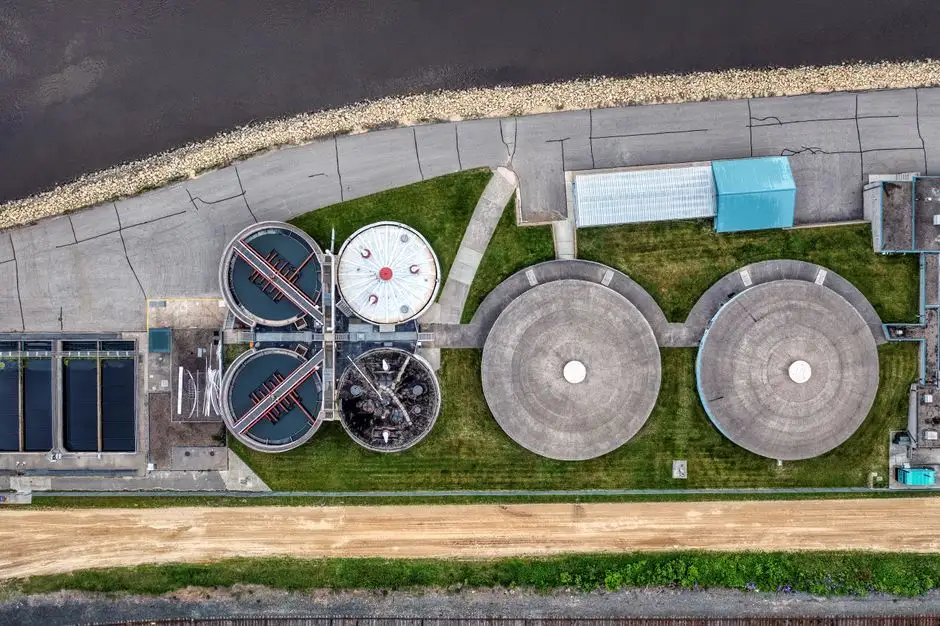
A lamella (inclined-plate) clarifier stacks parallel plates at 55–60° inside a rectangular tank, multiplying the effective settling area in a small footprint. The high-efficiency sedimentation tank (lamella clarifier) configuration routinely achieves surface loading rates of 20–40 m/h, with sludge recirculation that enhances floc contact and produces a denser underflow than a plain settling tank.
Lamella is effective for cool, dense, readily settleable grit, metals-precipitation slurries, and low-colloid cooling-tower side-streams. It has no compressed-air system, modest OPEX, and the smallest civil footprint of any primary separator. Where it loses on fab feed is on the upstream side of the train: colloidal CMP nanoparticles, photoresist flakes, and emulsified IPA (isopropyl alcohol) from developer tracks do not settle — they ride the hydraulic current through the plate pack or foul the plates. Surface loading rates that work for grit and metals sludge will not capture sub-10 μm colloids at any practical overflow rate.
Lamella is a polishing or post-precipitation clarifier, not a standalone primary separator for raw fab wastewater. Most NC fab trains pair a DAF as the primary separation step, then use a lamella or sand filter downstream to polish residuals before fluoride/TMAH destruction and UPW pre-treatment.
Side-by-Side Comparison: DAF vs. Lamella Clarifier for NC Semiconductor Wastewater
The table below provides data for engineers to use in procurement memos. Values are drawn from manufacturer published specifications and standard engineering practice; ranges reflect the gap between circular and rectangular DAF geometries and between lamella plates and tube settlers.
| Parameter | DAF (Dissolved Air Flotation) | Lamella (Inclined-Plate) Clarifier |
|---|---|---|
| Mechanism | Microbubble flotation of coagulated/flocculated particles | Gravity settling across inclined plates (55–60°) |
| Microbubble / plate spec | 20–40 μm (DAF Corp MBG) or 30–50 μm (SigmaDAF/Clearwater) | Plates spaced 50–80 mm, 55–60° incline, sludge recirculation |
| TSS removal on fab feed | 85–98% (DAF Corp FC Maximizer 92–98%, RC UniMax 85–90%) | 40–70% on colloidal fab feed; 80–95% on dense settleable grit |
| Typical surface / hydraulic loading | 5–25 m/h hydraulic, recycle ratio 20–50% | 20–40 m/h surface loading rate |
| Footprint | Larger tank + saturator skid; skid-mount available (48–450 GPM) | ~3× smaller tank area for equivalent flow; minimal auxiliaries |
| Best feed match | Colloidal CMP, photoresist, FOG, low-density surfactants, oily emulsions | Dense grit, metals-precipitation slurry, cool non-fab side-streams (boiler blowdown, cooling-tower bleed) |
| Worst feed match | Dissolved-phase fluoride and TMAH (no particulate to float) | Sub-10 μm colloids, photoresist, emulsified IPA — particles do not settle |
| Standard material | 304SS standard; 316SS or PP for HF / high-Cl streams | 304SS, PP, or FRP (fiberglass-reinforced plastic) options |
| Sludge consistency | 2–4% solids (thickened float) | 1–3% solids (underflow) |
| Decision rule | Choose if >30% of feed solids are colloidal or low-density | Choose if feed is cool, dense, and <10% colloidal |
For most North Carolina fab wet-bench and CMP waste streams, the DAF row wins on removal efficiency and on the fundamental physics of low-density colloids, while the lamella row wins on OPEX and footprint for non-fab side-streams and downstream polishing.
North Carolina Compliance and Siting Considerations in 2026
NC DEQ's industrial pretreatment program administers local limits through the receiving POTW. For Research Triangle facilities discharging to OWASA, Durham, or Raleigh, those local limits — typically TSS, FOG, fluoride, metals, and pH — drive equipment selection more than any federal category. The federal 40 CFR Part 469 semiconductor categorical standards apply only when a fab discharges directly to surface waters, not to a POTW; most NC fabs are indirect dischargers and are governed by site-specific POTW permits rather than by Part 469 numeric limits.
Fluoride and TMAH are usually handled before any primary separator, because both are dissolved-phase. Calcium precipitation for fluoride (target <20–30 mg/L F⁻ to most NC POTWs) and wet oxidation or biological destruction for TMAH (target <5–10 mg/L) produce precipitates and biomass that downstream DAF or lamella can then remove as particulates. Sequencing this correctly is the difference between a stable clarifier and one that re-suspends fines.
Siting in a fab environment is constrained by cleanroom adjacency, floor load, and containment. A skid-mounted DAF like the SigmaDAF COMPACT (≤66 GPM single skid, modular two-skid above 66 GPM) fits a retrofit or a tool-room side-yard; a large concrete clarifier typically needs civil work that fab operations cannot easily accommodate (per Clearwater Industries, 2026). The CMOS and mix-signal fab pretreatment limits guide walks through how these constraints shape the spec sheet.
2026 Procurement Checklist: Choosing the Right Primary Separator for Your NC Fab
1. Jar-test the feed with and without coagulant/polymer. Measure SVI (sludge volume index), Zeta potential, and float-vs-settle behavior at 20–50 μm bubble conditions. If the float fraction is >60% of total TSS, the answer is DAF. For coagulant and polymer dosing control, specify an automatic chemical dosing system tied to the DAF flow signal.
2. Map peak flow against equipment classes. DAF Corp covers 10–11,000 GPM; SigmaDAF COMPACT handles ≤66 GPM single skid. Lamella plate packs scale linearly with flow and footprint. For fab wet-bench and CMP concentrate, plan for the higher end of the range and modular expansion.
3. Match materials to chemistry. 316SS or PP for HF / HCl streams; 304SS for general fab runoff. Confirm vendor welding procedures and passivation protocols for any HF-served vessel.
4. Reserve lamella for polishing and for cool, dense, non-fab streams — boiler blowdown, cooling-tower side-stream, RO (reverse osmosis) reject. Use a dissolved air flotation (DAF) system as the primary separator for the fab wet-bench and CMP waste train. The semiconductor etching wastewater treatment engineering specs reference goes deeper on the etch-stream interactions.
5. Verify local POTW discharge limits and confirm whether 40 CFR Part 469 categorical standards apply to your discharge mode (direct vs. indirect). The US chemical plant pretreatment compliance guide covers the typical paperwork and self-monitoring pathway.
Frequently Asked Questions
What TSS removal can a DAF clarifier achieve on semiconductor wastewater?
DAF Corp's FC Maximizer delivers 92–98% TSS removal on high-solids feeds; the rectangular RC UniMax delivers 85–90%. On colloidal CMP and photoresist streams with proper coagulant and flocculant conditioning, a well-tuned DAF typically reaches ≤10–20 mg/L TSS in the clarified overflow (per DAF Corporation, 2025-12).
Why not just use a lamella clarifier for fab wastewater?
Lamella clarifiers rely on gravity settling across inclined plates. Colloidal silica and ceria from CMP, photoresist flakes, and emulsified IPA from developer tracks do not settle — they pass through the plate pack. A lamella is best used as a downstream polishing step or for cool, dense, non-fab side-
Frequently Asked Questions
DAF or clarifier for semiconductor wastewater — which is better in 2026?
In 2026, the choice depends primarily on the density and particle size of the waste stream rather than a universal preference. Dissolved Air Flotation (DAF) is increasingly favored for semiconductor wastewater characterized by low-density, hydrophobic, or oil-based contaminants that do not settle readily. Conversely, traditional gravity clarifiers remain the standard for high-density inorganic solids and metal hydroxides common in complex fab effluent.
Why does a DAF work better than a clarifier for CMP slurry?
Chemical Mechanical Planarization (CMP) slurry contains sub-micron abrasive particles, such as silica or ceria, that exhibit slow settling velocities due to their small size and surface charges. A DAF system utilizes micro-bubbles (typically 30-50 microns) to attach to these particles, effectively lowering their specific gravity and forcing them to the surface. This process achieves higher separation efficiency in a smaller footprint compared to a clarifier, which would require extensive retention times or excessive chemical flocculant dosing to overcome the slow settling rates of CMP particulates.
What TSS removal can a DAF achieve on fab wastewater?
When optimized with proper coagulation and flocculation chemistry, a DAF system can consistently achieve Total Suspended Solids (TSS) removal efficiencies of 90% to 98%. In typical semiconductor applications, influent TSS levels ranging from 500 mg/L to 2,000 mg/L can be reduced to effluent concentrations of less than 20-50 mg/L, depending on the specific chemical nature of the slurry and the hydraulic loading rate.
When should a semiconductor fab use a lamella clarifier instead of a DAF?
A lamella clarifier is the preferred choice when the wastewater contains heavy metal precipitates or high concentrations of dense inorganic solids that settle rapidly by gravity. Because lamella plates increase the effective settling area within a compact footprint, they are more cost-effective and energy-efficient than DAFs for streams where air saturation and bubble generation are unnecessary. They are particularly suitable for primary treatment stages where the goal is to remove high-density grit or metal hydroxide sludge prior to secondary biological or membrane processes.
Do North Carolina semiconductor fabs discharge under 40 CFR Part 469 or local POTW limits?
North Carolina semiconductor facilities must comply with both federal and local regulations simultaneously. They are subject to 40 CFR Part 469 (Electrical and Electronic Components Point Source Category), which sets federal categorical pretreatment standards for specific pollutants like arsenic, copper, and lead. Additionally, they must adhere to local Publicly Owned Treatment Works (POTW) limits, which are often more stringent than federal guidelines to protect local infrastructure and meet the specific water quality standards of the receiving North Carolina river basin or watershed.