Why Abu Dhabi's Wastewater Market Is Different in 2026
Abu Dhabi operates two of the largest reuse-fed sewage treatment networks in the Middle East: the Al Wathba 2 plant at 300,000 m³/day (1.5 million population equivalent) and the Allahamah plant at 130,000 m³/day (650,000 PE), both commissioned in January 2012 and still feeding 430,000 m³/day of treated water into district cooling, parks irrigation, and defined agricultural reuse (Veolia Middle East project reference, 2012). For an industrial buyer, those two plants are not the procurement target — but they set the discharge and reuse envelope every private plant must meet.
Three structural drivers shape every quotation an Abu Dhabi buyer will receive. First, fresh water scarcity forces a near-100% reuse policy, so treated-effluent quality is a procurement gate, not a finishing touch. Second, ambient temperatures above 45°C from May to September derate biological kinetics (nitrification rates drop roughly 30% per 10°C above 25°C), force tropicalised electrical enclosures (IP54 minimum, often IP65), and push designers toward membrane processes that are less sensitive to temperature swings than conventional activated sludge. Third, Gulf industrial-zone feed water frequently runs 3,000–8,000 mg/L TDS, which dictates material selection (FRP or duplex stainless in lieu of mild steel) and pushes brine management into the scope of any plant above 200 m³/day.
Mid-scale procurement is best framed by the Ruwais wastewater treatment plant, which has served a 68,000-resident industrial community since 2015 and is the size class (roughly 12,000–15,000 m³/day) most large Abu Dhabi industrial zones procure. Smaller food, hospitality, and real-estate developments typically fall in the 50–500 m³/day band, where the buying decision is manufacturer-led rather than EPC-led. The Abu Dhabi Economic Vision 2030 keeps treated-effluent reuse at the centre of utility planning, so any shortlisted manufacturer must demonstrate compliance with irrigation-grade limits — not just sewer-discharge limits.
UAE Discharge Limits and Compliance Requirements
UAE industrial discharge is regulated by the Federal Authority for Identity & Citizenship (which absorbed the earlier DCD/ICP environmental permitting function) and, at the emirate level, by the Abu Dhabi Department of Municipalities & Transport. The headline limits for industrial effluent are pH 6.0–9.0, COD ≤150 mg/L, BOD₅ ≤30 mg/L, and TSS ≤50 mg/L (per the UAE pH discharge compliance guide, 2026). For irrigation reuse — which is the de facto standard in Abu Dhabi — the envelope tightens: TSS must drop to ≤15 mg/L and fecal coliform to ≤200 CFU/100 mL, which forces tertiary filtration and disinfection into the design whether the buyer wants it or not.
Process selection follows directly from those numbers. An MBR wastewater treatment system with 0.1–0.4 μm PVDF membranes delivers <1 NTU turbidity and <5 mg/L TSS without a separate clarifier, which is why it is the default for buyers targeting reuse. A sequencing batch reactor (SBR) at the same feed will typically discharge 15–30 mg/L TSS and therefore needs a downstream sand filter or disc filter to enter the irrigation envelope. That filter is not optional, and it is a frequent source of unbudgeted scope change during RFQ evaluation.
Biosolids handling is the second non-obvious compliance line item. Abu Dhabi restricts landfill disposal of dewatered sludge above 60% moisture, so any plant above 100 m³/day is normally quoted with a filter press or centrifuge in scope. Operators should expect a target dry solids content of 18–22% cake from a plate-and-frame press running a polyacrylamide-based flocculant at 0.2–0.5% solution.
| Parameter | Industrial discharge limit | Irrigation reuse limit | Process implication |
|---|---|---|---|
| pH | 6.0–9.0 | 6.5–8.5 | Inline pH correction with CO₂ or NaOH dosing |
| COD | ≤150 mg/L | ≤100 mg/L | MBR or SBR + tertiary filtration |
| BOD₅ | ≤30 mg/L | ≤20 mg/L | Defines HRT and MLSS design |
| TSS | ≤50 mg/L | ≤15 mg/L | Drives membrane vs clarification choice |
| Fecal coliform | — | ≤200 CFU/100 mL | UV at 40 mJ/cm² or chlorination |
| Oil & grease | ≤15 mg/L | ≤5 mg/L | DAF pretreatment for FOG feed |
Process Options: MBR, SBR, MBBR, and Packaged STP Compared
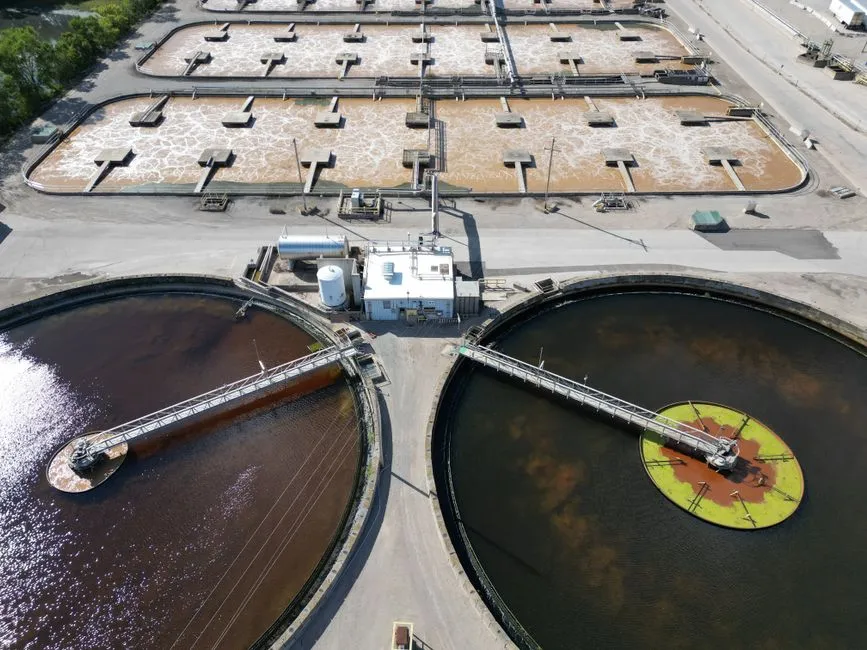
The single most consequential decision in manufacturer selection is biological process. MBR, SBR, MBBR, and packaged/underground STP each solve a different problem, and Gulf operating conditions shift the trade-off space meaningfully compared to temperate-climate reference projects.
MBR (Membrane Bioreactor): Submerged PVDF hollow-fibre or flat-sheet membranes at 0.1–0.4 μm pore size, operating at mixed liquor suspended solids (MLSS) of 8,000–12,000 mg/L — roughly double that of a conventional activated-sludge plant. Hydraulic retention time (HRT) is 4–6 hours, sludge retention time (SRT) 20–40 days, and effluent TSS is typically <5 mg/L. The MBR footprint is 60% smaller than a conventional plant of equal capacity (HydropureWater MBR catalogue, 2026), and the closed-tank design minimises aerosol carryover — a real issue in 45°C open-tank SBRs. The trade-off is membrane replacement every 5–8 years and a higher aeration energy load (0.35–0.55 kWh/m³) than SBR.
SBR (Sequencing Batch Reactor): Fill-react-settle-draw in a single tank. CAPEX is 20–30% below MBR for the 50–500 m³/day band, but effluent TSS lands in the 15–30 mg/L band and requires tertiary filtration to meet Abu Dhabi's reuse limits. SBR tolerates shock loads well and is mechanically simple, which is why it remains a defensible choice for sites without an irrigation reuse obligation. The deeper engineering comparison is laid out in the MBR vs MBBR engineering comparison.
MBBR (Moving Bed Biofilm Reactor): Biofilm carriers in a conventional aeration tank, no sludge recirculation pumps, tolerant of hydraulic and organic shocks. The right answer for retrofitting an existing basin or for variable-strength industrial effluent where biomass retention on a carrier outperforms suspended growth. MBBR effluent typically lands at 20–40 mg/L TSS, so it still needs downstream clarification or filtration to hit reuse limits.
Packaged / underground STP (WSZ series): A buried A/O biological unit, fully automatic, sized 1–80 m³/h, designed for residential compounds, hotels, and small commercial sites where landscaping must be preserved. The buried configuration also reduces thermal loading from direct sun — a measurable benefit in Abu Dhabi summers, where uncovered tank temperatures can reach 50°C and inhibit nitrification.
DAF pretreatment: The DAF pretreatment system (4–300 m³/h) is typically paired with any of the above for high-FOG or high-TSS industrial influent. Food processing, edible-oil, and metalworking effluent should not be sent to a biological stage without DAF upstream — the load variability will destabilise the biomass within 24–48 hours.
| Process | HRT (h) | Effluent TSS (mg/L) | Footprint | Best-fit capacity | CAPEX band |
|---|---|---|---|---|---|
| MBR | 4–6 | <5 | 0.4× conventional | 50–2,000 m³/day | High |
| SBR | 8–12 | 15–30 | 0.7× conventional | 50–500 m³/day | Medium |
| MBBR | 6–10 | 20–40 | 0.8× conventional | 100–5,000 m³/day | Medium-low |
| Packaged STP (buried) | 6–8 | 10–20 | Surface zero | 1–80 m³/h | Low (per m³) |
CAPEX and OPEX Benchmarks for Abu Dhabi Plants (2026)
Budget sanity-check ranges for Abu Dhabi industrial buyers in 2026, in AED, based on HydropureWater field data and recent Gulf project quotations. Every range includes skidded MBR/SBR/MBBR equipment, civil works allowance, and one-year spares, but excludes land cost and incoming power line upgrades beyond 200 m from the plant boundary.
The 50 m³/day packaged STP is the typical entry point for hotels, staff accommodation, and small commercial buildings. Expect CAPEX of AED 250,000–450,000 and OPEX of AED 0.85–1.40 per m³, with operator visits averaging 2 hours/day and electrical load at 0.8–1.2 kWh/m³. The 200 m³/day MBR is the most common industrial capacity in Abu Dhabi food, hospitality, and small manufacturing sectors, with CAPEX of AED 600,000–1,100,000 and OPEX of AED 0.45–0.85 per m³. Add a DAF pretreatment system if the influent carries FOG or settleable solids above 400 mg/L.
A 500 m³/day MBR with DAF pretreatment and a sludge dewatering filter press lands in the AED 1,800,000–2,800,000 CAPEX band with OPEX of AED 0.40–0.70 per m³. The 1,000 m³/day class — typical of large food-processing facilities, district cooling makeup, and major real-estate developments — runs AED 2,800,000–4,200,000 CAPEX and AED 0.32–0.55 per m³ OPEX, usually in containerised or modular steel construction to compress the site install window.
Two premiums recur across quotations. Hot-climate derating — chillers for MBR permeate, UV in place of chlorine in high-UV-index sites (Abu Dhabi annual UV index averages 10–12), and tropicalised enclosures to IP54/IP65 — typically adds 8–15% over a temperate-climate baseline. Salt-tolerant materials (FRP, duplex 2205, EPDM seals) add another 5–10% where feed TDS exceeds 5,000 mg/L. Buyers who receive a temperate-climate baseline price should expect those uplifts and budget them into the RFQ envelope rather than treating them as extras.
| Capacity | Process configuration | CAPEX (AED) | OPEX (AED/m³) | Power (kWh/m³) | Typical site |
|---|---|---|---|---|---|
| 50 m³/day | Packaged STP | 250,000–450,000 | 0.85–1.40 | 0.8–1.2 | Hotel, staff camp |
| 200 m³/day | MBR | 600,000–1,100,000 | 0.45–0.85 | 0.5–0.8 | Food processing, hospitality |
| 500 m³/day | MBR + DAF | 1,800,000–2,800,000 | 0.40–0.70 | 0.4–0.7 | District cooling, large food plant |
| 1,000 m³/day | MBR + DAF + filter press | 2,800,000–4,200,000 | 0.32–0.55 | 0.35–0.6 | Real-estate, industrial zone |
Vetting a Wastewater Treatment Plant Manufacturer
Five checks separate a defensible shortlist from a quote-fest. The first is certification: ISO 9001 for quality management, ISO 14001 for environmental management, and CE or equivalent electrical compliance. In Abu Dhabi, also confirm ADCE (Abu Dhabi Centre for Economic Authorisation) registration so imported equipment clears customs without a re-permitting cycle. The second is Factory Acceptance Testing — request video records and signed test sheets for the actual skidded system being shipped, not a generic demonstration unit. A 200 m³/day MBR should run a continuous 72-hour FAT at design load before it leaves the factory.
Third, local service footprint. A manufacturer with no UAE-based engineer and no regional service partner within four hours' drive of Abu Dhabi is a long-term risk; membrane cleaning cycles, aerator bearing replacement, and automatic chemical dosing system calibration all need local response. Ask specifically for Gulf-climate operating references, not temperate-climate ones — a plant that runs at 25°C MLSS will not behave the same at 38°C. Fourth, comparable reference projects: at least three operating plants in the 50–1,000 m³/day band, ideally in the Middle East or with feed water TDS above 3,000 mg/L.
Fifth, performance guarantees backed by liquidated damages. The BOD, COD, and TSS removal warranties should be specific (≤30, ≤150, ≤50 mg/L respectively for industrial discharge), with a clear 12-month defect liability period and a defined response time for non-conformance. Spare-parts lead time is the hidden cost driver — confirm membrane replacement availability (5–8 years for PVDF), aerator bearings, and dosing-pump heads before signing, not after the first failure. A working rotary mechanical bar screen upstream of any biological stage is also a procurement gate, since screenings handling is a frequent compliance gap during commissioning.
Implementation Timeline and Commissioning in Abu Dhabi
For a 200 m³/day plant, expect 10–14 weeks of engineering and fabrication ex-works, 4–6 weeks of shipping and on-site installation, and 4–8 weeks of commissioning and performance testing — a realistic 20–28 week total from PO to hand-over. Three Abu Dhabi permits consistently drive the critical path: Abu Dhabi Civil Defence approval for the electrical room and any enclosed chemical store, Department of Municipalities & Transport connection approval for the discharge point, and ADDC approval for the power connection. Each can add 2–4 weeks if not pre-coordinated before the manufacturer mobilises.
Biological commissioning deserves its own calendar. Seed sludge sourcing in the Gulf is a real constraint — acclimation typically takes 4–6 weeks for a system to reach design effluent quality, and operators should expect to keep the manufacturer's commissioning engineer on site for at least half of that period. UV lamps, chemical dosing pumps, and PLC tuning add another 1–2 weeks on top. Buyers who compress this window to 2–3 weeks consistently see COD and TSS excursions in months 2–4 of operation.
Frequently Asked Questions
What CAPEX should an Abu Dhabi buyer expect for a 200 m³/day MBR plant in 2026? CAPEX typically lands in the AED 600,000–1,100,000 range for a skid-mounted MBR with the controls and one-year spares included; adding DAF pretreatment or a sludge dewatering filter press pushes the upper band toward AED 1,400,000 (HydropureWater field data, 2026).
What are the UAE industrial discharge limits for pH, COD, and TSS in 2026? Industrial effluent must meet pH 6.0–9.0, COD ≤150 mg/L, BOD ≤30 mg/L, and TSS ≤50 mg/L; irrigation reuse tightens TSS to ≤15 mg/L and fecal coliform to ≤200 CFU/100 mL (per the UAE pH discharge compliance guide, 2026).
MBR or SBR for a 200 m³/day food-processing plant in Abu Dhabi? MBR is the default when the buyer needs irrigation reuse, because it delivers <5 mg/L TSS without tertiary filtration; SBR saves 20–30% CAPEX but requires downstream sand or disc filtration to reach the ≤15 mg/L TSS reuse envelope.
How large is Abu Dhabi's benchmark wastewater treatment capacity? The Veolia-operated Al Wathba 2 plant (300,000 m³/day) and Allahamah plant (130,000 m³/day) together produce 430,000 m³/day of reused water; the Ruwais plant has served a 68,000-population industrial community since 2015.
What does Gulf-climate derating add to a temperate-climate baseline quotation? Hot-climate derating — chillers, UV in place of chlorine, tropicalised IP54/IP65 enclosures, and salt-tolerant materials — typically adds 8–15% over a temperate-climate baseline for Abu Dhabi installations.