UAE pH Discharge Limit: The 2026 Regulatory Framework
The UAE pH discharge limit for industrial wastewater is 6.0–9.0 under Federal Decree-Law No. 45 of 2021 (Use and Conservation of Water Resources), enforced by the Ministry of Industry and Advanced Technology (MOIATE). Specialized sectors override this default: ADNOC code requires pH 6.5–8.5 for oil & gas process streams, marine discharge under Regulation 2006 also requires 6.5–8.5, and Treated Sewage Effluent (TSE) reuse standards set 6.0–8.5. Compliance is achieved with two-stage pH neutralization plus online pH/ORP monitoring at the discharge header.
Federal Decree-Law No. 45 of 2021 replaced the older Federal Law No. 24 of 1999 as the parent statute governing water use, discharge permitting, and reuse across the UAE mainland. Implementing regulations issued between 2024 and 2025 (Cabinet Decision No. 19 of 2022, as amended; MOIATE Decision 142/2024) consolidated permit authority under MOIATE for industrial operating licenses, where previously jurisdiction was fragmented between MOCCAE and individual emirate municipalities. The 6.0–9.0 pH band is the binding range for any industrial facility discharging to a municipal sanitary drainage network on the mainland, including facilities in Dubai Industrial City, Sharjah Industrial Area, and Abu Dhabi's ICAD zones.
Enforcement is not theoretical. Per Cabinet Decision No. 19/2022, non-compliant industrial discharge carries fines of AED 50,000–500,000 and may result in facility shutdown or suspension of the operating license. A second violation within 24 months doubles the fine and triggers mandatory MOIATE re-audit before operations can resume. Modern permit conditions now require pH to be measured continuously at the discharge header, not by grab sample, and the data must be retained for five years under MOIATE Inspection Checklist 2025.
pH Limits by Discharge Pathway: Mainland, Marine, TSE Reuse, and Hazardous Waste
UAE regulators set pH limits by discharge pathway, not by industry — and the difference between a 6.0–9.0 band and a 6.0–8.0 band can determine whether a facility passes inspection. The table below consolidates the four most common discharge routes and the controlling regulation for each.
| Discharge Pathway | pH Limit | Controlling Instrument | Other Key Parameters |
|---|---|---|---|
| Municipal sewer (mainland industrial) | 6.0–9.0 | Federal Decree-Law 45/2021 | TSS < 50 mg/L, COD < 1,000 mg/L, no visible oil/grease |
| Marine waters (open sea outfall) | 6.5–8.5 | Cabinet Decision 12/2006 (Regulation 2006) | ΔT max +1°C above ambient; residual Cl₂ < 0.02 mg/L; TSS < 50 mg/L |
| TSE reuse (landscape/agricultural irrigation) | 6.0–8.5 | TAEP standard (Dubai DM-PHED-2023; ADQCC TS-2024) | FC < 2.2 CFU/100 mL; BOD < 10 mg/L; turbidity < 5 NTU |
| Deep-well injection (groundwater) | 6.0–8.0 | Abu Dhabi Regulation 2/1999 (ADCEEF) | Tighter band for potable aquifer injection; TDS < 10,000 mg/L |
| Landfill leachate (hazardous stream) | 5.5–9.0 | Federal Law 24/1999, Art. 28 | Heavy metals per SWA schedule; COD < 3,000 mg/L pre-treatment |
For facilities discharging more than one stream — a common case in Jebel Ali where a plant sends sanitary effluent to the municipal sewer and cooling-tower blowdown to a marine outfall — the most restrictive limit applies to each individual stream. The marine 6.5–8.5 band is tighter than the mainland 6.0–9.0 band, and the +1°C temperature rise cap often forces facilities to install plate heat exchangers before discharge. Groundwater injection into a non-potable formation accepts the 6.0–8.0 band; injection into a designated potable aquifer tightens to 6.5–8.0 plus additional metals testing under ADCEEF guidance.
Free Zone and Sector-Specific pH Rules: JAFZA, ADNOC, and Fujairah

Free zone facilities and oil & gas concessions follow the federal pH band on paper but are sampled and enforced by their zone authority, not MOIATE directly. In practice this means a JAFZA factory receives its discharge permit from the Jebel Ali Free Zone Authority, a JAFZA-accredited laboratory visits the site every 14 days, and a non-conformance report is issued under JAFZA bylaws rather than the federal cabinet decision.
| Jurisdiction / Concession | pH Limit (Process) | pH Limit (Sanitary) | Sampling Frequency | Enforcing Body |
|---|---|---|---|---|
| JAFZA / SAIF Zone / DMCC / Hamriyah | 6.0–9.0 | 6.0–9.0 | Every 14 days (3rd-party accredited lab) | Free zone authority |
| ADNOC / GASCO / BOROUGE / ADOC concessions | 6.5–8.5 | 6.0–9.0 | Continuous online + weekly lab | ADNOC HSE Code, supervised by MOIATE |
| Fujairah offshore (bunkering, ship repair) | 6.5–8.5 | 6.0–9.0 | Per ballast event + monthly | Port of Fujairah bylaws |
| Sharjah Industrial Area (mainland) | 6.0–9.0 | 6.0–9.0 | Continuous online, 24/7 telemetry | Sharjah Municipality Decision 14/2023 |
ADNOC's 6.5–8.5 process water band is one full pH unit tighter than the federal default and reflects downstream injection constraints at the field level. Operators on ADNOC concessions typically retrofit their existing equalization tanks to add a final polishing reactor with a closed-loop pH controller; the federal 6.0–9.0 limit still governs the sanitary side of the same facility. Sharjah Industrial Area is the most data-intensive: Sharjah Municipality Decision 14/2023 requires 24/7 online pH telemetry to the municipality control room, and any reading outside 6.0–9.0 for more than 15 minutes triggers an automatic non-compliance flag.
Why pH Excursions Happen: Root Causes in UAE Industrial Plants
Most pH excursions are predictable once the upstream process is mapped. MOIATE 2024 enforcement data from Jebel Ali shows that acid-wash streams from electroplating, battery manufacturing, and printed circuit board lines are the single largest source of pH non-compliance, with pH routinely below 4 at the equalization tank inlet. Alkaline CIP effluent from dairy, beverage, and food processing plants is the second leading cause, with pH values above 10 during the rinse cycle.
Refinery and sour-gas treatment units present a different failure mode. Sulfide oxidation in desulfurization units produces sulfuric acid within hours of an air ingress event, driving pH to 2–3 across the stripper bottoms. A common related failure point is unagitated equalization: stratified tanks can hold pH 4.0 in the bottom third and pH 8.5 at the surface, so a top-of-tank grab sample passes while the bottom fails at the discharge header. High TDS, high temperature, and high oil & grease content in produced water blind conventional pH probes — the sensor reads 7.0 while actual pH is 2.5. For facilities treating petrochemical or oil-field brines, the MBR system described in the rubber processing wastewater guide is increasingly used as a final polishing barrier because it tolerates influent pH swings of ±2 units without biological upset.
Two-Stage pH Neutralization: Engineering the Compliance Path
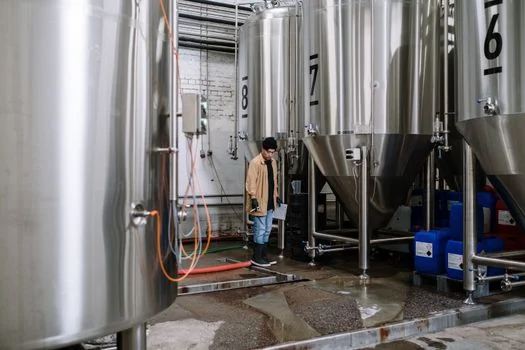
Two-stage neutralization is the standard compliance path for UAE industrial plants because single-stage systems cannot reliably hold ±0.2 pH at the discharge header when the influent swings between 2 and 12. Stage 1 (coarse) handles the bulk acid or alkali load; Stage 2 (fine) trims to the regulatory point. The chemical dosing package is normally delivered as a pre-engineered automatic chemical dosing skid for two-stage pH neutralization rather than field-assembled, because the dosing pump, control valve, pH probe, and PLC need to be factory-calibrated together.
| Parameter | Stage 1 — Coarse | Stage 2 — Fine |
|---|---|---|
| HRT | 20–30 min | 5–10 min |
| Reagent (typical) | NaOH 32–50% or H₂SO₄ 98% | NaOH 10–20% or H₂SO₄ 10–20% (diluted) |
| Target pH exiting stage | 5.5–9.0 (process band) | 7.0 ± 0.2 (regulatory point) |
| Control loop | On/off or simple proportional | PLC PID with adaptive tuning |
| pH probe location | Inside equalization tank | Discharge header (regulatory point) |
| Typical reagent dose | 0.3–0.8 g/L NaOH (lift from 4 to 7) or 0.2–0.5 g/L H₂SO₄ (drop from 10 to 7) | Trim dose, typically 5–15% of Stage 1 rate |
Reagent selection depends on safety and cost constraints. NaOH + H₂SO₄ is the default and is the cheapest option at roughly AED 1.2–1.8 per cubic meter of wastewater treated (HydropureWater field data, 2026). Lime (Ca(OH)₂) is preferred for high-flow, low-precision applications such as mining leachate or pulp & paper where exact pH is less critical. CO₂ is favored for food and beverage plants because it cannot overshoot below pH 5.5 even on a failed injection stroke. Exact reagent dose depends on influent buffering capacity: a weak buffer at pH 4 may need only 0.2 g/L NaOH to reach pH 7, while a phosphate-buffered stream at the same pH can require 0.9 g/L.
Online pH Monitoring and Telemetry for UAE Permit Compliance
Online pH/ORP monitoring at the discharge header is no longer optional for facilities above 50 m³/day in JAFZA, SAIF Zone, and Sharjah Industrial Area — it is written into the permit condition itself. The regulator's data expectation is concrete: 1-minute resolution, 5-year retention, and direct telemetry to the authority's control room.
| Component | 2026 Specification | Permit Reference |
|---|---|---|
| pH sensor type | Differential, Pt1000 temp compensation, self-cleaning flat-glass | MOIATE Inspection Checklist 2025 |
| Output signal | 4–20 mA + Modbus TCP | JAFZA Permit Schedule 4, Clause 7 |
| Enclosure | IP68 rated for outdoor installation | Sharjah Municipality Decision 14/2023 |
| Data retention | 5 years, 1-minute resolution | MOIATE Inspection Checklist 2025 |
| Telemetry | 4G cellular or wired SCADA; JAFZA requires private APN (no public internet) | JAFZA Cybersecurity Annex |
| Probe cost (2026) | USD 800–2,500 industrial probe; USD 3,200–6,500 full transmitter + auto-clean station | Market reference — see the IoT Sensor Cost in 2026: Industrial Pricing, Specs & Buyer's Guide for full pricing breakdown |
For facilities in the oil & gas sector where produced water often carries high TDS and trace H₂S, differential pH probes with a potassium chloride reference junction are specified over combination electrodes because they tolerate poisoning better. ORP sensors are typically added in parallel to pH for cyanide- and chrome-bearing streams in electroplating, where ORP confirms whether a reducing or oxidizing chemistry is active — see the ORP Sensor Cost in 2026: Pricing, Specs & Industrial Buyer's Guide for typical electrode and transmitter pricing in the 2026 market.
Frequently Asked Questions
What is the pH discharge limit for industrial wastewater in the UAE mainland?
The pH discharge limit for industrial wastewater discharged to a municipal sewer on the UAE mainland is 6.0–9.0, set under Federal Decree-Law No. 45 of 2021 (Use and Conservation of Water Resources) and enforced by MOIATE.
What is the pH limit for marine discharge in the UAE?
Marine discharge requires pH 6.5–8.5 under Cabinet Decision No. 12/2006 (Regulation 2006), with a maximum temperature rise of +1°C above ambient, residual chlorine below 0.02 mg/L, and TSS below 50 mg/L.
How is pH measured for permit compliance in the UAE?
The current expectation under MOIATE Inspection Checklist 2025 is continuous online measurement at the discharge header with a differential pH sensor and 1-minute data resolution. The minimum practical check is a grab sample drawn at the discharge header, measured with a calibrated bench meter, and recorded in a 24-hour pH log retained for five years.
What is the fine for non-compliant pH discharge in the UAE?
Per Cabinet Decision No. 19/2022, non-compliant industrial discharge carries a fine of AED 50,000–500,000 plus suspension of the operating license, with a doubled fine and mandatory re-audit for a second violation within 24 months.
Do free zone facilities in the UAE follow the same pH limit?
Yes. JAFZA, SAIF Zone, DMCC, and Hamriyah Free Zone all adopt the federal 6.0–9.0 pH band, but enforcement is handled by the free zone authority with third-party accredited laboratory sampling every 14 days and a permit-specific continuous monitoring requirement.
Related Equipment
- MBR system — specifications, capacity range, and technical data