How Much CO2 Does Wastewater Treatment Really Emit?
Wastewater treatment is a significant, yet often overlooked, source of global greenhouse gas (GHG) emissions. According to the Intergovernmental Panel on Climate Change (IPCC 2019), the sector emits an estimated 0.38 gigatonnes of CO2 equivalent (CO2e) annually. This places its carbon footprint on par with the global chemical industry (0.37 Gt CO2e) and underscores its critical importance in industrial decarbonization strategies. Current estimates from bodies like the US EPA may significantly underreport the problem; recent studies suggest on-site methane (CH4) emissions from collection and treatment systems could be double previous estimates due to incomplete measurement methodologies. This discrepancy highlights the urgent need for more accurate, plant-level monitoring to inform mitigation efforts.
For plant engineers evaluating systems, the most practical metric is carbon emission intensity, expressed as kg CO2e per cubic meter of treated wastewater. For conventional activated sludge plants, this typically ranges from 0.8 to 1.2 kg CO2e/m³. A substantial portion of this footprint comes from highly variable nitrous oxide (N2O) emissions during nitrification/denitrification, which are often calculated using outdated or oversimplified emission factors (e.g., 0.005–0.01 kg N2O-N/kg NOx-N removed). In reality, N2O emissions can spike dramatically due to process upsets, low dissolved oxygen, or insufficient carbon sources, making real-time monitoring crucial.
Primary Sources of Greenhouse Gases in Treatment Plants
The total carbon footprint of a treatment plant is a sum of direct emissions from biological processes and indirect emissions from energy and chemical consumption. Understanding this breakdown is the first step toward targeted reduction.
Direct emissions are primarily methane (CH4) and nitrous oxide (N2O), which have global warming potentials 28 and 265 times that of CO2, respectively. CH4 is generated in anaerobic zones, sewers, and sludge storage tanks and can constitute up to 60% of a plant's total footprint. N2O is a byproduct of incomplete nitrification or denitrification and typically contributes 10–25% of emissions. For example, a sudden drop in pH or dissolved oxygen can trigger a rapid, temporary release of N2O, significantly impacting the daily carbon balance.
Indirect emissions dominate the operational carbon cost. Aeration alone accounts for 50–60% of a plant's total energy consumption, with pumping and mixing adding significantly. Chemical production for coagulation (e.g., alum, ferric chloride) and denitrification (e.g., methanol) contributes another 5–15% via embodied carbon. Finally, sludge processing—including digestion, dewatering with equipment like a plate and frame filter press, and transport—is a major source, responsible for 20–30% of the total global warming potential (GWP). The carbon cost of transporting sludge for final disposal can add another 0.05–0.1 kg CO2e/m³, depending on distance.
Engineering Strategies to Reduce Carbon Footprint
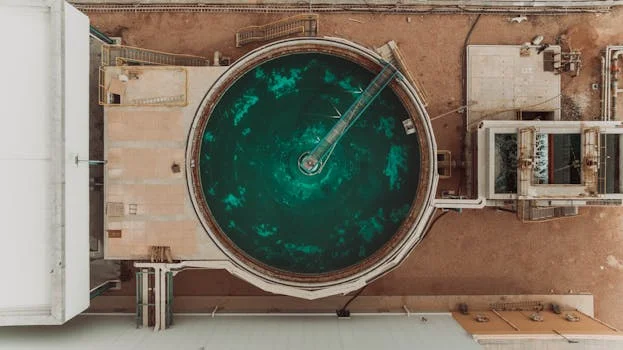
Reducing the carbon footprint of wastewater treatment requires targeted, equipment-level interventions. The following strategies offer proven, quantifiable reductions in CO2e emissions.
Optimize Aeration Efficiency: Aeration is the largest energy consumer. Upgrading to fine-bubble diffusers and implementing advanced dissolved oxygen (DO) control can reduce aeration energy use by 20–35%, directly cutting emissions by 0.15–0.25 kg CO2e/m³. For optimal control, pair DO sensors with ammonia or nitrate probes to match aeration to the real-time biological demand, preventing both over-aeration and conditions that cause N2O emissions.
Implement Sludge In Situ Reduction (SIR): Technologies like sludge ozonation or thermal hydrolysis can reduce biomass yield by 30–50%. This directly lowers the carbon-intensive burden of digestion, dewatering, and disposal, resulting in a net emissions reduction of up to 23%. While these systems require an energy input, the net carbon saving is positive due to the avoided emissions from reduced hauling and processing.
Adopt Advanced Processes like M-CAST: The Membrane-Coupled Activated Sludge Technology (M-CAST) process has been shown to achieve a 30% lower GWP than conventional activated sludge due to higher biomass retention, reduced sludge production, and a smaller physical footprint which also lowers the embodied carbon of construction materials.
Maximize Energy Recovery from Biogas: For plants with anaerobic digestion, capturing and utilizing biogas is paramount. One cubic meter of biogas (~60% CH4) can generate approximately 6 kWh of electricity. When used for on-site power and heat, biogas energy recovery can offset 4–5 kg CO2e per m³ of treated wastewater, moving a plant toward net-zero operation. Upgrading biogas to renewable natural gas (RNG) for vehicle fuel or grid injection can provide an even greater carbon offset and revenue stream.
| Strategy | Key Technology/Action | Carbon Reduction Impact |
|---|---|---|
| Aeration Upgrade | Fine-bubble diffusers, DO control | 0.15–0.25 kg CO2e/m³ |
| Sludge Handling | In Situ Reduction (SIR) | Up to 23% total CO2e |
| Process Design | M-CAST technology | 30% lower GWP vs. CAS |
| Energy Recovery | Biogas cogeneration | Offset 4–5 kg CO2e/m³ |
Implementing an integrated MBR system with 60% smaller footprint and lower sludge yield combines several of these strategies into a single, high-efficiency solution.
Technology Comparison: Carbon Footprint by Treatment Process
For procurement managers and plant engineers, selecting the right technology is the most impactful decision for long-term carbon management. The carbon intensity varies significantly between processes.
Membrane Bioreactor (MBR): MBR systems typically achieve a carbon footprint of 0.6–0.8 kg CO2e/m³, approximately 30% lower than conventional activated sludge. This is due to a more concentrated biomass, which improves treatment efficiency and reduces sludge production, and a compact footprint that minimizes construction embodied carbon. The main trade-off is the higher energy demand for membrane scouring, though this is often offset by the other savings.
Conventional Activated Sludge (A/O): The workhorse of the industry, conventional A/O processes have a higher range of 0.9–1.2 kg CO2e/m³. This is driven by higher energy demand for aeration, larger tank volumes, and a greater sludge yield that requires further processing. Its carbon performance is highly dependent on the age and maintenance of the equipment.
Dissolved Air Flotation (DAF): When used for pre-treatment, a high-efficiency DAF system with 92–97% TSS removal and 40% lower sludge volume outperforms clarifiers. DAF systems operate with a footprint of 0.4–0.6 kg CO2e/m³ due to faster hydraulic retention times, more efficient solids separation, and often reduced chemical consumption. This makes them an excellent first step in a treatment train for lowering overall plant emissions.
Integrated Package Plants: Automated package plants, such as underground integrated systems, offer a balanced footprint of 0.7–0.9 kg CO2e/m³. Their carbon advantage comes from optimized, pre-engineered processes that minimize operator error and chemical overfeeding. They are particularly effective for decentralized treatment, eliminating the massive carbon cost of long sewer collection systems.
| Treatment Process | Carbon Intensity (kg CO2e/m³) | Relative Energy Use | Sludge Yield |
|---|---|---|---|
| DAF (Pre-Treatment) | 0.4 - 0.6 | Low | Low |
| MBR | 0.6 - 0.8 | Medium-High | Low |
| Integrated Package Plant | 0.7 - 0.9 | Medium | Medium |
| Conventional A/O | 0.9 - 1.2 | High | High |
Case Example: Cutting Carbon in a 500 m³/day Industrial Plant
A real-world example demonstrates the tangible ROI of low-carbon technology upgrades. A 500 m³/day industrial facility sought to improve effluent quality and reduce operating costs while cutting its carbon footprint.
The project had two phases. First, the plant replaced its conventional clarifier with a high-efficiency DAF system for primary treatment. This change alone reduced chemical use by 25% and decreased sludge production for disposal by 40%. Second, the biological stage was upgraded to an MBR system, which improved final effluent quality to under 1 NTU, reduced the physical footprint by 60%, and cut overall energy consumption by 18% through more efficient biomass management and a more optimized aeration cycle.
The combined upgrades resulted in annual carbon savings of 128 tons CO2e. The project achieved a simple payback of 3.2 years through avoided costs for sludge hauling, disposal, and energy. This case proves that investments in advanced technologies like an MBR membrane module deliver both environmental and economic returns, making a compelling business case for sustainability.
Frequently Asked Questions
What is the carbon footprint of 1 m³ of treated wastewater?
For conventional activated sludge plants, the typical range is 0.8–1.2 kg CO2e/m³. Advanced systems like MBR or those with energy recovery can achieve a significantly lower footprint of 0.5–0.7 kg CO2e/m³. This is a life-cycle assessment value that includes both direct emissions and indirect emissions from energy and chemicals.
Which process has the lowest carbon footprint?
Research indicates that M-CAST and modern MBR systems show a 30–40% lower global warming potential (GWP) than conventional activated sludge processes, making them among the lowest-carbon options available. The absolute lowest footprint is achieved by plants that combine these advanced biological processes with comprehensive biogas energy recovery and renewable power.
How does sludge reduction lower carbon emissions?
Reducing sludge production via in-situ reduction (SIR) technologies means less mass requiring digestion, dewatering, and transport—all of which are energy- and carbon-intensive. This can cut up to 23% of a plant's total CO2e emissions by avoiding the diesel fuel for hauling trucks and the energy for dewatering equipment like centrifuges and presses.
Are DAF systems better for carbon footprint than clarifiers?
Yes. DAF systems achieve 92–97% TSS removal with 20–30% lower sludge volume and reduced chemical use compared to clarifiers, resulting in a lower overall carbon footprint for pre-treatment. Their faster loading rates also mean smaller tanks, reducing the embodied carbon of concrete and steel.
Can wastewater treatment be carbon negative?
While not yet standard, net-zero or carbon-negative operation is achievable through a combination of maximal biogas energy recovery, solar/wind integration, and advanced processes that minimize direct emissions and sludge production. Proper sludge bulking prevention and optimized phosphorus removal are also key to reducing energy and chemical use. Some pioneering plants are already achieving this by exporting surplus renewable energy.