Quezon City industrial plants discharging to Class C waters must meet DENR DAO 2016-08 General Effluent Standards of BOD ≤ 50 mg/L. Earlier buyer briefs often cited TSS ≤ 70 mg/L for Class C. The DAO 2016-08 GES table sets Class C TSS at 100 mg/L. Class D BOD is 120 mg/L rather than 100 mg/L (WEPA briefing of DAO 2016-08). Typical packaged trains for 50–500 m³/day still price near ₱5M–₱50M CAPEX. This guide maps 2026 engineering specs, compares Quezon City equipment suppliers on capability gaps, and gives a selection checklist for plant engineers and EPC buyers.
Why Quezon City Industrial Buyers Need DENR-Compliant Sewage Treatment Equipment in 2026
Quezon City industrial dischargers must meet DENR DAO 2016-08 General Effluent Standards for the receiving-water class on the Discharge Permit. Class C limits include BOD ≤ 50 mg/L, COD ≤ 100 mg/L, and TSS of 100 mg/L. Class D allows BOD ≤ 120 mg/L and TSS ≤ 150 mg/L. Missed limits can bring Cease and Desist Orders.
According to FAOLEX records of DAO 2016-08, DENR Administrative Order 2021-19 later updated selected nutrient and metal parameters while leaving BOD and TSS unchanged. Class C GES pH is 6.0–9.5; Class D GES pH is 5.5–9.5. Clean Water Act penalties are commonly cited from ₱10,000 to ₱200,000 per day of violation. A 2023 Quezon City food plant case reported a ₱2.4M DENR NCR penalty after TSS exceedance from an undersized primary clarifier.
Compliance failures in Novaliches and Balintawak rarely trace to one fault. Undersized hydraulic design, missing standby blowers or RAS pumps, and weak sludge handling stack together. Most plants we size for QC food and light industry run at the lower end of the nameplate flow until a night shift or washdown doubles instantaneous load. Washouts during peak production still show up when clarifiers were built for yesterday’s m³/day. As densification shrinks expansion land, footprint becomes a hard constraint.
Local industrial siting data still point to about a 30% rise in demand for containerized STPs for space-constrained Quezon City sites. Modular trains let a plant add capacity inside the existing fence line. For 2026 projects, facility managers favor higher nutrient removal and smaller footprints so the next DENR Administrative Order revision does not force a rebuild.
Quezon City-Specific Engineering Specs for Industrial Sewage Treatment Systems
Quezon City industrial wastewater often carries high organic strength: food-processing COD of 1,200–3,500 mg/L and TSS of 800–2,000 mg/L are common design envelopes. Hospital wastewater in Diliman is milder on organics—BOD 300–600 mg/L—but pathogen counts can reach 10^6 CFU/mL (per DENR NCR 2024 data cited in prior project briefs). Those benchmarks set the treatment train before any supplier quote is credible.
For high-strength organic loads, MBR systems for Quezon City’s high-organic-load wastewater are the usual 2026 choice when reuse or tight footprint rules apply. Membrane bioreactors reach COD removal of 95–99% under steady MLSS control, above typical Conventional Activated Sludge performance on the same influent. Where FOG dominates—commercial kitchens and food plants—DAF systems for TSS and FOG removal in food processing wastewater deliver 92–97% TSS removal and protect downstream biology. Healthcare sites often add on-site ClO₂ generators for hospital wastewater disinfection to meet pathogen limits without storing bulk chlorine gas. Compact buried options such as the Underground Package Sewage Treatment Plant (WSZ Series) suit sites that cannot spare surface area for open tanks.
Quezon City ambient temperatures of 28–35°C speed biology but strip dissolved oxygen quickly. Aeration packages are routinely oversized 15–20% versus temperate designs to hold DO near 2.0 mg/L. MBR energy use of 0.8–1.2 kWh/m³ trades against a roughly 60% footprint cut versus CAS at 0.4–0.6 kWh/m³—often decisive on urban lots.
| Parameter | Food Processing (QC) | Hospital (QC) | DENR Class C Target |
|---|---|---|---|
| Influent COD (mg/L) | 1,200 - 3,500 | 500 - 800 | < 100 |
| Influent BOD (mg/L) | 600 - 1,500 | 300 - 600 | < 50 |
| Influent TSS (mg/L) | 800 - 2,000 | 200 - 400 | < 70 |
| Recommended Tech | DAF + MBR | A/O + ClO₂ | N/A |
| Removal Efficiency | 98% (BOD) | 95% (BOD) | N/A |
Design note on the Class C TSS cell above: older QC sheets used < 70 mg/L. DAO 2016-08 GES Class C TSS is 100 mg/L. The 70 mg/L figure matches Class A GES TSS in the same order. Keep the contractual target aligned with the actual receiving-water class on the Discharge Permit.
How Do Quezon City Equipment Suppliers Compare on Capabilities?
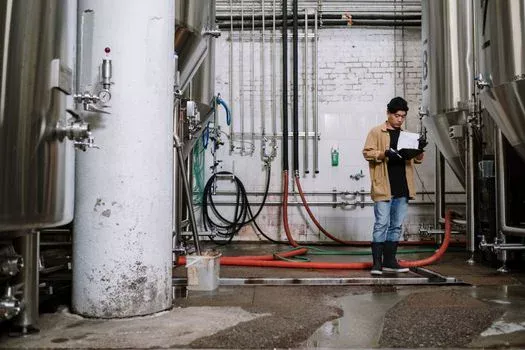
Wastewater treatment plant equipment suppliers serving Quezon City cluster into five practical groups, each strong in a different slice of the train. Hydrochem Plus Industrial Sales & Services in Novaliches is known for stainless and PVC fittings used on high-pressure lines and DAF skids. Their core is component supply, not proprietary MBR membrane fabrication, so buyers often source membrane modules from a second vendor.
Techbrokers Inc. deploys BioCleaner technology for turnkey STPs in residential and commercial work and supports DENR DAO 2016-08 permitting. Large industrial plants still need mechanical sludge dewatering such as screw presses, which that portfolio often lacks. Envirokonsult concentrates on septage management and desludging—strong for O&M contracts, thinner on first-principles design of high-strength chemical industrial WWTPs.
Pro-Envirotek focuses on Biological Nutrient Removal upgrades, a frequent gap when older plants must meet tighter nitrogen and phosphorus limits. Technosave International covers a wide industrial WWTP range, though lead times move with custom fabrication complexity. Most reputable Quezon City equipment suppliers quote a 1–2 year equipment warranty and a 5–10 year design life when O&M protocols are followed.
| Supplier | Core Strength | Notable Gap | Certification |
|---|---|---|---|
| Hydrochem Plus | High-pressure fittings/DAF | Limited MBR expertise | ISO 9001 |
| Techbrokers | BioCleaner/Turnkey STPs | Sludge dewatering limits | DENR Permitted |
| Envirokonsult | Septage/Desludging | Industrial WWTP design | ISO 14001 |
| Pro-Envirotek | BNR Upgrades | Component manufacturing | DENR Permitted |
| Technosave | Industrial WWTPs | Lead time variability | SEC Registered |
2026 CAPEX and OPEX Cost Models for Quezon City Industrial STPs
Total capital expenditure for a 500 m³/day sewage treatment plant in Quezon City ranges from ₱20M to ₱50M, with equipment near 60% of the budget. Civil works—excavation and tanks—usually take about 20%, and rise where soil is weak or groundwater is high. Smaller 50–200 m³/day A/O trains land around ₱5M–₱15M CAPEX but need more land than MBR on the same flow.
Operating cost is energy-led: power often takes about 40% of monthly OPEX. MBR CAPEX is higher, yet 10-year ownership can improve if permeate replaces cooling-tower makeup or irrigation water. Chemical spend for coagulants and polymers typically sits at ₱1.50–₱3.00 per m³ treated. Hospitals that borrow automation practices from Singapore’s NEA-compliant hospital wastewater treatment systems often cut labor, which still averages near 20% of Philippine OPEX.
Hidden line items include DENR permit fees (₱50K–₱200K), sludge disposal (₱1,500–₱3,000 per ton), and quarterly compliance testing (₱20K–₱50K per round). Integrated sludge dewatering that cuts disposal volume by about 70% commonly pays back in 5–7 years on the dewatering package alone.
| Cost Component | Conventional A/O (200 m³/d) | MBR System (200 m³/d) |
|---|---|---|
| CAPEX Range | ₱8M - ₱12M | ₱15M - ₱22M |
| Energy (kWh/m³) | 0.4 - 0.6 | 0.8 - 1.2 |
| Chemicals (₱/m³) | ₱2.00 | ₱1.50 |
| Footprint (sqm) | 120 - 150 | 40 - 60 |
| ROI (Years) | 3 - 4 | 5 - 7 (with reuse) |
What Makes a Wastewater Treatment Equipment Supplier Reliable?
A reliable wastewater treatment plant equipment supplier for Quezon City proves DENR track record and mechanical redundancy before debating unit price. Use this checklist when shortlisting Quezon City equipment suppliers:
- Step 1: Verify DENR permits and local registrations. Cross-check the firm on DENR NCR records for active environmental service permits, not only a business name on a brochure.
- Step 2: Request 3+ Quezon City project references. Ask for influent/effluent laboratory sheets (BOD, COD, TSS, pH) from plants of similar m³/day and industry, not generic testimonials.
- Step 3: Audit hydraulic and process calculations. Confirm peak-hour peaking factor, FOG load, and aeration DO of 2.0 mg/L at 28–35°C design ambient—not only average daily flow.
- Step 4: Require mechanical redundancy. Standby blowers and return-sludge pumps should cover routine maintenance without collapsing MLSS.
- Step 5: Score sludge handling. Screw press or equivalent dewatering that cuts haul volume ~70% usually beats hauling wet cake at ₱1,500–₱3,000 per ton.
- Step 6: Lock warranty and spare-parts lead time. Target 1–2 year equipment warranty, documented critical spares, and a named local service contact in Metro Manila.
- Step 7: Tie payment to compliance proof. Hold a retention until the plant meets the Discharge Permit limits on independent lab results for at least one full production week.
Who This Is For / Who Should Look Elsewhere / Next Step
This guide is for Quezon City plant engineers, EPC contractors, and procurement leads buying 50–500 m³/day industrial or institutional STPs under DENR DAO 2016-08. Pure septage haulers or buyers seeking only chemical dosing drums should look elsewhere. If you need a sized train and CAPEX band for your influent sheet, send flow, COD/BOD/TSS, and discharge class through our request-quote form for Quezon City STP sizing.
Frequently Asked Questions
What DENR limits apply to Quezon City Class C sewage discharge?
DENR DAO 2016-08 Class C General Effluent Standards set BOD ≤ 50 mg/L and COD ≤ 100 mg/L for discharge to Class C waters. Class C TSS under the same GES table is 100 mg/L; older QC briefs that used 70 mg/L were aligning with Class A TSS, not Class C. Confirm the receiving-water class on your Discharge Permit before freezing the design target.
How much does a 200–500 m³/day industrial STP cost in Quezon City?
A 200 m³/day conventional A/O package typically ranges ₱8M–₱12M CAPEX, while an MBR at the same flow runs about ₱15M–₱22M. A 500 m³/day plant often lands between ₱20M and ₱50M total, with equipment near 60% of spend. Civil cost rises where groundwater or poor soils force deeper excavation or tank liners.
Which process fits Quezon City food-processing wastewater?
Food plants with COD 1,200–3,500 mg/L and FOG usually need DAF ahead of biology, then MBR or A/O sized for peak washdown. DAF TSS removal of 92–97% protects membranes and clarifiers. Most plants we size for QC kitchens run aeration 15–20% above temperate rules of thumb to hold DO at 2.0 mg/L in 28–35°C weather.
How can buyers compare trusted wastewater plant equipment suppliers?
Compare suppliers on verified QC references with lab sheets, DENR permit status, standby mechanical equipment, and sludge dewatering—not brochure technology lists alone. Ask for three local projects in the same industry and flow band. A lower bid that omits dewatering or standby blowers often costs more after the first CDO or sludge haul spike.
Do Quezon City hospitals need different disinfection than factories?
Hospital wastewater in Diliman often shows BOD 300–600 mg/L with pathogen levels up to 10^6 CFU/mL, so disinfection is non-negotiable after biological treatment. On-site ClO₂ generation avoids bulk chlorine gas storage while meeting pathogen limits. Factories without clinical waste can often stop at BOD/TSS compliance unless reuse or sewer agreements add extra rules.