Industrial wastewater treatment in Stuttgart follows EU Directive 91/271/EEC plant-discharge benchmarks of ≤125 mg/L COD, ≤25 mg/L BOD₅ and ≤35 mg/L TSS. Local sewer permits under the German Water Resources Act (WHG) and Abwasserverordnung (AbwV) are often tighter. Municipal capacity around 1.6 million population-equivalent at plants such as Stuttgart-Mühlhausen sets the receiving baseline, so factories still need on-site pretreatment. Typical CAPEX spans about €80,000 for a skid-mounted DAF unit to €1.2M+ for a full-scale MBR train, with many sites targeting 3–5 year payback through lower surcharge fees.
EU Directive 91/271/EEC: Stuttgart Discharge Limits Explained
Stuttgart industrial sewer permits track EU Directive 91/271/EEC Annex I Table 1 values of ≤125 mg/L COD, ≤25 mg/L BOD₅ and ≤35 mg/L TSS for urban plant effluent. Large sensitive-area plants also use ≤10 mg/L total nitrogen and ≤1 mg/L total phosphorus. Factories pretreat so municipal works stay inside those caps.
According to the EUR-Lex consolidated text of Directive 91/271/EEC, Table 1 and Table 2 apply to urban wastewater treatment plant discharges. Directive (EU) 2024/3019 will repeal and replace 91/271/EEC from 1 August 2027 (EUR-Lex summary, updated 24 January 2025). Permit reviews should already map to the successor framework.
Local monitoring protects the Neckar River and the Stuttgart-Mühlhausen works. Exceeding agreed sewer limits typically triggers surcharges of about €0.50 to €2.00 per cubic meter, scaled to pollutant concentration. Persistent non-compliance can lead to permit revocation under the WHG. Sector rules for automotive and chemical sites are often tighter than the EU urban plant table.
Electroplating and metal finishing streams are a clear example. Earlier project notes often cited Chromium VI ≤0.5 mg/L and Nickel ≤2 mg/L. German AbwV Annex 40 (metal working/processing) sets Chromium VI at 0.1 mg/L and Nickel at 0.5 mg/L before mixing for galvanizing and related origin areas, with total chromium at 0.5 mg/L. While EU-compliant hospital wastewater treatment in Stuttgart focuses on pathogens, industrial sites must also control high TSS and synthetic oils.
| Parameter | Stuttgart Limit (Industrial) | Munich Limit (Reference) | Berlin Limit (Reference) |
|---|---|---|---|
| COD (mg/L) | ≤125 | ≤150 | ≤110 |
| BOD₅ (mg/L) | ≤25 | ≤30 | ≤20 |
| TSS (mg/L) | ≤35 | ≤50 | ≤30 |
| Total Nitrogen (mg/L) | ≤10 | ≤12 | ≤10 |
| Total Phosphorus (mg/L) | ≤1 | ≤1.5 | ≤0.5 |
Plant managers should treat the city comparison table as a planning screen, then lock final numbers to the written sewer contract and AbwV annex for their process code.
Industrial Wastewater Treatment in Stuttgart: DAF vs MBR vs Chemical Dosing
Dissolved Air Flotation (DAF) systems achieve 92–97% TSS removal when FOG and paint solids dominate, which is common on Stuttgart automotive lines. Micro-bubbles attach to suspended particles so DAF systems for Stuttgart’s industrial wastewater separate Fats, Oils, and Grease before they foul municipal biology. Facilities with high soluble organics or pharmaceutical residues usually need Membrane Bioreactors instead. MBR systems for Stuttgart’s pharmaceutical and chemical sectors combine biology with ultrafiltration and routinely hold COD below 50 mg/L, often enabling non-potable reuse.
Chemical dosing remains the workhorse for pH control and coagulation-flocculation. In chemical manufacturing zones, PLC-controlled chemical dosing for Stuttgart’s pH and nutrient compliance precipitates heavy metals at about ±2% dosing accuracy. Most plants we size for metal finishing run precipitation and solids capture first, then polish only if reuse is required.
Decision rule: if influent TSS exceeds 500 mg/L and FOG exceeds 100 mg/L, DAF is usually the lowest-cost path to sewer limits. If the load is mainly soluble biodegradable COD, MBR or hybrid biology is the safer surcharge hedge. Compact sites with limited civil works also evaluate package biology. An Underground Package Sewage Treatment Plant (WSZ Series) fits sanitary or low-strength process streams beside the main industrial train.
| Technology | Primary Removal Target | Removal Efficiency | Typical Application |
|---|---|---|---|
| DAF | TSS, FOG, Insoluble COD | 92–97% TSS | Automotive, Food Processing |
| MBR (DF Series) | Soluble COD, BOD, Bacteria | >95% COD | Chemical, Pharmaceutical |
| Chemical Dosing | Heavy Metals, pH, Phosphorus | Variable (pH ±0.1) | Electroplating, Textiles |
Cost Breakdown: Stuttgart Industrial Wastewater Systems (CAPEX/OPEX)
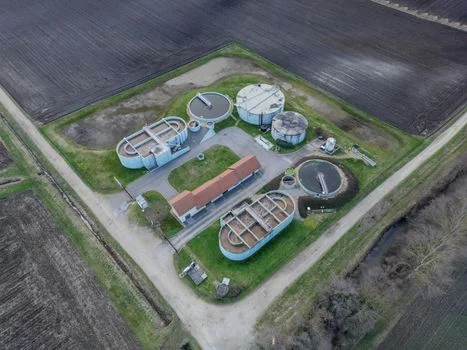
Capital expenditure for Stuttgart industrial wastewater systems tracks footprint as much as process intensity. Industrial land in zones such as Bad Cannstatt or Zuffenhausen often ranges from €500 to €1,000 per square meter. A skid-mounted DAF rated near 10 m³/h typically needs €80,000 to €150,000 CAPEX. Full-scale MBR plants for about 100 m³/day can exceed €1.2M because of high-flux membranes and automation.
MBR’s compact layout can cut land area by up to 60% versus conventional activated sludge, which matters on expensive Neckar-valley plots. Operating expenditure is driven by energy. Industrial power in the region has recently averaged about €0.15 to €0.25 per kWh. Aeration-heavy MBR trains consume roughly 0.8–1.5 kWh per cubic meter treated.
Coagulants and polymers commonly cost €2 to €5 per kg. Even so, ROI can be short. A €200,000 DAF at a Stuttgart metalworking plant can pay back in about 3 years by cutting municipal surcharges and sludge volume when dewatering is integrated.
| System Type | Typical CAPEX | Avg. OPEX (€/m³) | Estimated Payback |
|---|---|---|---|
| Skid-Mounted DAF | €80k – €300k | €0.30 – €0.60 | 2.5 – 4 Years |
| Integrated MBR | €500k – €1.2M+ | €0.80 – €1.40 | 4 – 6 Years |
| Chemical Dosing | €30k – €150k | €0.20 – €0.50 | 1.5 – 3 Years |
Zero-Discharge Compliance in Stuttgart: Hybrid Systems for High-Strength Wastewater
Hybrid trains are now common where Stuttgart plants face high-strength wastewater and rising process-water costs. Pairing DAF for primary solids removal with RO systems for zero-discharge compliance in Stuttgart can recover up to 95% of process water in chemical service. The sequence matters: precipitation and solids capture first, membrane polishing second.
One Stuttgart automotive supplier case in the source material faced influent Chromium VI near 500 mg/L from electroplating. A multi-stage train cut discharge fees by about 70%. It used pH adjustment for precipitation, DAF for sludge separation, and RO for polishing. Local environmental grants can cover up to 30% of CAPEX for reuse projects that clearly exceed WHG baseline duties.
Nutrient-heavy streams should add targeted polishing. Integrating phosphorus removal systems keeps total phosphorus under the strict <1 mg/L mandate used in the Stuttgart planning table.
Supplier Selection Checklist for Stuttgart Wastewater Partners
Stuttgart buyers should shortlist vendors that document EU Directive 91/271/EEC alignment, WHG/AbwV annex mapping, and local service response—not brochure claims alone. Demand written guarantees for COD, BOD, heavy metals, and peak-load performance before award.
| Selection Criteria | Requirement for Stuttgart Buyers | Priority |
|---|---|---|
| Regulatory Expertise | Documented compliance with WHG and EU 91/271/EEC | Critical |
| Energy Efficiency | Specific energy consumption <1.0 kWh/m³ for MBR | High |
| Service Proximity | Spare parts and technicians available within 24 hours | High |
| Automation Level | PLC integration with remote monitoring (Industry 4.0) | Medium |
| Footprint | Compact design to minimize industrial land use costs | Medium |
RFP packages should request peak-load performance data, AbwV annex references for the process code, and spare-parts lead times. Consulting wastewater engineering groups at institutions such as HFT Stuttgart can supply an independent technology screen for Neckar-valley hydraulics and geology.
Who This Is For / Next Step
This guide is for Stuttgart automotive, chemical, electroplating, and food-processing teams sizing pretreatment against sewer contracts. Pure municipal utilities with no industrial load should look at city-scale plant documents instead. Need a CAPEX band matched to your influent and AbwV annex? Request a Stuttgart wastewater treatment quote with flow, COD/BOD/TSS, metals, and discharge permit limits.
Frequently Asked Questions
What COD and BOD limits apply to industrial discharge in Stuttgart?
Under EU Directive 91/271/EEC Annex I Table 1, urban treatment-plant effluent benchmarks are ≤125 mg/L COD and ≤25 mg/L BOD₅, with ≤35 mg/L TSS. Stuttgart industrial sewer permits usually mirror these figures as acceptance targets. They then add metals and nutrient clauses from WHG/AbwV. Always confirm the written Indirekteinleiter contract; municipal surcharge formulas use permitted concentrations.
How much does a DAF system cost for a Stuttgart factory?
A typical skid-mounted Dissolved Air Flotation (DAF) system costs between €80,000 and €300,000, with many 10 m³/h packages landing near €80,000–€150,000 CAPEX. OPEX often falls around €0.30–€0.60 per m³ when chemicals and sludge handling are included. Payback of 2.5–4 years is common where FOG and TSS surcharges are high.
Can MBR systems help Stuttgart plants reach zero-discharge goals?
Yes. MBR systems produce high-quality effluent with COD ≤50 mg/L and strong bacteria removal, which makes them a solid feed for RO polishing. Alone, MBR is a reuse enabler rather than full zero liquid discharge. Most plants we size for chemical or pharmaceutical service add RO after MBR or DAF-plus-biology when recovery targets approach 95% of process water.
Which heavy-metal limits matter for Stuttgart electroplating wastewater?
Earlier internal planning notes often used Chromium VI ≤0.5 mg/L and Nickel ≤2 mg/L. German AbwV Annex 40 for metal working sets Chromium VI at 0.1 mg/L and Nickel at 0.5 mg/L before mixing. Those limits cover galvanizing and related origin areas, with total chromium at 0.5 mg/L. Precipitation, DAF solids capture, and verified methods belong in the performance guarantee.
When should a Stuttgart plant choose hybrid DAF-RO instead of MBR only?
Choose hybrid DAF-RO when FOG exceeds about 100 mg/L or TSS exceeds about 500 mg/L, or when metals need precipitation before membranes. MBR-only suits soluble biodegradable COD with modest solids. Where land costs €500–€1,000/m² and reuse grants cover up to 30% of CAPEX, hybrid recovery often beats surcharge-only strategies over 3–5 years.