LED wastewater treatment system cost and specs for 2026: UVC LEDs at 260–280 nm deliver about 50 mJ/cm² for roughly 99.9% bacterial reduction, OPEX near $0.12–$0.25/m³ at 100 m³/h, and CAPEX of $150,000–$500,000. A 2025 semiconductor case cut energy about 40% versus mercury lamps.
LED Wastewater Treatment System Cost and Specs: 2026 Budget Bands
LED wastewater treatment systems at 100 m³/h carry CAPEX of $150,000–$500,000 and OPEX of $0.12–$0.25/m³, falling to $0.08–$0.18/m³ at 500 m³/h and above. UVC LEDs deliver about 50 mJ/cm² at 260–280 nm for roughly 99.9% reduction of E. coli. A 2025 semiconductor case saved about 40% of energy versus mercury lamps.
Every LED wastewater treatment system cost and specs model we build starts with three inputs: measured flow, UV transmittance (UVT), and the fluence the permit or reuse spec demands. The bands below assume TSS below 10 mg/L ahead of the reactor, delivered by DAF or MBR. Engineers size UV-LED modules for intermittent flows, semiconductor and PCB reuse, and municipal polishing where chemical residuals are restricted; the modules switch instantly, run cool, and carry no mercury inventory.
How UV-LED Pathogen Inactivation Works
UVC LEDs emit in the 260–280 nm band that microbial DNA and RNA absorb strongly. Wikipedia's ultraviolet article states "DNA absorption has a peak at 260 nm", and its UVGI entry calls 265 nm "the most effective UV light" against most bacteria. Absorption at these wavelengths forms thymine dimers in DNA and uracil dimers in RNA, blocking replication. Reactor UV-C LED lamps are commercially offered, in the same source's words, "at selectable wavelengths between 255 and 280 nm".
Dose logic follows from that mechanism. EPA UVDGM guidance is commonly applied at about 50 mJ/cm² for 99.9% reduction of common bacteria such as E. coli; more resistant targets in the original plant specs were sized up to about 120 mJ/cm². For calibration, reference dosimetry puts 90% kill of most bacteria and viruses between 2,000 and 8,000 μJ/cm² (2–8 mJ/cm²), so a 50 mJ/cm² design fluence carries a wide margin over laboratory minimums. Wikipedia's entry also notes most validated systems "are validated to deliver 40 mJ/cm2 within an envelope of flow and transmittance".
Thermal behavior separates LED from mercury in daily operation. Instant on/off removes mercury warm-up and cool-down losses, which WEFTEC 2018 put near 15–20% energy savings in low-flow or intermittent duty. Surface temperatures stay below about 50°C, versus roughly 600°C on mercury lamps, cutting heat-driven calcium carbonate fouling on reactor windows.
According to a 2024 Water Research X critical review (Rauch et al.), commercial UV-LED wall-plug efficiency still sits near 1–6%, while low-pressure mercury lamps remain near 30–35%. Optical power has risen sharply, and full-scale wastewater niches are opening; Wikipedia likewise notes LED electrical-to-UV-C efficiency still trails mercury lamps. Most plants we size for intermittent duty therefore chase delivered dose and duty-cycle savings, not raw wall-plug efficiency alone.
| Parameter | UV-LED | Mercury Vapor Lamp |
|---|---|---|
| Emission Wavelength | 260–280 nm (narrow band) | Broad spectrum (254 nm primary, plus others) |
| Required Fluence for 99.9% E. coli Reduction | ~50 mJ/cm² | ~40 mJ/cm² |
| Instant On/Off | Yes | No (requires warm-up/cool-down) |
| Surface Temperature | < 50°C | ~600°C |
| Energy Efficiency (approx.) | High | Lower |
| Fouling Tendency (Heat-Induced) | Low | High |
UV-LED Pre-Treatment TSS Limits for Semiconductor Reuse and DAF/MBR Integration
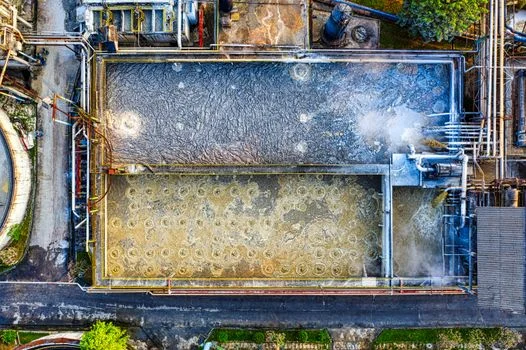
UV-LED reactors need clear water. Hold total suspended solids (TSS) below 10 mg/L before the LED chamber when the train targets reuse or zero-liquid-discharge (ZLD). Higher solids shade microbes, raise the fluence you must buy, and foul LED windows. Dissolved air flotation (DAF) routinely removes 92–97% of TSS on FOG-rich industrial streams (EPA 2024 benchmarks cited in the source plant notes), and semiconductor and PCB plants often prefer membrane bioreactors (MBR) that push TSS below 1 mg/L, as shown in a 2025 case focused on PCB wastewater treatment with LED integration.
Skip adequate pre-treatment and you inherit organic films, mineral scale, and biofilm that cut transmittance. Counter with filter backwash, tuned DAF chemistry, and disciplined MBR cleaning. For high-FOG feeds, integrate a DAF pre-treatment system for LED wastewater treatment; for ultra-low TSS reuse, use an MBR pre-treatment for semiconductor wastewater reuse. Wikipedia's MBR overview describes the effluent as "clear and pathogen free" and "particularly suitable for water reuse applications" — exactly the feed a LED polisher wants.
DAF hydraulics also reward compact designs. Wikipedia's dissolved air flotation entry notes circular units need "just 3 minutes" while rectangular units require "20 to 30 minutes", with lamella plate packing adding separation surface where floor space is tight. EU discharge framing for urban works is summarized separately in the EU Urban Wastewater Treatment Directive 2026 compliance update.
LED vs Ozone Wastewater Disinfection CAPEX Comparison: Where Chlorine Dioxide Fits
UV-LED disinfection typically draws about 5–10 kWh per kilogram of pathogen inactivated under the plant models used here. Ozone generation sits near 10–15 kWh per kilogram of O₃ produced. Chlorine dioxide precursor routes land near 3–5 kWh per kilogram of ClO₂ when chemical production energy is counted. For a 100 m³/h plant, UV-LED CAPEX commonly falls between $150,000 and $500,000; ozone generators $300,000–$800,000; ClO₂ generators $100,000–$300,000.
OPEX favors UV-LED at about $0.12–$0.25/m³ versus $0.30–$0.60/m³ for ozone and $0.50–$2.00/m³ for ClO₂ including dechlorination. UV-LED forms no classic disinfection byproducts. Ozone can form bromate when bromide is present, and ClO₂ can leave chlorite and chlorate that need monitoring. LED modules last about 5–10 years without lamp swaps; ozone needs dielectric tube service; ClO₂ needs precursor handling.
For chemical-free duty, UV-LED is the cleaner long-term path; where a residual oxidant is required, a chlorine dioxide generator remains an option. Broader oxidant trade-offs are covered in our ozone vs LED disinfection comparison.
| Parameter | UV-LED System | Ozone Generator | Chlorine Dioxide Generator |
|---|---|---|---|
| Energy Consumption (approx.) | 5–10 kWh/kg pathogen | 10–15 kWh/kg O₃ | 3–5 kWh/kg ClO₂ |
| CAPEX (100 m³/h plant, est.) | $150,000 – $500,000 | $300,000 – $800,000 | $100,000 – $300,000 |
| OPEX (approx.) | $0.12 – $0.25/m³ | $0.30 – $0.60/m³ | $0.50 – $2.00/m³ (incl. dechlorination) |
| Disinfection Byproducts (DBPs) | None | Potential bromate formation | Potential chlorite/chlorate residuals |
| Maintenance | Low (LED lifespan 5-10 years) | Moderate (dielectric tube replacement) | Chemical handling, generator maintenance |
| Chemical Use | None | None (on-site generation) | Chemical precursors required |
2026 CAPEX and OPEX for 100–1,000 m³/h LED Plants
LED wastewater treatment CAPEX scales with hydraulic capacity. At 100 m³/h, budget about $150,000–$500,000 for reactor, controls, and basic pre-treatment. At 500 m³/h the band is roughly $500,000–$1.5 million; at 1,000 m³/h about $1.5–$3 million. OPEX at 100 m³/h sits near $0.12–$0.25/m³ and often falls to $0.08–$0.18/m³ at 500 m³/h and above when utilization is steady.
Skid-mounted installs usually add 10–15% of CAPEX; custom tie-ins can add 20–30%. Annual maintenance commonly holds $5,000–$15,000 for LED module reserve (5–10 year life) plus $2,000–$5,000 for sensor calibration. Location-specific plant packages, such as Christchurch industrial wastewater treatment cost and compliance checks, still start from the same CAPEX bands below.
| Flow Rate | Estimated CAPEX | Estimated OPEX (per m³) | Estimated Annual Maintenance |
|---|---|---|---|
| 100 m³/h | $150,000 – $500,000 | $0.12 – $0.25 | $7,000 – $20,000 |
| 500 m³/h | $500,000 – $1,500,000 | $0.08 – $0.18 | $10,000 – $30,000 |
| 1,000 m³/h | $1,500,000 – $3,000,000 | $0.08 – $0.18 | $15,000 – $40,000 |
Note: CAPEX includes reactor, control, and basic pre-treatment. Annual maintenance includes LED replacement fund and sensor calibration.
How Do UPW Design Decisions Cut Long-Term Costs?
UPW design decisions cut long-term costs when UV-LED polishers are sized for real UV transmittance, duty cycle, and redundancy instead of nameplate flow alone. Document the target fluence (often ≥50 mJ/cm² for semiconductor rinse loops), the pre-treatment TSS/TOC limits, and the on/off profile that justifies LED over mercury. Most plants we size for UPW loops run at the lower end of the OPEX band once TSS stays below 1–10 mg/L and the reactor idles cleanly between batches.
Record lamp-free mercury compliance, spare-module lead times, and sensor calibration intervals in the design basis. Those notes protect the $0.12–$0.25/m³ operating case when audits revisit energy and chemical budgets years later.
What cost savings come from UPW design choices?
UPW design choices save money mainly through instant LED dimming on low flow, avoided mercury disposal, and lower heat fouling that stretches cleaning intervals. Pair the LED skid with documented DAF or MBR setpoints so dose credit is not lost to turbidity spikes. For regional packaging of similar trains, see the Ajman Industrial Effluent Guide: 2026 Specs and Compliance.
Industrial UV-LED Reactor Sizing Checklist 2026: Flow, Dose, Redundancy
LED system selection starts with flow, effluent standard, and redundancy. Under 50 m³/h, a compact single-reactor UV-LED unit is usually enough. Between 50 and 500 m³/h, modular arrays give spare capacity without a full custom build. Above 500 m³/h, multi-reactor custom trains with validated dose monitoring are typical. Semiconductor plants often set a minimum 50 mJ/cm² fluence for rinse-water polish; municipal polishing may accept lower validated doses when upstream barriers share the log-credit.
Selection checklist:
- Measured UVT% and TSS at the LED inlet (target TSS <10 mg/L; <1 mg/L for UPW)
- Required fluence and challenge organism for the permit or reuse spec
- Duty cycle: continuous, batch, or wide turndown
- N+1 reactor or module redundancy for critical loops
- Pre-treatment choice: DAF for FOG, MBR for ultra-low solids
- CAPEX band vs 5–10 year module replacement fund
- DBP and chemical-handling constraints versus ozone or ClO₂
If you need a broader process train beyond UV polish, review sibling guidance on industrial wastewater treatment for Auckland plant packaging, then return here for the LED dose and cost model.
Who This Is For and Next Step
This guide suits semiconductor, PCB, food, and municipal teams comparing mercury-free UV polishers on CAPEX, OPEX, and pre-treatment fit. Look elsewhere if you need primary solids removal or biological COD reduction — the LED stage is a disinfectant, not a clarifier. When you have flow, UVT, and reuse targets, request a UV-LED sizing and quote with those numbers attached.
Frequently Asked Questions
What fluence do LED wastewater treatment systems need for E. coli?
About 50 mJ/cm² is the working benchmark for roughly 99.9% reduction of common bacteria such as E. coli under EPA UVDGM-style dose logic used in these plant models. More resistant organisms may need higher validated doses. Always confirm with collimated-beam data on your water matrix before freezing reactor power.
How much energy can UV-LED save versus mercury lamps?
A 2025 Chinese semiconductor plant case reported about 40% energy savings versus mercury lamps under that site's duty cycle. Intermittent or low-flow service can add another 15–20% from instant on/off (WEFTEC 2018). Absolute kWh/m³ still depends on UVT, fluence target, and hours online.
What TSS limit should precede a UV-LED reactor?
Keep TSS below 10 mg/L before the LED chamber for reuse and ZLD trains; semiconductor polish often targets below 1 mg/L via MBR. Excess solids shade microbes and foul windows. DAF removing 92–97% TSS is a common FOG pre-treatment path before UV.
How does UV-LED OPEX compare with ozone and ClO₂?
Modeled OPEX for UV-LED is about $0.12–$0.25/m³ at 100 m³/h, versus roughly $0.30–$0.60/m³ for ozone and $0.50–$2.00/m³ for ClO₂ including dechlorination. UV-LED also avoids bromate and chlorite/chlorate residuals. CAPEX for UV-LED at 100 m³/h typically lands between $150,000 and $500,000.
What is UV-LED disinfection OPEX per cubic meter?
UV-LED disinfection OPEX per cubic meter runs about $0.12–$0.25 at 100 m³/h under the plant models here, dropping toward $0.08–$0.18 at 500 m³/h and above with steady utilization. The number holds only while inlet TSS stays below 10 mg/L and UVT is stable. Turbidity spikes are what push real spend past the band.
When is UV-LED a poor fit?
UV-LED is a poor fit when inlet TSS stays high, UVT is chronically low, or the plant really needs a residual oxidant in the distribution network. Fix clarification first, or choose ozone/ClO₂ when a lasting residual is mandatory. LED performs best on clear, intermittent, mercury-restricted polish duties.