What Telangana Municipal STPs Must Deliver
Telangana municipal STPs treat influent BOD of 200–400 mg/L to effluent BOD ≤10 mg/L under TSPCB limits. Optimized trains use about 0.3–0.6 kWh/m³. CAPEX for 10–100 MLD plants typically spans ₹800M–₹4.2B. High TDS and industrial inputs decide among MBBR, SBR, and MBR.
Earlier local summaries framed Hyderabad as already treating 100% of daily sewage in 2024 with roughly 160+ MLD across a dozen plants. December 2024 reporting put city generation near 1,950 MLD, with 772 MLD treated in 25 existing plants (Deccan Chronicle, 2024). The same package funds 31 STPs adding 1,259.50 MLD at ₹3,866 crore toward full treatment capacity by March 2025. By July 2025, HMWSSB said most of those 31 plants were commissioned and was still pushing toward citywide coverage, with 39 further ORR STPs (972 MLD) proposed (Telangana Today, 2025).
The HMWSSB program remains the technical template for Tier-II cities such as Warangal, Nizamabad, and Khammam. Decentralized siting at catchments like Mullakathuva and Amberpet cuts long pumping runs. Storm-drain mixing and small industrial discharges often lift influent TDS to 1200–2500 mg/L, so biology must tolerate osmotic swings.
Land scarcity forces a footprint-first mix. MBBR suits retrofit tanks; SBR suits new sites that need nitrogen and phosphorus control; MBR fits zones below about 0.2 m² per m³ of treated water. Telangana municipal STPs that skip this mix check usually overrun civil budgets within the first tender revision.
| Project Parameter | Hyderabad Milestone Data (2024) | Telangana Municipal Target (2026) |
|---|---|---|
| Total Treatment Capacity | ~160 MLD (Phase-wise) | 10 MLD – 100+ MLD (per city) |
| Dominant Technology | MBBR (60%), SBR (30%), MBR (10%) | MBBR / MBR Hybrid |
| Influent BOD (Avg) | 250–450 mg/L | 200–400 mg/L |
| Effluent BOD Limit | ≤10 mg/L | ≤10 mg/L (TSPCB Standard) |
| Energy Consumption | 0.5–0.7 kWh/m³ | 0.3–0.6 kWh/m³ (Optimized) |
| Average Footprint | 0.2–0.4 m²/m³ | <0.3 m²/m³ (Urban sites) |
Why Generic STP Designs Fail in Telangana
Telangana municipal wastewater carries higher TDS and industrial load than generic CPCB design envelopes assume. Pharmaceutical and chemical clusters in Hyderabad, Jeedimetla, and Bollaram leak into municipal sewers. Summer TDS spikes of 1800–3000 mg/L slow activated-sludge metabolism and weaken floc. COD often reaches 500–800 mg/L, about 15–25% above the national municipal average.
Industrial contributions make up roughly 30–40% of sewage volume in many Hyderabad catchments. Plants need PLC-controlled chemical dosing for Telangana’s industrial sewage pre-treatment to correct pH and precipitate chromium and nickel before biology. Without that step, MBBR or SBR biomass sees periodic toxicity and misses TSPCB discharge limits. Comparing notes with how European cities handle industrial inputs in municipal sewage helps size equalization and buffer tanks.
Solvents such as tetramethylammonium hydroxide (TMAH) from electronics and pharma need longer contact time. A six-hour HRT often leaves residuals. Telangana designs lean toward 8–12 hour HRT on MBBR, or MBR systems for high-TDS municipal sewage in Telangana at MLSS 8,000–12,000 mg/L for shock buffering.
| Parameter | National CPCB Average (2024) | Telangana Municipal Profile (2026) | Impact on STP Design |
|---|---|---|---|
| TDS (mg/L) | 500–1200 | 1200–3000 | Requires salt-tolerant microbes |
| COD (mg/L) | 400–600 | 500–800 | Increased aeration demand |
| Heavy Metals | Trace | Detectable (Cr, Ni, Zn) | Mandatory pre-treatment |
| Industrial Input | <10% | 30–40% (Urban clusters) | Requires high-MLSS processes |
| Temperature | 20–30°C | 25–45°C (Extreme summers) | Impacts oxygen solubility |
MBBR vs SBR vs MBR Engineering Specs
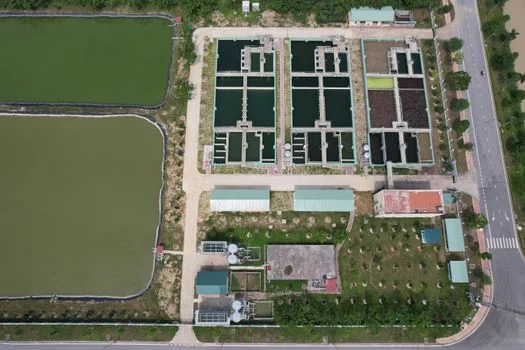
Technology choice for Telangana plants turns on land price, energy budget, and nutrient limits. Above 50 MLD with moderate land, MBBR usually wins on operating simplicity. Inside Hyderabad, where land can exceed ₹25,000/m², MBR is often the only footprint that closes the plot.
MBBR uses high-surface plastic media (typically K3 or K5) in aeration tanks. A 50–60% fill fraction supports 92–95% BOD removal. Skipping RAS pumping keeps energy near 0.3–0.5 kWh/m³, but the train still needs a clarifier or DAF for sloughed biofilm.
SBR cycles fill, react, settle, and decant, and routinely reaches TN <10 mg/L. On the Warangal 50 MLD plant, footprint ran about 0.5–0.8 m²/m³. High-TDS sewage slows settling, so settle phases stretch and tanks grow. Most plants we size for Deccan summers run settle times at the upper end of the vendor range.
MBR couples biology with 0.04 μm PVDF membranes at MLSS 8,000–12,000 mg/L and footprint near 0.2–0.3 m²/m³. Scouring lifts energy to 0.5–0.7 kWh/m³, yet effluent often sits at BOD <2 mg/L and TSS <1 mg/L for direct non-potable reuse. For decentralized trains under 500 KLD, integrated sewage treatment systems cut civil cost versus site-built tanks.
| Engineering Parameter | MBBR (Moving Bed) | SBR (Sequential Batch) | MBR (Membrane Bio) |
|---|---|---|---|
| MLSS Concentration | 3,000–4,500 mg/L | 3,500–5,000 mg/L | 8,000–12,000 mg/L |
| HRT (Hydraulic Retention) | 8–12 Hours | 12–18 Hours (Cycle) | 4–6 Hours |
| SRT (Sludge Retention) | 15–20 Days | 20–25 Days | 25–40 Days |
| Removal Efficiency (BOD) | 92–95% | 90–93% | 95–99% |
| Sludge Yield (kg/kg BOD) | 0.3–0.4 | 0.3–0.4 | 0.1–0.2 |
| Footprint Requirement | Medium | High | Very Low |
What Does a Municipal STP Cost?
Municipal wastewater treatment plant cost in Telangana must cover rocky Deccan civil works and rising power tariffs. CAPEX for a 10–100 MLD plant usually splits as civil 40–50%, mechanical 25–30%, electrical 15–20%, and commissioning 5–10%. MBR buyers should reserve membrane replacement every 5–7 years, often about 15% of lifecycle cost.
Unit CAPEX runs about ₹8M–₹12M per MLD for MBBR, ₹9M–₹14M for SBR, and ₹12M–₹18M for MBR. When Hyderabad industrial-zone land hits ₹30,000/m², the smaller MBR plot can undercut SBR on total project cost despite higher equipment spend.
OPEX is dominated by energy (40–50%) and chemicals (20–30%). A 50 MLD SBR in Warangal at about ₹3.2/m³ versus a 50 MLD MBR in Nizamabad at about ₹4.1/m³ shows the premium for reuse-grade water. Selling that water to industry can offset part of the gap. A high-pressure filter press for municipal sludge that reaches 30–35% cake solids also cuts haulage.
| Cost Element | MBBR (₹/MLD) | SBR (₹/MLD) | MBR (₹/MLD) |
|---|---|---|---|
| Initial CAPEX (10-100 MLD) | ₹8M – ₹12M | ₹9M – ₹14M | ₹12M – ₹18M |
| Civil Works % | 50% | 55% | 35% |
| Mechanical & Membrane % | 25% | 20% | 45% |
| OPEX (Energy/Chemicals) | ₹2.8 – ₹3.5/m³ | ₹3.0 – ₹3.8/m³ | ₹4.0 – ₹5.5/m³ |
| Land Required (Acres/MLD) | 0.4 – 0.6 | 0.6 – 1.0 | 0.2 – 0.3 |
Ozone or chlorine: which costs less?
Chlorine dioxide or hypochlorite usually costs less per cubic metre than ozone when the only target is fecal coliform ≤100 MPN/100 mL under TSPCB municipal limits. Ozone raises both generator CAPEX and continuous kWh draw, so it rarely wins on ₹/m³ for large city flows. Keep ozone for reuse buyers that also need organics polish; otherwise specify chlorine dioxide or UV as the default disinfection train for Telangana municipal plants.
Telangana PCB Compliance and Permitting

TSPCB discharge limits for STPs feeding the Musi catchment or sensitive lakes sit tighter than many national CPCB baselines. Under G.O. Ms. No. 22 (2023), municipal STPs must hold BOD ≤10 mg/L and TSS ≤20 mg/L. Fecal coliform is capped at ≤100 MPN/100 mL, which drives advanced disinfection such as chlorine dioxide disinfection for Telangana PCB coliform compliance.
Permitting typically takes 6–9 months. Teams start with 30-day composite influent sampling. Plants above 10 MLD need an EIA; above 50 MLD a public hearing. Failures often trace to weak industrial pre-treatment and biomass washout. Cross-check local practice against India-specific compliance strategies for high-risk wastewater before freezing P&IDs.
STPs above 5 MLD must run OCEMS for pH, DO, turbidity, and COD/BOD with live feeds to TSPCB. Fines of ₹50,000–₹500,000 per violation apply, and repeated breaches can revoke the Consent to Operate.
How do CETP discharge standards apply?
CETP discharge standards apply in parallel with municipal STP limits whenever industrial parks share a city sewer. Pharma and chemical CETPs must meet their own SPCB consent before any overflow enters a trunk main. Untreated CETP spikes still leave the downstream municipal plant exposed to TSPCB BOD ≤10 mg/L and metal toxicity. Equalization tanks, diversion valves, and enforceable trade-effluent agreements are the controls that keep both permits intact.
| Effluent Parameter | CPCB National Norms | Telangana PCB (G.O. 22) | Compliance Strategy |
|---|---|---|---|
| BOD (mg/L) | ≤30 | ≤10 | MBR or MBBR + Tertiary Filter |
| TSS (mg/L) | ≤50 | ≤20 | Ultrafiltration or PSF/ACF |
| COD (mg/L) | ≤250 | ≤50 | Extended Aeration (SRT >20d) |
| Total Nitrogen (mg/L) | ≤10 | ≤10 | Anoxic/Oxic (A/O) Zones |
| Fecal Coliform (MPN) | ≤1000 | ≤100 | Chlorine Dioxide / UV |
Selection Checklist and Next Step
This guide is for municipal engineers, EPC contractors, and city procurement teams sizing 10–100 MLD plants in Telangana. Look elsewhere if you only need a package STP under about 100 KLD with no industrial sewer contribution.
Before freezing technology, confirm influent TDS, COD, and metals from a 30-day composite. Then weigh land cost against footprint, reuse buyer specs, and TSPCB BOD, TSS, and coliform limits. Add OCEMS scope above 5 MLD, sludge cake handling, and a membrane replacement reserve for MBR. For a plant-specific CAPEX/OPEX build-up, send your flow and effluent targets through our request-quote form for Telangana municipal STP sizing.
Frequently Asked Questions
What is the optimal STP technology for a 20 MLD plant in Telangana?
MBBR is usually the best CAPEX–performance balance for a 20 MLD municipal plant when land is available. On land-constrained Hyderabad plots, MBR is the better fit despite roughly 20% higher OPEX. Choose SBR when influent nitrogen and phosphorus are high and footprint is secondary to nutrient removal reliability.
How much land is required for a 50 MLD STP in Hyderabad?
A 50 MLD MBR plant needs about 10,000–15,000 m² including sludge handling and buffer zones. An MBBR layout typically needs 15,000–25,000 m², while an SBR layout can approach 40,000 m². Rocky Deccan excavation and access roads often push the upper end of each range on real plots.
What are the penalties for non-compliance with Telangana PCB standards?
TSPCB environmental compensation fines commonly range from ₹50,000 to ₹500,000 per incident. Continued non-compliance can trigger power disconnection, legal action against municipal officers, and suspension of the Consent to Operate. OCEMS gaps on plants above 5 MLD are a frequent enforcement trigger in recent inspections.
Can treated sewage be reused for irrigation in Telangana?
Yes, treated sewage may be reused for irrigation, industrial cooling, and lake recharge when it meets CPCB 2022 reuse targets such as BOD <10 mg/L and fecal coliform <100 MPN/100 mL. Hyderabad has reused about 20 MLD for parks and green belts. Always confirm the buyer’s tighter limit before signing offtake contracts.
What are the key differences between Telangana PCB and CPCB discharge standards?
The main gap is stringency on BOD, TSS, and coliform. CPCB baselines often allow BOD up to 30 mg/L in many zones, while Telangana PCB mandates ≤10 mg/L for new municipal STPs. Telangana’s fecal coliform cap of ≤100 MPN/100 mL is ten times tighter than the ≤1000 MPN/100 mL national figure used in many CPCB contexts.