MVR evaporation concentrates high-strength organic wastewater by recompressing secondary vapor and reusing its latent heat. Typical design envelopes cover feed COD 5,000–50,000 mg/L, evaporation rates 1–20 m³/h, and compressor power 0.02–0.05 kWh/kg evaporated water. Relative to single-effect steam evaporation, steam demand often falls 80–90%. Distillate COD targets of ≤500 mg/L and TDS ≤500 mg/L are common engineering goals when VOC carryover is controlled.
Dairy, pharmaceutical, and chemical plants hit a biological wall when influent COD outruns aerobic or anaerobic digesters. A dairy line at 500 m³/day and COD 30,000 mg/L can spend about $2.50/m³ on off-site hauling—over $450,000/year—while facing discharge-limit risk. High COD alone is not the full story: VOCs, ammonia, and salts foul membranes and starve biology. Concentrating organics into brine or solids, then reclaiming distillate, is the practical ZLD path for these streams.
Why high-strength organic wastewater needs thermal concentration
High-strength organic wastewater with COD above about 5,000 mg/L usually needs thermal concentration when biology or RO cannot hold the load. Systems sized for 5,000–50,000 mg/L COD, 1–20 m³/h evaporation, and 0.02–0.05 kWh/kg compressor energy commonly deliver 88–95.5% COD reduction and 80–90% steam savings versus single-effect evaporation when pretreatment controls fouling and VOC carryover.
Most plants we size for organic MVR duties run near the lower end of that energy band when boiling-point elevation stays modest. Salt spikes and viscous syrups push ΔT and compressor power up. The decision is not “evaporate or not”—it is whether DAF, oxidation, and materials of construction can keep heat-transfer surfaces clean long enough for the compressor to earn its CapEx.
How MVR evaporation recovers latent heat
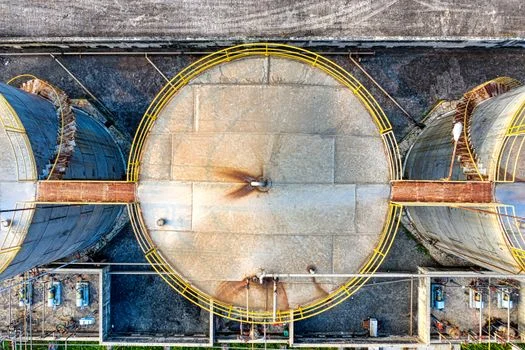
Mechanical vapor recompression runs as an open-cycle heat pump. Secondary vapor from the boiling liquid is compressed, raising its saturation temperature, then returned as the heating medium. Latent heat is reused instead of vented. Compared with single-effect evaporation, steam use typically drops 80–90%. According to Danish Energy Agency technology data, MVR can evaporate water at 5–30 kWh/m³ depending on ΔT, brine temperature, and compressor efficiency, with large plants often near 7–13 kWh/m³; a reference case of 20 kWh/m³ equals about 0.02 kWh/kg evaporated water. Earlier project specs commonly used 0.02–0.05 kWh/kg; both bands remain useful when ΔT and viscosity are stated.
Organic feeds need extra steps. Start with DAF pre-treatment systems for high-TSS organic wastewater to strip fats and solids that coat exchangers. Upstream solids polishing with a High-Efficiency Sedimentation Tank (Lamella Clarifier) further cuts TSS before the evaporator. Then automated chemical dosing for MVR pre-treatment and pH optimization meters H2O2 and pH control so oxidized organics stay in the concentrate instead of flashing into distillate.
| Process Stage | Technical Mechanism | Organic Wastewater Benefit |
|---|---|---|
| Pre-treatment | DAF + H2O2 Oxidation | Reduces COD by 88%+; prevents heat exchanger fouling. |
| Vapor Compression | Centrifugal or Roots Compressor | Raises vapor temp by 5–9°C using 0.02–0.05 kWh/kg energy. |
| Heat Exchange | Falling Film or Forced Circulation | Maximizes heat transfer coefficient (U) for viscous organic feeds. |
| Separation | Flash Evaporation + Hot Filtration | Separates concentrated organics and salts from clean condensate. |
Engineering specs: COD, NH3-N, TDS, and energy
MVR duty for organic streams must account for boiling-point elevation (BPE) as dissolved solids rise and raise the boiling point. HydropureWater 2026 sizing keeps heat-transfer temperature difference ≤9°C to protect compressor life and specific energy. Superheat eliminators keep vapor from overheating the machine. At high ammonia, hold feed near pH 8.5 during pretreatment so NH3 stays in brine rather than stripping into vapor. Organic-acid feeds usually need titanium or 2205 duplex exchangers to resist pitting.
| Parameter | Influent Range (Feed) | Effluent Target (Distillate) | Removal/Efficiency Rate |
|---|---|---|---|
| COD (Chemical Oxygen Demand) | 5,000 – 50,000 mg/L | ≤500 mg/L | 88% – 95.5% |
| NH3-N (Ammonia Nitrogen) | 500 – 5,000 mg/L | ≤50 mg/L | 90.1% (at pH 8.5) |
| TDS (Total Dissolved Solids) | 10,000 – 100,000 mg/L | ≤500 mg/L | >99% |
| Specific Energy Consumption | N/A | 0.02 – 0.05 kWh/kg | 80-90% steam saving |
| Evaporation Capacity | 1 – 20 m³/h | N/A | Scalable modular design |
In one EPA-reviewed MVR dataset on pretreated shale-gas wastewater (Hayes et al., 2012, summarized in EPA’s 2018 CWT study), median influent TDS of 46,900 mg/L fell to 103 mg/L—about 99.8% TDS removal under those site conditions. That result supports >99% TDS separation when scaling ions are controlled upstream; organic COD behavior still depends on VOC volatility and mist elimination.
MVR vs. multi-effect evaporation vs. reverse osmosis
Technology choice tracks organic strength and final water quality. RO is efficient on low-TDS feeds but fouls quickly on high-strength organics. multi-effect evaporation (MEE) as an alternative to MVR fits steam-rich sites, yet continuous live steam raises long-term OpEx. Danish Energy Agency comparisons show MVR using roughly 12–13 times less energy than a multi-effect TVR case when MVR is taken at about 20 kWh/m³ versus ~0.25 kWh/kg thermal equivalent for that TVR benchmark.
| Feature | MVR Evaporation | Multi-Effect (MEE) | Reverse Osmosis (RO) |
|---|---|---|---|
| Energy Source | Electricity (Compressor) | Steam (External) | Electricity (Pump) |
| OpEx ($/m³) | $0.30 – $0.80 | $1.00 – $2.50 | $0.50 – $1.50 |
| COD Removal | Excellent (88-95%) | Good (70-85%) | Poor (Fouling Risk) |
| ZLD Compatibility | Native | High | Requires Post-Treatment |
| Feed Flexibility | High (Viscous/Organic) | High (Saline) | Low (Clean water only) |
For ZLD trains with COD >5,000 mg/L, MVR concentrates toward crystallization without the large RO reject volume. Payback versus MEE hinges on electricity versus steam prices. Integrated plants often pair organic units with MVR systems for high-salinity wastewater treatment so each skid sees a matched feed chemistry.
Cost drivers and payback for a 10 m³/h organic MVR
CapEx for a 10 m³/h organic MVR typically spans $1.2M–$5M (2026 model), driven by titanium versus SS316L and pretreatment depth. OpEx in the original cost model is $0.30–$0.80/m³ versus about $2.50/m³ hauling. Energy line items of $0.05–$0.15/m³ at $0.10/kWh reflect that model; compressor SEC of 0.02–0.05 kWh/kg implies higher electricity cost when billed per cubic meter evaporated, so always reconcile SEC, recovery, and tariff in the site heat-mass balance.
| Cost Component | Estimated Cost (2026 Model) | Notes |
|---|---|---|
| CapEx (10 m³/h System) | $1.2M – $5.0M | Includes DAF, MVR, and Automation |
| Energy Cost (OpEx) | $0.05 – $0.15 / m³ | Based on $0.10/kWh electricity |
| Chemical/Maintenance | $0.25 – $0.65 / m³ | H2O2, pH adjusters, and CIP |
| Total OpEx | $0.30 – $0.80 / m³ | Vs. $2.50/m³ for hauling/disposal |
Payback case from the source article: a dairy plant at 500 m³/day moves from $1,250/day hauling to about $250/day MVR OpEx, saving $1,000/day. At $1.8M CapEx, simple payback is about 4.9 years; distillate reuse and avoided fines often pull that toward 3 years. Sites under tight water scarcity—see regional compliance requirements for industrial wastewater treatment—should price freshwater avoided as a separate line.
Compliance and ZLD for organic concentrate trains
US indirect dischargers must satisfy 40 CFR Part 403 general pretreatment rules plus local POTW limits; Part 403 itself does not publish a universal COD ≤500 mg/L number. Design distillate COD ≤500 mg/L remains a common engineering target when carryover is controlled. EU plants still reference Directive 91/271/EEC organic-load removal expectations. Under China’s GB 8978-1996, Class I COD ≤100 mg/L usually needs a polishing step after MVR distillate.
Selection checklist for organic MVR projects:
- Confirm TSS <200 mg/L after DAF (and clarifier polishing) before heat exchangers.
- Validate H2O2 oxidation at pH 8.5 with adequate retention when NH3-N is high.
- Hold compressor ΔT ≤9°C and verify superheat eliminator function.
- Specify duplex or titanium where organic acids drive pitting risk.
- Plan brine solids with sludge dewatering for MVR brine and salt byproducts.
- Install online COD/conductivity on distillate for carryover alarms.
- Match electricity tariff and startup steam availability before locking CapEx.
What are the main limitations of MVR?
MVR limitations center on boiling-point elevation, organic fouling, VOC carryover, and compressor sensitivity to liquid droplets. Viscosity above the falling-film window forces a switch to forced circulation and higher power. Feeds above about 50,000 mg/L COD often need hybrid MVR–MEE or crystallizer staging. Electricity must be reliable; steam-rich sites may still prefer MEE on OpEx. MBR biology is a different tool: it fits biodegradable COD within aeration and membrane flux limits, not salt-laden syrups that demand phase-change concentration.
Field failures we see most often are not “wrong compressor curves.” They are missing DAF capacity, antifoam control, or CIP frequency when sticky organics drop the U-value week by week.
What limits reclaim recovery and scaling in ZLD?
Reclaim recovery in ZLD is limited by scale-forming cations, silica, and organic films on heat-transfer surfaces, not by compressor nameplate alone. EPA’s CWT review notes that calcium, barium, and magnesium salts drive exchanger scaling and raise energy use unless pretreated by precipitation and filtration. Semiconductor-style ultrapure reclaim loops add even tighter particle and TOC limits; industrial organic MVR reclaim usually targets process-water reuse grades first. Keep hardness and TSS out with DAF plus a High-Efficiency Sedimentation Tank (Lamella Clarifier) before raising concentration factors.
Raise recovery only after BPE, antiscalant, and CIP intervals are proven on the real feed. Pushing concentration without that proof shortens run length faster than it saves disposal volume.
Troubleshooting organic MVR operation
Organic MVR upsets differ from clean salt service. Fouling shows up as a slow drop in heat-transfer coefficient before capacity collapses.
| Issue | Root Cause | Actionable Solution |
|---|---|---|
| Rapid Heat Exchanger Scaling | Inadequate DAF performance or high TSS | Optimize DAF flocculant dosing; schedule bi-weekly CIP (Clean-In-Place). |
| High Distillate COD | VOC carryover or foaming | Increase H2O2 dosing via automated chemical dosing; add food-grade anti-foaming agents. |
| Compressor Vibration/Noise | Liquid droplets in vapor (carryover) | Check mist eliminator integrity; reduce evaporation rate to lower vapor velocity. |
| Reduced Evaporation Rate | Boiling Point Elevation (BPE) increase | Adjust compressor speed (VFD) to increase pressure ratio; check feed concentration. |
| Pitting Corrosion | Organic acids (e.g., acetic, lactic) | Upgrade heat exchanger plates to Titanium; maintain pH >7.0. |
Watch vapor superheat continuously. Too dry and hot damages seals; wet vapor erodes blades. Plan compressor inspection about every 6 months and major overhauls on roughly 24-month intervals for high-strength organic service.
Who this is for and next step
This approach fits food, pharma, and chemical plants with COD roughly 5,000–50,000 mg/L that need distillate reuse or ZLD solids. Look elsewhere if the load is readily biodegradable at modest TDS—an MBR or high-rate anaerobic train may cost less. If your feed assays and utility prices are ready, request a quote for an organic MVR package sized to your COD and flow so compressor ΔT, materials, and pretreatment can be locked to the real mass balance.
Frequently Asked Questions
What COD range can MVR handle on organic wastewater?
MVR is typically designed for influent COD between 5,000 and 50,000 mg/L under stated viscosity and BPE limits. Beyond 50,000 mg/L, forced-circulation evaporators or MVR–MEE hybrids usually keep specific energy workable. Distillate COD targets near ≤500 mg/L still need VOC and foam control, not compressor power alone.
How does MVR keep ammonia in the concentrate?
Holding feed near pH 8.5 with H2O2 oxidation for about 24 hours before evaporation is the pretreatment path cited for ~90.1% NH3-N retention in the concentrate. The goal is to limit free NH3 stripping into vapor. Online distillate conductivity and COD still catch carryover if pH drifts.
Is MVR more expensive than reverse osmosis?
CapEx is usually higher than RO. On high-strength organics, RO membranes often foul within weeks, and reject disposal dominates OpEx. The organic MVR OpEx band of $0.30–$0.80/m³ in the 2026 cost model is meant to be compared with hauling near $2.50/m³ and with RO membrane replacement plus reject handling on the same feed.
Can MVR deliver zero liquid discharge?
Yes, when brine is finished in a crystallizer, centrifuge, or plate-and-frame filter press so solids leave the site and distillate returns to process. MVR alone produces concentrated slurry, not automatic ZLD. Solids handling and condensate polishing close the water balance.
When should I choose MBR instead of MVR?
Choose MBR when COD is biodegradable, salinity is moderate, and discharge or reuse specs fit membrane bioreactor effluent. Choose MVR when salts, viscosity, or non-biodegradable COD force concentration and distillate recovery. Many ZLD flowsheets use biology upstream and MVR only on the hard residual.