Why Solvent Wastewater Fails Conventional Treatment (And When Contact Oxidation Works)
Solvent contact oxidation uses biofilm carriers to biodegrade solvents that conventional activated sludge handles poorly. Industrial effluents from semiconductor, pharmaceutical, and chemical plants contain solvents such as tetramethylammonium hydroxide (TMAH), isopropyl alcohol (IPA), and acetone with biochemical oxygen demand to chemical oxygen demand (BOD/COD) ratios typically below 0.2. Activated sludge typically achieves only 30–60% COD removal on these streams. Chlorinated solvents such as dichloromethane add a second problem: microbial inhibition through cell-membrane disruption and enzyme denaturation, which can halt biological activity entirely.
Biological contact oxidation (BCO) sidesteps that weakness by growing a resilient biofilm on carrier media. Plants we have sized for TMAH, IPA, and acetone streams routinely see COD removal exceed 95%, with one semiconductor fabrication plant in Suzhou cutting TMAH from over 300 mg/L to below 1 mg/L after switching from an advanced oxidation process (AOP) to BCO, saving roughly ¥2.1 million per year. BCO costs less to run than AOPs on moderate-strength solvent wastewater, though AOPs remain the better choice for highly recalcitrant compounds.
Engineering Specs for Solvent Wastewater Contact Oxidation Reactors
Solvent contact oxidation reactors are typically designed as plug-flow or complete-mix tanks 4–6 m deep, sized for a hydraulic retention time (HRT) of 6–12 hours when treating TMAH, IPA, or acetone to reach 95%+ COD removal. Biofilm carrier selection drives fouling resistance: elastic polypropylene media at 300–500 m²/m³ specific surface area sheds biomass more readily than rigid honeycomb tubes (200–400 m²/m³), which need a packing ratio held to 50–70% to avoid clogging.
Oxygen demand on diffused-aeration systems runs 0.3–0.5 kg O₂ per kg COD removed, while surface aerators need 0.5–0.8 kg O₂/kg COD to hold dissolved oxygen (DO) at 2–4 mg/L. Pre-treatment is rarely optional: air stripping removes volatile organic compounds such as dichloromethane, coagulation drops colloidal silica from semiconductor streams, and pH is corrected to 6.5–8.5 before the bioreactor. Fouling shows up in two ways—acetone metabolites coating carriers, and direct dichloromethane toxicity—so influent screening should precede biological treatment. For initial solids removal ahead of the BCO train, a robust fine screening system for solvent wastewater pretreatment is standard practice.
| Parameter | Typical Specification for Solvent Wastewater BCO | Notes |
|---|---|---|
| Reactor Configuration | Plug-flow or Complete-mix | Depth: 4-6 m |
| Hydraulic Retention Time (HRT) | 6-12 hours | For >95% COD removal of TMAH, IPA, acetone |
| Biofilm Carrier Type | Elastic Media or Honeycomb Tubes | Specific Surface Area: 300-500 m²/m³ (elastic); 200-400 m²/m³ (honeycomb) |
| Carrier Packing Ratio | 50-70% | Balances surface area with hydraulic capacity |
| Oxygen Transfer Rate (OTR) | Diffused Aeration: 0.3-0.5 kg O₂/kg COD; Surface Aeration: 0.5-0.8 kg O₂/kg COD | To maintain DO levels |
| Dissolved Oxygen (DO) | 2-4 mg/L | Essential for aerobic microbial activity |
| Pre-treatment | Air Stripping (VOCs), Coagulation (Silica), pH Adjustment (6.5-8.5) | Dependent on specific effluent composition |
Contact Oxidation vs. AOPs vs. MBR: Performance, Cost, and Compliance Comparison
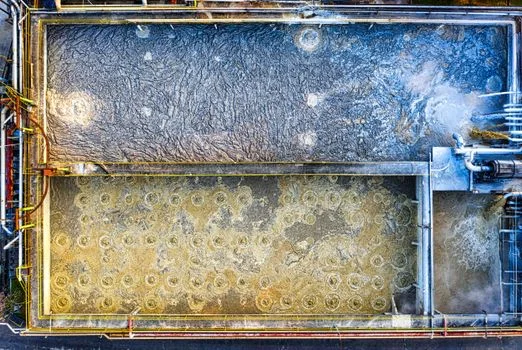
Biological contact oxidation, advanced oxidation processes (AOPs), and membrane bioreactors (MBRs) can all meet EPA 40 CFR Part 433 and EU Directive 2010/75/EU limits, but they trade off differently on cost, footprint, and feed strength. BCO delivers 95%+ COD removal at $0.10–0.30/m³ OPEX, AOPs reach 92–97% at $0.80–2.00/m³ (driven by H₂O₂, ozone, and electrical load), and MBRs land at 90–95% removal and $0.40–0.60/m³ once membrane replacement and pumping energy are counted.
AOPs are the only option that comfortably handles 500+ mg/L COD feeds and near-reuse polishing. BCO occupies more floor area (1.5–2.5 m²/m³/day versus 0.5–1.0 for AOPs and 1.0–2.0 for MBRs) and needs 4–6 weeks for biofilm maturation, versus 2–4 weeks for an MBR and immediate operation for AOPs. Sludge output is similar across BCO and MBR (0.2–0.5 kg TSS/kg COD) and lowest for AOPs (0.1–0.2 kg TSS/kg COD). For plants that need near-reuse effluent in a tight envelope, an MBR system for solvent wastewater with near-reuse-quality effluent is the closer fit. Where pre-treatment demands precise reagent control, a PLC-controlled chemical dosing unit for pH adjustment and coagulation keeps the upstream chemistry stable.
| Parameter | Biological Contact Oxidation (BCO) | Advanced Oxidation Processes (AOPs) | Membrane Bioreactor (MBR) |
|---|---|---|---|
| COD Removal Efficiency | 95%+ | 92-97% | 90-95% |
| Influent Concentration Handling | Moderate (up to ~500 mg/L COD) | High (50-500+ mg/L COD) | Moderate (up to ~500 mg/L COD) |
| OPEX ($/m³) | $0.10–0.30 | $0.80–2.00 | $0.40–0.60 |
| Footprint (m²/m³/day) | 1.5–2.5 | 0.5–1.0 | 1.0–2.0 |
| Sludge Production (kg TSS/kg COD) | 0.2–0.4 | 0.1–0.2 | 0.3–0.5 |
| Start-up Time | 4–6 weeks | Immediate | 2–4 weeks |
| Compliance (EPA 40 CFR 433 / EU Directive 2010/75/EU) | Achievable | Achievable, preferred for ZLD | Achievable |
Zero-Fouling Reactor Design: Preventing Biofilm Inhibition from Solvents
Fouling control in solvent contact oxidation starts with keeping inhibitory solvents out of the bioreactor. Air stripping removes more than 90% of volatiles such as dichloromethane, and activated carbon adsorption pushes removal past 95%; either approach keeps influent below the ~50 mg/L threshold where biofilm health collapses. A pharmaceutical plant in Hangzhou combined air stripping with a switch from honeycomb tubes to elastic media and recorded an 80% drop in reactor fouling within one operating cycle.
Carrier choice matters as much as pre-treatment. Polypropylene elastic media tolerate the polymer coatings that acetone metabolites leave behind far better than rigid honeycomb structures. A weekly air-scour at 10–15 m³/m²/h for 30–60 minutes strips excess biomass before it compacts. Fine-bubble diffusers (3–5 mm orifice) deliver 30–40% oxygen-transfer efficiency and keep DO above 2 mg/L, avoiding the anaerobic pockets that drive fouling. Hydraulic loading stays in the 10–20 m³/m²/day band; above that, shear sloughs the biofilm faster than it regrows. For feeds above 500 mg/L COD, step-feed or pre-dilution prevents oxygen starvation in the lead zones. For floatables and oil carryover that aggravate fouling, a Dissolved Air Flotation (DAF) System upstream of the BCO tank is a common add-on.
Compliance Checklist: Meeting EPA and EU Standards for Solvent Effluents
A BCO system holds EPA 40 CFR Part 433 limits when run at 6–12 hours HRT with DO above 2 mg/L: TMAH under 1 mg/L, COD under 50 mg/L, and pH 6.0–9.0. For EU Directive 2010/75/EU, an 8–10 hour HRT followed by secondary clarification keeps COD under 125 mg/L, BOD under 25 mg/L, and TSS under 30 mg/L.
Pre-treatment is composition-driven. Air stripping handles volatiles; coagulation targets colloidal silica in semiconductor wastewater; pH correction to 6.5–8.5 protects microbial kinetics. Online UV-absorption probes for COD and TSS give continuous trending, while periodic third-party labs verify TMAH and IPA. Records of HRT, DO, and contaminant concentrations are the first thing auditors request. For polishing or disinfection at the end of the train, an on-site ClO₂ generation unit for solvent wastewater disinfection closes the loop without shipping oxidant.
Selection Checklist for a Solvent BCO System
Before committing to a solvent contact oxidation reactor, confirm the following against your feed data:
- Influent COD ≤ 500 mg/L, otherwise plan step-feed or pre-dilution.
- Dichloromethane and other volatiles addressed by air stripping or carbon adsorption to <50 mg/L entering the bioreactor.
- Carrier specification: elastic media at 300–500 m²/m³ with packing ratio 50–70%.
- Aeration sized at 0.3–0.5 kg O₂/kg COD via diffused air; DO controlled at 2–4 mg/L.
- HRT envelope of 6–12 hours matched to target effluent (6 h for acetone-dominant, 10–12 h for TMAH-dominant feeds).
- Hydraulic loading capped at 10–20 m³/m²/day to protect biofilm integrity.
- Monitoring: online COD/TSS probes plus scheduled third-party verification for TMAH and IPA.
Who This Is For (And Who Should Look Elsewhere)
BCO is a strong fit for plant engineers and EPC teams running semiconductor fabs, pharmaceutical APIs, or specialty-chemical lines with moderate-strength (≤500 mg/L COD) solvent wastewater and a target of 95%+ COD removal at low OPEX. Teams chasing near-reuse quality, zero-liquid-discharge polishing, or feeds above 500 mg/L COD will get more from AOPs or MBRs as a primary or polishing step. If you need a sized proposal and a P&ID, send your influent profile and target effluent to request a quote.
Frequently Asked Questions
What solvents can biological contact oxidation treat effectively?
Biological contact oxidation is effective for TMAH, IPA, and acetone, typically exceeding 95% COD removal at 6–12 hours HRT. Chlorinated solvents such as dichloromethane require air stripping or carbon adsorption upstream to drop influent below inhibitory thresholds before the biofilm is exposed.
How does contact oxidation compare to MBR for solvent wastewater?
BCO runs at $0.10–0.30/m³ OPEX versus $0.40–0.60/m³ for MBR, mainly because there are no membranes to replace. MBRs win on footprint (1.0–2.0 m²/m³/day vs 1.5–2.5) and start-up (2–4 weeks vs 4–6 weeks), and produce slightly clearer effluent for reuse.
What is the optimal hydraulic retention time for solvent wastewater?
Target 6–12 hours of HRT for TMAH, IPA, or acetone feeds to reach 95%+ COD removal. Going below 6 hours risks incomplete degradation and discharge-limit violations, while extending past 12 hours rarely improves removal enough to justify the extra tankage.
Can contact oxidation handle high-strength solvent effluents above 500 mg/L COD?
Yes, with modifications: step-feed configurations distribute load along the reactor, and pre-dilution reduces shock to the biofilm. For feeds consistently well above 500 mg/L COD, AOPs are often a better primary stage before polishing with BCO.
What biofilm carriers work best for solvent wastewater?
Elastic polypropylene media at 300–500 m²/m³ shed fouling from acetone metabolites more reliably than rigid honeycomb tubes.
Further Reading
Explore these in-depth articles on related wastewater treatment topics: