Third-Gen Semiconductor Etching Wastewater Treatment: 2026 Hybrid ZLD Engineering Blueprint with 99.9% Fluoride & TMAH Recovery
Third-generation semiconductor (SiC/GaN) etching wastewater contains fluoride at 500–2,000 mg/L, TMAH at 100–500 mg/L, and silicon carbide nanoparticles sized 10–50 nm. Hybrid treatment trains combining forward osmosis (FO), nanofiltration (NF), and reverse osmosis (RO) achieve 99.5%+ fluoride removal and 98% TMAH recovery, with 2026 ZLD operating costs of $0.25–$0.60/m³. Compliance with China's GB 31570-2022 and the EU Industrial Emissions Directive 2010/75/EU requires pretreatment that controls membrane fouling caused by SiC nanoparticles.
Why SiC/GaN Etching Wastewater Breaks Legacy Treatment Systems
Legacy wastewater treatment systems designed for traditional silicon semiconductor fabs are proving inadequate for the demands of SiC/GaN fabrication. The primary divergence lies in the contaminant profile. While silicon fabs typically manage fluoride below 50 mg/L, SiC/GaN processes that use aggressive hydrofluoric acid (HF) etching generate wastewater with fluoride concentrations of 500–2,000 mg/L. Standard lime precipitation, often sufficient at lower fluoride concentrations, fails to meet the limits set by GB 31570-2022, which drives retrofits and non-compliance costs. For instance, a 2025 SiC fab in Suzhou absorbed a $1.2M retrofit to integrate FO pretreatment after its existing RO system could not achieve the required fluoride discharge levels.
TMAH (tetramethylammonium hydroxide), used in photoresist stripping, appears at much higher concentrations in SiC/GaN wastewater (100–500 mg/L) than in silicon fab wastewater (10–100 mg/L). TMAH's toxicity (oral LD50 ≈ 1.5 g/kg in rats) also defeats conventional biological treatment, frequently causing process upset. A third, often underestimated, challenge is silicon carbide (SiC) nanoparticles, typically 10–50 nm in diameter, originating from chemical mechanical planarization (CMP) slurries. These ultrafine particles are highly abrasive and adsorb strongly onto membrane surfaces. Without appropriate pretreatment, SiC nanoparticles can accelerate membrane fouling by 30–50% in RO and NF systems, cutting flux and raising energy draw. Dissolved Air Flotation (DAF) systems see similar loading, reducing their effectiveness on suspended solids and oil/grease.
| Parameter | SiC/GaN Wastewater | Traditional Silicon Wastewater | Impact on Treatment |
|---|---|---|---|
| Fluoride (mg/L) | 500–2,000 | <50 | Requires advanced precipitation or membrane separation; exceeds capacity of basic treatment. |
| TMAH (mg/L) | 100–500 | 10–100 | Toxicity to biological systems; requires oxidative or recovery methods. |
| SiC Nanoparticles (nm) | 10–50 | Minimal/Silica-based | Severe membrane fouling acceleration; DAF system clogging; increased O&M. |
Hybrid Treatment Systems for Third-Gen Semiconductor Wastewater: FO/NF/RO vs. MBR + EDI vs. Electro-Ceramic Desalination
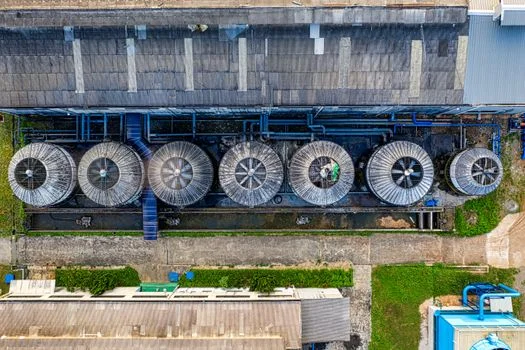
Addressing the contaminant profile of third-gen semiconductor wastewater requires a hybrid approach that stacks treatment technologies around specific removal and recovery objectives. Architecture selection changes CapEx, OPEX, and ZLD compliance outcomes in measurable ways, which is why most SiC/GaN plants we size for end up running a Lamella clarifier plus a high-efficiency DAF system ahead of the membranes.
The leading hybrid configuration is the FO/NF/RO system. Forward Osmosis (FO) starts the train by selectively recovering TMAH: a concentrated draw solution pulls water across a semipermeable membrane, leaving concentrated TMAH behind, and the draw solution is then separated and recycled. Nanofiltration (NF) downstream rejects most fluoride ions and divalent cations, and Reverse Osmosis (RO) polishes for dissolved solids, delivering high-purity water for ZLD or reuse. This stack achieves 99.5% fluoride removal and 98% TMAH recovery. Pretreatment is the gatekeeper: lamella clarifiers run at 20–40 m/h surface loading to drop larger particles, the DAF unit hits 95% TSS reduction for FOG and suspended solids, and pH is held at 6–9 to protect the membranes. When comparing SiC fab footprints to GaN fab footprints, GaN lines usually carry higher TMAH and lower fluoride, which tilts the choice toward more FO capacity or an MBR polishing step.
An alternative for high TMAH and organic load is the MBR + EDI system. Membrane Bioreactor (MBR) units use submerged polymeric membranes with pore sizes around 0.1 µm to retain suspended solids and drive biological degradation of organics such as TMAH. The MBR effluent then flows through Electrodeionization (EDI) modules, which use ion-exchange membranes and DC current to strip residual ions, including fluoride, without chemical regeneration. MBR + EDI systems typically draw 0.8–1.2 kWh/m³. Fluoride removal can be lower than a dedicated NF/RO stage, so this train is best when organics dominate over fluoride.
Emerging electro-ceramic desalination (e.g., Membrion-style cells) targets high-TDS streams and reports up to 90% water recovery with an estimated OPEX of $0.35/m³. These systems tolerate challenging feedwater and fit advanced reuse loops in fabs.
| System Architecture | Primary Contaminants Targeted | Typical Removal Efficiency (Fluoride/TMAH) | Key Pretreatment Needs | Estimated Energy Consumption (kWh/m³) | CapEx Indication |
|---|---|---|---|---|---|
| FO/NF/RO Hybrid | Fluoride, TMAH, Dissolved Solids | 99.5% / 98% | Lamella Clarifier, DAF, pH Adjustment (6-9) | 1.0–2.5 | High |
| MBR + EDI | TMAH, Organics, Residual Ions | 85-95% / 99%+ | Primary clarification, nutrient addition (if required) | 0.8–1.2 | Medium-High |
| Electro-Ceramic Desalination | High TDS, Mixed Ions | Variable (up to 90% water recovery) | Coarse filtration | N/A (proprietary) | Medium |
A typical process flow for a SiC/GaN fab wastewater train runs as follows:
- Primary Treatment: Lamella clarifier for SiC nanoparticle settling, followed by a high-efficiency DAF system to remove FOG and suspended solids.
- TMAH Recovery: Forward Osmosis (FO) module to concentrate and recover TMAH from the wastewater.
- Fluoride Removal: Nanofiltration (NF) to reject fluoride ions.
- Final Polishing & ZLD: Industrial Reverse Osmosis (RO) system for final dissolved solids removal and water recovery.
- Sludge Management: Dewatering and disposal of concentrated waste streams.
2026 Cost Breakdown: CapEx, OPEX, and ROI for ZLD Systems in SiC/GaN Fabs
Justifying CapEx and OPEX for Zero Liquid Discharge (ZLD) in SiC/GaN fabs requires a granular cost view and a defensible ROI case. By 2026, comprehensive ZLD systems designed for third-generation semiconductor wastewater at 50–500 m³/day run from $500K to $3M total CapEx. For a mid-range buildout, an FO skid sits around $150K, NF/RO units around $250K, the DAF system about $80K, and automation and controls another $120K.
OPEX drivers stack up predictably. Membrane replacement runs $20–$50/m²/year for FO/NF/RO membranes. Energy for pumping and membrane operation typically lands at 0.5–1.5 kWh/m³ for advanced hybrid systems. Chemical costs for antiscalants and cleaning agents fall between $0.05–$0.15/m³. Skip advanced pretreatment and the SiC-nanoparticle fouling penalty adds 15–25% to OPEX through more frequent cleaning and earlier membrane replacement, as observed in numerous field studies (HydropureWater internal data, 2025).
The ROI case is straightforward. For a 200 m³/day system in China, achieving ZLD compliance averts fines above $500K/year under GB 31570-2022. In the U.S., significant water reuse translates to roughly $200K/year by cutting reliance on municipal water and reducing discharge fees. Factoring both savings and avoided penalties, payback typically lands at 2–4 years. For a detailed regional CapEx/OPEX breakdown, see our analysis on wastewater treatment plant costs. For a sized proposal matched to your flow rate and feedwater profile, request a free quote.
| Cost Component | Estimated Range | Notes |
|---|---|---|
| CapEx | $1.2M – $2.0M | Includes FO, NF/RO, DAF, piping, tanks, automation. |
| FO Skid | $150K – $250K | |
| NF/RO Skid | $250K – $400K | |
| DAF System | $80K – $150K | |
| Automation & Controls | $120K – $200K | |
| OPEX (per m³) | $0.25 – $0.60 | Excludes sludge disposal. |
| Energy | $0.10 – $0.25 | 0.5–1.5 kWh/m³ @ $0.15/kWh |
| Membrane Replacement | $0.08 – $0.18 | $20-50/m²/year; assumes 5-year lifespan. |
| Chemicals (Antiscalants, Cleaners) | $0.05 – $0.15 | |
| Maintenance & Labor | $0.02 – $0.07 |
Regulatory Compliance: GB 31570-2022, EU IED 2010/75/EU, and U.S. EPA Limits for Fluoride and TMAH
Semiconductor fabs run into significant penalties when effluent misses the mark on fluoride, TMAH, and pH, so the regulatory numbers drive equipment sizing. For third-gen semiconductor etching wastewater, the three jurisdictions that matter most are China, the EU, and the United States.
In China, GB 31570-2022 sets fluoride at a maximum of 10 mg/L and TMAH at no more than 1 mg/L, with a permitted pH range of 6–9. The standard mandates monthly effluent reporting, which forces robust monitoring and meticulous record-keeping. Non-compliance fines range from $10K–$100K per instance.
The EU's Industrial Emissions Directive (IED) 2010/75/EU does not always pin down a number for every pollutant, but it requires Best Available Techniques (BAT) for industrial pollution control. BAT-associated emission levels (BAT-AELs) for wastewater containing fluoride and TMAH commonly target fluoride below 15 mg/L and TMAH below 5 mg/L. The IED also requires an annual emissions inventory for hazardous substances, pushing operators toward proactive pollution management.
In the United States, regulation is decentralized. The U.S. EPA sets a secondary Maximum Contaminant Level (SMCL) for fluoride in drinking water at 4 mg/L, which often shapes industrial discharge permits. TMAH is not federally regulated but falls under the Clean Water Act's general pretreatment standards to prevent interference with Publicly Owned Treatment Works (POTWs). Individual states and regional authorities impose their own, often stricter, discharge limits. California, for example, has historically enforced fluoride limits as low as 0.2 mg/L. Continuous compliance depends on real-time monitoring: pH held at 6–9, conductivity kept below 1,000 µS/cm for high-purity reuse, and fluoride/TMAH ion sensors ($20K–$50K per fab) for immediate feedback.
| Region/Regulation | Fluoride Limit (mg/L) | TMAH Limit (mg/L) | pH Range | Reporting Frequency |
|---|---|---|---|---|
| China (GB 31570-2022) | ≤ 10 | ≤ 1 | 6–9 | Monthly |
| EU (IED 2010/75/EU - Typical BAT-AEL) | ≤ 15 | ≤ 5 | N/A (general discharge limits apply) | Annual emissions inventory |
| U.S. EPA (SMCL for drinking water) | ≤ 4 (influential) | Not federally regulated (Pretreatment Standards apply) | N/A (POTW dependent) | Varies by permit |
| California (Example State) | ≤ 0.2 | Not explicitly regulated (Pretreatment Standards apply) | N/A (POTW dependent) | Varies by permit |
Case Study: 2026 SiC Fab in Jiangsu Achieves 99.9% Fluoride Removal with Hybrid FO/NF/RO System
A SiC fab in Jiangsu province, China, struggled to meet GB 31570-2022 on high-volume etching wastewater. The plant processed about 300 m³/day of wastewater averaging 1,200 mg/L fluoride and 300 mg/L TMAH. Its existing RO skid, without adequate pretreatment, kept missing the <10 mg/L fluoride ceiling, causing operational disruption and exposing the fab to fines.
The retrofit built a multi-stage hybrid train. A lamella clarifier went in first to drop SiC nanoparticles before they reached the membranes, followed by a high-efficiency DAF unit for FOG and suspended solids. The core train ran an FO module for TMAH recovery, a dedicated NF skid for primary fluoride rejection, and a final RO skid for polishing and water recovery. Automated pH adjustment sat across the train to optimize performance and prevent scaling.
Results from the installed hybrid FO/NF/RO system: effluent fluoride consistently below 5 mg/L, TMAH below 0.5 mg/L, and a 95% water recovery rate that effectively met ZLD objectives. Total CapEx landed near $1.8M, OPEX averaged $0.42/m³, and the fab projected an 18-month ROI driven by avoided fines and water reuse savings.
The lessons from this project are concrete. Despite advanced pretreatment, monthly cleaning of the FO and NF modules was still required, which added about 20% to OPEX versus systems treating less challenging wastewater. Optimizing TMAH recovery in the FO stage came down to tuning draw solution concentration, which means continuous monitoring and adjustment, not a one-time commissioning exercise.
Frequently Asked Questions
How does FO (forward osmosis) recover TMAH from etching wastewater?
Forward Osmosis (FO) uses the osmotic pressure difference between the wastewater feed and a more concentrated draw solution. Water moves across a semipermeable membrane into the draw solution, leaving concentrated TMAH behind, and the diluted draw solution is then processed to separate the TMAH and regenerate the draw solution. Common draw solutions such as concentrated NaCl or MgCl₂ reach TMAH recovery rates of 90–98% depending on draw concentration and operating parameters.
Why do SiC nanoparticles foul membranes faster than silica nanoparticles?
SiC nanoparticles foul faster because of their surface chemistry, narrow 10–50 nm size range, and higher surface energy compared with silica. Their abrasiveness and strong adsorption drive rapid cake-layer formation and pore blocking. Field observations show flux decline of 30–50% within 30 days in RO/NF systems without adequate pretreatment, which is materially faster than silica-based fouling under similar conditions.
Compare ZLD costs for SiC vs. GaN fabs?
SiC and GaN fabs both generate challenging wastewater, but the contaminant mix differs and that shifts the line-item costs. GaN wastewater typically runs higher in TMAH and lower in fluoride than SiC wastewater, so the FO or MBR stages tend to dominate. SiC fabs with very high fluoride loads need more aggressive NF/RO stages, which raises those skid costs. Total ZLD cost is broadly comparable across the two, but the technology mix and the CapEx/OPEX split are not.
How to select a hybrid system for a 100 m³/day fab?
Match the train to the dominant contaminant and the recovery target:
- Wastewater with fluoride above 500 mg/L and moderate TMAH points to a FO/NF/RO system.
- Wastewater with TMAH above 300 mg/L and moderate fluoride favors an MBR + EDI block for organic degradation, followed by RO polishing.
- Wastewater with very high TDS and mixed ions may justify electro-ceramic desalination as a primary or polishing step.
A detailed feedwater analysis plus pilot testing is the only reliable path to a defensible design at this scale.
Provide maintenance tips for FO/NF/RO systems in semiconductor fabs?
Maintenance discipline is what keeps these trains within OPEX budget:
- Cleaning frequency: FO membranes typically need monthly cleaning because the concentrated draw solution amplifies fouling potential; NF/RO membranes are usually cleaned quarterly, though SiC nanoparticle fouling can force more frequent cycles.
- Antiscalant dosing: Hold dosing at the recommended 3–5 mg/L to prevent mineral scaling on the membranes.
- Membrane lifespan: With proper pretreatment and maintenance, FO membranes typically last 3–5 years and NF/RO membranes 5–7 years; integrity testing catches premature degradation.
- Pretreatment monitoring: Track DAF and clarifier performance continuously so fouling agents do not slip downstream.
Operators looking at hydrofluoric acid wastewater treatment can compare this hybrid approach against a zld for etching reference design, or review a solar-cell etching wastewater line for a related fluoride-dominated train, or benchmark copper-laden streams against PCB etching wastewater treatment designs. To scope a sized system for your flow rate and contaminant profile, send your feed data through our intake form: request a tailored ZLD quotation.