A lamella clarifier (inclined plate settler) removes 90-98% of total suspended solids (TSS) from industrial wastewater by directing flow upward between plates set at 45-60°. Settling distance falls to 50-100 mm, and surface loading rates of 20-40 m/h support the same duty in about 60% less plan area than a conventional clarifier. The US EPA promulgated the Metal Finishing Effluent Guidelines (40 CFR Part 433) in 1983, and those rules still define the effluent side of the process. Industrial lamella clarifier sizing for metal finishing therefore starts at the permit limit and works back through precipitation, flocculation, and plate hydraulics.
How a Lamella Clarifier Works
A lamella clarifier settles flocculated solids on parallel plates inclined at 45-60°, cutting each particle's settling distance to 50-100 mm. The geometry supports surface loading of 20-40 m/h and removes 90-98% of TSS in roughly 60% less plan area than a conventional clarifier.
Field data tracks those figures. A 2024 Guangdong metal finishing upgrade replaced an aged circular clarifier with a High-Efficiency Sedimentation Tank (Lamella Clarifier) rated at 20-40 m/h surface loading. Effluent TSS fell from 350 mg/L to 25 mg/L, reclaiming about 150 m² of floor space and avoiding roughly $120,000 per year in discharge fines (HydropureWater field data, 2024).
Industrial plants in dense manufacturing hubs face tighter discharge limits and little spare land. Conventional tanks need 2-4 m of depth and long retention for particles to settle. Lamella packs multiply projected settling area inside a compact shell, which matters on brownfield sites where civil expansion is blocked. Space saved on clarification can hold the dosing skid, sludge thickener, or a future filter stage instead.
Earlier drafts of this guide cited "GB 8978-2023"; China's Ministry of Ecology and Environment still lists the Integrated Wastewater Discharge Standard as GB 8978-1996 (MEE). Many plants still face TSS targets near 50-70 mg/L under local permits and industry rules. Real-time monitoring can turn a short TSS spike into fines or a forced outage. A stable solids buffer often pays for itself faster than a larger concrete basin.
For a deeper walk-through of plate geometry and sludge paths, see our note on lamella clarifier details and mechanism. The sections below focus on sizing numbers, technology trade-offs, and buyer checks.
Industrial Lamella Clarifier Sizing for Metal Finishing: The 2026 Method
Industrial lamella clarifier sizing for metal finishing starts from the discharge permit, not the plate pack. According to the US EPA, the Metal Finishing regulation is defined by manufacturing processes and not by industrial sectors. The category covers plants performing one or more of six operations, from electroplating and electroless plating to anodizing, coating, etching, and printed circuit board manufacture. The EPA counts about 44,000 facilities that discharge this process wastewater directly or indirectly.
Those permit numbers then set the hydraulic duty. For direct dischargers, 40 CFR § 433.13 sets a TSS daily maximum of 60 mg/L and a monthly average of 31 mg/L. Indirect dischargers answer mainly to local pretreatment limits for metals and cyanide, so their clarifier duty is driven by the sewer authority rather than the federal TSS figures. Either way, the clarifier is usually the unit operation that protects the number.
The sizing sequence itself has four steps. Run jar tests on precipitated hydroxide sludge first, to fix the coagulant dose and the floc settling velocity. Convert that velocity into a design loading on projected plate area, typically 20-40 m/h for dense metal finishing flocs. Then add margin for upset batches, dragout dumps, and pH swings on plating lines, and check that hopper withdrawal keeps pace with heavy hydroxide sludge.
Sludge handling deserves early attention. Chemical precipitation with lime or caustic is the standard first step for dissolved metals. The US EPA calls chemical precipitation a widely used, proven technology for the removal of metals and other inorganics, including heavy metal removal from metal plating wastes. The same EPA fact sheet warns that added coagulants can increase the volume of waste sludge up to 50 percent, so size the thickener and dewatering loop for that extra mass.
Lamella Clarifier Engineering: How Inclined Plates Accelerate Sedimentation
Stokes' Law sets terminal settling velocity from particle size, density difference, and fluid viscosity. In a conventional clarifier a particle may travel 3,000 mm or more before it is captured. Inclined plates cut that path to 50-100 mm; once the solid rests on a plate face, it is removed from the bulk flow even if the tank is much deeper. Hydraulic retention time of 10-30 min after flocculation is typical, and dense inorganic solids reach 90-98% TSS removal under those conditions.
Plate angle is the main geometric trade-off. Angles of 45-60° are standard. Near 60°, sludge slides more reliably and bridging risk falls. Shallower angles raise horizontal projected area for a given plate length and can lift theoretical capture. Most plants we size for metal finishing and mining settle near 55° so plates self-clean under hydraulic load without excessive structural span.
Uniform inlet distribution is the second control. Short-circuiting sends solids straight to the effluent launder. Baffles and distribution ports keep upward velocity between plates near 0.5-1.5 m/h so flow stays laminar. If the Reynolds number climbs above about 500, turbulence re-suspends flocs and undoes the plate advantage.
Published design summaries often quote surface loading of 10-25 m/h on clarifier plan area. Industrial packs are still commonly specified at 20-40 m/h when projected plate area and solids density are counted differently. Procurement teams should state which area a vendor quote uses before comparing bids.
Lamella units are not stand-alone filters. Fine colloids need chemical conditioning before gravity can finish the job. Automatic chemical dosing systems for lamella clarifier pre-treatment dose coagulants and flocculants so micro-particles form denser flocs that settle on the plates and support 90-98% TSS removal.
| Engineering Parameter | Typical Range | Impact on Performance |
|---|---|---|
| Settling Distance | 50 - 100 mm | Reduces time required for particle to reach a solid surface. |
| Plate Angle | 45° - 60° | Determines sludge slide velocity and effective footprint. |
| Upward Velocity | 0.5 - 1.5 m/h | Maintains laminar flow to prevent particle re-suspension. |
| Reynolds Number | < 500 | Ensures stable, non-turbulent flow between plates. |
Lamella Clarifier Design Specifications: Parameter Table for Sizing and Selection
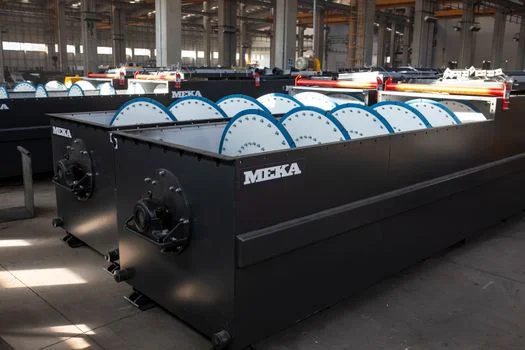
Surface loading for lamella systems typically spans 20-40 m/h, set by solids specific gravity and the effluent target. Effective settling area is the sum of horizontal projections of every plate, so a 10 m² footprint can deliver 100 m² or more of settling surface. The table below is the benchmark set most procurement teams use across sectors. Parallel notes on the lamella clarifier working principle cover the same geometry from a principle-first angle.
| Parameter | Typical Range | Industry Benchmark | Technical Notes |
|---|---|---|---|
| Plate Angle (°) | 45 - 60 | 55 (Standard) | Steeper angles improve sludge slide but require thicker plates for support. |
| Plate Spacing (mm) | 50 - 100 | 75 (Mining/Metal) | Narrower gaps improve removal but increase clogging risk in high-solids use. |
| Surface Loading Rate (m/h) | 20 - 40 | 30 (Metal Finishing) | Higher rates reduce footprint but may require aggressive pre-treatment. |
| Hydraulic Retention Time (min) | 10 - 30 | 20 (Textile) | Longer HRT improves removal of lighter flocs but increases tank volume. |
| Influent TSS (mg/L) | 50 - 5,000 | 1,000 (Pulp & Paper) | Systems designed for >2,000 mg/L require integrated sludge recirculation. |
| Effluent TSS (mg/L) | 10 - 50 | 25 (General EPA) | Achievable only with optimized coagulation and flocculation dosing. |
Note: Parameters vary by manufacturer and specific wastewater chemistry; application-specific sizing and pilot data should confirm the final rating.
Lamella vs Conventional Clarifiers vs DAF: Head-to-Head Comparison for Industrial Applications
Lamella clarifiers need about 10-15 m² of footprint per 100 m³/h of flow, while conventional clarifiers need 25-40 m² for the same volume. Space alone does not decide the technology. Solids buoyancy, FOG content, CapEx, and maintenance staffing must be weighed together.
Dissolved Air Flotation (DAF) fits streams rich in fats, oils, and grease. Food and refining wastes float rather than settle; oil on lamella plates fouls channels fast. Dense inorganic solids in mining or metal finishing favor lamella hardware: fewer moving parts and lower energy than DAF. Plants chasing reuse often follow lamella clarification with MBR systems for post-lamella clarification and reuse applications.
| Feature | Lamella Clarifier | Conventional Clarifier | DAF System | Best Use Case |
|---|---|---|---|---|
| Footprint (m²/100 m³/h) | 10 - 15 | 25 - 40 | 15 - 20 | Lamella for tight spaces. |
| TSS Removal (%) | 90 - 98 | 80 - 90 | 95 - 99 | DAF for light/oily solids. |
| CapEx ($/m³/h) | $2,000 - $5,000 | $1,500 - $3,500 | $3,000 - $6,000 | Conventional for low budget. |
| OPEX ($/m³) | $0.05 - $0.15 | $0.08 - $0.20 | $0.10 - $0.25 | Lamella for low-FOG sites. |
| Maintenance | Medium (Plate cleaning) | Low (Scraper gear) | High (Air saturation) | Lamella for inorganic solids. |
Complex oily trains should be checked against an oil lamella clarifier case only when FOG stays low; otherwise review DAF systems for high-FOG wastewater applications. Lamella packs balance footprint and cost for heavy settleable solids; DAF is the right spend when contaminants float.
How Do You Select an Industrial Wastewater Clarifier?

Industrial wastewater clarifier selection starts with FOG and solids density, not brochure footprint claims. FOG above about 50 mg/L often fouls inclined plates; above 100 mg/L most sites should pivot to DAF. Use the checklist below before freezing CapEx.
- Step 1: Assess Influent Characteristics: Analyze TSS, FOG, pH, and flow rate. Lamella clarifiers suit TSS of 50-5,000 mg/L. If FOG is >100 mg/L, pivot to DAF. If TSS is >5,000 mg/L, include sludge recirculation so the hopper does not clog.
- Step 2: Determine Space Constraints: Measure available footprint. At 100 m³/h with less than 20 m² free, a lamella pack is often the only workable sedimentation option.
- Step 3: Compare CapEx and OPEX: A lamella unit can cost more upfront than a plain concrete settler, yet OPEX runs about 20-30% lower than DAF from lower power draw. Market quotes still cluster near $50,000 to $500,000 depending on stainless vs carbon steel and automation.
- Step 4: Evaluate Maintenance Access: Sticky mining sludge may need plate cleaning every 4 weeks; light municipal pre-treatment may need only a 6-month check. Confirm plate removal paths or spray headers in the bid drawings.
- Step 5: Check Compliance Targets: Limits below 20 mg/L TSS usually need a multi-media filter or MBR after the lamella stage to catch residual micro-flocs.
What design criteria matter for clarifier selection?
Clarifier design criteria that decide primary vs secondary vs lamella vs DAF are solids settleability, FOG, surface loading, HRT, and the effluent TSS permit. Dense inorganic flocs at 20-40 m/h loading favor lamella; buoyant FOG favors DAF; large land banks and low CapEx favor conventional tanks. Size on effective projected area, not shell footprint alone, and lock chemical dosing before you freeze plate spacing.
ROI Calculation Example: For a 100 m³/h train, a $200,000 lamella CapEx can save about $30,000 per year in fines and $15,000 per year in energy and labor versus a weak conventional settler. That is roughly a 3.5-year payback for many procurement boards. For a broader CapEx/OPEX split, see wastewater treatment plant cost in 2025.
Common Lamella Clarifier Problems and How to Fix Them
Calcium carbonate scale on inclined plates can cut effective settling area by up to 30% within one quarter in high-hardness service such as glass plants or cooling-tower blowdown. Scaled plates break laminar flow, raise carry-over, and push effluent TSS above the permit. Planned wash cycles beat emergency shutdowns.
| Symptom | Likely Cause | Diagnostic Step | Solution |
|---|---|---|---|
| TSS Carry-over (>50 mg/L) | Short-circuiting or poor flocculation | Perform a dye test to track flow paths. | Optimize chemical dosing; check inlet baffles. |
| Scaling on Plates | High hardness or pH imbalance | Inspect plate surfaces for white crust. | Implement acid wash (pH 2-3) every 3-6 months. |
| Sludge Bridging in Hopper | High solids loading/low pump rate | Check sludge blanket level. | Increase sludge pump frequency; add hopper vibrators. |
| Uneven Flow Distribution | Clogged inlet ports | Observe weir overflow uniformity. | Clean inlet distribution channel; realign plates. |
Material choice closes many failures early. Corrosive pickling or acid-mine streams need 304 or 316L stainless plates to limit pitting. Monroe Environmental documents a 660 GPM lamella plate vertical clarifier for cobalt hydroxide reduction, with tankage and separator plates in 304 stainless steel. That unit also carried wash-down headers with spray nozzles for in-place plate cleaning, a feature worth specifying on any metal hydroxide service.
Who This Is For / Next Step
This guide is for plant engineers, EPC designers, and procurement managers sizing primary or secondary clarification for dense, settleable solids on space-limited sites. Look elsewhere if FOG stays above 50-100 mg/L, if you need a pure flotation process, or if land is cheap and a conventional basin already meets the permit. To match plate area, dosing, and materials to your influent, request a lamella clarifier sizing review with flow, TSS, and FOG data.
Frequently Asked Questions
What is the difference between a lamella clarifier and an inclined plate settler?
There is no technical difference; the industry uses both names for the same unit. "Lamella clarifier" is the commercial label, while "inclined plate settler" (IPS) describes gravity capture on angled surfaces. Spec sheets, RFQs, and EPC drawings often mix the terms without changing hydraulics or plate geometry.
Can lamella clarifiers handle high-FOG wastewater from food plants?
Usually no. Lamella packs are built for solids that sink. Fats, oils, and grease float, coat plates, and cut removal. When FOG exceeds about 50-100 mg/L, a DAF system is the more reliable primary solids step before biological or membrane treatment.
What is the typical payback period for a lamella clarifier?
Payback commonly falls between 2 and 5 years. A 100 m³/h unit at about $200,000 CapEx that saves roughly $45,000 per year in fines and operating cost yields near a 3.5-year return. Mines and dye houses with high discharge fees often see faster recovery when space and fines dominate the cash case.
How often should lamella plates be cleaned?
Cleaning interval tracks solids loading and hardness. High-solids mining trains may need monthly washing. Municipal or light industrial service often runs on quarterly or twice-yearly checks. Use low-pressure water or a mild acid wash (pH 2-3) so scale leaves without scarring plate faces.
What pre-treatment is required before a lamella clarifier?
Coagulation and flocculation are required for peak capture. Gravity only removes particles that are large and dense enough to settle between plates. The US EPA describes chemical precipitation as a widely used, proven technology for removing metals and other inorganics, and stable dosing keeps floc size constant when influent TSS or pH swings on batch lines.
What TSS limits apply to metal finishing wastewater?
Direct dischargers in the US must meet a TSS daily maximum of 60 mg/L and a monthly average of 31 mg/L under 40 CFR § 433.13. Indirect dischargers face local pretreatment limits for metals and cyanide instead of the federal TSS figures. Local permits can set stricter numbers, so pull the actual permit before sizing plates.
Which plate material suits metal finishing wastewater?
Stainless steel is the default for corrosive metal finishing service. Use 304 stainless for general plating rinse streams and 316L where chlorides or pickling acids raise pitting risk. Documented metal hydroxide clarifiers, such as a 660 GPM cobalt removal unit, use 304 stainless plates with spray wash headers for cleaning.