Alkaline Wastewater Treatment Cost: CAPEX, OPEX & ROI Breakdown
For facilities with effluent pH 11–13, alkaline wastewater treatment cost ranges from $350,000 for chemical neutralization to $1.2 million for an MBR at 50 m³/h. OPEX typically averages $0.80–$3.50/m³, led by chemical dosing at $0.50–$2/m³ and sludge disposal at $0.20–$1/m³. Meeting China GB 8978-1996 or EU Directive 2000/60/EC adds 15–30% via monitoring and pretreatment.
Why Alkaline Wastewater Costs More Than Generic Wastewater Treatment
Alkaline wastewater (pH > 9) needs corrosion-resistant materials that raise equipment costs by 20–40% versus neutral streams (per ASTM G31-72 standards). Highly alkaline effluent does not behave like neutral wastewater, and that gap lifts both CAPEX and OPEX. Elevated pH forces Hastelloy, fiberglass, or specialized epoxy coatings on tanks, pipes, and pumps, which raises component prices. High alkalinity (pH 12–14) also needs larger chemical dosing skids for precise pH trim; CAPEX for those skids alone runs $50,000–$200,000 at 50–500 m³/h (industry benchmarks, 2025).
Compliance costs run higher for alkaline streams. China GB 8978-1996 sets discharge pH at 6–9, while EU Directive 2000/60/EC frames progressive cuts in priority-substance discharges and often drives nickel and copper monitoring in electroplating and PCB alkaline flows. For facilities comparing treatment options alongside metal-finishing streams, the electroplating wastewater treatment cost and ROI analysis offers a useful side-by-side. Sludge disposal costs rise 30–50% for alkaline streams because chemical precipitation generates more solids—$0.20–$1/m³ versus $0.10–$0.50/m³ for neutral streams (HydropureWater field data, 2025). That extra volume, and the risk of hazardous classification, shifts the CAPEX versus OPEX balance.
Alkaline Wastewater Treatment Technologies: Cost Breakdown by System Type
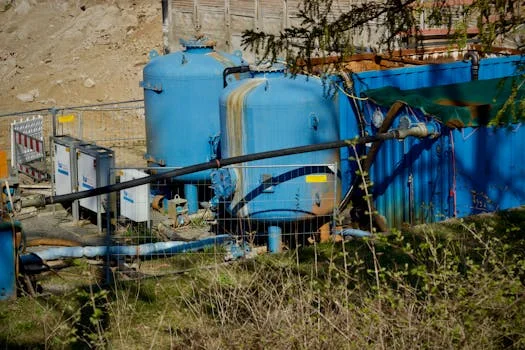
Chemical neutralization systems offer the lowest CAPEX for alkaline wastewater treatment, typically $50,000–$300,000 at 50–500 m³/h. They deliver a low entry price for pH adjustment but carry the highest OPEX, averaging $1–$3/m³, mostly from continuous purchases of 98% sulfuric acid at $0.50–$2/kg.
Membrane systems (NF and RO) require higher CAPEX, usually $500,000–$2 million, but OPEX drops to $0.50–$1.50/m³, which suits alkaline streams with TDS above 1,000 mg/L. Recovery rates of 70–90% cut water purchase costs and enable reuse. Pretreatment using a high-efficiency DAF system for alkaline wastewater pretreatment or multimedia filters adds $100,000–$300,000 to CAPEX. For plants with downstream purity needs, a reverse osmosis (RO) water purification system typically anchors the polishing train.
Biological treatment, such as MBR, sits in a mid-range CAPEX band of $400,000–$1.5 million with OPEX of $0.80–$2/m³. MBR systems for organic-rich alkaline wastewater suit streams with high organics, like food-processing effluent, though they need careful pH trim—$0.30–$0.80/m³ for CO₂ dosing—to keep microbes active.
Hybrid systems that combine chemical pretreatment with membranes represent the highest CAPEX ($800,000–$2.5 million) but the lowest OPEX ($0.30–$1/m³) for high-recovery uses such as semiconductor manufacturing. A 100 m³/h system treating pH 12–13 effluent can land at $1.2 million CAPEX and $0.60/m³ OPEX (industry analysis, 2025). Plants considering zero-liquid-discharge designs often compare this layout against the hybrid ZLD system approach for semiconductor alkaline wastewater.
| Technology Type | Typical CAPEX (50-500 m³/h) | Typical OPEX (per m³) | Key Drivers | Best For |
|---|---|---|---|---|
| Chemical Neutralization | $50,000 – $300,000 | $1.00 – $3.00 | Chemical costs (acid), sludge disposal | Simple pH adjustment, low flow rates |
| Membrane Systems (NF/RO) | $500,000 – $2,000,000 | $0.50 – $1.50 | Pretreatment, energy, membrane replacement | High TDS, water reuse, high effluent quality |
| Biological Treatment (MBR) | $400,000 – $1,500,000 | $0.80 – $2.00 | Energy (aeration), pH adjustment (CO₂), sludge disposal | Organic-rich alkaline streams |
| Hybrid Systems (Chemical + Membrane) | $800,000 – $2,500,000 | $0.30 – $1.00 | Initial complexity, specialized components, energy | High recovery, stringent discharge, complex streams |
CAPEX Breakdown: What Drives the Upfront Cost of Alkaline Wastewater Systems?
Equipment accounts for 60–70% of total CAPEX for industrial alkaline wastewater treatment systems. That share covers specialized components built for corrosive alkaline service. pH adjustment tanks run $20,000–$100,000, and a robust PLC-controlled chemical dosing system for precise pH adjustment runs $30,000–$150,000. Corrosion-resistant piping (PVC, CPVC, or fiberglass) adds another $10,000–$50,000. For a 50 m³/h system treating pH 11–13 effluent, a dedicated chemical dosing skid alone can represent an $80,000 line item (industry benchmarks, 2025). Many plants also drop in a high-efficiency sedimentation tank for solids removal, which lifts equipment CAPEX further.
Engineering and design take 15–20% of CAPEX, a higher share than for neutral streams because the work itself is heavier. Detailed chemical equilibrium calculations, material selection (fiberglass vs. specific stainless grades), and process modeling add $50,000–$200,000 at 50–500 m³/h.
Installation and commissioning account for 10–15% of CAPEX. Corrosion-resistant materials often need specialized welding and handling, so labor runs 20–30% above neutral-water rates. Installing a 100 m³/h alkaline treatment system typically costs $150,000–$300,000 (per EPA 2024 benchmarks).
Hidden CAPEX items deserve a line of their own. Permitting and regulatory approvals for hazardous-component discharges run $20,000–$100,000. Soil testing for foundation integrity and contamination adds $5,000–$20,000. A contingency budget of 10–20% of total CAPEX is standard practice to cover unexpected corrosion, site surprises, or shifting compliance demands.
OPEX Breakdown: The True Cost of Treating Alkaline Wastewater Daily
Chemical costs for acid dosing dominate OPEX, often $0.50–$3/m³. Continuous neutralization of high-pH effluent with sulfuric acid ($0.50–$2/kg) or hydrochloric acid sets the daily cost tempo. A 100 m³/h system treating pH 12 effluent can run about $1.20/m³ in acid alone (industry analysis, 2025).
Energy costs land between $0.10 and $0.50/m³. Membrane systems like NF/RO draw 1–3 kWh/m³ for pumping and pressure, while MBRs use 0.5–1.5 kWh/m³ mostly for aeration. A 200 m³/h RO system typically incurs $0.30/m³ in energy (per EPA 2024 data).
Sludge disposal averages $0.20–$1/m³. Alkaline streams generate 20–50% more sludge than neutral ones because metal hydroxides and other solids drop out during neutralization. A 50 m³/h system can produce 1–2 tons/day of sludge, which translates to $200–$500/day in disposal (industry benchmarks, 2025). A plate and frame filter press helps shrink that volume before it leaves the site.
Labor and maintenance typically run $0.20–$0.80/m³. Corrosion-resistant systems need fewer major overhauls, but specialized equipment and tight pH-and-chemical monitoring drive higher training and ongoing maintenance—$50,000–$150,000/year for a 100 m³/h system.
Compliance monitoring adds $0.10–$0.30/m³. Alkaline streams from industries like electroplating require frequent pH and heavy-metal testing ($50–$200/test), and that analytical load feeds industrial wastewater compliance costs and penalty exposure. Disinfection, often delivered through a chlorine dioxide generator, can also sit on the OPEX line.
| OPEX Category | Typical Cost Range (per m³) | Key Drivers | Impact on Total OPEX |
|---|---|---|---|
| Chemicals (Acid Dosing) | $0.50 – $3.00 | Alkalinity level, acid price, dosing efficiency | Highest (40-60%) |
| Energy | $0.10 – $0.50 | System type (membrane vs. biological), flow rate, electricity tariff | Moderate (10-20%) |
| Sludge Disposal | $0.20 – $1.00 | Sludge volume, hazardous classification, disposal fees | Significant (15-30%) |
| Labor & Maintenance | $0.20 – $0.80 | System complexity, automation level, labor rates, specialized repairs | Moderate (10-20%) |
| Compliance Monitoring | $0.10 – $0.30 | Required tests (pH, metals), frequency, lab fees | Lower (5-10%) |
ROI and Payback Period: When Does Alkaline Wastewater Treatment Pay Off?
Chemical neutralization systems deliver the fastest payback, often 1–3 years for low-flow applications below 50 m³/h. Modest savings from avoided fines and reduced effluent surcharges cover the relatively low CAPEX quickly. A $300,000 chemical neutralization system with $1.50/m³ OPEX can pay back in about 2.5 years on a 50 m³/h stream once compliance and discharge-fee savings are tallied (industry benchmarks, 2025).
Membrane systems (NF/RO) need 3–7 years to pay back, but water-reuse savings run $0.50–$2/m³ and lift lifetime value. A $1.2 million RO system hitting 80% recovery can save an industrial facility $150,000/year in fresh-water and discharge costs, putting payback near 5 years.
Biological treatment (MBR) systems typically pay back in 4–8 years. They shine on organic-rich alkaline streams—food processing, for example—where they handle both pH and COD. An $800,000 MBR system at $1/m³ OPEX on a 100 m³/h food-processing line can pay back in about 6 years once reduced organic discharge fees and compliance benefits are included.
Hybrid systems carry the longest payback, 5–10 years, but produce the largest long-term savings in high-recovery applications like semiconductor fabs. A $2 million hybrid system at $0.60/m³ OPEX, achieving 90% recovery on a 200 m³/h stream, can pay back in roughly 7 years through water reuse and waste minimization.
Compliance-driven ROI can shorten payback by 1–2 years. Avoided regulatory fines of $10,000–$100,000 per violation in regions like China show up immediately on the bottom line. A $500,000 treatment system at $1/m³ OPEX can pay back in about 3 years if it prevents $200,000/year in recurring fines. Sound alkaline wastewater treatment ROI calculation always combines direct operating savings with these indirect compliance benefits.
| Technology Type | Typical Payback Period | Primary ROI Driver | Example Scenario |
|---|---|---|---|
| Chemical Neutralization | 1 – 3 years | Avoided fines, reduced discharge fees | $300K system, 50 m³/h, $1.50/m³ OPEX, pays back in 2.5 years |
| Membrane Systems (NF/RO) | 3 – 7 years | Water reuse savings ($0.50-$2/m³) | $1.2M RO system, 80% recovery, saves $150K/year, pays back in 5 years |
| Biological Treatment (MBR) | 4 – 8 years | Reduced organic discharge, compliance | $800K MBR system, 100 m³/h, $1/m³ OPEX, pays back in 6 years for food processing |
| Hybrid Systems | 5 – 10 years | Maximized water reuse, ZLD benefits | $2M hybrid system, 200 m³/h, 90% recovery, pays back in 7 years for semiconductor fab |
| Compliance-Driven | 1 – 3 years (accelerated) | Avoided regulatory fines ($10K-$100K/violation) | $500K system avoids $200K/year in fines, pays back in 3 years |
Hidden Costs of Alkaline Wastewater Treatment (And How to Avoid Them)
Corrosion damage in alkaline systems can eat through standard 304/316 stainless steel within 1–2 years, forcing $50,000–$200,000 in replacements—an expense many budgets miss. The fix is proactive material selection: fiberglass, Hastelloy, or epoxy-coated components rated for high pH (per ASTM G31-72).
Chemical overdosing from weak pH monitoring can inflate OPEX by 20–50% through excess acid consumption. Real-time pH monitors ($10,000–$30,000) paired with PLC-controlled chemical dosing for precise pH adjustment keep acid addition tight.
Sludge disposal surprises hit hardest when alkaline sludge gets reclassified as hazardous, lifting disposal from $100–$300/ton to $500–$2,000/ton. Running TCLP testing early ($1,000–$5,000) reveals toxicity before the budget locks in.
Compliance penalties for pH or heavy-metal exceedances run $10,000–$100,000 per violation in jurisdictions like China. Building in more frequent monitoring ($50–$200/test) and a robust pretreatment step—such as a high-efficiency DAF system for alkaline wastewater pretreatment (CAPEX $100,000–$300,000)—protects effluent quality. For a closer look at the pretreatment step, the walkthrough of how DAF systems handle alkaline wastewater pretreatment fills in the engineering detail.
Downtime and repairs tend to run 2–4 events per year on alkaline systems versus about 1 per year on neutral ones. A 10–20% contingency on the OPEX budget covers unexpected maintenance, parts, and lost production.
Who This Is For and Next Step
This breakdown suits plant engineers, EPC contractors, and procurement managers sizing systems in the 50–500 m³/h range with effluent pH 11–13. If your stream is neutral (pH 6–9), heavy-metal dominated without high pH, or below 10 m³/h, a simpler packaged skid will likely serve you better. Send flow rate, influent pH, TDS, and target discharge limits with your inquiry so the proposal arrives with real numbers attached.
Request a sized CAPEX/OPEX proposal for your alkaline wastewater stream.
Frequently Asked Questions
What is the average cost per m³ for treating alkaline wastewater?
Costs for treating alkaline wastewater typically range from $0.50–$5/m³, depending on technology and effluent alkalinity. Chemical neutralization systems average $1–$3/m³ under continuous acid dosing. Membrane systems (NF/RO) often run $0.50–$1.50/m³ in operating cost when recovery and energy stay in band (industry benchmarks, 2025).
How does alkalinity level affect treatment costs?
Higher alkalinity (pH 12–14) raises treatment costs because more acid is needed for neutralization, which can boost chemical dosing costs by 30–100%. Extreme pH also forces more expensive corrosion-resistant materials, adding 20–40% to CAPEX. Treating a pH 13 stream might cost $1.50/m³ compared with $0.80/m³ for a pH 10 stream (per EPA 2024 benchmarks).
What are the most cost-effective technologies for alkaline wastewater?
Chemical neutralization is generally the most cost-effective choice for low-flow systems below 50 m³/h because CAPEX stays low. Membrane systems (NF/RO) deliver the best long-term ROI when plants need high water recovery or treat high-TDS streams such as semiconductor wastewater. Biological treatment (MBR) fits organic-rich alkaline streams typical of food processing.
How do compliance regulations impact alkaline wastewater treatment costs?
Compliance regulations add 15–30% to total spend through extra monitoring ($0.10–$0.30/m³ for frequent pH and heavy-metal tests) and stronger pretreatment ($100,000–$300,000 for DAF systems). China GB 8978-1996 mandates discharge pH 6–9. EU Directive 2000/60/EC often drives broader heavy-metal testing programs.
What are the long-term savings of treating alkaline wastewater?
Long-term savings come mainly from water reuse and avoided regulatory fines. Water reuse can generate $0.50–$2/m³ in savings by cutting fresh-water purchase and discharge fees. Avoiding fines of $10,000–$100,000 per violation can shorten payback by 1–3 years. A $1 million RO system at 80% recovery can save about $150,000/year in water-related expenses.