Why Phosphorus Treatment is Critical for Wafer Fabs
Wafer fab phosphorus wastewater treatment requires hybrid systems to achieve 99.8% removal and zero liquid discharge (ZLD) compliance. Chemical precipitation using aluminum or iron coagulants removes 90-95% of inorganic phosphates at pH 5.5-7.0, while dissolved air flotation (DAF) systems capture residual solids with 95% TSS removal efficiency. For semiconductor fabs, combining these processes with UV oxidation (for chelate breakdown) and MBR filtration ensures effluent phosphorus levels below 0.5 mg/L, meeting China GB 31573-2015 and EPA 40 CFR Part 469 standards. CAPEX for a 100 m³/h system starts at $1.2M, with OPEX of $0.35/m³.
The environmental stakes for phosphorus management in the semiconductor industry have never been higher. Phosphorus levels as low as 0.1 mg/L in surface water can trigger rapid eutrophication, leading to algal blooms and subsequent oxygen depletion that devastates aquatic ecosystems (EPA 2023 data). In the context of wafer fabrication, phosphorus is a primary constituent of phosphoric acid (H₃PO₄) used in wet etching, Chemical Mechanical Planarization (CMP) slurries, and specialized photoresist strippers. Unlike municipal wastewater, fab effluent often contains high concentrations of phosphorus alongside complex organic chelating agents, making conventional biological treatment insufficient.
Regulatory frameworks have tightened globally to address these risks. China’s GB 31573-2015 standard mandates total phosphorus (TP) levels below 0.5 mg/L for semiconductor discharge. Similarly, the EU Urban Waste Water Directive targets levels below 1 mg/L in sensitive areas, while the US EPA 40 CFR Part 469 sets a ceiling of 2 mg/L specifically for semiconductor subcategories. Compliance is not merely a legal formality but a financial necessity; in 2024, a major wafer fab in Taiwan was assessed $2.1M in fines for repeated phosphorus discharge violations, necessitating a total 6-month overhaul of their wastewater infrastructure to restore operational permits.
Chemical Precipitation: Process Parameters and Coagulant Selection
Chemical precipitation remains the primary method for bulk phosphorus removal, converting soluble orthophosphates into insoluble metallic salts. For semiconductor engineers, selecting the correct coagulant depends on the influent pH, the presence of silica from CMP processes, and the target effluent concentration. The three most common reagents are aluminum sulfate (alum), ferric chloride, and calcium hydroxide (lime).
Aluminum sulfate (alum) is widely utilized due to its cost-effectiveness in treating non-chelated phosphorus streams. It typically achieves 90-95% removal efficiency at an influent range of 50-200 mg/L (EPA 2024 benchmarks). The optimal pH for alum precipitation is narrow, ranging between 5.5 and 7.0. If the pH exceeds 7.0, the solubility of aluminum phosphate increases, leading to "pin-floc" carryover. Ferric chloride offers a broader operating pH range (6.5-8.0) and is more effective at breaking down certain phosphorus-containing complexes, though it carries a higher risk of equipment corrosion and effluent discoloration.
A significant challenge in wafer fabs is chelated phosphorus, common in CMP wastewater where EDTA or other organic ligands prevent metal ions from binding with phosphate. In these scenarios, a PLC-controlled chemical dosing system for precise coagulant injection must be paired with pre-treatment steps like acid hydrolysis or UV oxidation to liberate the phosphate ions before precipitation can occur. (HydropureWater field data, 2025).
| Coagulant Type | Optimal pH Range | Dosing Ratio (Metal:P) | Removal Efficiency (%) | Primary Advantage |
|---|---|---|---|---|
| Aluminum Sulfate (Alum) | 5.5 - 7.0 | 1.5:1 to 3.0:1 | 90 - 95% | Low cost; minimal sludge volume |
| Ferric Chloride | 6.5 - 8.0 | 2.0:1 to 3.5:1 | 92 - 97% | Better performance with chelates |
| Calcium Hydroxide (Lime) | 9.5 - 11.5 | Stoichiometric (Ca:P) | 85 - 90% | Simultaneous silica removal |
Dissolved Air Flotation (DAF) for Residual Phosphorus and TSS Removal
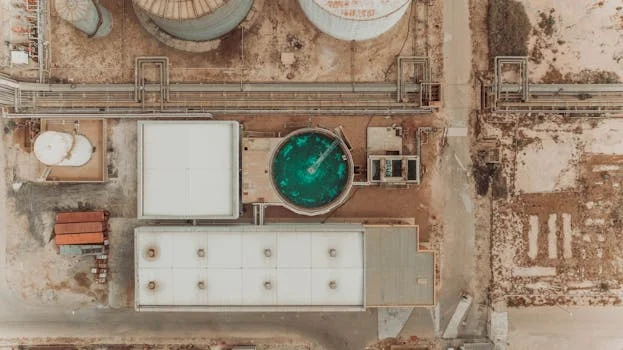
While precipitation converts soluble phosphorus into solids, the resulting flocs are often too light or small to settle efficiently in traditional gravity clarifiers, especially in the high-flow environments of a wafer fab. This is where Dissolved Air Flotation (DAF) becomes essential. DAF systems utilize micro-bubble physics to accelerate the separation process. By dissolving air into the wastewater under pressure (4-6 bar) and then releasing it at atmospheric pressure, millions of 20-50 μm bubbles are generated.
These micro-bubbles attach to the phosphorus-laden flocs, reducing their effective density and causing them to float to the surface. This "buoyancy-driven" separation is significantly faster than sedimentation. A DAF system for high-efficiency phosphorus and TSS removal can achieve 95%+ TSS removal and 85-90% removal of residual precipitated phosphorus (per HydropureWater DAF benchmarks). This is critical for fabs aiming for ultra-low phosphorus limits, as even a small amount of escaped suspended solids can push the effluent TP over the 0.5 mg/L threshold.
Design considerations for DAF in semiconductor fabs include a hydraulic loading rate of 4-6 m/h and an air-to-solids (A/S) ratio of 0.02 to 0.05. The skimmed sludge, which contains high concentrations of metal phosphates, is typically sent to a plate-and-frame filter press for dewatering. For engineers seeking to optimize these systems, an in-depth guide to DAF clarifier operation and optimization provides the necessary physics calculations for bubble-floc attachment efficiency.
Hybrid System Design: Combining Precipitation, DAF, and MBR for ZLD Compliance
For modern wafer fabs, especially those operating in water-stressed regions or under Zero Liquid Discharge (ZLD) mandates, a single-stage treatment is insufficient. A hybrid process design is required to manage the diverse phosphorus species found in CMP wastewater treatment solutions for high silica and phosphorus loads. The most effective configuration is a three-stage hybrid system: UV/Advanced Oxidation → Chemical Precipitation → DAF → MBR Filtration.
The first stage involves UV oxidation to break down chelating agents like EDTA, which otherwise sequester phosphorus. Once the phosphorus is liberated, chemical precipitation and DAF remove the bulk of the inorganic load. The final polishing step utilizes an MBR system for near-reuse-quality effluent in wafer fabs. The MBR’s 0.1 μm pore size membranes act as a physical barrier, ensuring that no particulate phosphorus escapes into the permeate. This hybrid approach allows fabs to reach 99.8% total phosphorus removal, producing water suitable for feed into a ZLD system design for semiconductor wastewater.
| Parameter | Single-Stage (Precipitation) | Hybrid (Precip. + DAF + MBR) | ZLD Integrated System |
|---|---|---|---|
| Effluent TP (mg/L) | 1.5 - 3.0 | < 0.1 | < 0.05 |
| TSS Removal (%) | 70 - 80% | > 99% | > 99.9% |
| Footprint | Large (Clarifiers) | Compact (DAF/MBR) | Moderate to Large |
| Water Reuse Potential | Low | High (Cooling Towers) | Ultra-High (Process Water) |
Integrating these technologies ensures that the MBR permeate can be further treated by Reverse Osmosis (RO) for reclaim, while the RO concentrate—containing the concentrated phosphorus and salts—is sent to an evaporator/crystallizer for final ZLD solids recovery. (HydropureWater field data, 2025).
Cost Breakdown: CAPEX, OPEX, and ROI for Phosphorus Treatment Systems
Procurement teams must balance the high initial investment of hybrid systems against the long-term savings of compliance and water reclamation. For a standard 100 m³/h wafer fab phosphorus treatment line, the CAPEX and OPEX are broken down by component to assist in budgetary planning.
| System Component | Estimated CAPEX (USD) | Estimated OPEX (USD/m³) |
|---|---|---|
| Chemical Dosing (PLC-Controlled) | $50,000 - $80,000 | $0.10 (Reagents) |
| DAF System | $200,000 - $280,000 | $0.05 (Power/Air) |
| UV Oxidation (Chelate Break) | $150,000 - $220,000 | $0.07 (Lamp replacement) |
| MBR Polishing System | $300,000 - $450,000 | $0.08 (Membrane lifecycle) |
| Total System (Hybrid) | $1.2M - $1.8M | $0.30 - $0.45 |
The Return on Investment (ROI) for such a system is typically realized within 18-24 months for high-volume fabs. This calculation considers the avoidance of environmental fines (which can exceed $1M per incident in strict jurisdictions) and the value of reclaimed water. By reusing MBR permeate for cooling tower makeup, fabs can reduce raw water intake by up to 30%, significantly lowering operational costs. To further optimize OPEX, fabs should implement online phosphorus analyzers to automate coagulant dosing, preventing the "over-dosing" of alum or ferric, which is a common source of wasted chemical spend.
Compliance Checklist: Meeting Global Phosphorus Discharge Standards
EHS managers must maintain rigorous documentation and sampling protocols to ensure continuous compliance with regional standards. The following checklist serves as a baseline for wafer fab phosphorus management:
- China GB 31573-2015: Ensure Total Phosphorus (TP) is consistently < 0.5 mg/L, COD < 50 mg/L, and TSS < 10 mg/L.
- US EPA 40 CFR Part 469: Maintain TP < 2.0 mg/L. Note that some local POTW (Publicly Owned Treatment Works) permits may require < 1.0 mg/L.
- EU Directive: Aim for < 1.0 mg/L in "Sensitive Areas" (e.g., near inland lakes or slow-moving rivers).
- Sampling Protocol: Utilize 24-hour composite samplers rather than grab samples to account for batch variations in CMP and etching cycles.
- Monitoring Frequency: Daily influent/effluent TP monitoring for high-risk fabs; weekly for low-volume facilities.
- Documentation: Maintain detailed logs of coagulant dosing rates, pH levels at the precipitation stage, and DAF air-to-solids ratios for regulatory audits.
Frequently Asked Questions

What is the most effective coagulant for semiconductor phosphorus wastewater?
Ferric chloride is generally preferred for its effectiveness across a wider pH range (6.5-8.0) and its ability to handle residual chelates after UV oxidation. However, for non-chelated streams, aluminum sulfate (alum) is more cost-effective and produces a more manageable sludge volume.
How do I treat CMP wastewater with high phosphorus and silica loads?
This requires a two-stage precipitation approach. First, use lime (calcium hydroxide) to raise the pH to 10-11 to precipitate silica as calcium silicate. Following silica removal, the pH is lowered to 7.0, and ferric chloride is added to precipitate the phosphorus. DAF is then used to remove both types of flocs efficiently.
What are the signs of poor phosphorus removal in a DAF system?
Key indicators include effluent TSS exceeding 50 mg/L, visible "pin-floc" in the clarified water channel, or a rising sludge blanket that fails to compact. These issues are usually caused by pH drift, insufficient polymer dosing for flocculation, or a mismatch in the air-to-solids ratio.
Can MBR systems remove phosphorus without chemical precipitation?
No. While MBRs are excellent for solids and organic removal, biological phosphorus uptake in MBR systems is typically limited to 20-30% of the influent load. Chemical precipitation is mandatory upstream of the MBR to meet the < 0.5 mg/L discharge limits required for wafer fabs.
What is the typical payback period for a hybrid phosphorus treatment system?
For fabs processing 500+ m³/day, the payback period is 18-24 months. This is driven by the avoidance of regulatory fines and the significant reduction in water procurement costs through MBR/RO reclamation. Smaller fabs (under 100 m³/day) typically see a payback in 3-4 years.