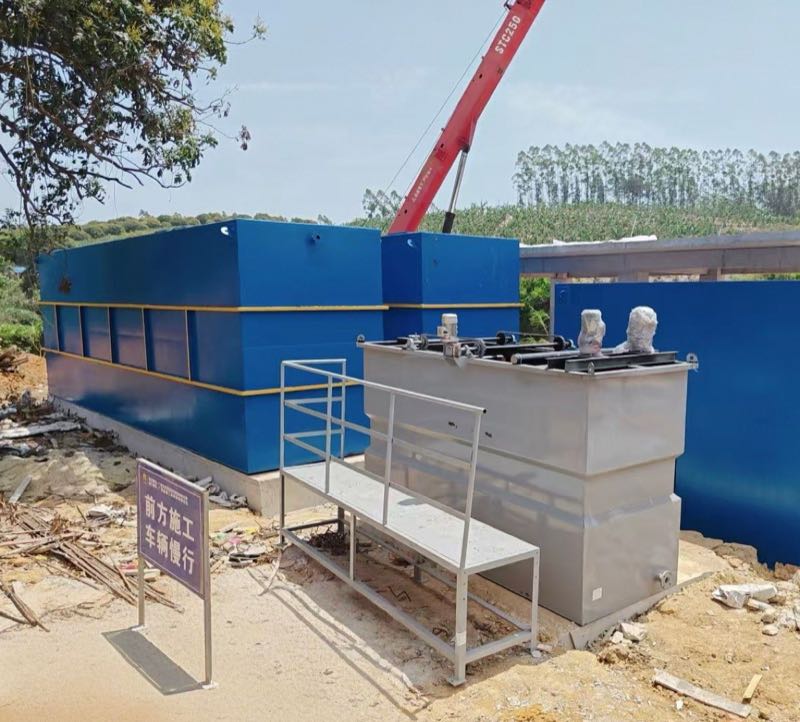
Characterize the wastewater before selecting equipment
A high-COD industrial wastewater treatment system in The Bahamas should be selected based on the wastewater profile rather than COD concentration alone. Confirm COD, BOD, the BOD/COD ratio, flow, pH, temperature, salinity, oil and grease, suspended solids, and toxicity indicators before comparing bids. High-strength streams may require equalization and DAF pretreatment, followed by anaerobic treatment where biodegradable, aerobic polishing, and membranes or other advanced treatment where required. The supplied research does not establish Bahamas-specific discharge limits, so the final route must be verified with the receiving authority and the facility’s permit.
COD is normally reported in mg/L and can be tested in two hours, but it measures oxidizable material rather than toxicity. ALAR’s COD overview makes that distinction explicit: COD results often correlate with BOD, yet the test does not measure toxic substances. A bid based on COD concentration alone leaves a material gap in the design basis.
Use paired COD and BOD results to assess biodegradability, not as interchangeable measurements. GL Environment’s high-COD treatment article identifies extreme organic loading, toxicity, salinity, oil and grease, and inhibitory substances as conditions that complicate biological treatment. A low BOD/COD ratio limits conventional aerobic performance and increases instability and operating costs.
Before selecting an anaerobic UASB, IC, or EGSB reactor, require wastewater characterization and project-specific treatability testing. The supplier should then use the measured COD load, BOD/COD ratio, inhibitory compounds, temperature, pH, salinity, hydraulic profile, and effluent requirement to establish reactor configuration and loading. The broader industrial wastewater treatment equipment selection guide provides the appropriate sequence for comparing these options.
| Required design input | What the buyer must obtain | Decision it controls |
|---|---|---|
| COD and BOD | Paired results from representative production and washdown samples | Organic load and preliminary biodegradability assessment |
| Flow | Average, peak and minimum flow, including batch-discharge conditions | Equalization and reactor hydraulic sizing |
| BOD/COD ratio | Calculated ratio from paired analyses | Whether biological treatment is credible without pretreatment |
| pH, temperature and salinity | Range during normal production and discharge cycles | Anaerobic and aerobic process suitability |
| Oil and grease and suspended solids | Concentrations and settleable or floatable fraction | Need for equalization, coagulation-flocculation or DAF |
| Toxicity indicators | Site-specific screening and treatability evidence | Whether direct biological treatment requires protection or pretreatment |
| Effluent requirement | Applicable Bahamian permit or approval condition | Final polishing and acceptance criteria |
Map COD strength to a defensible treatment train
A defensible high-COD treatment train reduces the organic load in stages rather than sending a high-strength stream directly to a single biological unit. GL Environment’s high-COD wastewater treatment article identifies pretreatment, anaerobic treatment, aerobic treatment, and advanced polishing as the practical sequence. This staged arrangement protects biological systems and allows performance to be tested at each boundary.
- Stabilize and remove material that can inhibit biology. Use equalization for flow and load variation, and coagulation-flocculation or DAF where suspended solids, oil, and separable organic matter warrant removal. A DAF system for high-COD wastewater pretreatment is relevant to floatable solids and oil removal, but it does not remove dissolved refractory COD.
- Reduce biodegradable organic load without aeration. Evaluate UASB, IC, or EGSB only after characterization and treatability testing. GL Environment identifies COD load, BOD/COD ratio, inhibitory compounds, temperature, pH, salinity, hydraulic profile, biogas objectives, and required effluent quality as the selection inputs. Project-specific sludge yield and operating cost remain part of that evaluation.
- Polish biologically under controlled conditions. Select A/O, SBR, or MBR according to the residual load, footprint, effluent quality, and operating requirements. GL Environment identifies MBR as a choice where compact construction or high effluent quality is required, while A/O and SBR provide alternatives that must be checked against the actual wastewater.
- Add final barriers where required. Activated carbon, UF, NF, RO, or additional advanced oxidation should be assessed where discharge limits are stringent or industrial effluent reuse is part of the project scope. Their selection depends on the compounds remaining after the biological train and the receiving or reuse specification.
| Measured condition | Preferred process step | Selection test before purchase |
|---|---|---|
| Variable flow or batch discharges | Equalization | Confirm equalization duty against measured flow and load ranges |
| Oil, grease or separable solids | Coagulation-flocculation and/or DAF | Establish removal need from oil-and-grease and suspended-solids results |
| Biodegradable high-strength stream | Anaerobic reactor followed by aerobic treatment | Use treatability results, hydraulic profile and loading criteria |
| Low BOD/COD ratio or inhibitory compounds | Enhanced pretreatment, advanced oxidation or non-biological separation | Identify the compound causing the treatment limitation |
| Strict effluent or reuse requirement | Activated carbon, UF, NF, RO or advanced oxidation | Test against the exact Bahamian acceptance or reuse specification |
The supplied reactor study provides a scoped performance reference, not a universal guarantee. In the three-phase fluidized bed work by Ryerson University Library and Archives, the reactor treated 1,500 L/day of wastewater containing 5,000 mg/L COD and 230 mg/L ammonia at an 8-hour hydraulic residence time; under the designed condition, COD removal was 91.7% and ammonia removal was 56.7%. The COD removal treatment train design should be evaluated as a sequence of unit duties rather than copied as a performance claim.
Set pretreatment and biological load around shock conditions
Shock loads and inhibitory compounds are process-design conditions that require robust system sizing. GL Environment states that direct biological treatment often fails when microorganisms cannot adapt to sudden loads or inhibitory conditions. A low BOD/COD ratio also limits conventional aerobic treatment, increasing operating cost and instability. Equalization and solids removal should be sized around the measured operating envelope, not only the average flow.
The three-phase fluidized bed study shows why hydraulic and biological loading cannot be separated. When influent COD increased from 5,000 to 6,000 mg/L, COD removal decreased from 91.7% to 84.5%, while ammonia removal increased from 56.7% to 75%. The increase in ammonia removal was associated with more biomass available for ammonia utilization. This result applies to a specific 1,500 L/day test with an 8-hour hydraulic residence time and should not be transferred directly to another wastewater or used as a design guarantee.
Use the EGSB reactor suitability and sizing checklist to obtain the wastewater-specific inputs needed for reactor selection. For pretreatment, the supplied HydropureWater DAF range covers 4-300 m³/h across 13 standard models. That range is a product-screening reference: confirm the selected model’s hydraulic duty, feed characteristics, flotation performance, and fit within the complete treatment train.
For procurement, require the designer to show how peak COD load, flow variation, temperature, pH, salinity, and inhibitory constituents affect equalization residence time, reactor loading, and downstream biological capacity. Where upstream batch operations create concentrated releases, the control strategy must identify how the system protects biomass while keeping the permitted discharge route available.
Verify The Bahamas discharge and reuse route
The discharge route is a design input that must be resolved before the equipment specification is frozen. The project needs a named receiving authority, confirmed discharge point, treatment destination, applicable Bahamas wastewater permit, and a clear statement of whether the effluent will be reused. These approvals and site constraints determine the final treatment boundaries and acceptance tests.
The supplied research does not establish a verified Bahamas-specific COD limit, discharge procedure, or reuse standard. Bristol A2’s wastewater treatment article explains that U.S. discharge standards are permit-specific, but that framework cannot be substituted for a Bahamian approval. Do not insert a U.S., European Union, or other foreign limit into the specification without written project confirmation.
Where the confirmed requirement is stringent or industrial effluent reuse is involved, GL Environment identifies activated carbon, UF, NF, RO, and additional advanced oxidation as potential polishing steps. The MBR system for aerobic COD polishing and water reuse may be relevant where the biological stage requires high effluent quality or a compact installation, but reuse quality must be documented separately from discharge acceptance.
Use the exact effluent requirement in the Bahamian approval or from the receiving authority as the contractual acceptance basis. A permit may address more than COD, including flow, pH, suspended solids, toxicity, and monitoring conditions. If reuse is proposed, record the receiving process, end use, and water-quality specification as distinct acceptance criteria; the permitted discharge route should not be used as a substitute for an industrial reuse specification.
Turn the design into a supplier-ready purchase package
A bid package should convert measured wastewater conditions and confirmed approval requirements into testable equipment and performance obligations. Issue every bidder the characterization results, flow range, treatment objective, site constraints, available utilities, waste-handling route, required documentation, and the exact effluent specification. A bidder should return a complete proposed train rather than an isolated reactor or clarification unit.
Require guaranteed process performance tied to the agreed influent envelope and final acceptance specification. A generic removal percentage is insufficient unless the influent COD, flow, operating condition, and test method are stated. Include the proposed treatment train, sizing calculations, materials of construction, control philosophy, commissioning tests, operator training, and consumables list.
| Bid item | Acceptance check |
|---|---|
| Process basis | Uses the issued wastewater characterization, flow range and site constraints |
| Equipment sizing | Shows hydraulic and organic loading calculations with stated assumptions |
| Performance guarantee | Defines test conditions, test methods and the agreed effluent specification |
| Mechanical design | Identifies materials of construction, access, utilities and site interfaces |
| Controls | Explains sequencing, equalization, level control, alarm response and operating modes |
| Residual waste | Documents sludge, DAF scum or spent-media handling and disposal route |
| Handover | Commits to commissioning tests, operator training and required documentation |
The supplied HydropureWater MBR catalog range is 10-2,000 m³/day with filtration below 1 μm. Treat that as a screening reference only when MBR polishing has been justified by the wastewater profile and effluent requirement. The industrial wastewater treatment equipment selection guide is useful when checking that each bidder has connected pretreatment, biological treatment, and final polishing into one operable train.
Frequently Asked Questions
How should a high-COD treatment system be sized for a Bahamian industrial facility?
Size the preliminary train from measured COD, flow, and biodegradability, together with pH, temperature, salinity, oil and grease, suspended solids, and toxicity. COD concentration alone cannot establish reactor volume, pretreatment duty, or biological loading. Obtain the required effluent specification before finalizing equipment capacity.
What should buyers request from a treatment-system supplier?
Request wastewater-specific sizing calculations, the complete proposed treatment train, guaranteed performance under the stated influent envelope, utility demands, controls, residual-waste handling, commissioning tests, and operator training. Do not accept an unqualified removal percentage or a performance claim from unrelated wastewater.
Which discharge requirement should be used for final equipment acceptance?
Use the facility-specific requirement confirmed by the relevant Bahamian authority and receiving point. The supplied research does not establish a verified Bahamas-wide COD limit or discharge procedure. Put the confirmed permit conditions into the bid package and acceptance tests instead of borrowing limits from another jurisdiction.
How much should a high-COD industrial wastewater treatment system cost?
Request a project-specific quotation after the wastewater characterization, flow range, treatment train, and effluent specification are defined. A defensible price should separate equipment, civil works, installation, controls, commissioning, utilities, chemical use, biological-media or membrane replacement, and residual-waste handling. No supplied research provides a representative quotation, so a generic price would not support procurement.