Smart Water Management Trends: Industrial Technologies & ROI for 2025-2033
Smart water management trends are driven by increasing water scarcity, stringent regulations, and the need for operational efficiency, pushing the global market to an estimated USD 50.74 billion by 2033 with a 12.7% CAGR. Key trends for industrial wastewater include IoT-driven real-time monitoring, AI/ML for process optimization, digital twins for predictive modeling, and advanced automation to reduce water loss and enhance treatment efficacy. These technologies offer industrial plant managers and environmental engineers actionable insights for modernizing their wastewater treatment infrastructure, promising significant returns on investment.The Growing Landscape of Smart Water Management: Market Dynamics & Industrial Imperatives
The global smart water management market was estimated at USD 18,340.5 million in 2024 and is projected to reach USD 50,740.8 million by 2033, demonstrating a robust compound annual growth rate (CAGR) of 12.7% from 2025 to 2033 (Grand View Research, 2024). This substantial growth underscores the escalating importance of advanced water resource management technology across various sectors. The industrial segment holds a dominant position within this market, accounting for a leading 43.8% revenue share in 2024, highlighting its key contribution to market expansion and innovation. Primary drivers fueling this growth include rising global concerns over water scarcity, increasingly stringent government regulations for water conservation, and growing investments in digital water infrastructure (Mordor Intelligence, 2024). Rapid urbanization and population growth place mounting stress on finite freshwater reserves, accelerating the demand for intelligent, sustainable water management alternatives in industrial settings to mitigate operational risks and ensure compliance. For a broader overview of the market, refer to our analysis on wastewater treatment market forecasts.Defining the Key Smart Water Management Trends for Industrial Wastewater
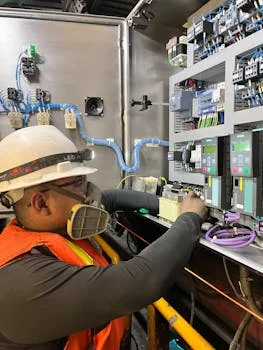
| Smart Water Management Trend | Industrial Wastewater Application | Key Benefit for Industrial Plants |
|---|---|---|
| IoT-Enabled Real-Time Monitoring & Data Acquisition | Continuous influent/effluent quality tracking, leak detection, equipment performance monitoring. | Enhanced operational transparency, early anomaly detection, optimized resource allocation. |
| AI and Machine Learning for Predictive Analytics & Process Optimization | Optimized chemical dosing, predictive maintenance, adaptive process control. | Significant reduction in operational costs, improved treatment efficacy, proactive problem-solving. |
| Digital Twins for Simulation, Optimization, and Strategic Planning | Virtual testing of process changes, infrastructure upgrades, operator training. | Reduced operational risks, optimized CAPEX/OPEX, informed decision-making. |
| Advanced Automation & Remote Control Systems | Automated pump control, valve adjustments, centralized plant operation. | Reduced labor, consistent performance, enhanced safety, rapid response. |
Trend 1: IoT-Enabled Real-Time Monitoring & Data Acquisition
IoT sensors provide continuous, granular data from various points within the industrial wastewater treatment process, forming the foundational layer of any smart water management system. These sensors, including flow meters, pH sensors, turbidity meters, level sensors, and dissolved oxygen probes, enable precise monitoring of critical parameters. In industrial applications, this translates to real-time influent and effluent quality monitoring, allowing operators to immediately detect deviations from regulatory limits or process setpoints. IoT also facilitates precise chemical consumption tracking, ensuring optimal dosing while enabling early leak detection in complex pipeline networks, preventing significant water loss and infrastructure damage. These sensors are vital for predictive maintenance of pumps, motors, and other mechanical components by continuously monitoring vibration, temperature, and power consumption, as discussed in our guide on selecting IoT sensors for wastewater treatment. The benefits for industrial plants are manifold: enhanced operational transparency through a unified data dashboard, early anomaly detection that prevents costly failures, optimized resource allocation by understanding real-time demand, and simplified compliance reporting with automatically logged data. The rapid adoption of LPWAN (Low-Power Wide-Area Network) connectivity, contributing a +1.9% impact on CAGR (Mordor Intelligence, 2024), further drives this trend by enabling cost-effective and reliable data transmission over long distances, making comprehensive industrial IoT water deployments more feasible.Trend 2: AI and Machine Learning for Predictive Analytics & Process Optimization
Trend 3: Digital Twins for Simulation, Optimization, and Strategic Planning
Digital twin technology offers a virtual replica of a physical wastewater treatment plant, continuously updated with real-time data from IoT sensors, empowering industrial operators with advanced simulation and strategic planning capabilities. This dynamic model mirrors the physical plant's layout, processes, and performance, allowing for comprehensive analysis without impacting live operations. In industrial settings, digital twins are applied to simulate the impact of varying influent loads, such as sudden industrial discharges or changes in production cycles, or to predict the effects of altering chemical addition points or dosages. Engineers can optimize process parameters virtually, identifying the most efficient operating conditions for MBR membrane bioreactor systems for high-quality effluent or other advanced treatment technologies. Crucially, digital twins enable the testing of infrastructure upgrades or new equipment integrations before physical implementation, significantly de-risking capital investments. The benefits include reduced operational risks by validating changes in a safe, virtual environment, optimized CAPEX and OPEX through data-driven planning and efficiency gains, faster and more informed decision-making based on predictive modeling, and enhanced operator training through realistic simulation scenarios. The growing importance of 'Digital-Twin Platforms for Predictive Modeling' is reflected in its +1.2% impact on CAGR (Mordor Intelligence, 2024), highlighting its importance in strategic infrastructure management. To learn more about this innovation, explore our guide on digital twin technology for wastewater plants.Trend 4: Advanced Automation & Remote Control Systems for Operational Efficiency
Implementing Smart Water Management: Challenges, ROI, and Future Outlook for Industry
Implementing smart water management solutions in industrial facilities presents several common challenges that require strategic planning and investment. Initial capital investment for sensors, software, and integration can be substantial, necessitating a clear business case and phased implementation. Ensuring robust data security and privacy is paramount, especially when dealing with sensitive operational data and connecting systems to external networks. Integrating new smart systems with existing legacy infrastructure, which often involves outdated hardware and proprietary software, can be complex and requires specialized engineering expertise. Finally, addressing the skill gap for operating and maintaining advanced technologies is essential, requiring investment in training for existing staff or recruitment of new talent. Despite these hurdles, the return on investment (ROI) for industrial plants adopting smart water management is significant and quantifiable. ROI can be calculated by quantifying savings from reduced energy consumption (e.g., optimized pumping, aeration), optimized chemical usage (e.g., AI-driven dosing), decreased labor costs due to automation and remote monitoring, and avoidance of costly regulatory fines through consistent compliance. Further financial benefits include extended asset lifespan through predictive maintenance, minimizing capital expenditure on premature equipment replacement, and improved water reuse potential, reducing reliance on fresh water sources and associated costs. These efficiencies contribute to enhanced sustainability, resource efficiency, and improved environmental stewardship, which also carries brand and reputational value. The future outlook for smart water technologies in industry is one of continued evolution and increasing integration. As AI capabilities advance and sensor technology becomes more affordable and robust, smart water management will become an indispensable component of resilient and sustainable industrial operations, driving further innovation in industrial water intelligence and sustainable water management.Frequently Asked Questions
What are the main drivers for smart water management adoption in industry?
The main drivers include increasing water scarcity, stringent government regulations for water conservation and discharge quality, and the growing need for operational efficiency to reduce costs and improve sustainability in industrial processes.What technologies are central to smart water management for wastewater?
Central technologies include IoT sensors for real-time data acquisition, AI and machine learning for predictive analytics and process optimization, digital twins for simulation and strategic planning, and advanced automation and remote control systems for operational efficiency.How does smart water management benefit industrial wastewater treatment plants?
Smart water management benefits industrial plants by reducing operational costs (energy, chemicals, labor), improving treatment efficacy and regulatory compliance, extending asset lifespan through predictive maintenance, enhancing operational transparency, and enabling proactive problem-solving.What are the challenges in implementing smart water management systems?
Key challenges include the initial capital investment, ensuring data security and privacy, integrating new systems with legacy infrastructure, and addressing the skill gap among staff for operating advanced technologies.How much is the smart water management market expected to grow?
The global smart water management market is projected to grow from USD 18,340.5 million in 2024 to USD 50,740.8 million by 2033, exhibiting a compound annual growth rate (CAGR) of 12.7% from 2025 to 2033.Related Equipment
- PLC-controlled chemical dosing systems — view specifications, capacity range, and technical data
- fully automated integrated wastewater treatment plants — view specifications, capacity range, and technical data
- MBR membrane bioreactor systems for high-quality effluent — view specifications, capacity range, and technical data
Need a customized solution? Request a free quote with your specific flow rate and pollutant parameters.