Start with a two-stream water balance
A Chiclayo data center generally needs two separate treatment trains: one for cooling-tower blowdown and one for sanitary wastewater. Blowdown should be equalized and characterized before discharge or reuse decisions are made. The reference relationship is Blowdown = Makeup ÷ (COC − 1). For sanitary flow, use sewer connection where capacity and pretreatment approval exist; otherwise consider a packaged treatment plant or MBR. Chiclayo’s actual limits must be confirmed with the competent sewer and environmental authorities because Lima figures are not automatically applicable.
Cooling blowdown and sanitary wastewater should remain hydraulically separate because their chemistry, biology and downstream treatment requirements differ. HydropureWater (2026) identifies this separation as essential: phosphonate and biocide residuals can disrupt a biological stage, while sanitary BOD variation can disturb a chemistry-controlled softening and RO train.
Use the mechanical engineer’s cooling-system data as the controlling input. Black Forge Data Centers states that blowdown volume depends on cooling design, climate and makeup-water quality; it should not be selected by rule of thumb. The mechanical design must provide makeup flow, cycles of concentration, seasonal operating profile, evaporation assumptions, drain-downs and peak discharge conditions.
HydropureWater (2026) uses a 40 MW campus at PUE 1.4 to illustrate 200–800 m³/day of makeup and 50–200 m³/day of blowdown at 4 COC. This is a planning reference, not a Chiclayo design. Sanitary demand should be calculated from occupancy and staffing assumptions; HydropureWater (2026) gives 50–100 L/person/day for a hyperscale staffing profile.
| Design input | Evidence-based basis | Information required for Chiclayo |
|---|---|---|
| Cooling makeup | HydropureWater (2026): 200–800 m³/day for its 40 MW, PUE 1.4 reference | Mechanical-engineer flow by season and operating condition |
| Cooling blowdown | HydropureWater (2026): 50–200 m³/day at 4 COC for the same reference | Makeup, COC, evaporation and drain-down schedule |
| Sanitary wastewater | HydropureWater (2026): 50–100 L/person/day for a hyperscale staffing profile | Staff count, shift pattern, visitors and kitchen flows |
| Source-water analysis | Parameters identified in the supplied engineering references | pH, conductivity or TDS, suspended solids, silica, calcium, hardness, temperature, residual biocide, scale and corrosion inhibitors, phosphonate, oil and grease, and chlorine or bromine residuals |
See also data center cooling blowdown treatment in a water-stressed location and the regional cooling blowdown treatment comparison.
Choose the discharge and reuse route before buying equipment
Sewer disposal is technically credible for cooling blowdown only after Chiclayo’s receiving utility confirms hydraulic capacity, pretreatment requirements, discharge route and acceptance of the proposed concentration, temperature and treatment chemicals. Black Forge Data Centers identifies dissolved solids, temperature, pH and residual treatment chemicals as typical discussion points, with pass-through and interference as the central sewer-discharge risks.
For sanitary wastewater, compare direct sewer discharge with on-site treatment. Black Forge Data Centers notes that utilities may impose industrial-user permits, sampling, reporting, inspections or capacity conditions. A sewer connection should therefore be treated as a utility entitlement rather than an assumed design outcome.
- If sewer capacity and pretreatment acceptance are confirmed: route each stream to the appropriate treatment route, subject to the utility’s written limits and permit conditions.
- If blowdown chemistry and a reuse destination are credible: evaluate side-stream reverse osmosis, with the recovered permeate defined for a specific use such as cooling-tower makeup.
- If discharge is severely constrained or sewer capacity is inadequate: reserve MVC or full ZLD for a demonstrated high-recovery case. IDE Tech (2026) describes controlled salt precipitation and dynamic RO operation as a route to higher recovery.
Do not transfer Lima permits or limits to Chiclayo. HydropureWater (2026) cites pH 5–9, BOD at or below 120 mg/L and oils and greases at or below 50 mg/L as Lima sewer-disposal floors, not Chiclayo standards. The Chiclayo concept should identify the competent municipal sewer authority, the discharge destination, applicable pretreatment requirements and any receiving-water or site-specific constraints.
| Route | Best fit | Main trigger | Key risk to close |
|---|---|---|---|
| Cooling blowdown to sewer | Utility has capacity and accepts the discharge chemistry | Written capacity and pretreatment confirmation | Pass-through, interference, temperature and treatment-chemical residuals |
| Sanitary wastewater to sewer | Receiving utility accepts sanitary flow | Capacity letter and applicable industrial-user conditions | Peak flows, reporting and connection obligations |
| Side-stream RO reuse | Reliable cooling chemistry and defined permeate use | Feed analysis, recovery target and water balance | Scaling, membrane fouling and no place to use the permeate |
| MVC or full ZLD | Severe discharge constraints or demonstrated high-recovery requirement | Mass balance, brine destination and solids handling | Capital exposure, energy demand and salt-management route |
The coastal data center blowdown treatment guide provides a comparison with another coastal setting, while the Villa Nueva treatment reference illustrates why discharge route remains jurisdiction-specific.
Build a treatment train that protects the reuse equipment
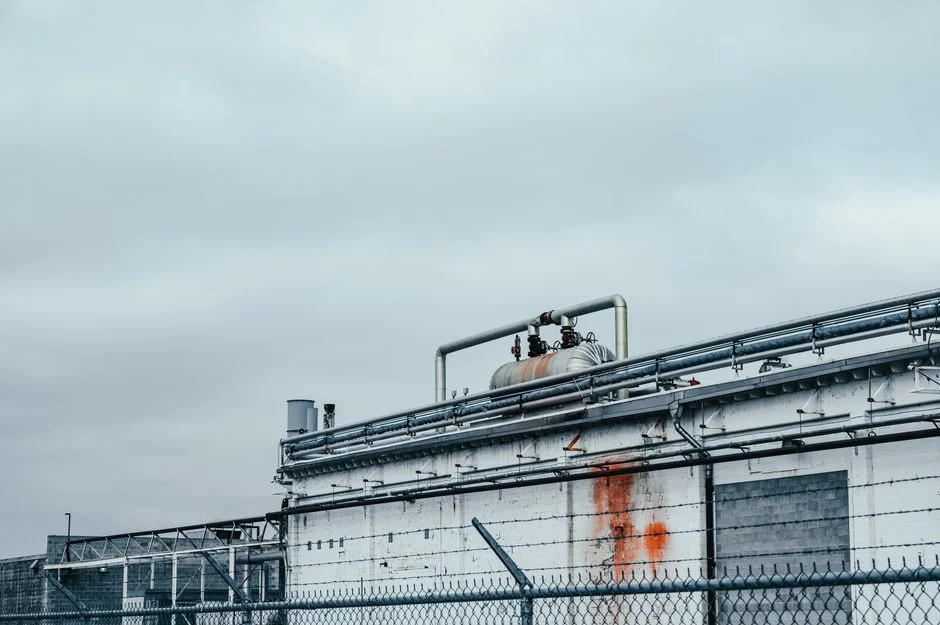
A typical blowdown sequence is equalization, solids removal, softening where required, membrane treatment and disinfection. The exact sequence must follow the water analysis, recovery target and reuse objective; it should not be copied from a Lima or other coastal reference.
Use an industrial DAF pretreatment system when suspended solids, oil and grease or colloidal material could overload downstream membranes. HydropureWater (2026) describes DAF capacity of 4–300 m³/h and a target outlet below 20 mg/L TSS in its Lima reference design.
Use softening when hardness and scaling tendency justify it. HydropureWater’s industrial softener range is 1–45 T/h with twin tanks and paired brine tanks. UF is another pretreatment option where it can reliably reduce colloids, bacteria and suspended solids; HydropureWater’s UF systems operate at 2,000–40,000 L/h with 0.03 micron PVDF membranes and automatic backwash and air scour.
Design the industrial RO blowdown reuse system around feed composition, recovery and scaling envelope rather than a headline recovery percentage. IDE Tech (2026) reports that conventional brackish RO commonly reaches 75–80% recovery before scaling becomes unmanageable. Chiclayo permeate quality, concentrate volume and the destination of that concentrate must therefore be established together.
Manage chemical feed with a PLC-controlled automatic chemical dosing system. HydropureWater (2026) identifies antiscalant, sulfuric acid and chlorine dioxide precursor dosing for cooling-loop treatment in the Lima reference design. The actual chemical program must follow Chiclayo feed chemistry and the chosen loop chemistry.
Use chlorine dioxide where on-site control of microbial risk and residual treatment is required. HydropureWater’s ClO₂ generators are available from 50 g/h to 20,000 g/h. If DAF generates sludge, provide an plate-and-frame sludge dewatering press; HydropureWater (2026) describes dewatering to 25–35% dry solids in the referenced Lima concept.
| Process stage | Function | Selection basis | Reference evidence |
|---|---|---|---|
| Equalization | Balance flow and concentration before treatment | Average, peak and seasonal blowdown | HydropureWater (2026) includes equalization in the Lima concept |
| DAF | Remove suspended and floatable material | TSS, oil and grease, colloids and membrane-fouling risk | HydropureWater (2026): 4–300 m³/h; target below 20 mg/L TSS |
| Softening | Reduce hardness-related scaling risk | Calcium, hardness, alkalinity and recovery target | HydropureWater: 1–45 T/h twin-tank range |
| UF | Provide membrane pretreatment | Colloids, bacteria and suspended-solids control | HydropureWater: 2,000–40,000 L/h; 0.03 micron PVDF |
| RO | Recover permeate for a defined reuse | Feed chemistry, scaling and concentrate route | IDE Tech (2026): conventional brackish RO commonly 75–80% recovery |
| Disinfection | Control microbial risk and residual | Reuse point and residual requirement | HydropureWater: ClO₂ generators from 50 g/h to 20,000 g/h |
Treat sanitary wastewater on a separate biological train
Sanitary wastewater should remain separate from cooling blowdown because biocide and scale-control residuals can inhibit biological treatment and because sanitary load changes can disturb the cooling-blowdown process chemistry. Use sewer disposal where the receiving utility has capacity and accepts the discharge without excessive industrial-user requirements.
For smaller flows with no reuse intent, HydropureWater (2026) states that a packaged buried sewage treatment plant can be sufficient; the WSZ series handles 1–80 m³/h. This option should be evaluated against Chiclayo’s sanitary flow, footprint, soil conditions, maintenance access and discharge route.
Where treated sanitary water may be reused for cooling-tower makeup or toilet flushing, evaluate an MBR sanitary wastewater reuse system. HydropureWater (2026) describes submerged PVDF MBR at below 1 µm filtration, BOD below 5 mg/L and TSS below 1 mg/L without tertiary polishing.
HydropureWater’s MBR product range covers 10–2,000 m³/day, while DF flat-sheet modules are offered in 32–135 m³/day configurations with 0.1 µm pores. These are equipment-selection ranges, not proof that a Chiclayo flow or reuse target has been met.
| Sanitary option | Indicative scope in supplied evidence | Decision condition |
|---|---|---|
| Sewer discharge | No equipment range specified | Utility capacity, acceptance and permit conditions confirmed |
| Packaged buried plant | HydropureWater (2026): WSZ handles 1–80 m³/h | Flow is suitable and there is no meaningful reuse requirement |
| MBR | HydropureWater (2026): 10–2,000 m³/day; below 1 µm filtration, BOD below 5 mg/L and TSS below 1 mg/L in the referenced design | Reuse requires a defined destination and the stated performance is appropriate |
The WSZ integrated sewage treatment concept is relevant only after the sanitary flow and site conditions are confirmed.
Compare capital cost, operating cost and compliance exposure
Available cost benchmarks support an initial business case, but they are not Chiclayo quotations. HydropureWater (2026), citing Genesis (2024), estimates $250,000–$500,000 installed and $1.50–$3.00 per 1,000 gallons treated for a 50,000 GPD RO blowdown system. The scope, feed chemistry, construction conditions and disposal costs are not established for the proposed campus.
For a more capital-intensive alternative, HydropureWater (2026), citing Genesis (2024), gives $1–3 million CAPEX and 15–25 kWh per 1,000 gallons of distillate for 10,000–30,000 GPD MVC. For full ZLD, the same source gives $3–8 million CAPEX and $5–$15 per 1,000 gallons OPEX at 95–99% overall recovery. These figures should not be transferred to Chiclayo without matched flow, feed chemistry, power cost, solids route and construction pricing.
Exclude sewer connection fees, power tariff changes, chemical consumption, membrane replacement, sludge disposal, staffing, seawater infrastructure and land costs unless they are added explicitly to the project model. These omissions can materially change total cost and must appear as explicit exclusions or allowances.
| Benchmark | Supplied scope | CAPEX | Operating basis |
|---|---|---|---|
| RO blowdown reuse | 50,000 GPD | $250,000–$500,000 installed | $1.50–$3.00 per 1,000 gallons treated |
| MVC | 10,000–30,000 GPD | $1–3 million | 15–25 kWh per 1,000 gallons of distillate |
| Full ZLD | 95–99% overall recovery | $3–8 million | $5–$15 per 1,000 gallons |
Ask suppliers to state design feed, average and peak flow, required recovery, permeate quality, guarantee points, included pretreatment and exclusions. Use a one-year sample campaign and written confirmation from the receiving authority before treating indicative costs as an approval-ready budget. Membrane replacement and chemical consumption should also be evaluated using the RO and UF replacement elements as an equipment reference rather than an assumed lifecycle allowance.
Turn the concept into an approval-ready supplier brief
A comparable bid requires one source-water package for cooling blowdown and sanitary wastewater, not a generic request for a “data center wastewater treatment system.” The package should include the cooling design, makeup source, cycles of concentration, seasonal operating profile, chemical inventory and proposed reuse destination. It should also state the staffing basis, sanitary peak flow and whether reuse is required.
Attach a 12-month influent dataset where available. Otherwise, require a sampling plan covering suspended solids, pH, conductivity, TDS, silica, hardness, temperature, residual chemicals and oil and grease, with the sampling frequency justified by operating variability.
Attach the sewer authority’s capacity letter, pretreatment requirements, approved discharge route, applicable local limits and sampling obligations. Written confirmation is more useful than a general statement that the plant will accept the flow.
Require each bidder to show:
- Stream separation and a preliminary mass balance.
- Equipment sizing based on average and peak flow.
- Recovery calculation and concentrate destination.
- Chemical requirements and residual-control strategy.
- Sludge handling and disposal assumptions.
- Controls, guarantees, battery limits and construction schedule.
Mark every permit-dependent assumption as a hold point. The effluent treatment buyer guide provides a useful structure for organizing that information, but the Chiclayo permit holder and limits must be identified locally.
Frequently Asked Questions
How much does cooling blowdown treatment cost for a Chiclayo data center?
Use $250,000–$500,000 installed and $1.50–$3.00 per 1,000 gallons treated only as the supplied 50,000 GPD RO benchmark, attributed by HydropureWater (2026) to Genesis (2024). Obtain a Chiclayo quotation because feed chemistry, construction, sewer connection and disposal costs are not included.
Should the Chiclayo data center buy a packaged sewage treatment plant or an MBR?
Choose a packaged plant when the flow falls within the WSZ range of 1–80 m³/h and there is no meaningful reuse objective. Consider an MBR when reuse is required and its below 1 µm filtration, BOD below 5 mg/L and TSS below 1 mg/L performance in the HydropureWater (2026) reference is appropriate for the intended use.
Can cooling blowdown and sanitary wastewater be treated together?
Keep them on separate process trains unless a site-specific engineering evaluation proves that equalization, chemical control and biological treatment can safely handle the combined chemistry and hydraulic peaks. HydropureWater (2026) identifies biocide and phosphonate residuals as a biological-treatment risk and sanitary BOD variation as a risk to the chemistry-controlled train.
What information should a wastewater-equipment supplier request?
Provide cooling-system flows, COC, makeup and seasonal data, measured blowdown chemistry, sanitary staffing, reuse intent, sewer requirements, applicable limits, operating hours and power availability. Require the bidder to identify any missing input rather than fill it with an unstated default.
Which permits and standards must be confirmed in Chiclayo?
Confirm the competent municipal sewer authority, ANA water-right requirements, the applicable DIGESA or environmental-discharge framework and any site-specific receiving-water or sewer limits. Do not apply the Lima values cited by HydropureWater (2026) without confirmation. See the related data center wastewater treatment reference and domestic sewage treatment guide for briefing structure rather than jurisdictional limits.
Related Equipment
- MBR sanitary wastewater reuse system — specifications, capacity range, and technical data