
Why Lima Is the Constraining City for Hyperscale Water
Lima averages less than 10 mm/yr of rainfall along its Pacific coastal strip, and almost every liter of municipal and industrial supply arrives through three Andean-fed rivers: the Rímac, the Chillón, and the Lurín. The Rímac basin alone supplies more than 70% of SEDAPAL's metropolitan demand, and even in a normal year it runs with seasonal low-flow windows that the Autoridad Nacional del Agua (ANA) manages through allocation caps. A 40 MW hyperscale campus at PUE 1.4 draws 200–800 m³/day of makeup water; at 4 cycles of concentration (COC) that is a 50–200 m³/day blowdown, but the absolute draw on the Rímac-Chillón system is the figure that triggers Lima-specific permit scrutiny, not the relative blowdown percentage (HydropureWater field data, 2026). Sediment loading during the Andean wet season and a multi-year allocation deficit have already pushed ANA to require seawater or reclaimed makeup commitments for new industrial water-rights licenses issued in stress sub-basins (HydropureWater, 2026).
The Lima-specific freshwater lever is the Costa Verde and Callao coastline, which enables seawater-assisted free cooling. Pushing COC to 5–7 on a seawater-blended loop versus the 4–6 freshwater baseline cuts freshwater draw 40–60% and produces a blowdown that is, by mass, still less dependent on Andean-fed surface water (HydropureWater, 2026). The structural parallel to Rio de Janeiro is useful: Brazil's post-2024 Paraíba do Sul and Guandu stress forced a similar re-think around Guanabara Bay (Rest of World, 2025). The Peruvian regulatory stack is not identical, but the hydrological pressure is.
Two Effluent Streams: Blowdown and Sanitary
A Lima campus generates two fundamentally different effluent streams that converge at the discharge point but cannot share a single equalization basin. Stream 1 is cooling-tower blowdown, sized by the relationship Blowdown = Makeup ÷ (COC − 1); for a 40 MW campus at PUE 1.4 the bleed runs 0.3–0.8% of makeup volume. Stream 2 is domestic sanitary wastewater at 50–100 L/person/day for a hyperscale staffing profile. The two streams diverge on biology, chemistry, and downstream unit operations, so they must be treated on parallel trains even at the smallest colocation scale (HydropureWater field data, 2026).
| Parameter | Cooling-Tower Blowdown (4–6 COC, freshwater) | Sanitary (50–100 L/person/day) | Seawater-Blended Free-Cooling Blowdown (5–7 COC) |
|---|---|---|---|
| TDS (mg/L) | 1,200–6,000 | 300–800 | 8,000–25,000 (blend-dependent) |
| Suspended solids (mg/L) | 10–50 | 150–350 | 10–50 |
| BOD₅ (mg/L) | <10 | 150–300 | <10 |
| Hardness as CaCO₃ (mg/L) | 600–1,800 | 100–250 | 1,500–3,500 |
| Phosphonate / biocide residual | Detectable | None | Detectable, biocide choice restricted |
| Bromide (mg/L) | <1 | <1 | 5–50 |
| Free Cl₂ / Br₂ demand | Moderate | Low | High; ClO₂ preferred to avoid brominated DBPs |
Cross-contamination is the design risk that drives the split. Phosphonate and biocide residuals in blowdown toxify the biological stage of any sanitary plant, and BOD swings in sanitary disrupt the chemistry-controlled softening/RO train. On Costa Verde and Callao sites where seawater-assisted free cooling is in scope, the 5–50 mg/L bromide residual forces biocide selection toward chlorine dioxide to avoid brominated DBPs that would otherwise breach DIGESA discharge expectations (HydropureWater, 2026).
Peru's Regulatory Stack for a Lima Data Center
Four overlapping regulators shape a Lima FEED package, and they must be sequenced correctly because their calendars do not align. ANA (Autoridad Nacional del Agua) issues water-use licenses on the Rímac, Chillón, and Lurín basins, and in dry years ANA has imposed allocation caps that effectively shut new freshwater allocations to large industrial users. A hyperscale applicant who wants freshwater rights must commit to seawater or reclaimed makeup as a condition of license issue. DIGESA administers the national Environmental Quality Standards (ECA) and Límites Máximos Permisibles (LMP) for discharge; the LMP floor for industrial effluent to sewer is broadly analogous to the CONAMA 430 envelope used in Brazil, with pH 5–9, BOD ≤120 mg/L for sewer disposal, and oils & greases ≤50 mg/L, but Lima's receiving waters along the Rímac and Chorrillos carry tighter site-specific overlays (HydropureWater, 2026). SUNASS sets SEDAPAL's potable tariffs, and per-m³ industrial rates in Lima's districts have already crossed the breakeven at which RO reuse CAPEX pays back in under three years; the figure should be plugged into the FEED tariff model rather than carried as an assumption.
| Regulator | Instrument | Target / Threshold | Lima-Specific Note |
|---|---|---|---|
| ANA | Water-use license (Rímac / Chillón / Lurín) | Allocated m³/day per basin; cap in dry years | Seawater or reclaimed makeup increasingly required for new industrial licenses |
| DIGESA / ECA-LMP | National discharge standards + LMP | pH 5–9; BOD ≤120 mg/L; O&G ≤50 mg/L (sewer floor) | Rímac and Chorrillos receiving-water overlays are tighter than national floor |
| SUNASS / SEDAPAL | Industrial potable tariff | S/m³ (district-dependent) | Above RO-reuse breakeven in industrial districts; payback <3 years |
| SUNAT / MEF | Hyperscale / data-center import-tax framework (D.Leg. 1262 and successor instruments) | Conditional on WUE (L/MWh) and clean-energy commitments | WUE is a design constraint, not a reporting afterthought |
Tax incentives under the Peruvian hyperscale / data-center framework (D.Leg. 1262 and successor instruments) typically condition import-duty benefits on a clean-energy commitment and a quantified water-efficiency target, expressed as Water Usage Effectiveness in L/MWh of IT load. The WUE threshold mirrors Brazil's REDATA benchmark (Mongabay, 2026-09): meeting it is a design constraint, not a reporting line, and the 15–25% freshwater-draw gap between hitting and missing the threshold translates directly into the per-m³ operating cost the finance team will see.
Five-Step Treatment Train for Lima Blowdown
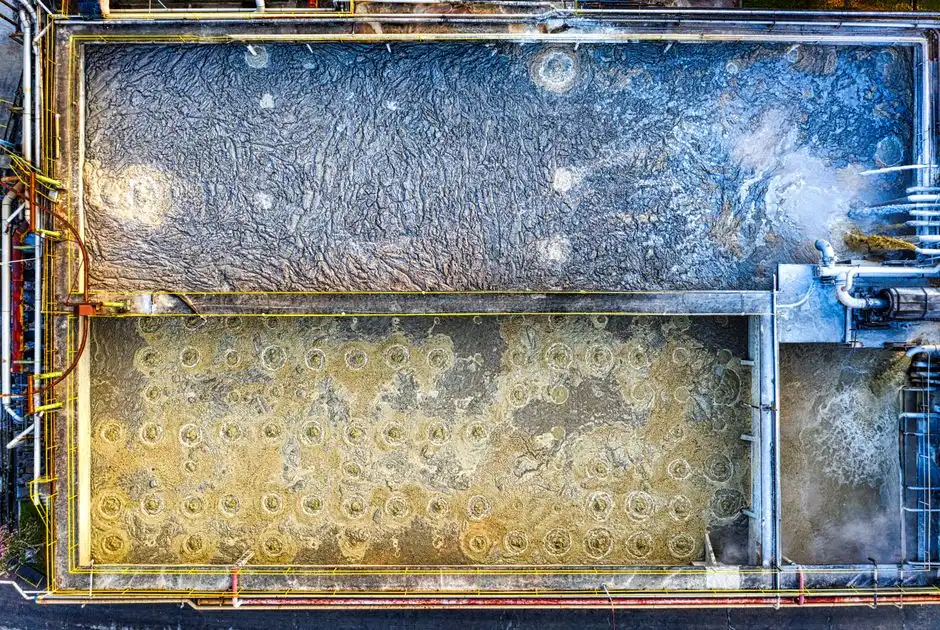
- Equalization and neutralization. A 24–48 h equalization basin smooths TDS swings and absorbs slug discharges from cycle dumps; sulfuric acid or CO₂ is dosed to trim pH into 7.0–8.0 before downstream processes (HydropureWater field data, 2026).
- DAF. A dissolved air flotation unit in the 4–300 m³/h envelope sits upstream of softening and RO, removing oils, silica scale, and metal hydroxides before they foul the membranes.
- Hardness reduction. Lime-soda softening or weak-acid cation exchange drops Ca and Mg to <50 mg/L as CaCO₃; the resulting sludge is dewatered on a plate-and-frame filter press to 25–35% dry solids for off-site haul (HydropureWater, 2026).
- Side-stream RO. An industrial side-stream RO polishing skid at 75–95% recovery, with multi-media plus 5 µm cartridge pretreatment, returns permeate at 10–50 mg/L TDS to the cooling-tower makeup line; overall recovery on the blowdown stream typically lands at 50–85% (Genesis, 2024; HydropureWater, 2026).
- Disinfection. A chlorine dioxide generator in the 50–20,000 g/h envelope holds 0.1–0.3 mg/L residual on the reuse line; ClO₂ is preferred over free chlorine on coastal Lima sites because it does not react with elevated bromide to form brominated DBPs (HydropureWater, 2026).
| Step | Unit Operation | Key Parameter | Lima-Specific Driver |
|---|---|---|---|
| 1 | Equalization + neutralization | 24–48 h HRT; pH 7.0–8.0 | Absorbs ANA allocation-cap cycle dumps |
| 2 | DAF | 4–300 m³/h; <20 mg/L TSS outlet | Protects RO from silica and metals |
| 3 | Lime-soda or WAC softening | Hardness <50 mg/L as CaCO₃ | Sludge to plate-and-frame press, 25–35% DS |
| 4 | Side-stream RO | 50–85% overall recovery; 10–50 mg/L TDS permeate | Reservoir for seawater-blended blowdown |
| 5 | ClO₂ disinfection | 0.1–0.3 mg/L residual; 50–20,000 g/h | Bromide-safe on Costa Verde/Callao loops |
The sanitary train runs on a separate line. For flows under 80 m³/d with no reuse intent, a packaged buried STP is sufficient. When reuse of treated sanitary to cooling-tower makeup or toilet flush is in scope, a submerged PVDF MBR with <1 µm pore delivers BOD <5 mg/L and TSS <1 mg/L without tertiary polishing, enabling direct reuse (HydropureWater, 2026).
Tier 1, 2, and 3 Design Packages
Three design tiers match the train to campus size and reuse ambition. The 40 MW breakpoint is the practical line where side-stream RO stops being optional under Lima permit conditions: below it, ANA will accept blowdown-to-sewer under DIGESA; above it, the Rímac/Chillón allocation risk makes reuse the cheaper compliance path (HydropureWater field data, 2026).
| Tier | IT Load | Sanitary | Blowdown Train | COC Target | Reclaimed / Seawater | Regulator Pathway |
|---|---|---|---|---|---|---|
| Tier 1 — Colocation | <5 MW | WSZ packaged STP, sewer discharge | DAF only if TSS >20 mg/L; no RO, no softening | 3–4 | None | DIGESA + SEDAPAL |
| Tier 2 — Mid-size | 5–30 MW | WSZ or MBR sanitary | DAF + softener + side-stream RO + ClO₂ | 6–8 | Seawater blending on Costa Verde/Callao | ANA + DIGESA + SUNASS |
| Tier 3 — Hyperscale | 30+ MW | Full MBR sanitary | DAF + softener + RO, optional ZLD crystallizer | 6–8 with ZLD bridge | Seawater + reclaimed-effluent blend (SEDAPAL concession) | ANA + DIGESA + SUNASS + SUNAT WUE |
At Tier 3, an optional ZLD bridge (MVC plus crystallizer) is reserved for sites where basin TDS exceeds 1,500 mg/L or where DIGESA imposes a discharge prohibition. For Lima, the reclaimed-effluent lever runs through a SEDAPAL concession raised in the FEED phase, mirroring the COPASA reclaimed-water model used in Belo Horizonte and the CEDAE concession used in Rio de Janeiro.
Costs, Payback, and ZLD on the Lima Coast
RO CAPEX for a 50,000 GPD blowdown system runs $250,000–$500,000 installed, with OPEX of $1.50–$3.00 per 1,000 gallons treated (Genesis, 2024). The RO reuse payback falls below three years when SEDAPAL industrial tariffs exceed the Lima-specific breakeven, a threshold that industrial districts in Lima have already crossed (HydropureWater, 2026). MVC systems for 10,000–30,000 GPD carry $1–3M CAPEX and 15–25 kWh per 1,000 gallons of distillate, while a full ZLD train runs $3–8M CAPEX with OPEX of $5–$15 per 1,000 gallons at 95–99% overall recovery — reserved for Tier 3 sites facing strong basin stress or a discharge prohibition (Genesis, 2024). The dosing chemistry on these loops is typically metered through a PLC-controlled chemical dosing skid sized for antiscalant, sulfuric acid, and ClO₂ precursor feed.
| System | Capacity | CAPEX (USD) | OPEX | Recovery | Lima Applicability |
|---|---|---|---|---|---|
| Side-stream RO | 50,000 GPD | $250k–$500k | $1.50–$3.00 / 1,000 gal | 50–85% | Tier 2 and Tier 3 baseline |
| MVC concentrator | 10,000–30,000 GPD | $1M–$3M | 15–25 kWh / 1,000 gal distillate | 95–98% on concentrate | Tier 3 with ZLD bridge |
| Full ZLD (RO + MVC + crystallizer) | Site-specific | $3M–$8M | $5–$15 / 1,000 gal | 95–99% | Reserved for severe allocation-cap or discharge-prohibition scenarios |
| Seawater free-cooling retrofit | Campus loop | Site-specific (intake + plate HX) | Energy + maintenance | Cuts freshwater draw 40–60% | Highest-leverage Lima CAPEX alternative on Costa Verde/Callao |
Life-cycle framing matters because the freshwater savings of reclaimed water are not free of upstream cost: reclaimed makeup carries roughly 0.93 L/m³ of indirect water from upstream electricity and chemicals, less than 0.1% of the direct displacement benefit, and approximately 2× the GWP of freshwater with about 80% of the gap attributable to treatment energy; under a decarbonized grid the GWP penalty shrinks while the freshwater savings remain (Cartagena Vaca et al., 2026, Open Engineering Inc.). Seawater free cooling is additive to the reclaimed-effluent lever rather than competing with it, and the parallel funding landscape — including the IDB/CAF US$500M Latin American water funding window opened in September 2026 — is a viable co-financing path for the civil works on Costa Verde and Callao sites.
Frequently Asked Questions
What wastewater and cooling blowdown treatment does a data center in Lima, Peru need?
A two-stream train: a cooling-tower blowdown line sized by Blowdown = Makeup ÷ (COC − 1) — typically 0.3–0.8% of makeup for a 40 MW campus at PUE 1.4 — routed through equalization, DAF, softening, side-stream RO at 50–85% recovery, and ClO₂ disinfection, designed against ANA water-rights limits, DIGESA/ECA-LMP discharge standards, and SUNASS potable tariffs; plus a separate sanitary train sized at 50–100 L/person/day, handled by a packaged STP or MBR depending on reuse intent.
What cycles of concentration should a Lima data center target?
A freshwater-only loop typically runs 4–6 COC; a seawater-assisted free-cooling loop on the Costa Verde or Callao coast runs 5–7 COC and cuts freshwater draw 40–60%. At Tier 2 and Tier 3 sites, pushing COC to 6–8 with side-stream RO and ClO₂ polish is the defensible Lima design point (HydropureWater field data, 2026).
Is seawater-assisted free cooling feasible for a Lima data center?
Yes. On Costa Verde and Callao sites, seawater blending through a plate heat exchanger reduces COC demand, cuts freshwater draw 40–60%, and produces a blowdown that still passes through the DAF, softener, side-stream RO, and ClO₂ train. The discharge must still meet DIGESA/ECA-LMP limits, but the operating-cost benefit of avoiding SEDAPAL freshwater draw typically justifies the intake at any campus above ~10 MW (HydropureWater, 2026). The CAPEX logic is similar to the seawater-assisted loop documented in the 2026 Manchester data-center blowdown guide for a different coastal hydrology.
When does zero liquid discharge become economic in Lima?
Full ZLD at $3–8M CAPEX and $5–$15 per 1,000 gallons OPEX is reserved for Tier 3 sites facing strong basin stress (basin TDS above 1,500 mg/L) or a DIGESA discharge prohibition. For most Lima campuses, side-stream RO plus seawater blending pays back in under three years and avoids the ZLD capital hurdle (Genesis, 2024; HydropureWater, 2026).