How Canned Food Wastewater Should Define the Centrifuge Duty
A decanter centrifuge for canned food wastewater should be designed around the separated solids, not peak wastewater flow alone. The design must establish representative solids loading, particle size, density, viscosity, oil content, abrasiveness, and variability before selecting bowl length, diameter, cone angle, pond depth, differential speed, and G-force. A horizontal, cylindrical-conical bowl continuously separates denser solids from liquid; the scroll moves compacted solids toward discharge. Final sizing should follow representative testing and a trial because food-derived contaminants materially affect separation and cake dryness.
Start by separating washing, blanching, peeling, cutting, cooking, product-loss, and chemical-cleaning streams before taking a composite sample. These streams can differ materially in suspended solids, free oil, temperature, salt, and cleaning-chemical content. Sampling only during one steady production period risks hiding changeover or clean-in-place peaks.
Request representative sampling across normal production, product changeovers, and cleaning cycles. The sampling plan should identify how each stream enters the collection system and whether segregation is practical. A single laboratory grab sample is not an adequate design basis for variable food-processing wastewater dewatering.
Define the decanter’s duty narrowly: continuous removal of suspended food solids from a liquid stream. It does not remove dissolved salt, soluble organics, sanitizers, or nutrients, and it is not automatically the correct device for recovering free oil. The feed basis should identify liquid flow, solids loading, particle-size distribution, solid-to-liquid density difference, viscosity, pond depth, target clarified-liquid quality, and required cake condition.
Wikipedia identifies food processing and wastewater treatment as established decanter application areas, while Alfa Laval describes the equipment as a continuous solid-liquid separator. Require each supplier to show how its proposed feed basis applies to the plant’s actual streams. A rotary mechanical bar screen for wastewater headworks may protect the downstream train, but it does not replace feed characterization.
Build the Canned Food Wastewater Treatment Flow
A decanter should occupy one defined stage in the treatment train: collection and equalization, coarse screening, optional free-oil removal, optional solids-conditioning or DAF clarification, decanter separation, downstream liquid treatment, and controlled cake disposal.
Equalization should absorb production, washdown, and cleaning-cycle fluctuations before the centrifuge. Coarse screening protects the feed system from rags, labels, packaging fragments, and fibrous material. Where these are present, a rotary mechanical bar screen for wastewater headworks reduces the chance that oversized debris will enter the feed pump or bowl.
Free oil is a separate design question. If floatable oil and grease must be removed before biological treatment, evaluate DAF pretreatment for canned food wastewater. The supplied DAF product scope is 4–300 m³/h across 13 standard models, using micro-bubble flotation and automatic skimming. Those values describe the offered equipment range; they are not evidence that a particular DAF configuration will fit a plant’s feed.
Within the decanter, denser particles migrate toward the rotating bowl wall. The scroll compacts and transports those solids along the cylindrical section and toward the conical discharge, while clarified liquid—the centrate—overflows through adjustable weir plates or other liquid-discharge devices. The centrate may still contain dissolved contaminants and fine material.
Downstream biological treatment or reuse remains a separate design obligation. Soluble chemical oxygen demand, salt, sanitizers, nutrients, and pH are not resolved by the decanter itself. The downstream biological wastewater treatment basis should therefore be coordinated with the centrate quality guaranteed by the centrifuge.
Select the Bowl, Cone, and Solids-Conveying Configuration
Bowl length, diameter, and cone angle must be selected together because they jointly determine clarification capacity, cake-bed depth, residence time, and solids conveyance.
Use a horizontal cylindrical-conical bowl for continuous separation. Feed enters the rotating bowl, denser solids migrate outward, and the scroll carries compacted material toward the conical discharge. Wikipedia identifies length-to-diameter ratios of 2, 3, and 4 as common design heuristics. With the same diameter, a longer bowl provides greater solids-conveying capacity and a larger suspension volume, which can improve separation of fine solids.
Cone angle must match cake behavior. Wikipedia reports that a small cone angle reduces slippage force and scroll wear. It can benefit soft, incompressible material and compact cake that requires substantial torque. A shallower angle does not automatically suit every food-derived solids stream; solids strength, abrasiveness, moisture, and required discharge consistency determine the appropriate geometry.
| Selection parameter | Design significance | Information to request |
|---|---|---|
| Bowl length and diameter | Controls suspension volume, solids-conveying capacity, and clarification residence | Proposed dimensions, length-to-diameter ratio, and duty envelope |
| Cone or beach angle | Influences slippage, cake compaction, torque demand, and scroll wear | Angle, discharge configuration, and basis for the selected geometry |
| Clarification and drying zones | Divide liquid residence from cake dewatering | Zone lengths, pond volume, and expected clarified-liquid quality |
| Solids discharge | Determines handling consistency and downstream cake route | Discharge form, solids condition, and downstream handling requirement |
| Centrifugal force | Influences separation and cake compaction | Maximum operating G-force at rated bowl dimensions and speed |
Flottweg states that bowl length, diameter, and taper angle are customized for each application to optimize the clarifying zone and solids transport. Do not accept a generic bowl drawing. Require the proposal to identify the clarification zone, beach or drying zone, pond volume, discharge arrangement, and intended solids duty.
For market comparison, Wikipedia gives an industrial range of 1,000–4,000 G, while Alfa Laval states that centrifugal force can reach 4,000 times gravitational force. These are reference limits, not a selection criterion to apply blindly: Wikipedia also notes that G-force aids dewatering but can hinder dry-cake transport, so clarification and conveyance must be balanced.
Set Pond Depth, G-Force, and Differential Speed
Pond depth, bowl speed, and scroll differential speed must be optimized together; maximizing any one control variable can reduce clarified-liquid quality, cake dryness, throughput, or service life.
Pond depth is the liquid filling volume in the bowl. Flottweg states that it affects liquid retention time and the lengths of the clarification and drying zones, while Alfa Laval identifies adjustable weir plates and PowerTubes as pond-level control mechanisms. A shallower pool can improve separation in the cylindrical zone by providing less liquid depth. A deeper pool can provide a thicker buffer against fine-particle loss when the cake layer is too thick. The appropriate condition must be established through testing.
| Control | Primary effect | Engineering trade-off |
|---|---|---|
| Pond depth | Sets liquid retention, clarification-zone length, and drying-zone length | Shallower separation versus deeper buffer against fine solids loss |
| Bowl speed and G-force | Supports particle separation and cake compaction | Greater separation can impede transport of dry cake |
| Differential speed | Sets solids residence time and compaction | Higher speed increases transport but shortens dewatering time |
| Feed rate | Determines hydraulic loading and available residence time | Higher throughput can impair centrate clarity and cake condition |
Use differential speed to control cake transport, residence time, and compaction, not simply to reach the maximum permitted value. Flottweg links it to retention time, compaction, and total dry solids. A 2024 Elsevier review, Energy analysis and numerical evaluation of the decanter centrifuge for wastewater management to allow a sustainable energy planning of the process, also found that cake dry matter content decreased as differential speed or feed rate increased.
Torque-based differential-speed control is appropriate where feed solids fluctuate. Alfa Laval describes a variable-frequency drive with torque control that automatically adjusts scroll speed: it reduces speed when loading rises to limit torque overload and lowers speed under lighter loading to reduce wear and energy use.
The same 2024 review reported lowest specific-energy values of 1.88, 1.76, and 1.57 kWh/m³ at 15, 20, and 25 m³/h, respectively, while recovered power was 5.88, 0.31, and 12.10 kW. Its central finding was that high energy recovery is not necessarily associated with greater energy saving. These are study-specific sludge-dewatering results, not guarantees for canned food wastewater.
Specify Food-Industry Materials, Wear Protection, and Hygiene
The wetted materials and wear-protection package must be assigned from the actual food-process chemistry, because the supplied research supports no universal alloy grade or temperature limit for canned food wastewater.
Require stainless-steel construction for wetted components. Alfa Laval states that it uses high-grade stainless steel for parts contacting the separation process and highlights TrueStainless construction for corrosive environments. Flottweg likewise identifies corrosion-resistant stainless steels as a means of improving service life and maintaining product quality in demanding applications.
Specify abrasion protection by process location. Alfa Laval identifies the feed zone, solids-discharge zone, bowl, and scroll as wear-prone and describes FlightGuard tiles welded to the conveyor for abrasive applications. The requirement should distinguish wear caused by fibrous material, retained food particles, or mineral-bearing soil from corrosion caused by chlorides, sanitizers, and acidic or alkaline cleaning chemicals.
Request a corrosion assessment that states how pH, chloride exposure, cleaning chemicals, temperature, and food-salt conditions affect the proposed materials. Do not accept an alloy designation without the design envelope that supports it. The evidence does not establish a single material selection suitable for every canned-food plant.
Include accessible inspection points for the scroll, bowl, wear parts, seals, bearings, feed zone, and discharge zone. Food residue and abrasive solids can shorten component life, so inspection access is part of the operating strategy rather than an optional convenience.
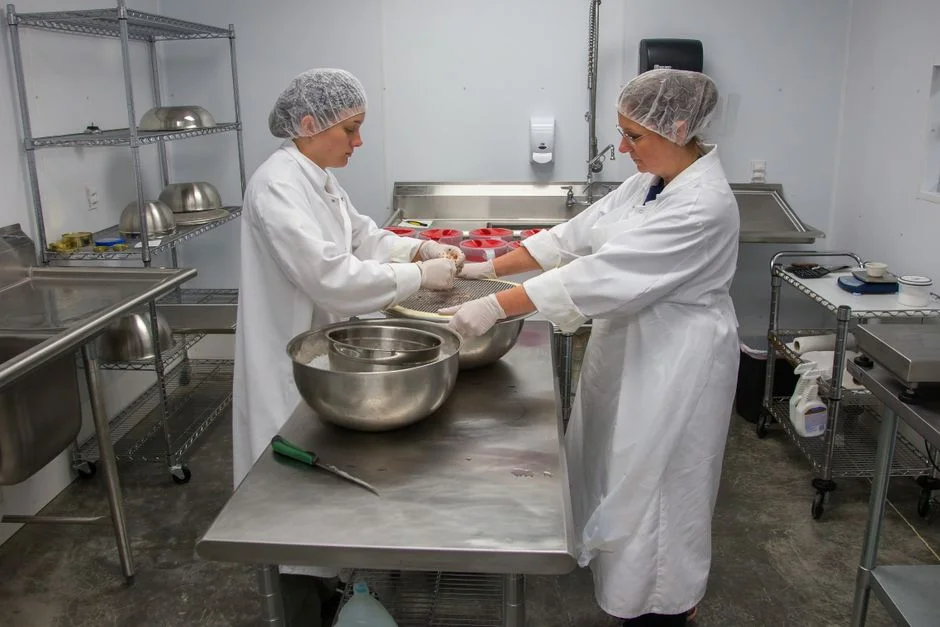
Frame cleanability as a lifecycle requirement. The machine should support routine washdown and inspection without trapped-product zones that compromise hygiene or obstruct maintenance. Require the supplier to identify cleanable surfaces, drain points, discharge interfaces, and access arrangements in the final drawing.
Compare Decanter, DAF, and Filter Press by Project Duty
Choose the separation route from the required solids and liquid outcomes; decanter, DAF, and plate-and-frame filtration are not interchangeable substitutes.
A decanter is appropriate when continuous solid-liquid separation and dewatering of substantial solids content justify a custom bowl, scroll, drive, controls, and wear-protection system. Flottweg describes decanters as continuous solid-bowl scroll centrifuges for high-solids mixtures, unlike chamber filter presses.
| Decision | Preferred route when | Key design caution |
|---|---|---|
| Solid-bowl scroll centrifuge | Continuous, high-solids separation and mechanical dewatering are required | Bowl, cone, pond, differential speed, and wear protection must match the feed |
| DAF | Floatable oil, grease, suspended solids, and colloidal material are principal objectives | The supplied range is 4–300 m³/h across 13 standard models; feed characterization still governs suitability |
| Plate-and-frame filter press | Batch or semi-continuous operation and retained cake are more important than continuous throughput | The supplied range is 1–500 m² filtration area, with manual, hydraulic, or fully automatic PLC operation |
DAF occupies the floatable-solids and oil-removal role; it does not replace the decanter’s continuous solids-conveying duty. Where this comparison is needed, use the DAF versus clarifier decision framework and, for oily streams, the DAF versus clarifier for oily wastewater as process-selection references rather than canned-food performance guarantees.
A plate-and-frame filter press for food-processing solids may suit batch operation or where cake retention is central. Its supplied product range spans 1–500 m² of filtration area, with manual, hydraulic, or fully automatic PLC operation.
For any route, request guarantees tied to the agreed feed envelope: feed rate, solids loading, clarified-liquid solids, cake dry solids, differential speed, power consumption, and maximum continuous operating hours. Also impose a contamination gate on cake reuse. A food-contact or process-recovery claim requires assessment of product history, composition, regulatory requirements, and the plant’s contamination-control plan; otherwise specify controlled waste disposal.
Design Basis, Pilot Testing, and Supplier Acceptance
A procurement-ready package should convert the feed characterization into a stated design basis, transparent supplier assumptions, and measurable acceptance criteria.
- Compile representative flow, solids loading, particle-size distribution, density difference, viscosity, oil content, pH, temperature, abrasiveness, and operating hours.
- State the required clarified-liquid solids, cake dry solids, throughput envelope, operating hours, and cake-disposal route.
- Require the supplier to identify every assumption and parameter that needs a representative trial.
- Use the trial to verify separation, cake transport, centrate quality, torque behavior, power consumption, and cleanability.
- Convert the verified result into purchase guarantees, control requirements, commissioning tests, and maintenance obligations.
Flottweg states that solid-bowl decanters must be custom-designed for the specific separation process. The proposal should therefore state why the selected bowl and scroll suit the characterized feed, not merely provide a flow-capacity curve.
| Acceptance item | Minimum information or test | Acceptance condition |
|---|---|---|
| Mass balance | Feed, separated liquid, and discharged solids | All specified streams accounted for |
| Solids performance | Centrate suspended solids and cake dry solids | Agreed values demonstrated on the representative feed |
| Controls | Bowl speed, scroll differential-speed range, torque monitoring, feed-rate control, and liquid-level control | Functions demonstrated across the stated feed envelope |
| Protection | Overload and excessive-vibration protection | Safe response verified during witnessed testing |
| Documentation | Startup procedure, operator training, spare-parts list, and maintenance schedule | Delivered and accepted before handover |
Require reported cake performance to be identified as dry matter rather than wet cake. Make acceptance conditional on the agreed feed characteristics and operating envelope. Include startup, training, maintenance, and spare-parts obligations in the purchase specification.
Use the 2024 Elsevier energy values as study-specific sludge-dewatering evidence only. They support pilot optimization, but they are not universal canned-food performance guarantees.
Frequently Asked Questions
How much does a decanter centrifuge for canned food wastewater cost?
The supplied research provides no defensible universal price. Request a quotation tied to representative flow, solids loading, particle characteristics, bowl configuration, wear protection, controls, installation requirements, and commissioning scope. Compare quotations on the same feed basis and acceptance criteria.
What feed data is needed to size a decanter centrifuge for a food plant?
Require representative flow, solids loading, particle-size distribution, density difference, viscosity, oil content, abrasiveness, temperature, pH, operating hours, and target centrate and cake conditions. Include samples across production, changeover, and cleaning cycles.
Should a canned food plant choose a decanter centrifuge or a plate-and-frame filter press?
Choose a decanter when continuous high-solids separation and dewatering are the main duties. Consider a plate-and-frame press when batch operation and retained cake matter more. Confirm the choice with the actual solids-loading and throughput envelope rather than equipment flow charts alone.
What is the best differential speed for canned food sludge?
No universal setting is supported by the research. Optimize it through representative testing because differential speed affects residence time, compaction, and dry solids. The 2024 Elsevier review found that cake dry matter content decreased as differential speed increased, so the highest permitted speed is not necessarily the best operating point.
Can decanter centrifuge cake be reused as animal feed or food-grade material?
Do not infer reuse from the centrifuge design. Assess product contamination, composition, regulatory requirements, and the plant’s contamination-control plan. If suitability cannot be demonstrated, specify a controlled waste-disposal route.