Choose the Treatment Objective Before Selecting Equipment
An effluent treatment plant in Santiago for an industrial facility should be selected by discharge route, influent characteristics and reuse goals. Under the supplied 2026 Santiago guide, industrial discharges to sewerage systems are governed by Supreme Decree No. 609/1998, while discharges to surface water or groundwater are governed by DS 90/2000. DAF is a pretreatment option for suspended solids, FOG, oil and colloidal matter; MBR combines biological treatment with membrane separation; UF can provide final solids and colloid removal. The appropriate train begins with verified wastewater testing and permit requirements, not a preselected machine.
The project boundary must be explicit. Sewer pretreatment is intended to reduce loads that could interfere with the receiving utility or trigger surcharges; it does not necessarily remove every contaminant required for direct environmental discharge. A direct-discharge project must establish the applicable receiving-water requirements and demonstrate compliance under the relevant regulatory framework. Industrial water reuse adds a product-quality and process-fit dimension: the treated stream must perform in its intended application, not merely pass a generic discharge limit.
The supplied Chilean effluent treatment plant guide identifies SISS for industrial sewer-discharge requirements and DGA for surface-water or groundwater discharge. It states that DS 609/1998 provides the general effluent framework for sewer discharge, while DS 90/2000 governs direct environmental discharges to surface water or groundwater. These instruments should be checked against the facility’s current authorization, receiving authority and applicable local requirements.
Statements in the supplied guide concerning fines, permit renewal, utility surcharges and 2025 deadlines are planning prompts, not verified advice on Chilean rules in 2026. Before procurement, obtain the current permit, sewer-discharge conditions, applicable self-monitoring schedule and written confirmation from the relevant authority or utility. That evidence should define the treatment objective and the parameters a vendor must guarantee.
Map the Influent Before Sizing the Plant
Peak hydraulic flow and contaminant loading—not average daily volume alone—must determine the treatment capacity and process selection. The supplied Santiago guide identifies four decision factors: influent volume and peak-flow variability, contaminant types, physical-space constraints and long-term water-reuse goals. A proposal based only on average flow will not define whether equalization, DAF, biological treatment or polishing is needed.
Request a flow-duration record covering average flow, peak flow, operating shifts, batch discharges, cleaning cycles and planned expansion. Characterize COD, TSS, FOG, pH, temperature, conductivity, metals and sector-specific contaminants. Sampling should cover normal production and documented peak-load periods; the laboratory scope and sampling points should be agreed before the design basis is frozen. The supplied guide recommends monthly effluent testing through SISS-certified laboratories, but the project team should confirm the required frequency and protocol for its facility.
DAF is a physical separation step: micro-bubbles attach to suspended and colloidal material, which is skimmed from the surface. It can remove FOG, oil and grease and suspended solids ahead of biological or municipal treatment, but it does not substitute for biological treatment of biodegradable organic load. MBR combines activated-sludge treatment with submerged membrane filtration, so it addresses both organics and membrane separation in one biological package.
| Input to obtain | Decision supported | Question for the design team |
|---|---|---|
| Average and peak flow; duration and operating schedule | Equalization and hydraulic sizing | Which flow governs equipment capacity: average, peak or a documented batch-discharge condition? |
| COD and TSS | DAF pretreatment, biological load and polishing | What influent envelope will the proposed train accept? |
| FOG and oil and grease | Primary separation | Is DAF needed ahead of the sewer, biological stage or reuse train? |
| pH, temperature and conductivity | Treatment compatibility and biological conditions | What conditioning, equalization or inhibition controls are required? |
| Metals and sector-specific contaminants | Permit limits and advanced treatment | Which parameters must be guaranteed at the discharge or reuse point? |
| Current permit and reuse specification | Compliance boundary | What sampling, reporting and final-water criteria apply to this facility? |
For industrial effluent pre-treatment in Santiago, the dataset should become a written design basis and then a contractual envelope. A vendor should state what happens outside that envelope: whether flow above the design condition bypasses treatment, whether increased COD requires additional chemical dosing, and whether recovery from an upset is covered by the warranty.
Build a Treatment Train That Fits the Discharge Route
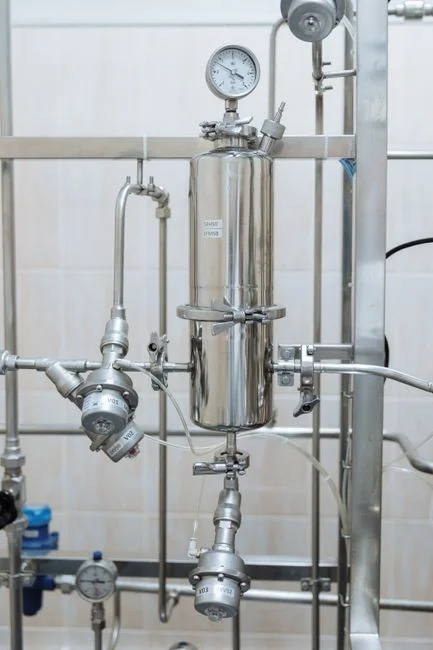
A complete treatment train separates hydraulic conditioning, contaminant removal, solids handling and monitored discharge or reuse. The typical sequence is incoming wastewater, screening and equalization as required, primary separation, biological treatment where needed, membrane polishing where required, disinfection if specified, sludge conditioning and dewatering, then monitored discharge or reuse. Each stage should have a defined purpose, design load and measurable outlet.
For FOG- and solids-dominated streams, DAF belongs before downstream biological or municipal treatment. The supplied Santiago guide reports up to 95% FOG removal and 92% TSS removal for DAF. Those figures indicate a physical pretreatment role; they are not a guarantee for a Santiago installation. An industrial DAF pretreatment system should be evaluated against the verified flow, contaminant envelope and downstream treatment needs.
MBR is appropriate where biological treatment and membrane separation are required in a compact installation. The supplied guide describes submerged PVDF membranes with a pore size of 0.03–0.1 μm and MBR effluent below 50 mg/L COD for high-risk sectors. These are design-guide claims with sector-specific scope, not blanket Chile limits. An integrated MBR wastewater treatment system should be selected against organic load, hydraulic variability, membrane maintenance requirements and the reuse or discharge specification.
UF is a final solids and colloid barrier that does not require chemical addition. The supplied product information specifies 2,000–40,000 L/h capacity, 0.03 μm hollow-fiber PVDF membranes, automatic backwash and air scour, and acceptance of turbidity up to 300 ppm. A UF polishing system can fit after biological treatment where the objective is final suspended-solids and colloid removal; it does not remove the biodegradable organic load that requires biological treatment.
The solids branch must be included in the design. The supplied guide states that plate-and-frame presses can reach 30–40% cake solids. The supplied plate-and-frame sludge dewatering press range is 1–500 m², with manual, hydraulic or automatic PLC operation. Cake dryness affects sludge transport, disposal cost and the achievable dewatering duty; the press should therefore be selected with the sludge characteristics, not from equipment area alone.
Research outside Chile does not establish local project performance. The University of Twente’s 2015 nanofiltration thesis examined direct polishing of wastewater-treatment-plant effluent for reclamation, while Wageningen University’s 2022 constructed-wetland thesis addressed micropollutant removal. These studies demonstrate additional design disciplines; they are not proof of performance for a Santiago facility.
| Process step | Primary function | Design evidence required |
|---|---|---|
| Screening and equalization | Protect downstream equipment and buffer hydraulic variation | Screening duty, storage volume, mixing and control response |
| DAF | Remove FOG, oil and grease, suspended solids and colloidal material | Flow range, contaminant load, chemical demand and recovered-sludge characteristics |
| Biological treatment | Reduce biodegradable organic load | COD load, biodegradability, temperature, nutrients and biological solids handling |
| MBR or UF | Provide biological separation or final solids and colloid removal | Membrane configuration, cleaning, replacement and guarantees tied to influent limits |
| Disinfection, if specified | Reduce specified microbiological risk | Permit or reuse requirement, dose and monitoring method |
| Sludge conditioning and dewatering | Stabilize and concentrate separated solids | Sludge flow, solids content, polymer demand, cake discharge and disposal route |
Compare DAF, MBR and UF by Function and Cost
DAF, MBR and UF are not interchangeable products: DAF performs physical pretreatment, MBR combines biological treatment with membrane separation, and UF provides a final solids and colloid barrier. The supplied catalog information lists DAF capacity across 13 models from 4–300 m³/h, MBR capacity from 10–2,000 m³/day with filtration below 1 μm and a stated footprint 60% smaller than conventional systems, and UF capacity from 2,000–40,000 L/h with 0.03 μm membranes. Catalog capacity establishes a comparison point, not a final size.
The supplied Santiago planning ranges place DAF at USD 50,000–300,000 CAPEX and USD 0.10–0.30/m³ OPEX. MBR is listed at USD 200,000–1 million CAPEX and USD 0.40–0.80/m³ OPEX. The guide’s food-processing illustration describes a 100 m³/h DAF plant at USD 120,000–180,000 CAPEX and USD 0.15–0.25/m³ OPEX. These are planning figures for comparison; they exclude project-specific civil works, electrical work, chemical systems, sludge handling, taxes and site constraints unless the proposal expressly states otherwise.
MBR’s higher cost must be tested against its operating benefits. The supplied guide attributes to a dairy example monthly surcharge savings of USD 20,000 and monthly sludge-disposal savings of USD 8,000. It identifies this as an industry example, not a guaranteed Santiago result. A buyer should therefore model the applicable surcharge formula, current discharge charges, expected sludge route and reuse value using verified site data.
| Criterion | DAF | MBR | UF |
|---|---|---|---|
| Primary role | Physical pretreatment for FOG, oil and grease, suspended solids and colloidal matter | Biological treatment combined with submerged membrane separation | Final solids and colloid removal without chemical addition |
| Supplied capacity range | 4–300 m³/h across 13 models | 10–2,000 m³/day | 2,000–40,000 L/h |
| Supplied planning CAPEX | USD 50,000–300,000 | USD 200,000–1 million | Not supplied |
| Supplied planning OPEX | USD 0.10–0.30/m³ | USD 0.40–0.80/m³ | Not supplied |
| Main procurement checks | Peak flow, FOG/TSS load, chemical demand, skimming and sludge conditioning | Organic load, footprint, membrane scouring, cleaning and replacement | Feed turbidity, solids loading, backwash, air scour and recovery |
The final selection should remain conditional on verified flow and load, treatment objective, available area, energy cost, chemical use, sludge route and current permit conditions. The DAF and clarifier selection guide can support process-level review, while the COD removal process selection guide provides broader biological-treatment context. Neither substitutes for a project-specific mass balance or Santiago permit review.
Verify Performance, Permits and Sludge Costs Before Purchase
A vendor proposal must guarantee a defined flow, influent envelope, effluent specification and test method; nominal treatment capacity alone does not demonstrate compliance. Require the guaranteed operating range, hydraulic and contaminant limits, sampling point, test protocol, acceptance criteria and remedy for non-performance. The guarantee should identify which results are demonstrated during commissioning and which remain operating obligations.
The supplied Santiago guide reports 2024 Chile installation data showing MBR turbidity below 0.2 NTU and copper and arsenic below 0.5 mg/L. Treat these as vendor-guide evidence requiring project-specific verification, not as blanket Santiago limits, discharge standards or guaranteed results. Ask for the underlying installation data, test methods and conditions if those claims are being used to justify selection.
Permit due diligence should establish the applicable current authorization, sewer-discharge conditions, self-monitoring frequency, reporting method and sampling protocol. The supplied guide notes that surcharge, permit and monitoring consequences depend on the applicable framework. Confirm these items directly with the facility’s permit and competent authority rather than relying on a generic compliance statement.
Compare lifecycle cost rather than equipment purchase price. The model should include membrane cleaning and replacement, compressed air, chemicals, sludge conditioning, transport, disposal, energy and operator attendance. The supplier comparison should also cover performance testing, commissioning, operator training, spare parts, remote monitoring, maintenance response and service availability.
Sludge is a recurring operating cost and an operating risk. Confirm whether DAF float, biological excess sludge and waste-treatment residuals can be conditioned and dewatered within the proposed route. Record cake solids, moisture or solids content, disposal acceptance, transport frequency and responsibility for rejected loads. A treatment train without a verified solids route is not a complete proposal.
Frequently Asked Questions
What does an effluent treatment plant in Santiago cost?
The supplied Santiago guide gives DAF planning ranges of USD 50,000–300,000 CAPEX and USD 0.10–0.30/m³ OPEX, and MBR ranges of USD 200,000–1 million CAPEX and USD 0.40–0.80/m³ OPEX. These are not quotations. Request a price based on verified flow, loads, treatment objective, civil works, utilities, controls, commissioning, training and the sludge route.
How should a supplier be selected for an industrial wastewater plant in Santiago?
Require the supplier to identify the design flow and influent envelope, propose a complete process train, state performance guarantees and test methods, and price membrane, energy, chemical and sludge lifecycle costs. A credible proposal should also identify permit assumptions and the operating conditions that trigger performance or warranty remedies.
Should equipment be sized from average flow or peak flow?
Size from both peak hydraulic flow and contaminant loading, not only average daily volume. Document the flow-duration pattern, batch discharges and operating schedule so the supplier can identify equalization needs and specify how the plant responds outside the guaranteed influent envelope.
Can DAF alone satisfy an environmental discharge permit?
Not by default. DAF is physical pretreatment for FOG, oil and grease, suspended solids and colloidal matter; it does not replace biological treatment for biodegradable organic load. The required train depends on the discharge route, current permit, contaminant profile and whether the treated water will be reused.