What an Effluent Treatment Plant in Peru Must Achieve
An industrial effluent treatment plant in Peru is an engineered treatment train that reduces pollutants before authorized discharge or reuse; it is not a single vessel. The correct train depends on wastewater source, flow and load variation, receiving pathway and effluent targets. Pretreatment may require screening, equalization, pH control, DAF or chemical dosing; biological treatment may address biodegradable organics, while MBR, UF or membrane polishing can support reuse. Equipment selection should be confirmed against applicable DIGESA, ANA, MINAM and sector-specific requirements. No single flow or cost applies to every Peruvian project.
The procurement boundary must be defined before quotations are requested. A discharge solution normally starts with the receiving requirement and the selected treatment stages. A reuse solution adds a defined end use, water-quality basis and additional treatment or disinfection. These are different performance problems.
Industrial ETP design must also be kept separate from municipal sewage and packaged domestic treatment. The Peru project hub treats domestic sewage treatment options in Peru as a distinct category, with different hydraulic characteristics, governance and acceptance criteria.
A defensible industrial wastewater process design therefore starts with five inputs:
- Wastewater source and production step;
- Average, peak and minimum flow;
- Pollutant concentrations and mass loads;
- Discharge, internal reuse, sewer-transfer or public-private pathway;
- Applicable regulator, sewer or sector requirement.
International research can clarify available treatment principles but cannot create a Peruvian authorization route. A University of Twente thesis, Direct nanofiltration of wastewater treatment plant effluent, describes nanofiltration as a method for polishing wastewater-treatment-plant effluent to EU Water Framework Directive standards for agricultural or direct/indirect potable use. That study does not establish those uses as legally available in Peru.
Map the Wastewater Before Choosing Equipment
Representative wastewater characterization must define both hydraulic and contaminant loading before equipment is selected. Collect flow, pH, BOD, COD, TSS, TDS, oil and grease, nutrients and relevant industry-specific contaminants over representative production conditions.
The 2023 review Tannery effluent treatment and its environmental impact: a review of current practices and emerging technologies, published by the Water Quality Research Journal, identifies pH, BOD, TSS, COD and TDS as significant tannery-effluent parameters and attributes their variability to differences in leather-manufacturing processes. It does not provide Peruvian discharge limits.
Separate streams before combining them. Cooling water, wash water and contaminated process effluent should not be routed through one treatment train unless a documented mass balance justifies it. The characterization should also record operating shifts, production variability, batch discharges, cleaning events and anticipated expansion.
| Design input | Information the buyer must obtain | Decision supported |
|---|---|---|
| Hydraulic profile | Average, peak and minimum flow; operating shifts; batch-discharge schedule | Equalization, pump duty and treatment-unit sizing |
| Contaminant profile | pH, BOD, COD, TSS, TDS, oil and grease, nutrients and sector-specific contaminants | DAF, biological treatment, polishing and chemical dosing |
| Source segregation | Origin, production step and contamination level of each stream | Separate treatment or justified recombination |
| Receiving pathway | Authorized discharge, internal reuse, sewer transfer or public-private arrangement | Documentation scope and required effluent quality |
| Future demand | Production expansion and changes in product mix | Installed capacity, redundancy and space reservation |
Monitoring should sample both normal production and representative worst-case events. A single spot sample cannot establish design loads if batching, cleaning or pH shocks drive the treatment obligation. Keep the original laboratory records, sampling locations and analytical methods with the design basis.
The final pathway changes the scope before technology does. Discharge may require a permit and discharge-control equipment. Internal reuse may add polishing and disinfection. Sewer transfer may require pretreatment sufficient to protect the sewer and receiving plant. A public-private project requires the contractual allocation of design, permitting, operation and performance risk to be explicit.
Build a Treatment Train from Source to Final Effluent
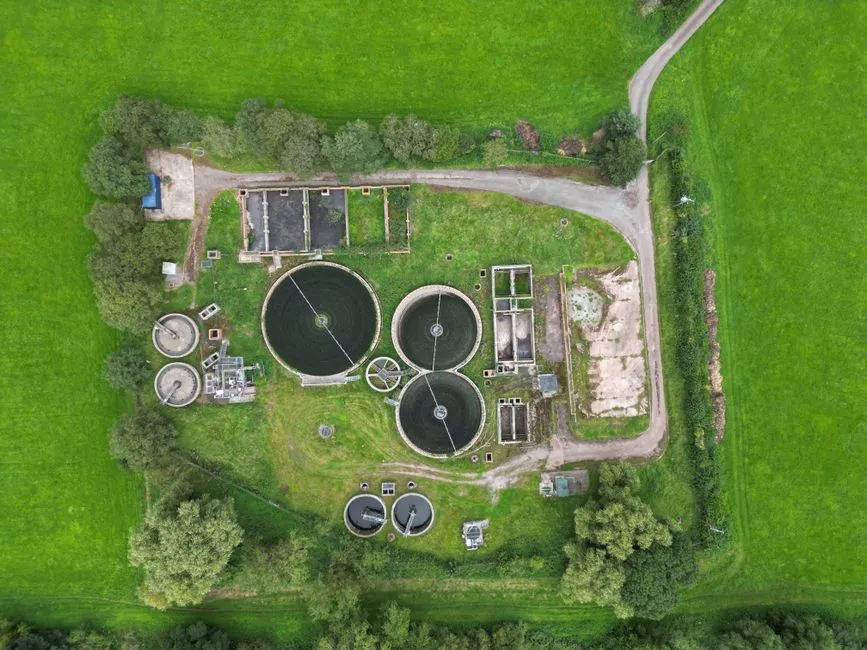
A complete train should remove contaminants in the order that protects downstream equipment and operators while preserving the required final water quality. The sequence below is a screening framework; the final design must follow site characterization and process testing.
- Headworks: remove rags, plastics, fibrous debris and suspended solids before pumping and biological treatment.
- Equalization: balance flow and load variation, including batch discharges and production peaks.
- Primary removal: remove oil, grease, floatable solids, colloids and suspended solids where these are dominant targets.
- Biological treatment: address biodegradable organics where wastewater characteristics and site conditions support biological conversion.
- Polishing: add membrane or ultraviolet treatment only where the receiving or reuse basis requires it.
- Sludge management: provide thickening, dewatering and a defined disposal route.
The GX rotary mechanical bar screen is designed for continuous-duty municipal and industrial wastewater screening. It belongs at the headworks, ahead of pumps and downstream process equipment.
A DAF system for industrial wastewater pretreatment can address suspended solids, oil and grease, FOG and colloidal material. The catalog range covers 4–300 m³/h across 13 standard models. Select the operating point from the hydraulic profile, contaminant loading and operating envelope; nominal catalog capacity alone is not a process-design basis.
Where biodegradable organics dominate, biological treatment should follow appropriate equalization and primary removal. An integrated MBR wastewater treatment system combines biological treatment with membrane separation where its footprint, operational control and effluent-quality benefits are justified. The catalog specification is 10–2,000 m³/day, using submerged PVDF membranes with filtration described as less than 1 micrometer. Neither figure establishes guaranteed project effluent quality; the guarantee requires a defined influent range, operating condition, sampling method and permit basis.
| Process stage | Primary function | Equipment or evidence required |
|---|---|---|
| Headworks | Remove rags, plastics, fibrous debris and coarse solids | Mechanical screen and associated handling |
| Equalization | Balance hydraulic and contaminant variation | Hydraulic profile, storage volume and mixing basis |
| DAF | Remove floatable material, colloids and suspended solids | Catalog capacity of 4–300 m³/h across 13 models; project hydraulic and contaminant basis |
| Biological treatment | Remove biodegradable organics | Process calculation, loading basis, controls and sludge route |
| MBR | Combine biological treatment with membrane separation | Catalog specification of 10–2,000 m³/day, submerged PVDF membranes and filtration below 1 micrometer |
| Polishing and disinfection | Meet defined reuse or pathogen-control requirements | UF, membrane or chemical-free UV disinfection equipment |
| Sludge handling | Recover water and prepare residue for treatment or disposal | Thickening, dewatering and disposal plan |
| Chemical dosing | Support coagulation, flocculation, pH correction or specialty dosing | PLC-controlled automatic chemical dosing system, storage and safety controls |
Include sludge treatment at concept stage. The plate-and-frame filter-press range covers filtration areas from 1–500 m², but the selected area must follow sludge solids, yield, cycle requirements and operating hours. A dewatering unit does not replace a disposal route. The plate-and-frame filter press should therefore be tendered together with sludge storage, transport or disposal requirements.
Match the System to Peru's Industry and Site
Industry characteristics determine which unit operations belong in the train, while site constraints determine how the train should be packaged and maintained.
For food processing, compare a DAF-to-biological-treatment arrangement with alternatives that may provide better integration or footprint control. The HydropureWater Peru hub gives a US$50,000–US$5 million CAPEX range for food-processing industrial wastewater projects in its 2026 guidance. This is a sector-specific planning benchmark, not an equipment quotation or a limit for every food plant.
For textiles, rubber, tanning and chemical processing, treat pH, COD, color, oil, solids and process variability as design drivers. The 2023 Water Quality Research Journal tannery review confirms the relevance of pH, BOD, TSS, COD and TDS but supplies no Peruvian limit values. For rubber applications, use the COD removal for rubber processing wastewater guide as an application screen; for adhesives, use the COD removal train for adhesive manufacturing wastewater to identify sector-specific questions.
| Application or constraint | Primary design question | Relevant process direction |
|---|---|---|
| Food processing | Which organics, fats and solids require removal before biological treatment? | Compare DAF-to-biological treatment with other pretreatment arrangements |
| Textiles, rubber, tanning and chemicals | How do pH, COD, color, oil, solids and batch variation change? | Design around stream-specific characterization and equalization |
| Remote or high-altitude site | Can operators, spare parts, power and heavy equipment reach the site? | Assess packaged equipment before assuming a large civil plant |
| Internal reuse | What end use and water-quality evidence define polishing? | Add membrane or UV stages only against an agreed basis |
The Peru hub’s 2026 industrial-wastewater guidance identifies DAF, MBR and chemical-dosing systems and provides a US$200 million World Bank program as context. That program figure is not the cost of a private ETP. The same hub reports a US$122 million public-private wastewater-plant initiative for the Peruvian Amazon, published on 26 October 2026, and a US$4.5 million wastewater-treatment contract in Peru, published on 24 September 2026. These figures indicate project and market scale, not the capital requirement of an individual facility.
For remote or high-altitude locations, evaluate access, constructability, power quality, operator availability and critical-spares logistics before selecting a large civil installation. Package treatment may reduce site works, but it does not remove the need for stable power, chemical supply, operator competence or an authorized discharge route.
Plan Compliance, Permits and Performance Acceptance
Permit and performance documents should be drafted together because each equipment guarantee depends on the receiving requirement that defines acceptance. The hydropurewater.com Peru guidance identifies DIGESA, ANA, MINAM and SUNASS as relevant authorities or entities depending on the project pathway; the correct combination must be confirmed for the facility, sector and receiving route.
Use DS 015-2015-MINAM as a reference point identified by the Peru hub, but do not reproduce generic discharge limits in the tender without checking the applicable sector instrument and obtaining current confirmation from the relevant authority. A limit applicable to one sector, location or receiving pathway cannot be transferred to another industrial ETP.
| Tender document | Required content | Acceptance check |
|---|---|---|
| Compliance basis | Named authority, applicable legal instrument, discharge or reuse route and responsible party | Written confirmation of the current pathway |
| Design basis | Influent flow and load ranges, operating conditions and exclusions | Each guarantee is linked to the stated influent and operating conditions |
| Performance guarantee | Parameter, limit, sampling method, frequency, duration and correction rules | No generic promise of “compliant effluent” |
| Commissioning | Pre-start checks, water or wastewater loading, calibration and demonstration runs | FAT or SAT scope and acceptance procedure are contractual |
| O&M handover | Operator training, manuals, controls, maintenance, monitoring and critical spares | Competency demonstration and complete document handover |
| Special-risk reuse | Treatability assessment or pilot work where required | Pilot data support the selected process before full-scale commitment |
For micropollutant-sensitive reuse, require a dedicated treatability assessment and pilot evaluation. Wageningen University and Research’s 2022 thesis, Removal of micropollutants from wastewater treatment plant effluent by constructed wetlands, provides research context for constructed wetlands; it is neither a default process nor evidence of a Peruvian reuse authorization.
The tender should also define controls, alarms, automatic and manual modes, chemical storage, laboratory requirements, preventive maintenance, operator training, commissioning support and spare parts. Performance tests should use a mutually agreed sampling plan. If the supplier’s guarantee depends on a narrow influent envelope, the owner must decide how production deviations and corrective actions are handled.
Compare Investment, Operating Cost and Supplier Risk
Equipment price is only one part of installed project cost. Compare civil works, utilities, chemical storage, sludge handling, controls, commissioning, operator training, maintenance and analytical support as a single scope. A low equipment quotation that omits pretreatment, biological capacity, polishing or sludge dewatering is not comparable with a complete ETP offer.
The HydropureWater Peru hub reports 2025 Lima benchmarks of €120 million–€663 million CAPEX and €0.20–€0.50/m³ OPEX for wastewater treatment plants in its Lima scope. For Arequipa, its 2025 guidance reports US$50,000–US$500 million CAPEX and US$0.15–US$2.50/m³ OPEX. These figures are geographically and temporally bounded planning benchmarks; they are not quotations for the reader’s facility and do not describe a uniform equipment scope.
| Published benchmark | CAPEX | OPEX | Correct use in procurement |
|---|---|---|---|
| HydropureWater Peru hub, Lima, 2025 | €120 million–€663 million | €0.20–€0.50/m³ | Planning context for Lima; require a site-specific installed-cost quotation |
| HydropureWater Peru hub, Arequipa, 2025 | US$50,000–US$500 million | US$0.15–US$2.50/m³ | Planning context for Arequipa; confirm scope and cost basis before comparison |
| HydropureWater Peru hub, food-processing industrial wastewater, 2026 | US$50,000–US$5 million | Not stated in the supplied research | Sector planning benchmark; request chemical, energy, sludge and maintenance costs separately |
Require each supplier to document design flow, process assumptions, duty cycle, materials, controls, guarantees, FAT or SAT scope, spare parts and local service support. Then verify how the quoted capacity relates to the complete hydraulic profile. Pretreatment, biological treatment, polishing and sludge handling should be visible in the offer, with exclusions and interfaces stated explicitly.
- Technical basis: influent envelope, process calculation and equipment duty.
- Scope transparency: civil interfaces, utilities, controls, chemicals, sludge and commissioning.
- Acceptance: defined test method, sampling plan, correction rules and remedy for non-performance.
- Delivery risk: manufacturing schedule, shipping terms, customs responsibility, site readiness and commissioning sequence.
- Lifecycle support: training, manuals, critical spares, maintenance and local technical access.
Do not infer a delivery or lead-time promise from an equipment range. Request the supplier’s contractual schedule, milestone definition, shipping scope, site-readiness dependency and consequence of delay.
Frequently Asked Questions
How much should an industrial effluent treatment plant in Peru cost?
Use published figures only as planning context. The HydropureWater Peru hub reports €120 million–€663 million CAPEX and €0.20–€0.50/m³ OPEX for Lima in 2025; for Arequipa in 2025, it reports US$50,000–US$500 million CAPEX and US$0.15–US$2.50/m³ OPEX. Its 2026 food-processing guidance gives US$50,000–US$5 million CAPEX. Request a project-specific quotation stating civil works, utilities, dosing, sludge handling, controls, commissioning, maintenance and exclusions.
How should an industrial ETP be sized?
Size from the measured peak flow, contaminant mass loads, batch-discharge profile and required treatment stages—not from a catalog headline. Request the hydraulic calculation, influent envelope, operating assumptions and confirmation that pretreatment, biological treatment, polishing and sludge handling are included. Confirm the selected operating point with the receiving authority before ordering.
Which authority should be involved before purchasing equipment?
Start with the receiving authority and the sector regulator. The HydropureWater Peru guidance identifies DIGESA, ANA, MINAM and SUNASS depending on the pathway, but names alone do not establish applicability. Require written confirmation of the applicable instrument, discharge or reuse route, and required monitoring or approval documents.
How should a supplier be selected without relying on unsupported performance claims?
Ask each supplier for the design calculation, influent limits, complete scope, control narrative, guarantee conditions, sampling method, FAT or SAT plan, commissioning scope, training, spares and service arrangements. Compare offers on like-for-like technical bases. For a site with material reuse risk, add a documented treatability or pilot assessment to the pre-award program.
What operating costs should be included in the tender?
Request separate estimates for electricity, chemicals, sludge transport and disposal, analytical services, operator labour, preventive maintenance and critical spares. OPEX should reflect the proposed duty cycle and actual utility or chemical suppliers. The published Lima and Arequipa OPEX benchmarks include their stated 2025 geography and should not replace a site-specific estimate.