What Is Known About Tesla’s German ZLD Requirement?
Tesla has not publicly disclosed a verified ZLD capacity for its Gigafactory in Grünheide, so no defensible m³/day figure can be quoted as Tesla’s requirement. The plant operates under 19 § 8a BImSchG early-start permits and sits in a drinking-water protection zone, making reuse, discharge and ZLD decisions permit-driven. A responsible sizing exercise must calculate wastewater generation, subtract NMP recovery and reuse, apply measured peak and operating factors, then verify pretreatment, RO recovery and evaporation capacity. The 3.0 m³/h figure from a 2025 German battery-plant study is a transferable reference only—not Tesla’s flow.
The Berlin-Brandenburg Gigafactory in Grünheide produced its first vehicles in March 2022 (Tandfonline 2024). Approval proceeded through 19 separate vorzeitiger Beginn early-start permits under § 8a BImSchG (Nomos 2024; Tandfonline 2024). That permit record is therefore the appropriate starting point for a site-specific treatment decision, rather than a generic battery-plant flow assumption.
Zero liquid discharge means that no liquid leaves the selected treatment boundary; it does not mean the factory generates no wastewater (HydropureWater CATL guide, 2025). Source reduction, stream segregation, NMP recovery and water reuse can all reduce the load reaching the ZLD unit.
The 2025 German battery-gigafactory study reports an intermittent wastewater flow of 3.0 m³/h for the plant it modelled. This supports ZLD as feasible for that plant, but it does not establish CATL’s selected configuration or a transferable flow for Tesla (HydropureWater CATL guide, 2025). The distinction between source evidence, reference assumptions and proposed design inputs should remain explicit throughout this German battery-plant ZLD sizing framework.
| Evidence item | What it establishes | What it does not establish |
|---|---|---|
| Tesla-specific public disclosure | No published m³/GWh or verified ZLD capacity for any Gigafactory (HydropureWater, 2026) | A defensible Tesla capacity in m³/day |
| Grünheide permit record | 19 early-start permits under § 8a BImSchG (Nomos, 2024) | Final plant flow or selected ZLD configuration |
| 2025 German battery-plant study | Intermittent flow of 3.0 m³/h for the modelled plant (HydropureWater CATL guide, 2025) | Tesla’s flow or CATL’s installed treatment capacity |
Berlin Permit Conditions That Drive the Treatment Decision
Grünheide’s location in a Trinkwasserschutzgebiet restricts discharge routes and on-site storage, making the final permit and reuse concept prerequisites for equipment sizing (HydropureWater, 2026). Generic “Berlin-class” values are useful screening criteria, not substitutes for the current site permit.
| Parameter | Typical Berlin-class envelope | Status for a Tesla design |
|---|---|---|
| COD | ≤125 mg/L | Confirm against the current permit |
| BOD₅ | ≤25 mg/L | Confirm against the current permit |
| Nickel | ≤0.5 mg/L | Confirm against the current permit |
| Cobalt | ≤0.5 mg/L | Confirm against the current permit |
| Hydrocarbons | ≤10 mg/L | Confirm against the current permit |
| TSS | ≤30 mg/L | Confirm against the current permit |
These values are identified as typical figures in the HydropureWater 2026 guide, not as final Tesla permit limits. The current discharge authorization, reuse conditions and monitoring requirements must override them.
The typical biological configuration is an MBR with denitrification and nitrification for nutrient removal. An integrated MBR membrane bioreactor can provide low-solids effluent and compact footprint, but biological suitability depends on stream-specific COD, BOD₅, nitrogen and toxicity.
Battery production introduces treatment risks that a general vehicle plant may not have. NMP from coating, electrolyte-bearing rinse water, and trace Ni, Co and Li from formation and aging must be addressed through source segregation and suitable pretreatment. The 2026 academic review in ScienceDirect identifies persistent organofluorine compounds and their bioaccumulation potential, supporting PFAS-specific assessment in ZLD and reuse schemes (ScienceDirect, 2026). The 2024–2026 scrutiny described in the HydropureWater 2026 guide should therefore trigger a project-specific PFAS scope.
Before deciding between sewer discharge, RO reuse and full ZLD, obtain the current Grünheide permit, discharge/reuse concept, PFAS monitoring scope and residue-disposal assumptions. A treatment train that is technically effective but inconsistent with those conditions should not be included in the procurement basis.
Separate the Wastewater Streams Before Calculating Capacity
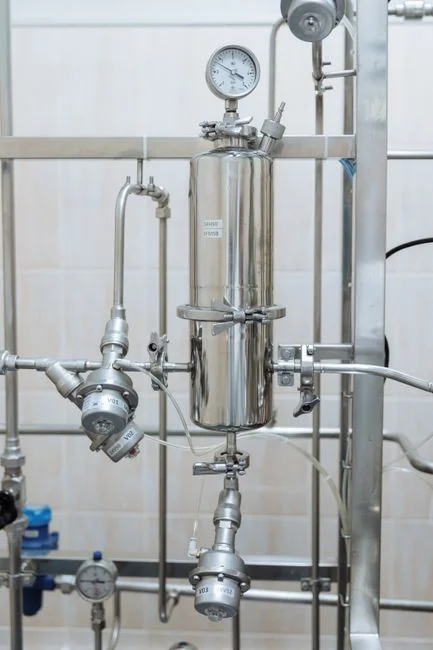
EV battery manufacturing wastewater should be divided into NMP solvent condensate, electrode and deionized-water rinses, paint-shop and assembly wash water, and sanitary sewage because each stream has different contaminant loads and suitable treatment routes (HydropureWater, 2026).
NMP recovery normally precedes biological treatment and commonly uses vacuum distillation or evaporative recovery. Combining NMP condensate with sanitary sewage can impose a high-BOD, poorly biodegradable load on an MBR or activated-sludge system. Keeping these streams segregated allows recovered solvent to return to the relevant process while the remaining liquid follows a separately verified treatment route.
DAF or lamella clarification should receive high-FOG, high-TSS electrode and paint-shop streams. DAF is preferred where the FOG load varies and float recovery is the objective; lamella clarification is more suitable where the flow is mainly inorganic suspended solids and footprint is constrained (HydropureWater, 2026). The supplied guide gives DAF design ranges of 20–40 minutes hydraulic retention time and 10–25 m³/m²·h surface loading. These are reference design values and must not be presented as Tesla requirements.
| Stream | Primary risks | Pre-ZLD treatment requirement |
|---|---|---|
| NMP solvent condensate | High-BOD, poorly biodegradable solvent load | Recover NMP before biological treatment |
| Electrode and deionized-water rinses | Electrolytes, trace metals and variable solids | Characterize metals and conductivity; define appropriate pretreatment |
| Paint-shop and assembly wash water | FOG, TSS, fillers and surfactants | DAF or lamella clarification, followed by stream-specific polishing |
| Sanitary sewage | Organic load and nutrients | Keep segregated from NMP; provide biological treatment |
Final capacity selection requires characterization by stream: flow, batch volume, COD, BOD₅, TSS, FOG, NMP, pH, conductivity, Ni, Co, Li, PFAS screen and cleaning-cycle profile. These measurements also establish whether a smaller average flow can produce a larger batch or membrane-system peak.
Equipment selection can then be developed around the industrial DAF pretreatment system and segregated sanitary treatment. The underground integrated sewage treatment option may be considered where sanitary flow can remain off the solvent train and civil space is constrained.
Build a ZLD Capacity Calculation From the Water Balance
A preliminary ZLD liquid duty should equal average wastewater entering the ZLD boundary plus stored inventory that must be processed, adjusted for measured batching and operating peaks. Do not add an arbitrary safety factor before resolving the plant’s actual flow profile.
Use this sequence:
- Establish process wastewater generation by production area and stream.
- Subtract documented NMP recovery and water-reuse return.
- Account for cleaning-cycle discharge volumes, batch frequency and permitted disposal or reuse.
- Apply measured peak and operating factors to the residual liquid flow.
- Check pretreatment, RO and evaporation constraints.
- Calculate annual concentrate and residue quantities and assign a disposal route.
The HydropureWater 2026 guide gives a high-level cell-manufacturing water-demand screening range of 1.5–3.0 m³/kWh. A meaningful fraction becomes wastewater, but the source does not specify what fraction applies to Tesla. These values are therefore suitable for early screening, not procurement-grade sizing.
Production rate alone is insufficient. A lower flow can drive a larger ZLD duty when wastewater is intermittent, highly concentrated or released in cleaning slugs. Use the wastewater-generating activities, recovery performance and operating calendar to establish the average residual duty, then use measured batch volumes and durations to establish the peak.
| Output | Required calculation basis | Permit or design check |
|---|---|---|
| Preliminary average liquid duty | Generated wastewater less source reduction and reuse, normalized across the operating calendar | Must fit the permitted treatment concept |
| Peak liquid loading | Maximum batch volume and discharge duration, including the operating pattern | Must be checked against equalization and downstream equipment constraints |
| Annual concentrate or residue | Residual liquid flow and constituent load through the selected recovery train | Requires a defined disposal route and waste classification |
RO recovery percentage, evaporation energy and cost are site-specific and cannot be transferred from generic ZLD claims. The ScienceDirect review’s global estimate of 3.3–5.1×10⁷ m³/yr shows the scale of lithium-ion battery wastewater, but it is not a Germany or Tesla sizing parameter (ScienceDirect, 2026).
The result should be three auditable outputs: average liquid duty in m³/day, peak loading in m³/h and annual concentrate or residue quantity. The method used for another site in the Tesla Texas ZLD capacity analysis can provide a consistent reporting structure, but not a German flow.
Select Pretreatment, RO and Evaporation as One Integrated System
RO and evaporation should be selected as one integrated train because upstream water quality determines membrane recovery and fouling, while concentrate chemistry determines the evaporation or crystallization duty. The HydropureWater 2026 guide identifies the general sequence as screening, DAF or lamella clarification, MBR or MBBR biology, and UV or RO/ZLD polishing.
MBR is favored where space is constrained or RO follows. The guide cites typical MBR mixed-liquor suspended solids of 8,000–12,000 mg/L, compared with 2,000–4,000 mg/L in conventional tanks (HydropureWater, 2026). That inventory supports compact treatment, but it does not establish the required reactor volume for Grünheide.
Equalization must accommodate measured cleaning and slug loads. Request the batch volume, discharge duration, return frequency, maximum storage time and expected operating pattern. An average daily flow alone will not reveal whether the biological and membrane systems can absorb a concentrated discharge.
For RO, evaluate feed chemistry, recovery rate, concentrate volume, scaling constituents, membrane replacement and pretreatment compatibility. An ultrafiltration system may form part of pretreatment, while the reverse-osmosis unit should be selected against the verified feed and required permeate quality.
Check the evaporator or crystallizer against residual concentrate flow, salt loading, available heat, fouling tendency and residue disposal. Incoming wastewater flow is not an adequate proxy for evaporation capacity. The ScienceDirect review treats water recovery, concentrate separation and resource recovery as an integrated circular-ZLD framework, which is the appropriate basis for a vendor mass balance (ScienceDirect, 2026).
Compare Sewer, Reuse and Full ZLD Development Options
The permitted treatment objective determines whether the project ends at municipal discharge, RO-based reuse with a permitted residual stream, or full ZLD with evaporation or crystallisation. The same upstream treatment train can support different Stage 4 outcomes, but its final duty changes materially.
| Development path | Information required | Principal design focus |
|---|---|---|
| Municipal discharge | Current permit, sewer acceptance conditions and receiving-utility limits | Concentration compliance, discharge route and monitoring |
| On-site RO reuse | Reuse targets, residual-stream route, feed chemistry and recovery basis | RO performance, concentrate quantity and storage |
| Full ZLD | Treatment-boundary definition, evaporation duty, energy source and residue route | Complete liquid balance, concentrate handling and disposal |
The supplied guide contrasts Nevada’s high on-site reuse with Shanghai’s municipal co-discharge model. That comparison demonstrates why water stress and permit philosophy, rather than battery chemistry alone, determine treatment depth (HydropureWater, 2026). For Grünheide, the drinking-water protection setting makes the permit central to the decision.
If the selected design changes from partial reuse to full ZLD, or changes the storage, evaporation or residue-disposal basis, obtain a permit-change review. Do not rely on generic return-on-investment or energy claims. Require a vendor mass and energy balance tied to the actual feed, recovery assumptions and concentrate route.
A broader international comparison is available in the 2026 Gigafactory ZLD development guide, but its assumptions should not be carried into Grünheide without site evidence.
Procurement Checklist for a Credible ZLD Bid
A comparable ZLD bid should be based on one common mass balance covering source characterization, segregation, equalization, NMP recovery, pretreatment, biology, membranes, ZLD, sludge dewatering and final waste routes.
Require every bidder to state:
- Design average flow, peak flow and maximum batch volume
- Operating hours and storage time
- Redundancy and availability assumptions
- RO recovery and resulting concentrate rate
- Evaporation capacity and residue quantity
- Normal, abnormal and startup-flow handling
Also request evidence for membrane and media life, chemical consumption, energy demand, controls, monitoring, maintenance and replacement-price assumptions. A headline evaporator or RO capacity is not a comparable offer unless its feed basis and operating guarantees are stated.
Compliance risk must be explicit. The permit, PFAS scope, hazardous-waste classification and residue route can invalidate an otherwise technically adequate unit if the system boundary is wrong. Ask how segregated NMP or electrolyte streams are contained and how they are prevented from upsetting downstream biology.
Residuals and replacement elements require separate disposal and replacement assumptions. The plate-and-frame filter press and RO and UF membrane elements should therefore be evaluated as parts of the waste and lifecycle-cost basis, not isolated products.
Any supplier claim of Tesla’s required ZLD capacity without a documented source should be treated as a commercial assumption requiring verification. The Tesla Gigafactory wastewater process guide also recommends verifying site-specific design values against current permits, influent testing and the final equipment proposal.
Frequently Asked Questions
What is Tesla’s verified ZLD capacity for the Grünheide Gigafactory?
Tesla has not publicly disclosed a verified ZLD capacity or a plant-specific m³/GWh water figure for any Gigafactory (HydropureWater, 2026). The 3.0 m³/h value belongs to a modelled German battery plant with intermittent flow and is not Tesla’s published requirement (HydropureWater CATL guide, 2025). For Grünheide, use the current permit record and site-specific water balance until Tesla or an authorized project document supplies a verified duty.
How should ZLD capacity be calculated for an EV battery plant?
Start with wastewater generated by each stream, subtract documented NMP recovery and water reuse, then calculate the residual average flow in m³/day. Apply measured batch volumes, discharge durations and operating peaks to establish m³/h, and carry concentrate flow and constituent loads through to evaporation and residue quantities. Preliminary screening may use the HydropureWater 2026 estimate of 1.5–3.0 m³/kWh for cell-manufacturing water demand, but procurement-grade sizing requires measured site inputs.
How should suppliers be compared for an EV battery manufacturing ZLD train?
Require all bidders to use the same source mass balance, stream split, batch profile, permit limits, RO recovery basis and residue route. Check operating guarantees, membrane and media life, chemical consumption, energy demand, availability, controls and abnormal-operation handling. Treat PFAS scope, hazardous-waste classification and segregated NMP handling as explicit compliance risks rather than optional design features.
What determines the cost of a battery plant ZLD system?
No defensible cost can be calculated without feed chemistry, flow profile, selected recovery, evaporation duty, energy assumptions and residue-disposal terms. Request a vendor-specific mass and energy balance with priced operating inputs, replacement assumptions and waste-route costs. Do not use generic RO recovery, evaporation-energy or cost claims as a substitute for a site-specific model.
Related Equipment
- industrial DAF pretreatment system — specifications, capacity range, and technical data