Barranquilla’s sewage treatment reality in 2026
Domestic sewage treatment in Barranquilla requires matching the treatment method to the wastewater source, available sewer route, discharge point and tropical operating conditions. The city faces a major service gap: a 2026 Urban Water Atlas report says only about 17% of Barranquilla’s wastewater is treated, while arroyos can convey sewage and stormwater toward the Magdalena River and Mallorquín Swamp. For properties without dependable sewer access, options include underground packaged A/O plants, MBR systems and constructed wetlands. Package A/O plants offer compact, automated treatment; MBR provides membrane-level solids separation and reuse potential; wetlands offer nature-based partial treatment. Final selection requires verified flow, wastewater characteristics, soil and flood data, and confirmation of the applicable Colombian discharge requirements.
The drainage context makes site selection more than a connection exercise. Urban Water Atlas reported in 2026 that roughly 83% of Barranquilla’s sewage flows directly into rivers and wetlands. Its reporting also states that the same arroyos carry untreated sewage, stormwater and solid waste toward the Magdalena River and Mallorquín Swamp.
Triple A’s reported service area covers around 2.8 million people across the metropolitan area, but that does not demonstrate that a particular parcel has a usable gravity connection, adequate sewer capacity or permission to discharge into the network. Those conditions must be verified at the property level.
Wet-season design is equally important. Urban Water Atlas reported that October rainfall can peak at almost 5 inches in one month, with some events delivering 100 mm in one day. A treatment train therefore needs a defined response to inflow, overflow, access and power conditions that occur when rainfall and wastewater converge.
Choose the discharge route before choosing the equipment
The first procurement decision is the discharge route, because it determines the required treatment performance, approval path and hydraulic design. Start by confirming whether the parcel has a gravity sewer, a pumped sewer or no formal connection. Do not infer availability from metropolitan coverage: the actual connection point, elevation, capacity, ownership and acceptance conditions must be confirmed with the utility and the authority responsible for the receiving environment.
Next, identify the authorized destination. It may be a sanitary sewer, surface water, an arroyo, an agricultural reuse system or another approved route. Request the applicable site-specific discharge criteria and reuse requirements in writing. Urban Water Atlas identifies Resolution 1207 of 2014 as the Colombian benchmark evaluated in the 2024 Sucre study, but that study does not establish which requirements apply to a particular Barranquilla project.
Constructed wetlands require careful terminology. Urban Water Atlas described them as decentralized partial treatment, not substitutes for a full Triple A treatment plant, and stated that they do not turn raw sewage into drinking water. They should not be presented as complete treatment without a project-specific compliance basis.
Receiving-water dilution must not be embedded as a design assumption. The receiving environment may affect the discharge point and environmental assessment, but it does not remove the project’s obligation to characterize and treat its wastewater.
| Decision item | Evidence required before equipment selection | Decision consequence |
|---|---|---|
| Formal sewer route | Connection point, invert level, available capacity, pumping requirement and utility acceptance | Sets the preliminary treatment duty and civil scope |
| Direct or indirect discharge | Receiving water, authority approval, site-specific limits and monitoring obligations | Defines the required effluent quality |
| Reuse | Intended reuse activity and applicable health or irrigation requirements | May require higher solids separation and additional treatment |
| Wetland route | Land, hydraulic residence time, vegetation, maintenance responsibility and regulatory acceptance | Proceed only as a verified partial-treatment option where appropriate |
Compare packaged A/O, MBR and wetland treatment
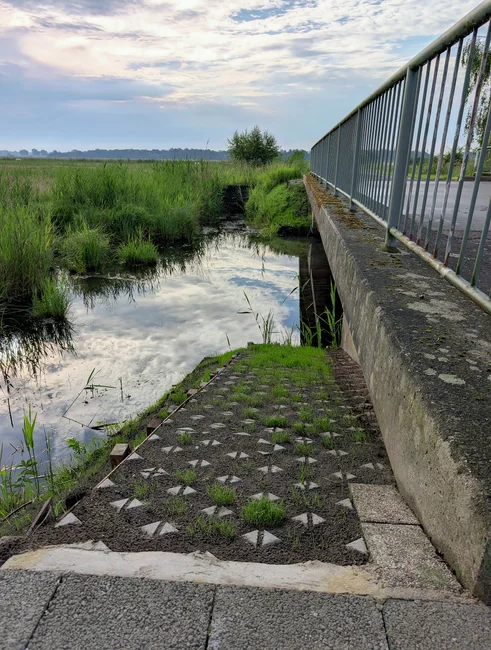
No treatment option can be ranked responsibly until the project duty, land, power, odor, flood and approval constraints are known. Packaged A/O, MBR and wetland systems solve different problems, and the evidence available for each has a different scope.
| Option | Process and documented evidence | Best fit after verification | Main diligence issue |
|---|---|---|---|
| Packaged A/O | HydropureWater’s product catalog describes an underground packaged A/O sewage treatment plant combining anoxic/aerobic contact oxidation, sedimentation and disinfection. It is automated, has no operator requirement according to the catalog, handles 1–80 m³/h and may be buried or trailer-mounted. | Compact, automated conventional treatment at the verified duty point | Confirm hydraulic loading, effluent guarantees, installation conditions and service scope |
| MBR | HydropureWater’s catalog describes an MBR wastewater treatment system combining activated sludge with submerged PVDF membrane filtration. The catalog reports filtration below 1 μm, a 60% smaller footprint than conventional systems and capacity from 10–2,000 m³/day. | Projects where solids separation, reuse potential or larger capacity justifies added process complexity | Verify the comparison basis, membrane fouling strategy, cleaning, power demand and solids handling |
| Subsurface-flow constructed wetland | Urban Water Atlas reported BOD removals of 79–91.5% and fecal-coliform removals of 96.4–99.8% for Colombian tropical-climate subsurface-flow systems treating domestic wastewater. | Land and maintenance arrangements that support hydraulic residence time, vegetation and partial treatment | Do not transfer research results directly to a new site; verify the loading and local approval basis |
The 2024 Sucre study evaluated a Canna-based horizontal subsurface-flow wetland with a mixed gravel and oil-palm-fruit-endocarp substrate in San Marcos, Sucre. During a 120-day startup and adaptation evaluation, it achieved removal efficiencies of up to 91% BOD, 94% TSS, 98% total phosphorus, 52% nitrates, 73% nitrites, 78% ammonium and 75% total nitrogen. Those results belong to that experimental system and cannot be presented as universal wetland guarantees.
Use packaged A/O when compact, automated conventional treatment fits the verified duty. Evaluate MBR when stringent solids separation, reuse potential or larger capacity justifies the additional process controls. Evaluate wetlands only where land, residence time, vegetation management, hydraulic separation and partial-treatment objectives fit the project. A further comparison of packaged A/O, MBR and decentralized sewage systems can support a wider screening process, but it cannot replace Barranquilla-specific design inputs.
Design for Barranquilla’s wet season and low-permeability conditions
Rainfall can overwhelm a treatment train unless wet-weather inflows are separated or deliberately included in its hydraulic basis. Urban Water Atlas reported October rainfall peaking at almost 5 inches in one month and individual events reaching 100 mm per day. Those conditions make inlet control, flow diversion and backflow protection core design issues rather than optional details.
Infiltration also requires restraint. Urban Water Atlas reported low-permeability soils on parts of Barranquilla’s southern slope, so meaningful infiltration cannot be assumed without site-specific testing. For above-ground or partially buried equipment, evaluate the design flood level, access routes, buoyancy, wastewater backflow and electrical safety during intense rainfall.
For wetlands, define the treatment sequence as detention, filtration, partial treatment and controlled discharge. Do not assume that direct infiltration will remove contaminants, particularly where low-permeability soil limits drainage and where stormwater may overwhelm the media.
Where stormwater and sewage converge, require hydraulic separation and treatment-pathway controls so incoming runoff cannot pass through or exceed the treatment unit without a defined response. The treatment plant should also have a clear overflow or bypass condition that prevents backflow toward occupied buildings.
The Bogotá Fucha study offers a comparative precedent rather than a Barranquilla design standard. Cipagauta-Linares et al., reported by Urban Water Atlas in 2026 from MDPI Water (2025), modeled a five-component SUDS package comprising detention tanks, vegetated swales, rain gardens, infiltration channels and porous pavements. It reduced peak flow by 31.8% and managed roughly 2,362 m³ of runoff per event. That evidence supports integrated stormwater planning, but it does not size a treatment plant.
Build the sizing and procurement data set

A defensible equipment inquiry starts with measured hydraulic and wastewater duty, not with a selected technology or a population estimate. Ask bidders to size and price against one common data set so their responses can be compared without changing the underlying assumptions.
| Data group | Items to request | Why it is required |
|---|---|---|
| Hydraulic duty | Average daily flow, peak-hour flow, peak-day factor, flow-duration profile and design horizon | Establishes process and equalization capacity; building area or population alone is insufficient |
| Influent quality | BOD, COD, TSS, fats and oils, nitrogen species, pH, pathogens and process-specific contaminants | Defines biological loading, pretreatment, disinfection and reuse requirements |
| Site and utilities | Footprint, soil, groundwater and flood levels, receiving-water route, power, odor constraints and maintenance access | Controls layout, siting, hydraulic protection and operability |
| Performance basis | Required effluent quality, reuse objective, test methods, monitoring and documentation | Prevents incompatible bids and unverifiable guarantees |
| Commercial scope | Process, duty point, civil works, installation, commissioning, utilities, solids handling, maintenance, spares, monitoring and warranty | Separates equipment price from the total ownership obligation |
The supplied research does not provide Barranquilla-specific treatment prices, footprints, delivery periods or universal discharge limits. Request those items in quotations rather than filling them with generic allowances. Each bid should state the exact duty and site conditions used, and each performance percentage should be accompanied by its test conditions, design loading and guarantee.
Distinguish evidence classes when reviewing bids. A peer-reviewed study supports the evaluated system under its stated conditions. A manufacturer catalog supports the manufacturer’s published configuration and capacity, but it is not independent validation at the buyer’s site. A regulatory limit must come from the applicable authority’s written project basis.
- Confirm sewer and discharge routes.
- Measure flow and characterize the influent.
- Complete flood, soil and site investigations.
- Define effluent, reuse and documentation requirements.
- Issue a common data set to shortlisted suppliers.
- Compare bids on scope, guarantees and long-term operating obligations.
Plan commissioning, monitoring and long-term ownership
Treatment performance depends on an assigned operator or service provider and a funded maintenance plan established before commissioning. The Bogotá SUDS literature summarized by Urban Water Atlas in 2026 identified unclear responsibility for operation and maintenance and weak agency coordination as dominant implementation barriers. The same ownership gap can defeat a packaged plant or wetland.
For packaged A/O and MBR systems, define routine inspection, biological-process checks, solids handling, membrane or media maintenance, power-failure response and effluent-sampling responsibilities. Clarify who responds to alarms, performs corrective work, transports residuals and keeps operating records.
For wetlands, include plant management, sediment accumulation, clogging inspection and verification that the treatment pathway remains functional. Urban Water Atlas noted that bioswales can clog, retention ponds require sediment removal and wetlands require plant management; an unmaintained system may deteriorate within two to three years, according to its 2026 report.
Require baseline and follow-up sampling so the installation generates operating evidence rather than relying only on installation reports or anecdotal observations. The sewage treatment plant servicing and maintenance KPIs provide a useful structure for converting those responsibilities into scheduled checks.
Include solid-waste controls and community engagement where the drainage corridor is visible to the public. Urban Water Atlas reported in 2026 that naturalized channels do not prevent dumping and that maintenance must be paired with public education.
Frequently Asked Questions
How much does domestic sewage treatment cost in Barranquilla?
No Barranquilla-specific treatment price appears in the supplied research, so a defensible budget cannot be derived from population or a generic unit rate. Request itemized quotations on the same duty basis, including the selected process, civil works, installation, utilities, commissioning, solids handling, routine maintenance, monitoring, spares and warranty. A further comparison of packaged A/O, MBR and decentralized sewage systems can help structure the quote request, but it does not establish local cost.
Which supplier should be selected for a Barranquilla treatment plant?
Select against project performance and ownership obligations, not catalog capacity alone. Ask each supplier to demonstrate the proposed duty, effluent guarantee, site-specific civil design, commissioning plan, local service capability, solids-management route and response time for corrective maintenance. Verify that the quote assumes the same wastewater characterization, flood conditions, utilities, discharge route and monitoring requirements.
How should a treatment plant be sized?
Final sizing follows the verified hydraulic and wastewater duty rather than the technology selected in advance. Provide average and peak flows, the flow profile, design horizon and influent characterization, then require each bidder to document its loading and redundancy assumptions. Confirm the resulting configuration with the engineer responsible for the site design.
Can the reported treatment-removal figures be used as guarantees?
No. The wetland figures are tied to the systems and conditions described in the cited studies, while the MBR and packaged A/O values are manufacturer catalog claims. Require each bid to state its test conditions, design loading and contractual performance criteria, then validate the installed system through baseline and follow-up sampling.
What treatment options fit a coastal city with wet-season and low-permeability conditions?
Final selection depends on site constraints, so compare alternatives only against verified requirements. Package A/O supports compact automated treatment, MBR adds membrane-level solids separation, and wetlands require adequate land and maintenance for partial treatment. The domestic sewage treatment options for coastal cities provides comparative context, but Barranquilla-specific flood, soil, sewer and discharge data remain controlling inputs.