How Vaccine Wastewater Differs From Other Pharmaceutical Effluent
Vaccine manufacturing wastewater is not one uniform stream, and its COD treatment requirements depend on which production activities generate it. Veolia Water Technologies’ Pharmaceutical Manufacturing Wastewater Treatment Guide (2020) classifies vaccines, antibodies, therapeutic proteins and gene therapies as biological API products made through bioprocessing. Fermentation and purification discharges can contain nutrients, proteins, amino acids, vitamins, organic and inorganic salts, surface-active agents and complex undefined ingredients. The same guide identifies starches, sugars, detergents and API residues in mixing and equipment-rinsing streams; detergents can promote foaming, while salts can hinder biomass development and increase corrosion.
Fill-and-finish operations add Water for Injection, salts, sugars and alcohols to formulations. Cleaning-in-place operations can introduce CIP chemicals, suspended solids and dissolved salts, while scrubber blowdown can contribute acids, bases and organic compounds. These streams may all carry COD, but they impose different downstream constraints. A design that treats them as one blended stream may hide the cause of foaming, toxicity, salinity or membrane fouling.
Separate streams by process function before fixing the equipment train. For each stream, determine whether the controlling objective is bulk biodegradable COD, soluble or refractory COD, suspended solids, foam, salinity or active-substance removal. That determines whether equalization, biological treatment, physical separation or advanced polishing should carry the design load. A pharma plant ETP upgrade guide provides a broader context for this source-by-source approach.
| Vaccine manufacturing stream | Typical constituents identified by Veolia, 2020 | Primary design issue |
|---|---|---|
| Fermentation and purification | Nutrients, proteins, amino acids, vitamins, organic and inorganic salts, surface-active agents, undefined ingredients | Biodegradable load, active substances, foaming, salinity and biomass compatibility |
| Mixing and equipment rinsing | Starches, sugars, detergents and API residues | Variable COD, foam and biological-system upset |
| Fill and formulation | Water for Injection, salts, sugars and alcohols | Dilution, soluble organic load and salinity contribution |
| CIP and utility discharges | CIP chemicals, suspended solids, dissolved salts, RO concentrate, cooling-tower and boiler blowdown | pH, salts, solids and changed wastewater composition |
Characterize the Wastewater Before Selecting COD Equipment
A single COD average cannot define the design basis for vaccine manufacturing wastewater because the load changes with batches, campaigns, cleaning cycles and production stages. Veolia’s 2020 guide describes pharmaceutical wastewater as inconsistent even between facilities manufacturing the same product. Build the sampling plan around batch starts, campaign changes, CIP events, peak fermentation discharges and routine operation rather than relying on one composite sample.
The initial analytical screen should cover COD, BOD5, pH, TSS, salinity, temperature and flow. Add ammonia and compound-specific analyses where the selected process could be affected by nutrients, active substances, biocides or inhibitory products. The COD/BOD5 ratio is the first biodegradability screen: Veolia classifies a ratio below 2 as easily biodegradable, 2 to 3 as biodegradable, and above 3 as wastewater that may not be biodegradable. This ratio does not quantify refractory COD, so low BOD5 alone does not establish that biological treatment will meet the final COD target.
Veolia reports pharmaceutical COD from 400 to 62,000 mg/L and COD/BOD5 ratios from 1 to 15, based on analysis of 50 plants; the guide also states that wastewater characteristics differ among plants producing similar products (Veolia Water Technologies, 2020). Use these values to justify site characterization, not as design loads for a vaccine facility.
Request bench or pilot testing with actual mixed wastewater, including representative batch and cleaning events. The test should demonstrate COD removal, foam control, solids handling and response to inhibitory constituents rather than only reporting removal under a synthetic-water condition. The industrial COD removal treatment-train comparison provides a useful structure for comparing unit-operation evidence.
| Parameter | Decision supported | Additional evidence to request |
|---|---|---|
| COD and BOD5 | Organic load and preliminary biodegradability | Batch-resolved results and refractory or non-biodegradable COD assessment |
| pH and alkalinity | Neutralization and biological-process suitability | Acid/base consumption and mixed-stream pH profile |
| TSS and settleable solids | Primary separation, DAF and membrane pretreatment needs | Oil, grease, colloid and solids characterization |
| Salinity and temperature | Biomass and membrane compatibility | Batch and CIP peak concentrations |
| Foam, toxicity and active substances | Foaming control and biological inhibition risk | Foam-rise test and compound-specific assessment |
| Flow and batch chronology | Equalization, hydraulic loading and equipment sizing | Flow series, campaign schedule and maximum batch discharge |
Build a Treatment Train from the Wastewater Sources
A defensible treatment train starts with equalization because batch discharges otherwise transmit flow and COD peaks directly to biological and membrane systems. Veolia’s 2020 pharmaceutical process framework identifies equalization as a core step, followed by neutralization, primary separation, biological treatment, tertiary treatment and sludge management as required by the source composition and receiving objective.
- Segregate and equalize. Identify fermentation, purification, filling, CIP and utility streams separately, then use equalization to dampen batch peaks and stabilize flow and load.
- Correct pH and assess inhibition. Neutralize acids, bases or scrubber blowdown where required. Confirm biodegradability and toxicity before routing the stream to biomass.
- Remove material that would foul the next process. Consider primary separation for suspended solids, oils, grease or colloids. A DAF system for wastewater pretreatment is applicable to floatable and suspended material; it should not be credited as a stand-alone treatment for dissolved COD.
- Remove biodegradable bulk COD biologically. Select a biological process according to the measured load, biodegradability, salinity and foam risk. An integrated MBR membrane bioreactor system combines biological treatment with membrane solids separation.
- Polish only against a defined objective. Consider tertiary treatment or RO for reuse or discharge requirements, but verify residual soluble COD, salinity, scaling potential and membrane compatibility. RO does not replace biological treatment where substantial biodegradable COD remains upstream.
- Design the solids path with the liquid train. Characterize sludge from DAF or primary separation and biological residuals; specify dewatering, handling and disposal before equipment selection.
Veolia includes an equalization-to-MBR treatment line in its pharmaceutical examples (2020). That does not make MBR universal: site testing must still establish loading, biodegradability, configuration and fouling behavior. Further process-selection context is available in the DAF and primary-separation selection guide.
| Treatment step | Contaminant or function addressed | Key qualification before selection |
|---|---|---|
| Segregation and equalization | Batch flow and load peaks | Representative batch and campaign data |
| Neutralization | Extreme pH from acids, bases or scrubber blowdown | Mixed-stream pH and chemical demand |
| Primary separation or DAF | Suspended solids, oil, grease, floatable and colloidal material | Oil, grease, colloid and foam characterization |
| Biological treatment | Biodegradable bulk organic load | COD/BOD5, toxicity, salinity and foam behavior |
| MBR | Biodegradable COD plus membrane solids separation | Loading, configuration, flux and fouling pilot data |
| Tertiary treatment or RO | Residual soluble COD or reuse-specific contaminants | Final objective, scaling and membrane compatibility |
| Sludge treatment | Separated solids and biological residuals | Residue characterization and disposal route |
Compare Pretreatment, Biological and Membrane Options
Each process should be assigned to the contaminant it actually removes. DAF is a physical separation step for suspended solids, oil, grease, floatable and colloidal matter. It can protect downstream biological and membrane equipment, but it does not by itself justify a soluble-COD removal claim. Chemical coagulation, flocculation and pH control can support solids removal, yet their performance depends on the chemical selected, the wastewater chemistry and the contaminant target.
MBR combines activated-sludge treatment with submerged membrane filtration, making it relevant where biological COD removal and solids separation are both required. Site testing must confirm biodegradability, hydraulic and organic loading, membrane configuration and fouling tendency. Veolia’s 2020 guide includes equalization-to-MBR pharmaceutical treatment lines and describes biological treatment and tertiary treatment as distinct stages rather than interchangeable units.
Industrial RO can support high-purity permeate for suitable pharmaceutical process applications, but sustainable performance depends on upstream COD reduction, scaling control and membrane compatibility. It is not a substitute for a biological stage where soluble biodegradable COD remains. For pretreatment comparison, the Fenton oxidation energy-efficiency guide provides a reference for assessing advanced chemical oxidation as a targeted step rather than a default COD solution.
Electrocoagulation belongs in the comparison only as a pilot-tested option. Abbas Muslim and Asel’s Wasit University study used aluminum and iron electrodes in a two-liter coagulation cell and reported 99.5% COD removal for its specified oily petroleum refinery wastewater. That result does not establish performance for vaccine effluent, where the contaminant matrix and target are materially different.
| Technology | What it addresses | What it does not settle | Required pilot or design evidence |
|---|---|---|---|
| DAF | Suspended solids, oil, grease, floatable and colloidal material | Removal of dissolved biodegradable COD | Oil and grease profile, solids loading, float and sludge behavior |
| Chemical dosing | pH control or coagulation-assisted solids capture | A universal removal rate independent of water chemistry | Jar tests, chemical demand and downstream compatibility |
| Biological treatment | Biodegradable bulk COD | Refractory COD and all inhibition risks | COD/BOD5, toxicity, salinity, foam and loading tests |
| MBR | Biodegradable COD and membrane solids separation | Fouling resistance and reuse compatibility | Pilot loading, flux, cleaning, solids and effluent-quality data |
| RO | Dissolved contaminants for suitable reuse objectives | Missing upstream COD removal or scaling control | Feed chemistry, scaling, fouling and concentrate-disposal assessment |
| Electrocoagulation | Potential treatment of specific oily or particulate wastewater | Transferable performance on vaccine effluent | Representative-wastewater pilot and whole-life comparison |
Pilot Electrocoagulation Only with Comparable Wastewater
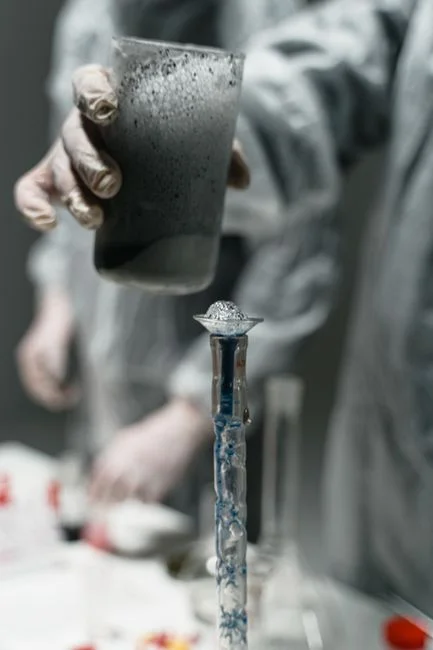
The Wasit University electrocoagulation study is useful as a testable pilot reference, not as a vaccine-plant performance guarantee. Abbas Muslim and Asel used a two-liter coagulation cell with four aluminum and four iron electrodes. Their reported optimum conditions were a 2 cm electrode distance, 12 cm electrode depth, pH 7, 10.5 V and a treatment time of 50 minutes.
The tested wastewater was oily petroleum refinery wastewater. It had initial COD of 710 mg/L, initial oil of 95 mg/L, sodium chloride of 0.5 g/L and TSS of 73 mg/L. The study reported 99.5% COD removal, 94.2% oil removal and estimated energy consumption of 12 kWh/m³ (Abbas Muslim and Asel, Wasit University, publication date not stated in the supplied record). These results apply only to the tested wastewater and experimental conditions.
For a vaccine plant, treat the study as a hypothesis to test using representative mixed effluent. The pilot should vary pH, voltage, treatment time and electrode configuration while recording COD removal, energy consumption, salinity effects, electrode consumption, sludge generation and residual COD. It should also characterize whether electrode passivation or foam limits performance.
Do not compare electrocoagulation on COD removal alone. Compare it with coagulation-flocculation, DAF, biological treatment and MBR using the same representative wastewater and the same effluent objective. Include chemical consumption, energy, electrode replacement, sludge handling, footprint, operating complexity and reuse compatibility. If the objective is COD removal, the primary clarifier engineering guide can help frame solids-capture performance and residuals.
| Pilot item | Wasit University study value or scope | Vaccine-plant interpretation |
|---|---|---|
| Wastewater | Oily petroleum refinery wastewater | Not comparable without representative vaccine-effluent testing |
| Initial COD | 710 mg/L | A test-feed characteristic, not a design load |
| Initial oil | 95 mg/L | Requires local oil and grease characterization |
| Sodium chloride | 0.5 g/L | Test salinity across actual batch conditions |
| TSS | 73 mg/L | Measure vaccine effluent solids independently |
| Cell and electrodes | 2 L cell; four aluminum and four iron electrodes | Laboratory configuration only; no automatic scale-up |
| Operating conditions | 2 cm spacing, 12 cm depth, pH 7, 10.5 V, 50 minutes | Pilot variables, not guaranteed full-scale settings |
| Reported performance | 99.5% COD removal; 94.2% oil removal; estimated 12 kWh/m³ | Use only to define what to measure and compare |
Design Monitoring Around COD Removal Performance
Monitoring must locate the source of poor performance rather than merely confirm an average final COD. Track flow, COD, BOD5, pH, TSS, salinity and temperature at equalization and after each major process stage. Relate these results to production records, including fermentation stages, cleaning events, formulation changes and campaign changes. That comparison can distinguish a treatment-capacity problem from a change in wastewater composition.
For DAF, monitor float removal, sludge withdrawal and upstream oil or grease loading. A satisfactory COD value does not demonstrate that recoverable solids are being removed or that sludge is leaving the system correctly. For biological treatment, include process indicators associated with biomass condition and organic removal; the supplied research does not establish a universal set of site-specific biological acceptance limits.
For MBR, monitor membrane flux, cleaning frequency and solids separation alongside COD. Low COD can result from a favorable batch or prior removal steps; it does not establish that the biological process is healthy or that membrane fouling risk is controlled. The MBR membrane cleaning and fouling-control guide provides practical detail on separating membrane condition from liquid-phase treatment performance.
Set the final acceptance criterion from the applicable permit, sewer authority or reuse specification. The supplied sources do not establish a universal vaccine-wastewater COD limit, and the target keyword does not establish one either. Engineering acceptance should therefore use a defined source, sampling method, analytical parameter and operating envelope rather than a single unqualified concentration.
Frequently Asked Questions
What determines the cost of a vaccine wastewater COD removal system?
The total budget depends on wastewater composition, flow, batch variability, pretreatment needs, biodegradability, the reuse or discharge objective and sludge handling. A generic equipment price is not a defensible budget. Request a quotation that states flow basis, design influent loads, treatment stages, membrane or polishing scope, civil works, chemical and sludge-disposal assumptions, guarantees and exclusions.
How should a wastewater-treatment supplier be selected?
Ask for relevant pharmaceutical or biological API experience, process guarantees based on representative wastewater, and a clear equipment and performance scope. The supplier should document the selected process, operating requirements, maintenance, spare parts and monitoring obligations. Request site-specific evidence rather than accepting performance transferred from petroleum wastewater or another product stream.
What data are needed to size the treatment train?
Provide batch-resolved flow and COD data, COD/BOD5, pH, TSS, salinity, temperature, toxicity or active-substance information, foam behavior and the intended effluent standard. Include campaign and cleaning schedules because batch peaks may control equalization and pretreatment sizing. These inputs are needed before comparing DAF, biological treatment, MBR or membrane polishing.
Does the reported 99.5% electrocoagulation COD removal apply to vaccine manufacturing wastewater?
No. The 99.5% result was obtained for the Wasit University study’s oily petroleum refinery wastewater under its stated experimental conditions. For vaccine manufacturing wastewater, run a controlled pilot with representative mixed streams and compare electrocoagulation with conventional biological and membrane alternatives on COD removal, energy, chemical use, sludge and reuse compatibility.