Map the Detroit Data Center's Wastewater Streams
A Detroit data center generally needs two coordinated treatment paths: one for cooling-tower blowdown and another for sanitary wastewater. Blowdown should first be characterized for conductivity, suspended solids, pH, residual chemicals, temperature and source-water chemistry. Its treatment may require physical separation with DAF, followed by UF for solids and bacteria removal when polishing or reuse is needed. Sanitary wastewater requires biological treatment, typically MBR for a compact site. The final train depends on whether water will be reused as cooling makeup, reused for lower-grade services, discharged to a permitted sewer, or managed under an industrial pretreatment permit.
Start with physical segregation. Cooling-tower blowdown, domestic sanitary sewage, process wastewater, stormwater, and construction or maintenance wastewater should not be combined before their treatment duties and discharge routes are established. A regional data-center wastewater planning example provides a useful framework for separating streams before selecting equipment.
Characterize each stream by flow and seasonal variation, temperature, pH, conductivity, hardness, suspended solids, oil and grease, residual biocide or chemical concentrations, and biological oxygen demand. Cooling blowdown contains concentrated dissolved solids, suspended matter, and residual treatment chemicals. Sanitary wastewater requires biological treatment rather than only physical separation; MBR is a candidate where biological treatment and membrane separation are required in a compact installation.
Before setting an effluent target, obtain the Detroit utility’s current discharge and industrial pretreatment requirements. The supplied research contains no numerical Detroit discharge limit, so a design based on an assumed limit would not be defensible. The discharge destination, applicable permit or sewer agreement, and reuse plan should be established before equipment is purchased.
| Stream | Primary contaminants and characteristics | Treatment responsibility | Decision required |
|---|---|---|---|
| Cooling-tower blowdown | Concentrated dissolved solids, suspended matter, residual treatment chemicals, temperature | Solids removal; optional disinfection, dissolved-solids reduction and polishing | Reuse endpoint and permitted discharge route |
| Domestic sanitary sewage | Organic matter, nutrients, suspended solids, biological oxygen demand | Biological treatment and solids separation; disinfection if required | Sanitary discharge, reuse, or separate handling |
| Process wastewater | Contaminants depend on the process; may include salts, oil and grease, chemicals or metals | Contaminant-specific physical and chemical treatment | Source characterization and applicable requirements |
| Stormwater and construction or maintenance wastewater | Variable solids, sediment, oils, pH and site-specific contaminants | Source control, equalization, and treatment appropriate to the release point | Whether to reuse, discharge, or isolate |
Calculate the Cooling-Water Balance Before Buying Equipment
The blowdown calculation must be based on measured water flows rather than a generic data-center assumption. Genesis Water Technologies gives the theoretical relationship blowdown ratio = 1/(CoC−1), where cycles of concentration (CoC) is the ratio of dissolved-solids concentration in circulating water to that in makeup water. Its published comparison is specific: at 4 CoC, blowdown equals 25% of makeup volume; at 6 CoC, it equals 20%. The change is five percentage points and a 20% reduction in blowdown volume, not 50%.
Genesis uses a 10 MW evaporative-cooled facility as an example: it may intake 15 million gallons monthly, with theoretical blowdown of 3.75 million gallons monthly at 4 CoC. Treat that as a scale reference rather than a Detroit design basis. Actual blowdown can exceed theoretical calculations by 15–30% because of unmeasured losses and emergency dumps, according to Genesis. That uncertainty belongs in capacity selection and operating scenarios.
Install or verify independent metering for makeup, blowdown, evaporation, and final discharge. Keep consumption separate from usage: Valicor defines consumption as water permanently removed through evaporation or incorporation into products, while usage includes water withdrawn, used, and returned to the source—potentially after treatment. A treatment skid should not be sized from “makeup demand” alone. Use peak and emergency flows, expected operating hours, and the selected reuse rate.
- Measure makeup and blowdown over representative cooling seasons.
- Reconcile the balance with evaporation and unmeasured losses.
- Calculate theoretical blowdown at the operating CoC and apply the site’s measured operating margin.
- Size treatment and storage for the selected duty, standby, and emergency-dump cases.
| Cooling-water measure | Published basis | Design implication |
|---|---|---|
| 4 CoC theoretical blowdown | 25% of makeup volume (Genesis Water Technologies, undated research excerpt) | Use as a theoretical baseline, not measured site flow |
| 6 CoC theoretical blowdown | 20% of makeup volume (Genesis Water Technologies, undated research excerpt) | Reduction from 4 CoC is five percentage points, or 20% of blowdown volume |
| Illustrative 10 MW evaporative-cooled facility | 15 million gallons monthly intake and 3.75 million gallons monthly theoretical blowdown at 4 CoC (Genesis Water Technologies, undated research excerpt) | Illustrative only; replace with Detroit site measurements |
| Operational uncertainty | Actual blowdown may exceed theory by 15–30% from unmeasured losses and emergency dumps (Genesis Water Technologies, undated research excerpt) | Carry into peak and contingency sizing |
The detailed data-center blowdown treatment workflow is useful for integrating this balance with treatment operations, but the Detroit equipment basis should remain the site’s own flow and chemistry data.
Match Each Treatment Objective to the Right Process
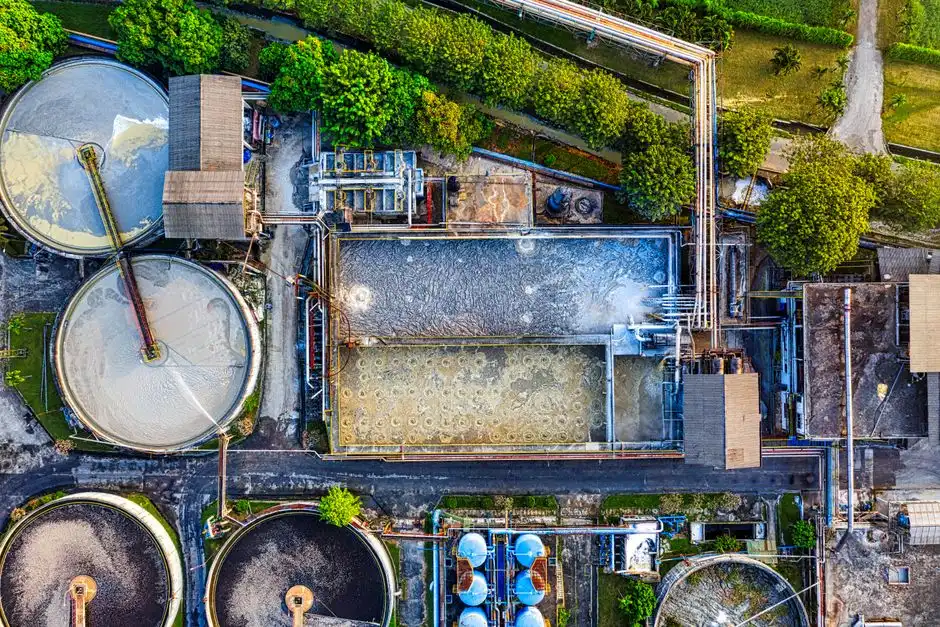
No single technology handles every contaminant in cooling blowdown and sanitary wastewater. DAF addresses suspended solids and entrained oil or grease; UF provides barrier separation for solids, colloids, and bacteria; RO targets dissolved salts and silica; MBR supplies biological treatment for sanitary wastewater; and disinfection addresses microbial control where the reuse or discharge objective requires it. The correct train follows the contaminants and endpoint, not a preferred brand of equipment.
Use DAF when suspended solids, colloids, FOG, or oil and grease are the principal targets. The specified DAF range covers 4–300 m³/h across 13 models with automatic skimming; a DAF system for cooling-blowdown solids removal is the relevant equipment category to evaluate. DAF does not remove dissolved salts.
Use UF when the train must remove bacteria, colloids, and suspended solids without chemical addition. The specified UF range is 2,000–40,000 L/h, using 0.03 μm PVDF membranes with automatic backwash and air scour. A UF polishing system for cooling-blowdown reuse is suitable where that separation duty is required. Use RO when dissolved salts or silica must be reduced for higher-quality reuse; the specified industrial systems offer recovery rates up to 95%, automatic PLC operation, and minimal chemical consumption.
For sanitary wastewater or industrial streams requiring biological treatment and membrane separation, the specified MBR product handles 10–2,000 m³/day and produces effluent with filtration below 1 μm. Where on-site disinfection is required for an industrial cooling loop or process-wastewater application, the specified chlorine-dioxide configurations range from 50 g/h to 20,000 g/h.
| Technology | Primary removal role | Specified equipment basis | Key limitation |
|---|---|---|---|
| DAF | Suspended solids, colloids, FOG and oil and grease | 4–300 m³/h; 13 models; automatic skimming | Does not provide dissolved-solids removal |
| UF | Bacteria, colloids and suspended solids without chemicals | 2,000–40,000 L/h; 0.03 μm PVDF; automatic backwash and air scour | Requires feed-water limits and membrane-cleaning strategy |
| RO | Dissolved salts and silica for higher-quality reuse | Recovery up to 95%; automatic PLC; minimal chemical consumption | Adds pretreatment, energy, concentrate and operator requirements |
| MBR | Biological treatment and membrane separation | 10–2,000 m³/day; filtration below 1 μm | Applies to sanitary or industrial biological streams, not merely physical blowdown treatment |
| Chlorine dioxide | On-site disinfection | 50–20,000 g/h configurations | Requires a defined contact, residual and safety-control basis |
The DAF versus clarifier selection guide provides a useful solids-separation comparison, while the blowdown treatment workflow helps place each unit within a complete train.
Build a Detroit Reuse and Discharge Decision Tree
The reuse endpoint determines how much treatment is justified. Genesis Water Technologies identifies irrigation, toilet flushing, and outdoor equipment washing as lower-grade reuse applications, with cooling-tower makeup requiring advanced treatment. For lower-grade reuse, determine whether filtration, pH correction, and local disinfection are sufficient after initial physical separation. Do not install RO merely because the source is a data center.
For cooling-tower makeup reuse, test for the contaminants that control scaling, corrosion, biological growth, and chemical compatibility. Genesis states that biological and scaling risks increase above 5–6 CoC without advanced treatment. UF alone does not reduce dissolved salt loading, while RO introduces concentrate handling and additional pretreatment and operating requirements.
For direct sanitary discharge, confirm the utility’s industrial pretreatment requirements and whether cooling blowdown can enter the permitted sewer route. Do not assume that a sanitary discharge approval also authorizes cooling-blowdown discharge. For zero-liquid-discharge or advanced reuse concepts, assess whether the added RO and membrane complexity fits the site’s scale, staffing, and reuse value. Genesis cautions against transplanting hyperscale treatment systems into smaller facilities without economic and operational fit.
| If the primary objective is | Then evaluate first | Then define |
|---|---|---|
| Toilet flushing, equipment washing or approved irrigation | DAF or equivalent solids separation, followed by filtration as needed | pH correction, local disinfection, storage and reuse controls |
| Cooling-tower makeup | Source-water analysis and scaling, corrosion and biological-risk assessment | UF and/or RO, residual chemical compatibility, concentrate management and pilot performance |
| Direct sanitary discharge | Current Detroit utility and pretreatment requirements | Permitted parameters, monitoring, sampling and contingency controls |
| Advanced reuse or zero liquid discharge | Full water balance and operating-scale review | RO performance, energy, pretreatment, concentrate disposal, staffing and redundancy |
Genesis presents a modular 100–300 GPM blowdown-treatment example as a scale reference only. Final capacity should come from measured peak flows, operating redundancy, and the chosen reuse rate. The comparative data-center treatment guide can support site-specific planning, but it does not replace Detroit flow data.
Size the Equipment From Site Data
A procurement-ready enquiry begins with measured operating data, not a generic flow range. Collect average, peak, and emergency blowdown flows; makeup-water chemistry; circulating-water conductivity; cycles of concentration; temperature; and the proposed reuse flow. Specify measured suspended solids, oil and grease, colloids, conductivity, pH, hardness, silica, residual biocide, and other chemicals relevant to the site’s cooling program.
Define the operating mode before asking for a price. Specify equalization requirements, duty or standby configuration, controls, telemetry, cleaning method, and integration points with cooling-tower operations. State the discharge destination, applicable permit or sewer agreement, sampling frequency, and client-specified acceptance criteria in the equipment enquiry.
Require each supplier to show guaranteed flow, feed-water limits, treated-water targets, utility requirements, footprint, automation scope, and validation protocol. No universal Detroit cost or lead time is supported by the supplied research. The sewer pretreatment information example shows why permit conditions should be written into the enquiry rather than appended after equipment selection.
| Procurement input | Minimum information to request | Why it affects selection |
|---|---|---|
| Hydraulic basis | Average, peak and emergency blowdown; selected reuse flow | Sets treatment capacity, equalization and redundancy |
| Feed-water characterization | Flow, temperature, pH, conductivity, hardness, silica, suspended solids, oil and grease, colloids and residual chemicals | Defines pretreatment and contaminant-removal duties |
| Operating integration | CoC, blowdown-control logic, cleaning method, utilities, controls and telemetry | Determines how the skid interacts with the cooling system |
| Destination and acceptance | Discharge route, permit or sewer agreement, sampling frequency and client acceptance criteria | Converts the treatment objective into enforceable performance requirements |
| Supplier guarantee | Guaranteed flow, feed limits, treated-water targets, footprint, automation scope and validation protocol | Allows technically comparable offers and performance verification |
Validate Performance With Monitoring and Pilot Testing
Commissioning should test whether the installed train meets the selected reuse, operating, and compliance objectives. Trend makeup, blowdown, evaporation, recovery, and reuse flows separately so consumption is not confused with recirculated water. Monitor conductivity, pH, suspended solids, and the contaminants relevant to the selected endpoint on both sides of the treatment process.
Genesis identifies conductivity, pH, and suspended solids among the baseline parameters needed to calculate true consumption and identify seasonal operating variation. Include startup, membrane or media cleaning, alarm response, chemical-control coordination, and emergency-dump procedures in the commissioning plan. Pilot testing is particularly important where reuse chemistry, scale tendency, biological growth, or pretreatment performance could change with seasonal operation.
Frequently Asked Questions
How much does a Detroit data-center cooling-blowdown treatment system cost?
The supplied research supports a total-cost decision, not a generic Detroit price. Ask each supplier to quote the selected flow, feed chemistry, reuse endpoint, treatment process, redundancy, controls, installation, utilities, chemical consumption, media or membrane replacement, cleaning, and waste-disposal costs. Request both capital cost and expected operating cost. Without those inputs and a site-specific quotation, no defensible price can be stated.
Should a Detroit data center choose DAF, UF or RO first?
Choose by contaminant and endpoint. DAF is the starting point when suspended solids, FOG, oil and grease, or colloids dominate. UF is appropriate when bacteria, colloids, and suspended solids must be removed without chemical addition. RO is the option when dissolved salts or silica must be reduced for higher-quality reuse. A comparative data-center blowdown treatment workflow can help map those duties to a train.
How should a Detroit data-center treatment system be sized?
Size from measured average and peak flows, emergency and dump scenarios, source and circulating-water chemistry, temperature, contaminants, selected reuse flow, discharge route, duty or standby philosophy, and operating redundancy. Theoretical CoC calculations are a baseline only. Include the measured operating margin, because Genesis reports actual blowdown can exceed theory by 15–30% because of unmeasured losses and emergency dumps.
Can cooling blowdown and sanitary wastewater share one treatment plant?
Stream segregation generally produces the simpler design. Cooling blowdown needs solids control and, where reuse requires it, dissolved-solids reduction. Sanitary wastewater requires biological treatment; the specified MBR option handles 10–2,000 m³/day and provides filtration below 1 μm. DAF or UF can provide the relevant blowdown solids-removal or polishing duty, but sharing equipment should follow a site-wide water balance and hydraulic assessment.
What permits and utility approvals are needed in Detroit?
The answer depends on the discharge destination and reuse plan. Obtain current sewer, industrial pretreatment, and discharge requirements from the responsible authorities, and verify whether cooling blowdown can enter the permitted sewer route. The supplied research provides no numerical Detroit discharge limit, so procurement should not use an assumed limit or rely on a permit criterion supplied by another facility.
Related Equipment
- DAF system for cooling-blowdown solids removal — specifications, capacity range, and technical data