Separate the data center's wastewater streams before selecting equipment
A data center in Banjarmasin generally needs two separately managed treatment trains: continuous cooling tower blowdown and intermittent commissioning or fill-and-flush wastewater. Blowdown is concentrated by evaporation, so treatment must address dissolved solids, silica, hardness, suspended matter, treatment chemicals, scaling, and biological control. A candidate train is side-stream filtration followed by ultrafiltration and brackish-water reverse osmosis, with permeate reused as cooling makeup and concentrate managed by controlled discharge, precipitation, or evaporation. The final design requires Banjarmasin source-water analysis, measured flows, receiving-WWTP acceptance limits, and an energy and serviceability review.
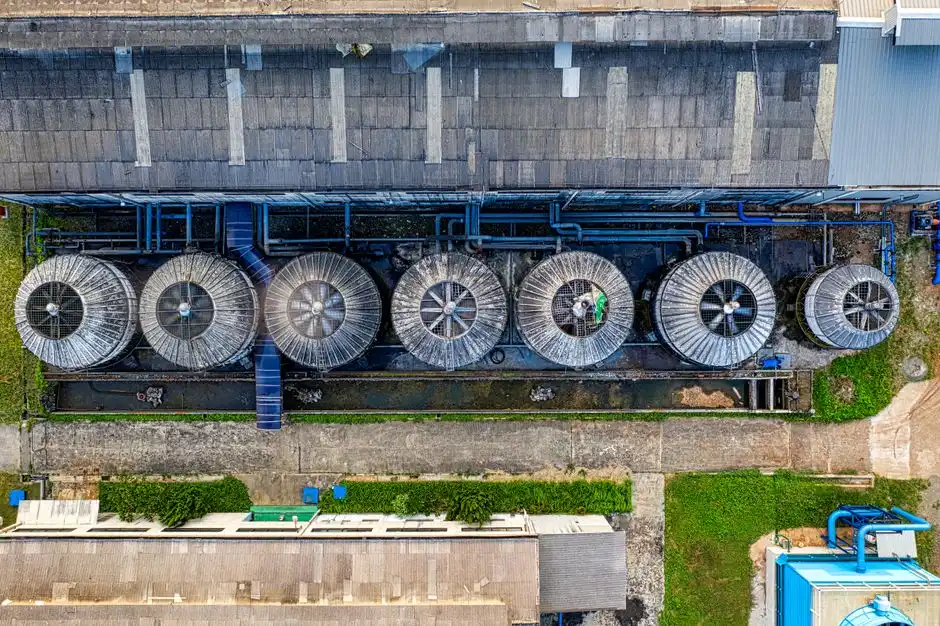
Start by defining cooling tower blowdown as the intentional purge used to control cycles of concentration, scale, corrosion, and biological growth. Evaporation leaves dissolved solids and treatment chemicals behind, so the stream is not equivalent to ordinary cooling water. Commissioning or fill-and-flush wastewater is different: it is intermittent water generated while flushing closed-loop pipework, and its contaminants depend on the cleaning chemicals used. Those contaminants cannot be inferred from normal blowdown chemistry.
The project water balance must also identify domestic sewage, equipment and floor washdown, rainwater, process-water reject, and any generator or fire-system drainage. Do not combine these streams by assumption. Their flow patterns, reuse eligibility, and compliance routes differ.
Request continuous flow and conductivity records, makeup-water analysis, chemical inventory, current blowdown destination, receiving-WWTP limits, and the commissioning cleaning procedure from the project team. A related data center cooling blowdown treatment guide uses screening values of 1,200–6,000 mg/L TDS, 4–8× makeup concentration, and 10–50 mg/L suspended solids for cooling blowdown. These are not Banjarmasin measurements and must not be used as local design values.
| Stream | Flow pattern | Main design issue | Required project evidence |
|---|---|---|---|
| Cooling tower blowdown | Continuous | Concentrated salts, silica, hardness, suspended matter, and cooling chemicals | Measured flow, conductivity, cycles of concentration, chemical inventory, discharge route |
| Commissioning or fill-and-flush | Intermittent | Cleaning chemicals, corrosion inhibitors, biological residue, and possible metals | Cleaning procedure, chemical inventory, sample results, temporary treatment or haul-off plan |
| Domestic and washdown flows | Diurnal or campaign | Organic load, solids, cleaning chemicals, and cross-contamination | Flow and chemistry records; separate reuse assessment |
| Rainwater and process reject | Variable | Variable quality and potential contamination | Seasonal flow, chemistry, and disposal or reuse route |
Build a cooling-water balance that reflects tropical operating conditions
The design flow for cooling blowdown must come from measured water use, not from a nominal cooling-system calculation alone. Genesis Water Technologies gives the relationship as blowdown ratio = 1/(CoC−1). At 4 CoC, the theoretical blowdown is 25% of makeup volume; at 6 CoC, it is 20%. The reduction is five percentage points, or a 20% reduction in blowdown volume, not the often-assumed 50% improvement (Genesis Water Technologies, 2026).
The same source warns that actual blowdown can exceed theoretical calculations by 15–30% because of unmeasured losses and emergency dumps. Treat this as a design warning rather than a fixed local allowance: verify makeup, blowdown, evaporation, and operating logs before sizing equipment. Genesis Water Technologies identifies makeup flow, blowdown flow, evaporation, conductivity, pH, and suspended solids as the baseline monitoring set.
Higher cycles of concentration can increase fouling, microbiologically influenced corrosion, and scaling. A recommendation to increase CoC therefore needs a chemistry-control plan, equipment-protection review, and confirmation that cooling chemicals remain compatible with downstream membranes. For tropical operation, the decision should account for warm-water biological activity and seasonal source-water changes rather than assuming a temperate operating profile.
For Banjarmasin, request at least one full wet-season and dry-season dataset covering source-water hardness, alkalinity, silica, TDS, conductivity, pH, temperature, and microbiological indicators. The supplied research does not establish these local values. They are design inputs, not optional refinements.
| Water-balance item | Evidence to obtain | Engineering use |
|---|---|---|
| Makeup water | Continuous flow, seasonal chemistry, temperature | Defines feed quality and freshwater demand |
| Blowdown | Flow meter and conductivity records, including abnormal dumps | Sets treatment capacity and confirms CoC |
| Evaporation | Site water balance reconciled against measured inputs and outputs | Separates consumption from recoverable discharge |
| Cooling chemistry | Biocide, antiscalant, corrosion inhibitor, and disinfectant inventory and dosing records | Protects the cooling loop and sets pretreatment requirements |
| Seasonal source water | Wet- and dry-season hardness, alkalinity, silica, TDS, conductivity, pH, temperature, and microbiological results | Supports the scaling, fouling, and recovery study |
Choose between sewer pretreatment, partial reuse, and high recovery
The lowest-risk treatment concept depends on confirmed sewer capacity, freshwater exposure, discharge constraints, energy availability, and operator capability. Select the route before issuing equipment quotations; otherwise, vendors will price different assumptions.
Option 1—sewer pretreatment. Use physical solids removal and targeted chemistry control when the receiving WWTP has confirmed capacity and permits the proposed discharge. Request written limits for TDS, hardness, silica, residual chlorine or biocide, pH, and temperature. Do not assume that a sanitary sewer will accept concentrated cooling blowdown.
Option 2—partial reuse. Use side-stream filtration, UF pretreatment, and brackish-water RO, returning permeate as cooling makeup while managing concentrate through the confirmed discharge route. A related guide cites 60–85% blowdown reuse as a realistic 2026 target for a greenfield Indonesian site with limited sewer capacity, but the target must be validated against Banjarmasin flow, chemistry, and receiving-plant constraints (HydropureWater, 2026).
Option 3—high recovery or zero discharge. Consider controlled salt precipitation with high-recovery RO where scaling chemistry and energy support it, or add MVC/evaporation where a verified water-resilience requirement justifies it. IDE Tech reports that conventional brackish-water RO commonly reaches 75–80% recovery before silica, calcium carbonate, and calcium sulfate constrain operation. It also reports a high-recovery case at approximately 95% recovery with permeate silica of about 1 mg/L. These are design references, not guaranteed Banjarmasin results (IDE Tech, 2026).
The related guide lists U.S. reference bands of $250,000–$500,000 for 50,000 GPD blowdown RO, $1–3 million for 10,000–30,000 GPD MVC, and $3–8 million for full zero-discharge treatment. They are not quotations and exclude Indonesian freight, local power, service, and disposal costs (HydropureWater, 2026).
| Decision condition | Preferred concept | Critical confirmation before selection |
|---|---|---|
| Receiving WWTP has capacity and accepts the proposed stream | Physical filtration, targeted chemistry control, and controlled sewer discharge | Written acceptance limits, tariff, hydraulic capacity, and monitoring conditions |
| Makeup reduction is valuable but some discharge capacity exists | Partial reuse with UF, brackish RO, and a controlled concentrate route | Measured flows, feed chemistry, permeate quality, recovery, and discharge consent |
| Discharge capacity is absent or the project has a verified zero-discharge requirement | High-recovery RO with controlled precipitation, or an evaporation-based system | Scaling study, energy availability, brine or solid-waste route, and life-cycle cost |
| Source water is high in silica or TDS | RO-based concept with conservative recovery and an explicit scaling study | Seasonal silica, calcium, sulfate, alkalinity, and temperature data |
Design the treatment train around contaminant removal and equipment protection
The normal treatment sequence is source segregation, equalization or flow control, physical filtration, UF where required, RO, reuse storage and return, then concentrate management. Each unit should have a defined contaminant-removal duty and a measurable operating limit.
Begin with side-stream mechanical filtration to remove suspended matter and protect the cooling loop and downstream membranes. The related guide uses a screening range of 1–5% of circulation flow and a U.S. reference CAPEX range of $50,000–$200,000 for this installation type. Neither is a Banjarmasin quotation (HydropureWater, 2026).
Use UF where reliable solids, colloid, and bacteria control is required before RO. HydropureWater’s UF systems use 0.03-micron PVDF membranes, operate from 2,000 to 40,000 L/h, accept turbidity up to 300 ppm, and include automatic backwash and air scour. These are product parameters, not a guarantee that the stated feed will be acceptable; the water analysis and supplier guarantee must be checked together.
Use industrial RO for controlled desalination when partial reuse is justified. The product catalog states up to 95% recovery with automated PLC operation, but that recovery cannot be assumed without matching feed chemistry and a scaling study. The hollow-fiber ultrafiltration pretreatment and industrial RO blowdown-reuse system should therefore be specified as a compatible system, not isolated products.
Add automatic chemical dosing where pH, antiscalant, coagulation, or biocide control is required. Check membrane compatibility and avoid unnecessary additions that increase dissolved solids. Treat RO concentrate according to the confirmed disposal route. Where the business case supports evaporation, the related guide cites 95–98% distillate recovery, TDS below 10 mg/L, and 15–25 kWh per 1,000 gallons for MVC. These values require local energy and economic validation (HydropureWater, 2026).
| Process step | Primary function | Information to obtain |
|---|---|---|
| Segregation and flow control | Keeps continuous blowdown separate from intermittent or unrelated flows | Stream-by-stream flow data, destination, and operating schedule |
| Mechanical filtration | Removes suspended matter before it reaches the cooling loop or membranes | Design flow, particle target, cleaning method, and differential-pressure control |
| UF | Controls solids, colloids, and bacteria before RO | Feed turbidity, membrane material, operating range, backwash, and air-scour requirements |
| RO | Reduces dissolved salts and produces reusable permeate | Feed chemistry, recovery limit, permeate target, scaling calculation, and cleaning plan |
| Chemical dosing | Controls pH, scaling, coagulation, or biological conditions | Compatibility with membranes and cooling chemicals; dosing control and chemical inventory |
| Concentrate management | Controls the final disposal burden | Confirmed sewer route, precipitation performance, evaporation demand, and solid-waste handling |
Verify reuse, monitoring, and operating safeguards
Reused water must remain inside a defined fitness-for-purpose boundary. UF permeate or RO permeate may serve as cooling makeup after confirming chemistry, but other uses require a separate assessment. The operator should be able to state which parameters are continuously measured, which actions occur automatically, and which conditions trigger shutdown or diversion to the confirmed discharge route.
Specify conductivity, pH, hardness, silica, suspended solids, residual biocide, flow, and differential-pressure monitoring across filtration, UF, and RO. Require automatic backwash, air scour, permeate-quality monitoring, and membrane-cleaning triggers appropriate to the selected equipment. A control philosophy should show how a failed sensor, chemical-delivery interruption, or membrane-cleaning event affects cooling-loop protection.
Obtain written compatibility statements between cooling chemicals and UF/RO membranes, including the consequences of chemical carryover. Antiscalant, biocide, and corrosion-inhibitor decisions must be coordinated with both the cooling loop and the treatment train.
Build operating redundancy around the facility’s staffing level. Modular equipment and locally supported commissioning are more defensible than an undersized specialist plant. The data center wastewater treatment process guide provides a useful screening reference for control and monitoring components, including conductivity meters, flowmeters, pressure gauges, RO controllers, valves, and metering pumps. These components should be confirmed against the project P&ID and local service capability.
Turn local compliance uncertainty into a documented approval plan
The supplied research does not establish Banjarmasin-specific effluent limits, sewer tariffs, source-water chemistry, or receiving-plant capacity. These must be confirmed with the relevant authority and receiving WWTP before the project commits to a discharge or reuse concept. A proposed treatment train is not evidence of legal compliance.
Request written discharge consent covering TDS, hardness, silica, residual chlorine or biocide, pH, temperature, and monitoring frequency where relevant. Include construction-phase fill-and-flush in the environmental management plan through characterization, temporary pretreatment, or licensed haul-off before the first cooling loop operates.
The Water Utility Report’s concern about cumulative loads is relevant to the procurement decision: a stream may be acceptable individually but require verification when several facilities discharge to the same receiving system. Record the receiving WWTP’s hydraulic and chemical capacity assumptions, not merely a statement that sewer discharge is permitted.
Retain sampling records, chemical logs, calibration certificates, training records, membrane warranties, commissioning results, and receiving-WWTP correspondence in the handover package. Use the pretreatment and compliance planning reference as an evidence-organizing aid, not as proof that a Banjarmasin approval path already exists.
| Approval item | Evidence required | Decision consequence |
|---|---|---|
| Receiving-WWTP consent | Written limits for stream chemistry, temperature, monitoring, and discharge route | Determines whether sewer pretreatment is technically available |
| Receiving-system capacity | Hydraulic loading and cumulative-load confirmation | Determines whether partial reuse or high recovery is required |
| Construction wastewater | Cleaning chemical inventory, sample plan, pretreatment or haul-off procedure | Controls commissioning risk before first cooling operation |
| Operations evidence | Sampling, calibration, training, chemical, cleaning, and warranty records | Supports handover, compliance monitoring, and future audits |
| Local authority requirements | Current project-specific requirements and correspondence | Confirms approval conditions; no outcome should be assumed |
Build a procurement package that allows fair supplier comparison
A comparable quotation requires a common performance basis. Issue one performance-based RFQ covering the agreed flow diagram, hourly and daily design flows, feed-water chemistry, required permeate quality, recovery target, concentrate destination, availability requirement, and operating envelope. If these inputs are unresolved, request budgetary alternatives with explicit exclusions rather than accepting a fixed price as a design commitment.
Request a complete P&ID, general arrangement, control philosophy, duty/standby concept, utilities, membrane specifications, cleaning method, guarantees, lead times, commissioning plan, and local service coverage. Require quotations to separate equipment, freight, civil works, installation, membranes, antiscalants, electrical works, commissioning, training, first-year spares, energy, and waste disposal.
Ask each supplier to state whether its recovery guarantee assumes a supplied water analysis and which feed parameters would void that guarantee. This is the first concrete check for comparing UF and RO offers. The second is to request a site-specific price in Indonesian currency, including local power, freight, taxes, financing, service, and disposal assumptions.
U.S. benchmark figures are preliminary screening only. Use the wastewater treatment supplier comparison as a structure for exposing assumptions, not as a substitute for a Banjarmasin quotation. Selection criteria should be explicit: compliance fit, lifecycle cost, recovery reliability, footprint, operator complexity, spare-parts availability, and service response.
| RFQ package | Minimum supplier response | Buyer check |
|---|---|---|
| Design basis | Flows, chemistry, recovery, permeate quality, concentrate route, and operating envelope | All bidders use the same inputs |
| Technical documents | P&ID, layout, controls, utilities, membranes, cleaning, guarantees, and commissioning | Performance claims are traceable to an operating envelope |
| Commercial breakdown | Equipment, freight, civil, installation, electrical, chemicals, commissioning, training, spares, energy, and disposal | No hidden scope or unexplained exclusions |
| Local delivery | Lead times, membrane supply route, local service partner, commissioning plan, and warranty support | Dates and responsibilities are contractual |
| Commercial comparison | Indonesian-currency budget price and lifecycle assumptions | Compare like-for-like rather than compare headline CAPEX |
Frequently Asked Questions
What treatment does a data center in Banjarmasin need for cooling tower blowdown?
It normally needs a source-specific train that addresses the confirmed discharge route: filtration and chemistry control for an accepted sewer discharge, or filtration followed by UF and brackish-water RO when permeate reuse is justified. The final selection requires Banjarmasin makeup-water analysis, measured blowdown flow, cooling-chemical inventory, receiving-WWTP limits, and a scaling study.
Is UF plus RO necessary, or is filtration enough for sewer discharge?
Filtration may be sufficient only if the receiving WWTP confirms capacity and written acceptance for the proposed contaminants. UF and RO become relevant when solids or colloid control is needed to protect membranes or when permeate reuse is required. Ask the receiving WWTP for limits on TDS, hardness, silica, residual chlorine or biocide, pH, and temperature before choosing the shorter train.
What does a data-center wastewater treatment system cost in Indonesia?
There is no defensible Banjarmasin price in the supplied research. Request a site-specific quotation in Indonesian currency with equipment, freight, civil works, installation, membranes, chemicals, electrical works, commissioning, training, spares, energy, and waste disposal separated. The U.S. reference bands in the related guide are screening benchmarks, not quotations, and exclude local freight, power, service, and disposal conditions.
How should an Indonesian buyer compare treatment suppliers and verify lead times?
Compare offers against one common performance basis, then verify the membrane supply route and contractual delivery date against the mechanical completion schedule. Require a named local service partner or service coverage, written commissioning responsibilities, warranty support, and a list of feed parameters that would void a recovery guarantee. A low equipment price is not comparable if the concentrate route, utilities, or membrane replacement scope is excluded.
Can cooling blowdown be reused as cooling tower makeup?
Yes, but only after confirming the treatment objective, feed chemistry, permeate quality, cooling-system compatibility, and concentrate route. UF permeate or RO permeate may be considered for cooling makeup after an engineering assessment; other reuse applications require separate fitness-for-purpose review. The reuse design should also define monitoring, automatic diversion, cleaning, and operator response for off-spec permeate.