What Petroleum Wastewater Changes About the MBR-versus-CAS Decision
For petroleum wastewater in Maumee, choose MBR when consistent solids separation, a compact footprint, high-quality effluent or future reuse outweighs higher energy and maintenance demands; retain conventional activated sludge when discharge-only service, adequate land and lower operating cost dominate. Neither technology replaces upstream oil control: source segregation, equalization and oil-water separation must come first. The final selection should follow representative sampling and a life-cycle comparison against the site’s actual Maumee discharge, pretreatment or reuse requirements.
Petroleum streams can contain free and emulsified oil, phenols, recalcitrant organics, sulfides, ammonia, and variable hydraulic or composition loads. Generic refinery values are not a sound design basis: characterize the actual production wastewater, stormwater, washdown and segregated drains through a site sampling program.
Oil entering the biological system can interfere with oxygen transfer, biomass activity and solids separation. Equalization buffers flow and concentration swings; upstream oil-water separation, DAF pretreatment for petroleum wastewater, and chemical dosing address contaminants that equalization alone cannot remove.
The comparison must therefore include the discharge route, applicable Maumee NPDES or POTW requirements, available footprint, reuse objectives, existing basin condition, energy availability and expected load changes. As defined in Water Research’s plant-wide comparison, CAS separates biomass through floc aggregation and a settling tank, while MBR uses a physical membrane for solid-liquid separation.
Compare the Two Treatment Trains from Influent to Effluent
MBR retains biomass independently of clarifier settling and generally operates at a higher sludge retention time, supporting degradation of more recalcitrant material and producing a lower observed sludge yield than CAS. CAS remains widely adopted and can have lower energy demand, but its separation depends on settleable floc, sludge wasting and effective scum removal.
The same academic comparison reports that MBR combines high effluent quality with a smaller footprint. That advantage comes with membrane fouling, which reduces permeate flow or raises transmembrane pressure. Physical membrane separation does not eliminate biological treatment: an integrated submerged-PVDF MBR system still includes an activated-sludge biological zone and upstream contaminant control.
A study reviewed in the plant-wide paper reported effluent microplastic concentrations of 0.4 MP/L for MBR and 1 MP/L for CAS. That comparison was not petroleum-specific, so it supports the solids-capture distinction but does not establish a Maumee reuse limit or refinery performance guarantee.
| Decision factor | Membrane bioreactor | Conventional activated sludge |
|---|---|---|
| Solids separation | Physical membrane retains biomass independently of settling | Clarifier depends on floc aggregation and successful settling |
| Biological behavior | Generally higher SRT; can degrade more recalcitrant material | Widely adopted; performance depends on biological and settling conditions |
| Sludge behavior | Generally lower observed yield | Requires sludge wasting; poorly settleable biomass can wash out |
| Footprint | Smaller solid-liquid separation units | Larger aeration and settling footprint |
| Primary operating exposure | Membrane fouling, aeration and cleaning demand | Clarifier performance, scum removal and sludge handling |
| Evidence scope | Plant-wide modeling and cited comparative studies; not a Maumee refinery guarantee | Plant-wide modeling and cited comparative studies; not a Maumee refinery guarantee |
For a module-level check, the DF-series membrane bioreactor module should be evaluated as one component of the complete treatment train, not as a stand-alone plant capacity statement.
Build a Maumee Petroleum-Wastewater Design Basis

A procurement-ready design basis starts with representative streams and ends with guarantees tied to the receiving requirement. The bidder should define what it will treat, how the streams will be controlled and what performance it will guarantee under the plant’s actual operating envelope.
- Sample production wastewater, stormwater, washdown, tank-bottom and other segregated streams. Obtain flow, COD, BOD, TSS, oil and grease, phenols, ammonia, sulfides, pH, temperature and toxicity data.
- Define source control and equalization. Then specify pretreatment for oil, FOG, colloids and substances that inhibit biology, including mechanical screening where solids protection is required.
- Set the biological and solids-separation basis. Require design flow, peak flow, influent COD loading, required SRT and HRT, membrane flux or design loading, cleaning frequency, redundancy and treated-water guarantees.
- Identify the receiving requirement as POTW discharge, direct NPDES discharge or reuse. Biological treatment performance does not by itself establish reuse suitability.
- Add downstream polishing where the intended use requires control of low TSS, dissolved solids, silica, conductivity or other reuse-specific constituents.
| Design-basis item | Information the bidder must state | Buyer check |
|---|---|---|
| Influent | Segregated stream sources, flow range, loads, oil and grease, toxicity and temperature | Does the basis reflect sampled plant conditions? |
| Equalization and pretreatment | Hydraulic control, oil-water separation, chemical dosing and protection of downstream equipment | Does the system prevent oil or FOG from reaching biology? |
| Biological reactor | Loading, HRT, SRT, oxygen demand and sludge handling | Are assumptions tied to the measured influent? |
| MBR equipment | Flux, membrane area, materials, cleaning method, redundancy and replacement strategy | Are guarantees linked to the receiving requirement? |
| Polishing and reuse | Required unit operations and final-water quality targets | Does the complete train address dissolved constituents? |
Chemical addition should be defined around actual stream chemistry rather than a generic dose. The automatic chemical dosing system is an equipment reference, while the bidder remains responsible for selecting chemicals, preparing them and demonstrating the required residual or removal performance.
Compare Cost, Energy and Maintenance Over the Asset Life
Initial equipment price is only one part of the comparison. MBR capital scope can include membranes, frames, blowers, controls and retrofit civil work; operating scope includes scour air, energy, CIP chemicals, labor and replacement parts. CAS shifts more attention toward basins, clarifiers, sludge wasting, scum handling and the consequences of settling failures.
Water Research’s plant-wide comparison states that membrane-fouling mitigation through aeration and cleaning increases MBR energy demand and operating costs, while CAS is generally recommended when operating cost is the primary criterion. In the cited Karim and Mark study, MBR was the lower-total-cost option for operation longer than 67 years under the study’s assumptions. That horizon is a study result, not a universal refinery breakpoint.
The cited Bertanza et al. comparison found better economic results for CAS, while MBR performed better in the study’s social-acceptance and environmental-impact assessments. Those findings came from three full-scale wastewater treatment plants and should not be transferred to a Maumee refinery without a site-specific model.
The MBR cost and application guide reports CIP generally every 6–12 months and membrane life of 5–8 years for planning context. Request warranty terms, replacement timing, spare-parts pricing and assumptions tied to the selected pretreatment.
| Lifecycle component | CAS evaluation | MBR evaluation |
|---|---|---|
| Capital | Existing basin, clarifier, aeration, controls and civil work | Membranes, frames, blowers, controls and retrofit civil work |
| Energy | Generally lower energy demand | Higher demand for fouling mitigation through aeration and cleaning |
| Maintenance | Sludge wasting, clarifier and scum management | CIP chemicals, labor, membrane replacement and scour-blower maintenance |
| Modeled direct GHG benchmark | 0.85 kgCO2eq/m³ | 0.91 kgCO2eq/m³ |
| Application of benchmark | Modeled plant-wide result, not a predicted Maumee site emission | Modeled plant-wide result, not a predicted Maumee site emission |
The GHG values above are modeled benchmark results reported in the plant-wide comparison. A Maumee lifecycle assessment should use site energy demand, chemical consumption, sludge disposition and the owner’s electricity assumptions.
Choose MBR, CAS or a Hybrid for the Actual Treatment Objective
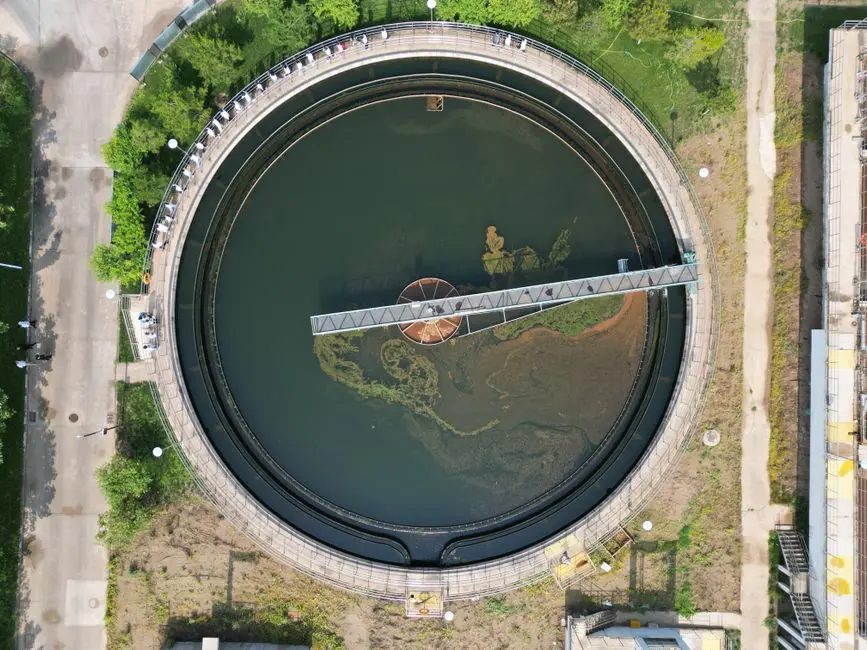
Select MBR when the footprint is constrained, consistent solids separation matters, high-quality effluent is required, variable loads create settling risk, or future reuse increases the value of reliable biomass capture. Select CAS when pretreatment is reliable, the basin and clarifier have adequate condition and capacity, land is available, the objective is discharge-only, and lower operating cost is the dominant criterion.
Evaluate a hybrid when the existing CAS basin has useful remaining life. Bulk biological treatment can remain in place while a polishing MBR or filtration stage supplies the required solids capture. This option avoids replacing the entire biological process, but its hydraulic, SRT and polishing guarantees must be demonstrated as one train.
The integrated MBR system catalog describes submerged PVDF membrane filtration below 1 μm, a stated 60% smaller footprint than conventional systems and a catalog capacity range of 10–2,000 m³/day. These are catalog claims for a vendor check, not a Maumee design guarantee.
The DF-series data provide a more specific equipment example: 0.1 μm PVDF flat-sheet elements with integrated aeration are offered in 80–225 m² configurations producing 32–135 m³/day. Treat that as module configuration data. Full-plant capacity still depends on influent loading, selected flux, redundancy, pretreatment and treatment objectives.
| Site condition | Preferred path | Required proof before selection |
|---|---|---|
| Constrained footprint or consistent solids capture is critical | MBR | Flux, SRT, fouling recovery, redundancy and treated-water guarantees |
| Reliable CAS assets, available land and discharge-only service | CAS | Clarifier performance, sludge handling, energy use and receiving compliance |
| Useful existing basin but tighter solids or reuse target | Hybrid | Integrated hydraulic and water-quality performance for the complete train |
| Reuse requires control beyond biological treatment | MBR or CAS with polishing | Downstream unit process sized for dissolved constituents and intended use |
For reuse, industrial reverse-osmosis equipment may be relevant, but biological treatment does not remove every dissolved constituent. The final award should include a signed performance basis, enforceable guarantees, lifecycle-cost model, upset-recovery plan and allowance for future load or reuse changes.
Frequently Asked Questions
Is MBR more expensive than conventional activated sludge for a petroleum plant?
MBR usually adds capital, membrane-scouring energy, CIP and membrane-replacement costs, while CAS commonly has lower operating costs. Request a site-specific lifecycle model covering pretreatment, aeration, chemicals, labor, sludge, replacements and residual value. The cited cost studies do not establish a Maumee refinery price because their assumptions and facilities were not site-specific.
How should an engineer size an MBR when the supplier offers a 32–135 m³/day module range?
Treat 32–135 m³/day as a module-configuration range, not full-plant capacity. The plant size must be calculated from actual flow, COD and oil loading, required SRT and HRT, design flux, membrane area, cleaning strategy, redundancy and upstream pretreatment performance.
What should a buyer check when selecting an MBR supplier for petroleum wastewater?
Require evidence of petroleum-duty pretreatment, membrane material and pore-size disclosure, SRT and flux assumptions, CIP procedures, scour-blower redundancy, remote monitoring, spare-parts support and enforceable performance guarantees. Ask bidders to demonstrate how they will protect membranes from oil, FOG, debris and biological upsets.
Does either technology establish compliance with Maumee discharge and reuse requirements?
No. Select the treatment train against the site’s actual NPDES permit, POTW requirements and reuse specification. The available research supports the process comparison but does not establish a Maumee discharge limit, and biological treatment alone does not demonstrate suitability for every reuse application.
Related Equipment
- DAF pretreatment for petroleum wastewater — specifications, capacity range, and technical data