When Anaerobic Digestion Fits an Airport Wastewater System
An anaerobic digester can treat suitable, separately collected airport wastewater because anaerobic digestion stabilizes high-strength organic streams and produces biogas, but airport projects are not automatically viable. Airport-specific assessment must segregate ablution and kitchen wastewater, aircraft wash-off, car-wash water, stormwater and contaminants such as oil and grease before comparing digestion with aerobic treatment or a packaged sewage plant. A 50 L industrial study identified 21 days HRT, pH 7.01 and 0.42 g/L magnetite as an optimized condition, while demonstrating that a small installation remained economically unviable. Feasibility therefore depends on stream composition, scale, pretreatment, reliable operation and a viable biogas-use plan.
The appropriate design target is the biodegradable fraction of a controlled, separately collected feed, not an undifferentiated mixture of every airport discharge. The airport-specific technoeconomic assessment by the International Journal of Mechanical and Production Engineering Research and Development, dated 2021, identifies materially different sources: airport ablution wastewater, kitchen sink runoff, stormwater, car-wash wastewater and aircraft ablution wash-off. Each has different dilution, organic strength, solids behavior and contaminant risk.
Use four preliminary viability tests:
- Does segregation provide a dependable high-strength organic feed?
- Can pretreatment remove materials that would inhibit or obstruct the reactor?
- Is the installation large and sufficiently stable to justify specialist equipment and controls?
- Is there a responsible route for gas capture, use or safe disposal?
If any answer is weak, compare the digester with an aerobic package plant, an underground packaged sewage treatment alternative, separate stream handling, sewer discharge or a combined treatment strategy.
| Airport stream | First assessment question | Implication for digestion |
|---|---|---|
| Ablution wastewater | Is flow and organic strength dependable? | Potential feed after source segregation and characterization |
| Kitchen sink runoff | Can oil, grease and food solids be removed? | Requires controlled pretreatment before biological treatment |
| Stormwater | Can it be excluded or greatly reduced? | Dilution may weaken organic loading and economics |
| Car-wash wastewater | What causes sediment, oil or chemical loading? | Segregate and characterize before accepting |
| Aircraft wash-off wastewater | How variable are flow and contaminants? | Equalization and feed-specific testing are required |
Characterize Each Wastewater Stream Before Choosing a Reactor
Airport digestion should begin with a source-by-source sampling and mass-balance program, because the combined flow can hide the contaminants that determine biological stability. The supplied research does not provide airport-specific acceptance limits for COD, BOD, suspended solids, oil and grease, pH, temperature, nutrients, sulfate or toxicity. These values must therefore come from the airport’s own wastewater characterization rather than from a generic digester specification.
Segregation is a biological control, not merely a plumbing decision. Stormwater can dilute the organic feed; concentrated kitchen or car-wash discharges can introduce fats and oils; variable aircraft wash-off can change loading; and storm events can send large, dilute flows through a reactor designed for a narrower operating envelope. Equalization may be necessary, but it should not be used to disguise uncontrolled variability.
The industrial study by Durban University of Technology, published in 2025, shows why organic strength cannot be evaluated independently of pH. At 4,320 mg/L COD, industrial sewage produced 76 mL/gTDS in the biochemical methane-potential test. When organic content increased to 18,770 mg/L, biogas production increased by 30%, but contaminant removal declined by more than 40%. The study attributes that decline to falling pH and the accumulation of inhibitory long-chain fatty acids. More gas did not therefore mean better treatment.
For airport procurement, use a representative campaign that covers ordinary and peak operating periods, wet-weather events, aircraft washing, terminal occupancy and vehicle-washing conditions. Composite samples should be linked to flow records so the engineer can calculate mass loading rather than concentration alone. A single grab sample is not a defensible sizing basis.
| Required information | Why it matters | Information not supplied by the research |
|---|---|---|
| COD and BOD | Organic loading and methane potential | No airport-specific limit |
| Suspended solids and volatile solids | Solids inventory, mixing and retention | No universal design value |
| Oil, grease and FOG | Potential toxicity and reactor fouling | No universal pretreatment limit |
| pH, temperature, nutrients and sulfate | Microbial activity, buffering and inhibition | No universal airport acceptance range |
| Toxicity and flow variability | Equalization and feed acceptance | Must be established through sampling and testing |
Pretreat the Feed to Protect Digester Biology
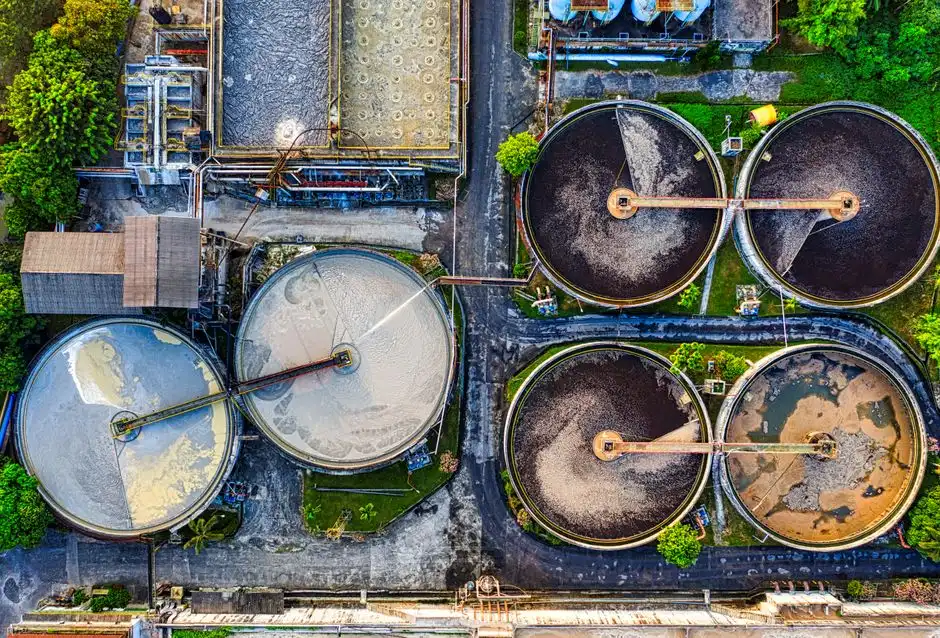
Pretreatment should remove the specific materials shown by characterization to obstruct equipment, foul surfaces or inhibit anaerobic microorganisms. Screening is the first control for plastics, wipes, fibrous material and other debris that could block pumps or interfere with reactor circulation. A mechanical bar screen for preliminary solids removal can be considered, but the supplied research does not establish a universal screen aperture for airport projects; that value must follow the selected pumping and reactor arrangement.
Where oil, grease, FOG or removable suspended solids are present, evaluate a DAF system for airport wastewater pretreatment. The supplied product range covers 4–300 m³/h and is designed for oil and grease, FOG and colloidal removal. That equipment range is a procurement reference, not proof that DAF is required or adequate for a particular airport. The process basis should identify the contaminant, required removal, resulting residual and the consequences for downstream digestion.
Automatic chemical dosing should follow the characterization rather than a generic treatment recipe. The automatic chemical dosing system provides PLC-controlled injection of coagulants, flocculants, pH adjusters and specialty chemicals. The engineer should specify which chemical control is needed, the control trigger, duty limits, interlocks and residual-management arrangements.
The magnetite findings from Durban University of Technology provide a research lead, not an airport default. In the 50 L reactor treating industrial and sugar-refinery streams, 0.4–0.6 g/L produced higher rates during days 9–12, while 0.8 g/L overloaded the catalyst and biogas production declined to 2 mL/d after 9 days. The same study’s optimum—21 days HRT, pH 7.01 and 0.42 g/L magnetite—cannot be transferred directly to airport design because the feed, reactor scale and operating conditions differed.
Use the oil and grease removal guide before anaerobic digestion to frame contaminant-specific pretreatment decisions. Validate any proposed dosage through bench testing or pilot work before fixing the equipment specification.
Select and Operate the Anaerobic Reactor
A viable airport digester is a treatment train, not a standalone vessel: screening and selective pretreatment, equalization, anaerobic digestion, gas capture, downstream solids separation, polishing, and discharge or reuse must be designed together. Omitting solids handling or leaving the gas without a use or disposal plan changes the project from a treatment proposal into an incomplete operating concept.
Hydraulic retention time, organic loading, pH, mixing, temperature and feed consistency must be verified through pilot or bench testing. The supplied evidence provides no universal airport reactor volume, loading rate or scale-up rule. The 50 L industrial optimum is useful as a reference condition: 21 days HRT, pH 7.01 and 0.42 g/L magnetite, with a desirability of 0.99 under the study’s response-surface model. Its validated removal exceeded 85% for industrial sewage and exceeded 60% for the higher-strength sugar-refinery stream.
Startup is a distinct design issue. Durban University of Technology observed poor initial biogas production and COD removal, exponential growth between days 9–18, decline between days 19–22, and retardant or no production between days 22–30. It identified an optimum HRT range of 18–22 days. Magnetite reduced the observed lag phase from 9 days to 3 days, but the deterioration at 0.8 g/L shows why additive dosage requires validation.
Monitoring must measure process conditions rather than rely on visible gas production. Sensors in the 50 L system supported control of operating conditions and methane content of 90%. An airport control narrative should therefore define measurements, alarms, operator response, emergency isolation, odor control and the point at which feed is bypassed.
| Design question | Evidence-based reference | Airport design requirement |
|---|---|---|
| What HRT should be selected? | 18–22 day optimum range in the 50 L industrial study | Validate with the actual segregated feed; do not adopt 21 days automatically |
| What pH should be maintained? | 7.01 optimum in the 50 L study | Confirm buffering, alkalinity and contaminant effects |
| Should magnetite be dosed? | 0.42 g/L optimum; overload observed at 0.8 g/L | Use only after feed-specific validation |
| How is stable operation verified? | Sensor-assisted monitoring supported 90% methane content | Define instruments, alarms, trends and sampling procedures |
| How large should the reactor be? | No universal airport value in the supplied evidence | Calculate from characterized flow, organic load, retention and operating scenarios |
Manage Digestate, Biogas and the Remaining Water
Digestate and biogas require separate engineering work because they impose different handling, safety and utilization obligations. Failure to resolve either output can remove much of the assumed benefit of digestion.
The solids side requires thickening or dewatering after digestion. The sludge dewatering for digested solids offers filtration areas from 1 m² to 500 m² for municipal and industrial sludge dewatering. Selection must account for feed consistency, solids characteristics, polymer demand, filtrate return, cleaning, odor and the destination of the dewatered cake.
The water side must meet the final discharge or reuse route. The MBR wastewater treatment option covers 10–2,000 m³/day, while the WSZ package plant covers 1–80 m³/h and is intended primarily for anoxic or aerobic treatment. Neither capacity establishes the correct airport solution; discharge criteria, reuse requirements, nutrient removal needs and the treated flow determine the selection.
Gas planning should follow the September 2026 American Biogas Council survey: 55% of surveyed facilities primarily used biogas for electricity or combined heat and power, and 89% of facilities generating electricity used it on site. This is evidence of an operating pattern, not a transferable airport revenue assumption. The same survey reported an average flow of 15.0 MGD among wastewater facilities with digesters, while identifying 103 surveyed facilities below 1 MGD. An airport project must therefore establish local demand, a credible off-take route or a safe gas-disposal plan rather than applying municipal-scale economics.
Test the Business Case Before Ordering Equipment
The business case should compare complete treatment alternatives using the same feed, discharge, operating-hour and residual-disposal assumptions. Include reactor and pretreatment capital cost, installation, operator time, mixing, heating, gas-system maintenance, downstream treatment, downtime, replacement and disposal. Comparing expected biogas yield with only the reactor price omits the costs that determine whole-life viability.
Durban University of Technology’s 2025 economic analysis is a warning about small-system economics. For its optimized 50 L system, annual operating costs exceeded annual revenue, producing net cash flow of -R8 506 and net present value of -R121 016. Reported payback was 19.03 years for 50 L, compared with 21.9 years for 5 L, 24.8 years for 1 L and 25.3 years for 10 L. The study concluded that upscaling beyond 50 L was necessary for economic viability and a benefit-cost ratio of 1 or above.
Do not transfer the South African pilot currency, tariffs or economics to an airport case. Use the findings to identify the variables that require local pricing: delivered-feed strength, installation scope, energy value, gas handling, operator labor, maintenance, downtime and residual disposal. The anaerobic digester design for high-strength industrial wastewater and anaerobic digester sizing and process design guide offer adjacent process references, but they do not replace an airport-specific feasibility model.
| Commercial item | Information required | Decision test |
|---|---|---|
| Capital and installation | Quoted feed-specific scope, civil works, pretreatment, controls, gas and downstream treatment | Does the quote cover the complete treatment train? |
| Operating cost | Operator time, chemicals, heating, mixing, maintenance and downtime | Are assumptions supported by the proposed equipment? |
| Gas value | Local electricity or heat value, utilization hours and credible offtake or disposal | Is there value in the gas after capture and safety costs? |
| Residuals | Digestate and chemical-residual handling costs | Are all residual routes included? |
| Alternative treatment | Priced aerobic or packaged-plant comparison using the same discharge basis | Does digestion deliver enough benefit to offset added complexity? |
Procurement Checklist for an Airport Digester Project
Procurement should begin with evidence, not with a reactor model. Require a source-by-source wastewater characterization and mass balance, including flow variability and operating periods. Do not accept a daily average as the sole sizing basis.
- Request the proposed reactor volume, design hydraulic retention time, organic-loading basis, temperature, mixing method, pH control, gas balance and solids-handling concept.
- Identify pretreatment equipment, bypass provisions, odor controls, safety systems, controls, alarms and monitoring responsibilities.
- Require validation of sludge retention time, startup and acclimation, performance guarantees, operator training, maintenance scope and emergency response.
- Request a whole-life cost model with explicit assumptions for gas utilization, energy savings, downtime, inflation, replacement and residual disposal.
- Require a pilot or validated reference installation when the feed is highly variable or the proposed duty falls outside the supplier’s demonstrated range.
Evaluate evidence by relevance. A high-strength industrial reactor can inform process behavior, but an airport package-plant reference cannot by itself demonstrate anaerobic performance on a blended airport feed. The supplier should explain which assumptions transfer, which do not and what site testing will verify them.
Also request written boundaries for each package. Identify which equipment is supplied, which civil and electrical work is excluded, who owns performance risk, how guarantees are measured and what happens when the feed exceeds the agreed characterization envelope.
Frequently Asked Questions
Can an anaerobic digester treat all airport wastewater?
No. The 2021 airport assessment identifies ablution wastewater, kitchen sink runoff, stormwater, car-wash wastewater and aircraft ablution wash-off as distinct streams. The 2025 Durban University of Technology study also shows that increasing organic content raised biogas production by 30% while contaminant removal declined by more than 40% because falling pH promoted inhibitory long-chain fatty acid accumulation. Each stream therefore needs segregation and characterization before reactor selection.
How much does an airport anaerobic digester cost?
The supplied research provides no airport capital-cost quotation, so the buyer should request a site-specific price covering reactor, pretreatment, civil works, gas capture, controls, downstream solids handling and commissioning. For an early viability check, the 2025 Durban University of Technology pilot showed that its optimized 50 L system generated net cash flow of -R8 506 and net present value of -R121 016. Those values demonstrate the need for a local cost-and-revenue model; they are not an airport price estimate.
What size should an airport anaerobic digester be?
Size cannot be selected from the supplied evidence without airport-specific flow, COD, pH, temperature, nutrients, toxicity, operating-hour and reuse data. The 50 L research optimum—21 days HRT, pH 7.01 and 0.42 g/L magnetite—does not supply a universal scale-up rule. A supplier should show the calculations connecting characterized mass loading and retention requirements to the proposed reactor volume and operating scenarios.
Should the airport buy a digester or an aerobic package plant?
Choose digestion when the segregated organic feed is dependable, pretreatment can protect the reactor, and gas use or safe disposal has credible value. Choose aerobic or membrane treatment when the feed is dilute, highly variable, inhibitory or lacks an economic energy pathway. The comparison must include installed cost, operating labor, downstream treatment and residuals rather than biogas yield alone.
What should a supplier demonstrate before selection?
Require a feed-specific process basis, reactor calculations, pretreatment criteria, controls and safety scope, startup and O&M plan, solids and gas handling, relevant reference evidence and a whole-life cost model. For variable airport flows, ask for pilot data or a validated reference installation that matches the proposed feed and operating envelope.