Which Rules Govern a Vancouver Food Plant’s Sewer Discharge?
Food and beverage plants near Vancouver, Washington, meet pretreatment limits by controlling wastewater before it enters the municipal sewer and proving compliance with the applicable POTW permit. Under EPA’s 40 CFR Part 403 framework, the federal program sets prohibited-discharge rules, applicable food-processing categorical standards add industry-specific requirements, and the POTW may impose stricter site-specific local limits at the point of connection. A defensible treatment train typically combines screening, equalization, DAF for suspended solids and FOG, biological treatment, chemical phosphorus control, and final polishing as required. Plants must also maintain permit-specific sampling, continuous pH and flow monitoring where applicable, and documented corrective action for excursions.
This roadmap applies to Vancouver, Washington, United States, not Vancouver, British Columbia. Natural Resources Canada identifies the Victoria–Vancouver, British Columbia–Washington cross-border geography, but a Washington plant discharges through a U.S. POTW rather than directly to surface water. The POTW therefore controls the point-of-connection permit, while federal and state pretreatment law applies through the delegated pretreatment program.
EPA explains that pretreatment standards apply to industrial users discharging indirectly to a POTW under 40 CFR Part 403. POTWs use local limits to protect treatment operations, sludge handling, receiving waters, and their NPDES permit obligations. EPA characterizes these limits as site-specific and applicable at the end-of-pipe connection to the POTW collection system; they may be numeric or narrative and may include best management practices.
The federal food-processing subparts are 40 CFR 405 for dairy, 406 for grain mills, 407 for canned and preserved fruits and vegetables, 408 for canned and preserved seafood, and 409 for meat products. These categorical requirements sit above the general prohibited-discharge framework. They do not replace the POTW’s controlling permit, which may be more stringent.
| Document or authority | Decision it controls | Evidence to obtain |
|---|---|---|
| 40 CFR Part 403 | General prohibited discharges and pretreatment framework | Applicable federal requirements for the facility’s industrial-user category |
| 40 CFR 405–409 | Food-processing categorical pretreatment standards | Correct subpart, applicable process units, and discharge parameters |
| Receiving POTW permit | Enforceable local limits, monitoring, reporting, and operating conditions | Current permit, local-limit schedules, appendices, and approved discharge point |
| State pretreatment authority | Delegated program administration and enforcement | State requirements, reporting systems, and notice procedures |
Before selecting equipment, identify the receiving POTW and request its current industrial-user limits and the applicable categorical subpart. Determine whether a general or individual permit applies, then obtain sample points, analytical methods, monitoring frequencies, reporting deadlines, record-retention rules, resampling conditions, and noncompliance-notification procedures. Do not assume numerical Vancouver-area limits from generic guidance; use the controlling POTW documents. For a broader look at this compliance sequence, see how plants near Iowa Falls organize pretreatment compliance.
Characterize the Wastewater Before Selecting Equipment
Food-processing wastewater must be characterized across production regimes, not reduced to an average daily flow. HydropureWater identifies BOD/COD, TSS, FOG, total phosphorus, pH, and temperature as the six parameters that govern most food-and-beverage pretreatment designs. Hixson reports that food-processing effluent can be 10 to 100 times stronger than domestic wastewater in BOD and COD terms, making dilution or off-site disposal unsuitable as the default design strategy.
Start by separating process wastewater from CIP drains and other concentrated streams. Record production batches, product changes, cleaning cycles, seasonal peaks, peak flow, and pollutant loads. Hixson identifies batch changes, CIP cycles, and seasonal peaks as causes of swings in flow, organic load, pH, and temperature. The resulting shock loads can overwhelm biological systems, so equalization must be sized around the relevant production and cleaning regime rather than a monthly average.
HydropureWater reports raw dairy and meat wastewater at 1,000–10,000 mg/L BOD and notes that FOG can reach several thousand mg/L in fryer, rendering, and stickwater streams. It gives total phosphorus of 10–100 mg/L as P for cereal, dairy, and meat wastewater. These figures are design-context ranges from HydropureWater, not Vancouver permit limits. HydropureWater also states that temperature excursions above 40 °C from CIP and cooking operations can disturb downstream nitrification biology, making equalization and temperature control part of the treatment basis.
| Parameter | Why it matters | Data a buyer should obtain |
|---|---|---|
| BOD/COD | Quantifies biodegradable organic load and biological treatment demand | Representative and peak concentrations, including production and CIP regimes |
| TSS | Drives solids removal and affects flocculation demand | Suspended-solids profile across normal production and cleanup periods |
| FOG | Can interfere with POTW treatment and sludge handling | Free and emulsified oil measurements by stream |
| Total phosphorus | May require biological uptake and chemical precipitation | Total phosphorus as P, including phosphorus form and alkalinity context |
| pH | Requires equalization and controlled chemical adjustment | Continuous trend plus event data for CIP discharges |
| Temperature | Influences biological activity and process performance | Temperature ranges during production, washing, and CIP |
For adjacent process-specific design context, compare the anaerobic digester design for brewery wastewater and anaerobic digester design for distillery wastewater. Those sources do not establish Vancouver permit values. A defensible wastewater study should provide representative data for each operating regime and identify whether streams can be segregated before final sizing.
Build a Treatment Train That Addresses Each Permit Parameter
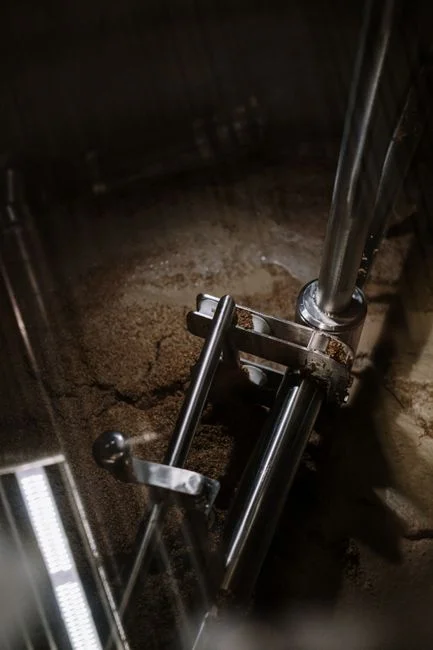
Each treatment stage should have a defined pollutant-removal objective, a measurable operating condition, and a failure response. The usual sequence is screening and flow control, equalization, dissolved air flotation, biological treatment, chemical precipitation, and final polishing where required. Hixson describes screening as protection against solids that can clog pumps and damage downstream biological stages, while equalization buffers production surges and concentrated CIP releases before biological treatment.
DAF targets suspended solids and FOG before the biological process. HydropureWater gives a surface-loading range of 4–25 m/h, an air-to-solids ratio of 0.005–0.02, and a recycle rate of 20–40% of forward flow. These are equipment-selection benchmarks, not final design values. Final sizing requires verified influent FOG and TSS plus peak hydraulic flow. HydropureWater reports DAF-conditioned performance of 25–50 mg/L for oil and grease and 50–100 mg/L for TSS; neither is a guaranteed permit result. For a industrial DAF system for food-processing wastewater, require the supplier to show how the selected surface area, recycle, and air supply address the measured duty.
Biological treatment addresses biodegradable dissolved organics. HydropureWater states hydraulic retention times of 8–24 hours for conventional activated sludge and 4–10 hours for MBR. MBR combines biological treatment with membrane solids separation and is appropriate where solids separation or footprint constraints justify it. HydropureWater reports MBR effluent benchmarks below 30 mg/L BOD and below 5 mg/L TSS, but those values must be tested against the current POTW permit. An MBR membrane bioreactor for compact biological polishing should therefore be evaluated as a treatment train, not as a stand-alone compliance guarantee.
Phosphorus control may combine biological uptake with chemical precipitation. HydropureWater states biological phosphorus uptake of 5–15 mg/L, alum dosing of 50–250 mg/L or ferric chloride dosing of 30–150 mg/L, and final total phosphorus of 0.5–1 mg/L as achievable after precipitation. Actual demand depends on phosphorus form, alkalinity, solids, and mixing.
| Stage | Primary target or function | Design evidence | Escalation trigger |
|---|---|---|---|
| Screening and flow control | Protect pumps and downstream equipment | Peak flow and solids inventory | Abnormal headloss or debris accumulation |
| Equalization | Buffer batch, CIP, pH, and temperature surges | Peak flow, load, and event duration | High basin level or untreated CIP bypass |
| DAF | Remove FOG and suspended solids | FOG, TSS, surface loading, recycle, air-to-solids ratio | FOG pass-through or skimmings deviation |
| Biological treatment | Remove biodegradable dissolved organics | BOD/COD, HRT, solids inventory, aeration and temperature | Abnormal biomass health or organic pass-through |
| Chemical precipitation | Remove residual phosphorus | Total phosphorus, alkalinity, chemical dose and mixing | Solids breakthrough or unstable dose |
| Final polishing | Meet residual solids or permit conditions | Required effluent quality and site constraints | Turbidity, TSS, or integrity alarm |
Diagnose failures by process. FOG pass-through suggests under-dosed DAF conditioning or hydraulic overload. pH excursions suggest inadequate equalization or failed trim control. Solids breakthrough can indicate poor flocculation control. For adjacent industrial treatment context, see the anaerobic digester guide for slaughterhouse wastewater and the MBBR design reference for fish-processing wastewater.
Size and Specify Equipment for Permit Approval
Equipment bids should begin with the permit and measured wastewater, not catalog capacity. HydropureWater identifies forward flow, peak-to-average ratio, raw BOD, and raw FOG as the four equipment-sizing inputs for food-and-beverage pretreatment. Add TSS, phosphorus, pH, temperature, flow duration, and operating variability where they affect the selected process. The bid should state which value controls each design calculation and identify any unresolved assumption.
For DAF, require the supplier to document surface loading, recycle rate, air-to-solids ratio, peak hydraulic capacity, conditioning chemicals, and expected skimmings characteristics. HydropureWater’s review points are 4–25 m/h surface loading, 0.005–0.02 air-to-solids ratio, and 20–40% recycle of forward flow. These benchmarks help compare proposals, but final values require verified influent FOG, TSS, and peak flow.
For biological equipment, require identification of the selected process, hydraulic retention time, mixed-liquor solids basis, aeration approach, phosphorus strategy, and expected response to production and CIP variability. HydropureWater gives HRT review points of 8–24 hours for conventional activated sludge and 4–10 hours for MBR; neither establishes a permit requirement.
| Bid item | Required clarification | Buyer acceptance check |
|---|---|---|
| Design basis | Permit limits, influent dataset, production regime, peak flow and loads | No value is based only on monthly average flow |
| DAF | Surface loading, recycle, air-to-solids ratio, skummings | Calculations match verified FOG, TSS, and peak flow |
| Biological system | Process, HRT, solids basis, aeration, phosphorus strategy | CIP and seasonal conditions are addressed |
| Controls | Alarms, pH trim, flow control, chemical dosing, event logging | Alarm and fail-safe responses are defined |
| Sludge handling | DAF skimmings, biological waste, storage and dewatering | Byproduct route and disposal capacity are included |
| Permit support | Drawing basis, monitoring provisions, submittal documents | Receiving POTW acceptance is obtained in writing |
Include sludge handling in the scope. HydropureWater identifies plate-and-frame filtration areas from 1 to 500 m² for industrial dewatering applications; that range is a catalog basis for comparing dewatering options, not a selected area for your plant. For another industrial sizing reference, review anaerobic digester design for winery wastewater. Final equipment selection should remain conditional on the current POTW limits, representative influent testing, and written permit acceptance.
Prove Compliance with Monitoring, Records, and Corrective Action
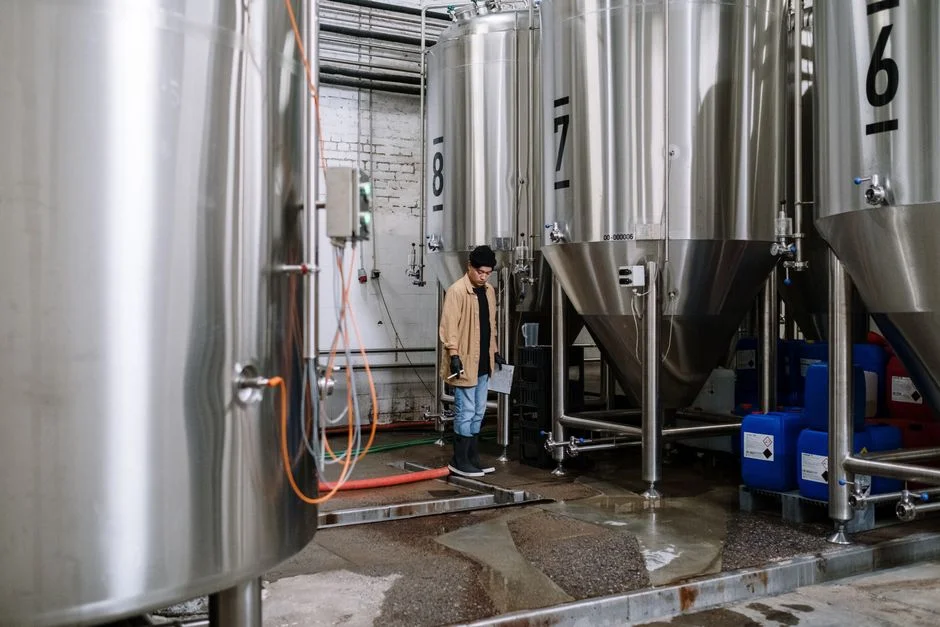
Compliance requires operating evidence, not only passing laboratory samples. HydropureWater identifies 24-hour composite samples for BOD, TSS, FOG, and total phosphorus at frequencies ranging from monthly to quarterly, plus continuous pH and flow monitoring for significant industrial users. The controlling POTW permit must determine whether each requirement applies and whether another parameter, frequency, sample point, method, or reporting system is required.
Confirm the sample location, analytical methods, reporting deadlines, electronic reporting system, record-retention period, and noncompliance-notification requirements directly in the current Washington permit. Do not import Connecticut requirements from a general compliance article; the state-specific process must be verified locally. For process context, see the industrial wastewater treatment process guide.
Configure the plant control system or SCADA to alarm on high flow, pH excursions, abnormal DAF oil skimmings, chemical-dosing faults, and biological-process instability. The operating record should connect equalization level, pH, flow, DAF condition, chemical dose, and biomass health to each sampling result. That history explains whether an excursion came from wastewater variability, equipment performance, or an operational response.
| Control step | Required action | Record |
|---|---|---|
| Detection | Confirm the alarm or analytical result and protect the discharge point | Timestamped event, instrument status, and sample result |
| Containment | Stop, divert, or equalize the affected flow as the permit and procedures allow | Valve, diversion, basin-level, and flow records |
| Investigation | Check production, CIP, power, dosing, biological condition, and instrument performance | Root-cause record with responsible personnel |
| Resampling | Follow permit procedures for any required follow-up sample | Chain of custody, analysis, and submission |
| Notification | Submit required noncompliance information through the applicable process | Submission confirmation and deadline |
| Corrective action | Repair, adjust, retrain, and verify restored performance | Work order, settings, training, and follow-up evidence |
Use a written corrective-action workflow covering detection, containment, investigation, any required resampling, equipment response, root-cause analysis, and documented notification. This preserves both the sample trail and the operating context that an enforcement reviewer needs.
Frequently Asked Questions
How much does a food and beverage pretreatment system near Vancouver cost?
The supplied research does not provide Vancouver-area capital-cost figures, so a defensible price cannot be stated without a site-specific budget. Ask bidders to price wastewater characterization, peak flow, each treatment stage, sludge handling, controls, monitoring, installation, and contingency separately. Compare proposals against the same permit basis and influent dataset rather than comparing an unqualified system price or catalog capacity.
Should a Vancouver food plant choose DAF, MBR, or a conventional biological system?
Use the pollutant and permit limit to make the selection: DAF addresses FOG and suspended solids, conventional biological treatment addresses biodegradable dissolved organics, and MBR adds membrane solids separation in a compact footprint. If FOG and solids controls are needed alongside biological treatment, these are complementary stages rather than mutually exclusive choices. Confirm the combination against the current POTW permit, measured wastewater variability, footprint, sludge handling, and monitoring requirements.
How do I size a DAF system for food-processing wastewater?
Require forward flow, peak-to-average ratio, raw BOD, raw FOG, and TSS, then compare those inputs with HydropureWater’s 4–25 m/h surface-loading, 0.005–0.02 air-to-solids, and 20–40% recycle benchmarks. Ask the supplier to show the peak-flow calculation and verify the selected values against representative wastewater tests. Do not select a DAF from forward flow alone.
Which documents should I request before ordering equipment?
Request the current POTW permit and local-limit schedules, applicable federal categorical subpart, wastewater characterization, production and CIP schedules, required monitoring and reporting, discharge-point details, and written acceptance of the proposed treatment basis. Also require equipment bids to identify every design assumption and any item requiring POTW approval. This documentation check can expose a mismatch before a supplier orders equipment.
How can a plant avoid a sewer-discharge exceedance during a CIP cycle?
Route and equalize concentrated CIP flows, maintain redundant pH and flow instrumentation, use automatic trim and diversion controls, and define operator response thresholds before the cycle begins. Record basin level, pH, flow, and any diversion or stop action. If an exceedance occurs, follow the permit’s containment, notification, resampling, and corrective-action requirements rather than relying only on a later passing sample.