Define the Screw Press Design Basis
A screw press for fruit processing wastewater should be sized from the sludge or residue solids flow, particle size, abrasiveness, organic content and required final consistency—not from wastewater flow alone. A 2026 study on fruit and vegetable waste found that 60 psig and 20 rpm recovered 61% of processed mass as liquid, but its 56% organic transfer and 3–5% material loss are feedstock-specific, not guaranteed plant performance. The design should therefore combine screening and grit removal, solids thickening, controlled conditioning and a screw press, followed by the appropriate biological, anaerobic or solids-disposal route.
The screw press is the solids-concentration and dewatering unit. It does not remove dissolved and colloidal contaminants, and it cannot substitute for source control, screening, grit removal or biological treatment. HUBER characterizes fruit and vegetable processing wastewater as often containing high solid loads, coarse material and significant grit; some production processes also produce high COD and other dissolved pollutants, according to its fruit and vegetable processing solution.
Before selecting equipment, obtain hourly and daily wet sludge or residue flow, total solids and volatile solids, particle-size distribution, fibrous content, grit and foreign-material content, temperature, pH, organic composition, odor characteristics and the required disposal or beneficial-use route. These inputs determine whether the feed behaves as a compressible sludge, a fibrous residue, a gritty solids stream or a pumpable mixture.
Keep three feed bases separate. Mixed wastewater sludge carries the widest range of contaminants; separated fruit-processing residues may have a different solids fraction and organic structure; anaerobically digested sludge has different odor, stability and downstream implications. For each basis, the controlling press feed is wet solids entering the dewatering stage, not incoming wastewater hydraulic flow. The fruit juice wastewater screw press design basis should therefore be tied to a measured solids inventory rather than a headline wastewater flow.
| Design input | What the buyer should establish | Effect on screw-press selection |
|---|---|---|
| Wet solids flow | Representative daily and peak feed rates | Sets wet-feed and dry-solids throughput |
| Solids concentration | Total solids and volatile solids | Determines dry-solids loading and liquid balance |
| Material character | Particle size, fibers, grit, foreign material and abrasiveness | Influences screen selection, wear and feed preparation |
| Process condition | Temperature, pH, odor and organic composition | Defines conditioning, containment and downstream treatment |
| Final route | Required cake consistency, transport, disposal or reuse conditions | Sets acceptance criteria and flushing requirements |
Build the Complete Treatment Train
The screw press belongs at a defined solids-concentration point in the fruit-processing wastewater mass balance, not at the head of the process as a universal treatment machine. A practical train is source segregation, screening, grit removal, equalization, sludge generation or residue thickening, conditioning, screw pressing, liquid treatment, residual-sludge handling and final disposal or reuse. The order must follow the actual plant process and the regulatory route for the recovered liquid.
HUBER identifies fine screening for coarse solids and impurities, longitudinal or fine grit traps for sand and soil, and dissolved air flotation for colloidal material and organic matter associated with COD in its fruit and vegetable processing solution. Screening and grit removal protect the downstream train, but they do not eliminate the solids mass balance. Removed screenings, sand and soil still require a specified handling or disposal route.
For mixed wastewater, the press commonly follows biological treatment when the duty is excess sludge, or follows thickening when the duty is concentrated organic residue. A DAF system for fruit-processing wastewater pretreatment may be used where the wastewater requires removal of colloidal material and COD-associated organics; a rotary mechanical bar screen can protect upstream equipment from coarse material. Neither device substitutes for a solids dewatering duty.
The liquid fraction leaving the screw press must be characterized before it is recycled, sent to biological treatment, routed to anaerobic digestion or accepted into a sewer. Soluble pollutants, pH, temperature, COD, suspended solids and upstream treatment history determine whether return flow is practical. Avoid assuming that all press liquid is directly reusable or dischargeable; the applicable permit and sewer requirements remain decisive.
| Process stage | Primary purpose | Design check |
|---|---|---|
| Source segregation | Separate concentrated residues from dilute wash water | Isolate high-solids streams before thickening |
| Screening and grit removal | Remove coarse material, sand, soil and foreign objects | Include retained solids in disposal and wear-control plans |
| Equalization and thickening | Stabilize feed and increase solids concentration | Measure representative total solids and peak wet flow |
| Conditioning and screw pressing | Concentrate solids and separate liquid | Control feed rate, pressure, speed and torque |
| Liquid treatment | Remove or manage dissolved and colloidal pollutants | Assess COD, pH, temperature and nutrients before reuse |
| Residual solids | Prepare digestate, cake or soil amendment for its final route | Specify moisture, contamination and handling requirements |
Translate Research into an Operating Envelope
The strongest directly relevant operating evidence comes from a 2026 study on fruit and vegetable waste, not from a full fruit-processing wastewater plant. In Waste and Biomass Valorization, published in 2026, the researchers investigated applied pressure from 10–60 psig, screw speed from 5–33 rpm and water addition from 0–100%. They reported a broader cited manufacturer envelope of 0–125 psig and 0–40 rpm. The experimental range is therefore a test range, not the complete equipment envelope.
During pressure testing, the researchers held screw speed at 20 rpm because the cited manufacturer’s manual did not recommend operation at the maximum speed of 40 rpm. At 60 psig and 20 rpm, the study reported 61% of processed mass recovered as liquid. Its cited 1,000 g example produced 610 g of liquid and 390 g of solids, subject to observed material loss.
These results support a controlled commissioning sequence, not direct scale-up. Pressure and speed both affect liquid expression, but increasing either can also increase shear, wear, energy demand or solids carryover. The equipment limits for torque, speed, pressure and feed rate must therefore be confirmed in the supplier’s technical proposal. A broader comparison of screw-press operating envelopes across wastewater duties is useful for planning tests, but it does not replace site-specific trials.
The cassava-mash study is a different-feedstock reference. It reports an average cake moisture content of 52% wet basis at 40–50 rpm with 200 N back pressure, according to the Greener Journal of Science Engineering and Technological Research. That finding does not establish cake moisture, throughput or operating limits for fruit-processing wastewater sludge.
| Parameter or result | Scope and source | Engineering interpretation |
|---|---|---|
| 10–60 psig; 5–33 rpm; 0–100% water addition | Experimental conditions in the 2026 Waste and Biomass Valorization study | Use as a test envelope, not an equipment guarantee |
| 0–125 psig; 0–40 rpm | Manufacturer range cited by the 2026 study | Confirm the actual machine’s restrictions and duty map |
| 60 psig and 20 rpm; 61% liquid recovery | Fruit and vegetable waste in the 2026 study | Use for pilot planning only until site feed is tested |
| 3–5% material loss | Material trapped around the barrel and inside the screen mesh in the 2026 study | Include solids capture, flushing and loss allowances |
| 52% wet-basis cake moisture at 40–50 rpm and 200 N back pressure | Cassava mash in the older cassava-mash study | Reference only; feedstock and machine are different |
Account for Organic Fraction and Water Addition
Organic transfer must be treated as a process outcome, not merely as a dewatering efficiency. The final mass balance in the 2026 Waste and Biomass Valorization study reported that 56% of the initial fruit-and-vegetable-waste organic content transferred into the liquid fraction, while 44% remained in a solid fraction equal to 20% of the initial waste mass. The same paper states that approximately 39% of the initial organic matter entered the liquid fraction under the optimized screw-press condition. Those values describe different accounting presentations and should not be merged.
The solid fraction remained wet. Total solids were measured at 256 ± 44 g/L, and the researchers stated that further processing was required. Consequently, a target based only on volume reduction can overlook the need for additional solids treatment, transport reduction or digestion.
Water addition also changes the balance. In a second-stage maceration and pressing trial, the 2026 study identified 0.5 kg of water for each 1 kg of first-press solids as optimal. That is a reported study condition, not a general dilution recommendation. At a plant, added water must be included in the hydraulic load, liquid-recovery calculation, downstream treatment capacity and energy balance.
Choose the operating objective deliberately. Use an organic mass balance, including biomethane potential where anaerobic digestion is intended, when the liquid fraction is valuable as a methane feedstock. Use moisture content, bulk reduction, transportability and disposal requirements when reducing sludge volume is the priority. Maximizing liquid recovery can be counterproductive if the returned liquid adds COD, nutrients, suspended solids or hydraulic load to the biological or anaerobic process.
| Accounting item | 2026 study result | Design implication |
|---|---|---|
| Final organic transfer | 56% of initial organic content entered the liquid fraction | Build an organic balance for the selected operating condition |
| Alternative statement in the paper | Approximately 39% of initial organic matter entered the liquid under optimized conditions | Clarify the denominator and balance boundary before using either value |
| Remaining solid fraction | 44% of initial organic content remained in solids representing 20% of initial waste mass | Do not equate low mass with low residual treatment demand |
| First-press solids | Total solids of 256 ± 44 g/L | The solid fraction still required further processing |
| Second-stage water addition | 0.5 kg water per 1 kg of first-press solids | Include added water in hydraulic and downstream balances |
Size the Press from Solids and Performance Data

Calculate press feed from measured solids performance, not from a universal capacity factor. The wet feed entering the press equals the required dry-solids delivery rate divided by the measured feed solids fraction. The dry-solids rate comes from the upstream wet sludge or residue flow multiplied by its measured total-solids concentration. Use representative daily data and peak feed conditions, and state the time basis for the selected capacity.
The 2026 Waste and Biomass Valorization study observed 3–5% material loss, with residue trapped around the barrel and inside the screen mesh. That is a process-loss allowance from the study, not a universal loss factor. A site-specific mass balance should include it until screening, flushing and feed-control trials establish the installed performance. Materials leaving the press must also be counted: the study used 20 rpm and 60 psig in the reported 1,000 g example, so its liquid and solid quantities should not be transferred directly to another feed.
Select capacity against dry-solids throughput, permissible wet-feed rate, screw torque, speed, pressure, screen area and cake-discharge behavior. The incoming wastewater volumetric flow may determine upstream tank and pumping requirements, but it is not the controlling press-sizing input. For a broader solids-handling comparison, see the lamella clarifier for solids-thickening applications, while recognizing that clarifier and screw-press duties are different.
Build the liquid balance from measured liquid recovery and add wash water, retained moisture, recycled liquid and any maceration water. Carry the resulting COD, organic-matter and suspended-solids loads into downstream treatment. Specify the required final cake moisture in the bid document, along with the feed condition and test method that apply to that guarantee.
The supplied research does not establish a universal screw-press size, cake-moisture guarantee or installed-power requirement for fruit-processing wastewater. Those values require a supplier’s duty-specific calculation and, where scale-up risk is material, a representative trial. The equipment scope should include an auxiliary-flush strategy, cleaning access and solids capture because material loss around the barrel and screen was observed in the 2026 study.
| Calculation step | Required input | Output |
|---|---|---|
| Dry-solids production | Wet residue flow and measured total solids | Dry-solids delivery rate |
| Wet press feed | Dry-solids rate divided by feed solids fraction | Wet-feed rate for capacity selection |
| Liquid balance | Measured recovery, wash water, retained moisture and recycle | Liquid flow to downstream treatment |
| Solid balance | Feed solids, cake solids and observed process loss | Cake rate and residual solids route |
| Acceptance test | Feed characterization, target moisture and test protocol | Verified throughput and cake performance |
Select Equipment and Supplier Commitments
Request a duty-specific proposal that identifies the feed basis, feed-solids concentration, wet and dry feed rates, expected cake moisture, liquid recovery, installed power, control method and performance-test protocol. A supplier should show how those values follow from the proposed machine, not replace them with general claims about dewatering effectiveness.
Compare the screw press with the plant’s other dewatering options using identical feed samples and acceptance criteria. The plate and frame filter press for comparison may be relevant where batch operation, cleaning access or a different cake structure is acceptable. Both routes should be compared on wet-feed rate, dry-solids throughput, measured cake moisture, liquid quality, labor exposure, auxiliary utilities, maintenance and downstream treatment effects.
Evaluate wetted materials against the actual corrosion exposure, including pH, temperature, cleaning chemicals and fruit-derived constituents. Review screen selection, torque-overload protection, flushing access, noise, odor containment, instrumentation, wear-part availability and service access. These items affect reliable performance more than a general efficiency percentage.
For a turnkey installation, define the supplier’s integration scope: equipment, upstream pretreatment, controls, electrical supply, commissioning, operator training and performance testing. A staged scope can reduce integration risk, but it should not leave responsibility for the solids mass balance or liquid routing ambiguous.
Request a representative trial or witnessed performance test when scale-up risk is material. Define how feed samples are collected, how the test duration is selected, how wet feed and dry solids are measured, how cake moisture is determined and how liquid quality is assessed. Do not convert the academic 61% liquid-recovery result into a commercial guarantee unless the supplier demonstrates equivalent feed characteristics and operating conditions.
| Procurement item | Required commitment | Buyer check |
|---|---|---|
| Feed basis | Solids concentration, wet and dry feed rates | Does it match measured plant data? |
| Performance | Cake moisture, liquid recovery and throughput | Are test method and feed conditions explicit? |
| Mechanical limits | Torque, speed, pressure and overload protection | Are restrictions tied to the actual feed? |
| Materials and wear parts | Wetted-material specification and support plan | Does exposure include pH, temperature and cleaning chemicals? |
| Integration | Controls, flushing, odor control and downstream interface | Is the solids and liquid mass balance complete? |
| Acceptance | Representative or witnessed test | Are sampling and measurement methods defined? |
Commission, Monitor and Troubleshoot the Installation
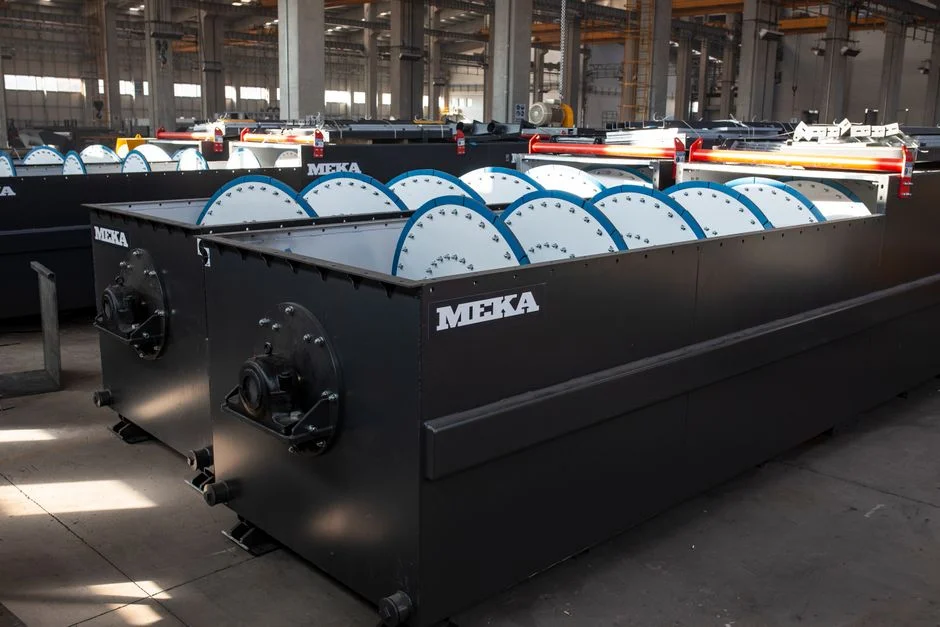
Before start-up, verify screen integrity, feed consistency, flush-water availability, torque and overload settings, emergency-stop function, odor controls and access for cleaning the barrel and screen area. Confirm that the upstream screens and grit removal prevent coarse material and foreign objects from reaching the press.
Start with the approved feed and gradually establish feed rate, screw speed and pressure. Record wet feed, total and volatile solids, cake moisture, liquid volume, organic or COD load, electrical demand and visible carryover. These readings establish the plant’s actual operating envelope and provide a baseline for troubleshooting.
For increasing cake moisture, check feed-solids concentration, feed rate against screw capacity, screen condition, pressure, speed, polymer conditioning and whether the feed exceeds hydraulic or torque limits. Do not compensate for inadequate feed preparation by raising pressure without checking the machine’s permitted operating range.
For high liquid return with poor solids capture, inspect screen damage, feed distribution, excessive dilution, upstream grit or foreign material, and liquefaction or emulsification of the feed. A high liquid fraction is not automatically a press failure; it may reflect the process objective or the feed’s physical behavior.
For high organic transfer, use the 2026 study’s 56% final mass-balance result as evidence that fractionation can be substantial. Verify whether the liquid is intended to return to biological or anaerobic treatment, and adjust the operating objective accordingly. A pressure test alone cannot establish the full plant balance.
| Observed condition | Checks | Corrective focus |
|---|---|---|
| Rising cake moisture | Feed solids, feed rate, screen, pressure, speed, polymer and torque | Restore feed and equipment operating balance |
| High liquid return, poor capture | Screen damage, distribution, dilution, grit and emulsification | Protect and prepare the feed |
| High organic transfer | Liquid COD, organic concentration and downstream capacity | Route liquid deliberately to the intended treatment step |
| Uneven discharge | Feed consistency, screw condition, screen and discharge opening | Inspect the press before changing the duty |
| Excessive wash demand | Flush strategy, screen fouling and cleaning access | Recover retained material and restore screen condition |
Frequently Asked Questions
How do I size a screw press for fruit processing wastewater?
Size it from measured dry-solids throughput and the permitted wet-feed rate, then verify torque, pressure, speed, screen area and cake discharge. Provide representative peak wet feed, total solids, volatile solids, particle size, grit, fibrous content, temperature and pH to the supplier. Do not size from incoming wastewater flow or apply the study’s 61% liquid recovery as a guaranteed output.
What screw-press performance data should I request from a supplier?
Request expected cake moisture, dry-solids and wet-feed throughput, liquid recovery, installed power, torque and operating-limit data, plus the test protocol. Require the feed-solids concentration and physical characteristics used in the calculation. Ask how process loss, flush water, retained moisture and downstream liquid loads are included.
Is 60 psig and 20 rpm the correct operating setting for a fruit-wastewater screw press?
No. Those settings produced 61% liquid recovery in the 2026 fruit-and-vegetable-waste study, but the material was not a full wastewater sludge. The cited manufacturer envelope was 0–125 psig and 0–40 rpm, while the study tested 10–60 psig and 5–33 rpm. Establish the plant setting through controlled testing within the actual machine’s limits.
Should the liquid from a screw press be returned to the wastewater treatment process?
Only after measuring its COD, organic content, suspended solids, pH and temperature and assessing the upstream treatment, hydraulic capacity and permit or sewer requirements. The 2026 study reported 56% final organic transfer into the liquid fraction, so a return stream can materially change the downstream load.
How do I compare a screw press with a plate and frame filter press?
Run both options against the same representative feed and compare dry-solids throughput, cake moisture, liquid quality, labor, cleaning, auxiliary utilities, maintenance and downstream treatment impacts. Use the plate and frame filter press for comparison as an alternative basis for the same performance test. Do not compare catalogue capacity with guaranteed site performance.