Why a Bogotá Factory Needs an ETP, Not Just a Drain
Industrial discharges in Colombia are subject to numeric discharge limits, and a factory cannot simply route process wastewater to the municipal sewer or a receiving water body without treatment. The conventional answer is an industrial Effluent Treatment Plant (ETP) that organises treatment in three levels: primary (physical and chemical), secondary (aerobic or anaerobic biological), and tertiary (final polishing with chlorine and alum), as described in the Quora thread on ETP mechanisms.
Inside that train, Dissolved Air Flotation (DAF) is the workhorse primary clarifier for most Bogotá industries. DAF is a physico-chemical separation process: very small air bubbles attach to suspended particles, oil droplets, and colloids, giving them a high rate of ascent so they float to the surface instead of slowly settling, according to the Quora answer on refinery DAF practice. DAF recovered solids are 3 to 4 times thicker than gravity sedimentation, and processing takes about 3 minutes compared to 2 to 3 hours in a conventional clarifier (SlideShare, DAF technology presentation). Both numbers shorten sludge-handling cost and shrink the clarifier footprint, which is decisive when factory land inside the Bogotá metropolitan area is at a premium.
Where DAF Fits in a Bogotá ETP Train
A typical industrial ETP flows in a fixed sequence: influent screening, equalisation, coagulation and flocculation, then a separation stage, biological treatment, clarification, disinfection, and finally discharge. In refinery configurations, the DAF unit sits downstream of an API oil-water separator as a secondary clarifier; in the process described in the Quora refinery answer, the API separator takes out the bulk free oil and heavy sediment first, and DAF then lifts the fine emulsions and ultrafine solids.
For most Bogotá factories—food, dairy, leather, cosmetics, pharmaceuticals, and metal finishing—the upstream API separator is rarely installed, so DAF is the primary clarifier that feeds biological treatment directly. The DAF unit injects chemical coagulants to destabilise emulsions and then uses microbubble flotation to lift oils and fine solids before they reach the aeration tank; this protective-barrier function is explicit in the Quora refinery DAF answer, which notes that emulsified oil reaching the biological stage will coat the bacteria and destroy the colony. For readers comparing the upstream oil-and-grease options (DAF, CPI, API) before specifying the train, the DAF vs CPI vs API oil and grease removal comparison walks through the trade-offs.
DAF Removal Efficiencies by Industry: What Bogotá Plants Can Expect
Published removal-efficiency data for DAF originates from the SlideShare presentation on DAF for highly polluted wastewater. The table below summarises the headline numbers by industry. These are reference values from the source, not Bogotá-specific case data; any supplier offer should be cross-checked against a treatability test on the actual factory effluent.
| Industry / stream | TSS removal | O&G removal | BOD removal | Reference |
|---|---|---|---|---|
| Paint shops and industrial wash operations | 85–95% | 90–95% | — | SlideShare, DAF technology presentation |
| Milk and dairy | 85–97% | 95–99% | 80–85% | SlideShare, DAF technology presentation |
| Pharma (penicillin production) | Up to 8,000 ppm TSS handled in a 6 ft DAF treating ~200 m³/day | — | — | SlideShare, DAF technology presentation |
| Slaughterhouse (fine meat particles) | ~3,500 ppm fine-particle load treated at 26 m³/hr | — | — | SlideShare, DAF technology presentation |
The milk and dairy row is relevant to Bogotá-region processors in the Cundinamarca and Boyacá supply zones, where 85–97% TSS, 95–99% O&G, and 80–85% BOD removal are realistic DAF targets. The 200 m³/day, 6 ft DAF datapoint and the 26 m³/hr slaughterhouse datapoint are useful sizing cross-checks. On the physics side, the DAF micro-bubbles measure 10 to 100 microns in diameter, generated by pressure release from a supersaturated recycle stream (Quora, refinery DAF answer); readers selecting a saturator should ask how that bubble-band is verified at their altitude. For a broader selection framework, the 2026 DAF engineering decision framework covers the spec and cost variables in more detail.
Bogotá-Specific Engineering Considerations
Bogotá sits at roughly 2,640 m elevation, meaning any sea-level DAF specification must be treated as a starting point rather than a final answer. The Quora refinery DAF answer explains that DAF performance is governed by dissolved-air saturation and pressure-release microbubble generation, which means the saturator working pressure, recycle ratio, and pump head all depend on local ambient pressure. At high elevation, air-to-water solubility drops as atmospheric pressure falls, so standard lowland saturation curves overstate the available microbubble volume if applied unchanged.
The practical move is to require a high-altitude performance correction from any supplier and to ask for rated microbubble output at Bogotá barometric pressure, not at sea level. Ambient temperature is a second flag: Bogotá mornings regularly sit in the 10–14 °C range, which raises air solubility but slows flocculation kinetics—coagulant dose and flocculation residence time should be reviewed for the local temperature band. Buyers who already operate in similar Andean conditions can compare notes in the parallel Santiago, Chile ETP and DAF engineering guide, which treats the same high-altitude correction problem.
Sizing a DAF for a Bogotá Factory: Flow and Footprint Logic
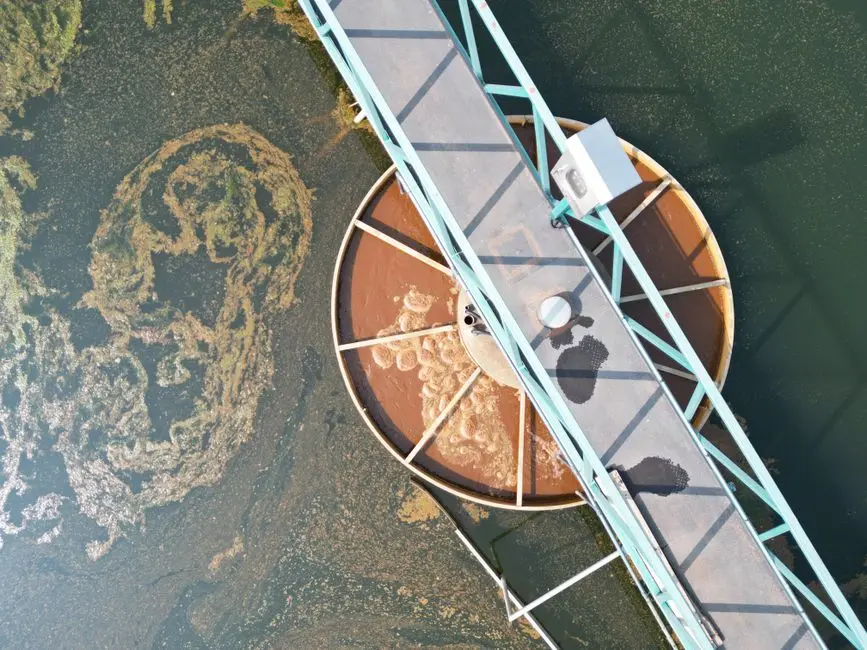
The SlideShare DAF presentation gives two useful capacity benchmarks: 1 MGD ≈ 18 ft (~5.5 m) diameter DAF clarifier, and a 6 ft (~1.8 m) DAF that handles about 200 m³/day. These figures serve as a cross-check after the supplier has run a treatability test on the actual factory effluent.
For a typical small-to-medium Bogotá factory in food, cosmetics, or light manufacturing (often 50–200 m³/day of process wastewater), a single circular DAF in the 2–4 m diameter range is the common starting point. Modular, pre-assembled circular DAFs with internalised overflow weirs reduce civil works and footprint, which fits constrained urban Bogotá sites (SlideShare, DAF technology presentation). A compact circular DAF unit paired with an automatic coagulant dosing system is the typical procurement package for the primary stage. Because the downstream biological load depends on what the DAF removes, buyers should treat the DAF size, the chemical dose, and the downstream biological stage as a coupled decision rather than three independent equipment orders.
Matching DAF to Bogotá's Dominant Industries
Bogotá's industrial mix shapes which DAF configuration actually performs. Cut-flower and cosmetics operations generate high colour, surfactant, and FOG loads, and DAF with coagulant dosing is the standard first step before biological polishing. Leather and tannery operations in the Bogotá region produce high TSS and sulfide-bearing wastewater, where DAF is widely used as a pre-clarifier to protect downstream anaerobic or aerobic biological stages from shock loads. Coffee processing, a Colombian flagship industry, generates high-strength organic effluent; DAF paired with coagulation and advanced oxidation can reduce COD before biological treatment, consistent with the topic of the ResearchGate paper on chemical flocculation and advanced oxidation in coffee wastewater.
Food and dairy processors in Cundinamarca can expect 85–97% TSS, 95–99% O&G, and 80–85% BOD removal from a properly sized DAF, per the SlideShare DAF presentation. Edible-oil and soapstock producers should confirm a DAF matched to their FOG and emulsified-fat profile, which is covered in the edible-oil DAF sizing guide; breweries and beverage plants generating protein-rich waste should weigh a downstream screw press for sludge dewatering against the DAF selection so the cake-handling decision is made together with the flotation choice.
A 2026 Supplier and Compliance Checklist for Bogotá
Procurement is where the sea-level-spec problem becomes expensive. The table below is the minimum data set a Bogotá buyer should request before signing a purchase order; a sea-level-only performance sheet is a red flag.
| Checklist item | Why it matters at 2,640 m |
|---|---|
| Removal-efficiency curves (TSS, O&G, BOD) on actual effluent or a chemically similar surrogate, plus a treatability test report | Generic curves are usually measured at sea level and do not capture Bogotá influent or altitude. |
| Saturator pressure, recycle ratio, and pump head re-rated for Bogotá altitude | Lower ambient pressure reduces dissolved-air yield; sea-level ratings overstate microbubble volume. |
| Skimmer duty and sludge solids concentration | DAF sludge is 3–4× thicker than clarifier sludge (SlideShare); downstream dewatering must be sized for that cake. |
| Local service presence or remote monitoring, plus spare-parts lead time for Colombia | Long parts lead times turn a minor fault into weeks of permit exposure. |
| Downstream sludge dewatering option (plate-and-frame filter press or screw press) | Without it, the DAF sludge becomes the bottleneck of the ETP. |
For sludge dewatering, a sludge dewatering filter press is the conventional downstream match; for the contractual side, the warranties and performance guarantees guide flags the clauses a Bogotá buyer should not sign without legal review.
Frequently Asked Questions
Does a small Bogotá factory (under 200 m³/day) actually need a DAF, or can it rely on a clarifier and biological stage alone?
If the influent carries emulsified oil, high TSS, or FOG—common in food, dairy, cosmetics, and metal finishing—a plain clarifier will pass too much load to the biological stage and risk killing the bacterial colony. The Quora refinery DAF answer is explicit that emulsified oil suffocates aeration-tank bacteria, which is exactly the failure mode a DAF prevents. For low-FOG streams a DAF can be smaller or omitted, but a treatability test on the actual influent is the only reliable way to decide.
What DAF capacity do I need to ask a supplier to quote for a Bogotá food or cosmetics plant?
Cross-check the supplier's quote against the published capacity anchors: about 200 m³/day per 6 ft (~1.8 m) DAF, and 1 MGD per 18 ft (~5.5 m) unit (SlideShare, DAF technology presentation). For a 50–200 m³/day plant, a 2–4 m circular DAF is the common starting range, but the supplier should be asked to size the unit against the specific flow and load, not against the generic anchors alone.
How do I compare DAF suppliers for a Bogotá project without buying a sea-level-only spec?
Require altitude-corrected performance data: saturator pressure, recycle ratio, pump head, and bubble-size band, all stated for Bogotá barometric pressure, not for sea level. Ask for a treatability test report on the actual effluent, a local service partner or remote-monitoring option for Colombia