How DAF and Clarifiers Actually Work in a Mining/Metals Plant
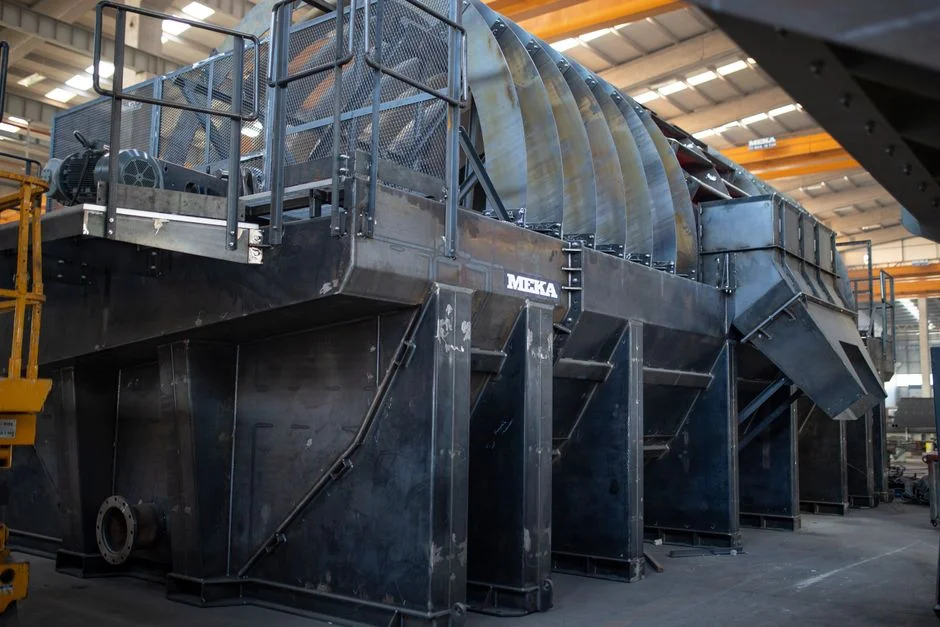
A dissolved air flotation (DAF) unit works by injecting pressurized air that comes out of solution as 30–50 micron microbubbles, which attach to suspended solids, oils, and FOG and lift them to the surface, where a paddle skimmer removes the float; heavier settleable solids drop to a bottom collection zone and are removed by an auger (Clearwater Industries, 2026-04-27). A conventional clarifier — a gravity settling tank, often fitted with inclined-plate lamella packs — relies on gravitational settling: denser particles drop to a sludge bed while clarified water overflows launders, a design that favors heavy, readily settleable solids rather than emulsified oils or low-density flocs.
In a Snoqualmie metals plant the influent usually mixes heavy mineral grit, metal hydroxide flocs from pH adjustment, lubricating oils and cutting fluids, and fine colloidal fines. Neither unit alone covers the full stream, which is why Sigmadaf Clarifiers / Clearwater Industries (2026-04-27) note that DAF performance depends on prior chemical coagulation and flocculation — without proper chemical conditioning, even a well-sized DAF will underperform on fine solids. The DAF product family covers a low-profile cross-flow model (FPAC) for very high solids/FOG, a high-profile lamella-pack model (FPBC) for low-buoyancy particles, a high-flow model (FPF) for variable loads, and a turnkey HydropureWater DAF system for mining and metals wastewater delivered as a single skid. Bulk settling of heavy slurries is typically handled by a HydropureWater lamella clarifier for bulk settling of mining slurries upstream of any flotation step.
Snoqualmie-Specific Drivers: Watershed, Permits, and Influent Reality
Snoqualmie-area mining and metals plants discharge under local industrial wastewater ordinances and ultimately into the Snoqualmie watershed feeding the King County regional system, so pretreatment requirements for TSS, FOG, and metals (Cu, Ni, Zn, Pb) typically drive clarifier and DAF selection. Mining and metals wastewater in the Cascades region shows seasonal flow swings from stormwater ingress and process batch dumps, which pushes designers toward equipment with broad turndown; DAF skimmers and lamella clarifiers both accommodate variable loading, but DAF typically has a faster startup and a smaller footprint per m³/h.
The supplied research does not name a specific Snoqualmie numeric limit, so a buyer must confirm current local discharge limits and metals action levels with the local POTW or state authority before locking any equipment selection. EPA HERO (Cornelius et al.) documents that DAF systems have been tested on high-strength water flows and showed good removal of fine soil particles producing an effluent suitable for the wastewater treatment plant, which is directly relevant to Snoqualmie plants handling soil-laden mining slurries. DAF earns its place on the fine-solids fraction, while the lamella clarifier handles the coarse, settleable fraction of the same stream.
Side-by-Side Comparison: DAF vs Clarifier for Mining/Metals Streams
The head-to-head numbers below come from Sigmadaf Clarifiers / Clearwater Industries (2026-04-27) for the DAF columns and from standard inclined-plate clarifier design practice for the lamella column; the supplied research does not give a generic mining/metals removal efficiency, so the table states the qualitative direction rather than inventing percentages. These operational metrics help determine which technology fits specific plant requirements.
| Parameter | DAF (e.g., FPAC / FPBC / FPHF / COMPACT) | Lamella / Gravity Clarifier |
|---|---|---|
| Removal mechanism | Floats suspended solids, oils, FOG, and fine colloids on 30–50 micron bubbles (Clearwater Industries, 2026-04-27) | Settles heavier particles by gravity through inclined plates |
| Footprint per m³/h | Compact, often skid-mounted; small plan area | Achieves high surface loading but needs larger plan area and deeper basin |
| Flow band (standard line) | 4–300 m³/h across 13 sizes; COMPACT DAF single skid ≤66 GPM, modular two-skid above 66 GPM (Clearwater Industries, 2026-04-27) | Scales with basin area; very large flows need multiple units or very large plate packs |
| Influent fit | Emulsified oils, low-buoyancy particles, high FOG, fine metal hydroxides | Readily settleable heavy solids, grit, mineral slurries |
| Material of construction | 304SS standard; 316SS and polypropylene available for corrosive or chloride-bearing streams (Clearwater Industries, 2026-04-27) | Typically carbon steel with rubber lining or concrete; 316SS available for corrosive service |
| Operator profile | Requires chemical dosing (coagulant, flocculant), skimmer speed control, sludge discharge tuning; PLC automation available on COMPACT (Clearwater Industries, 2026-04-27) | Requires sludge bed and underflow management but less day-to-day chemistry |
| Best role in a Snoqualmie metals plant | Primary workhorse on rinse waters and clarifier polishing | Primary workhorse on heavy TSS slurries and grit streams |
A Snoqualmie buyer should frame the decision as DAF and clarifier, sized to the fractions each one actually removes. For a 2026 capex decision, the HydropureWater DAF system for mining and metals wastewater and the HydropureWater lamella clarifier for bulk settling of mining slurries are usually specified together, with chemical conditioning tying the two stages together.
Three Snoqualmie Use Cases: Matching Equipment to the Stream
The table below maps three realistic influent profiles a Snoqualmie metals plant is likely to see in 2026 onto the equipment that fits each one, with sources kept to Sigmadaf Clarifiers / Clearwater Industries (2026-04-27) and EPA HERO (Cornelius et al.).
| Use case | Stream description | Primary unit | Secondary / polishing unit | Key caveat |
|---|---|---|---|---|
| A — heavy TSS mineral slurry | Mining runoff, mill discharge, high settleable solids | Lamella clarifier for bulk grit and mineral solids | DAF only if clarified water still carries fines, FOG, or metal-bearing colloids before discharge | Clarifier handles the bulk; DAF only earns capex if a polishing gap remains |
| B — metal finishing rinse water | Emulsified oils, cutting fluids, metal hydroxide flocs from pH adjustment | DAF — SigmaDAF FPAC (low-profile, very high solids/FOG) or FPHF (high flow, variable loads) (Clearwater Industries, 2026-04-27) | Lamella clarifier upstream if the stream also carries settleable grit | Emulsified oils and low-density flocs do not settle well, so a clarifier alone will not work |
| C — low-flow polishing | Clarifier overflow that still exceeds metals and TSS limits | Compact DAF skid sized to clarifier overflow | None | Single skid handles ≤66 GPM, two-skid modular above 66 GPM (Clearwater Industries, 2026-04-27) |
For most Snoqualmie plants the realistic 2026 answer is a hybrid: a lamella clarifier for bulk settling, a DAF for polishing, and chemical dosing (coagulant + flocculant) to make the DAF work — Clearwater Industries (2026-04-27) confirms that chemical conditioning is essential to DAF performance. The HydropureWater DAF system for mining and metals wastewater paired with an automatic chemical dosing system is the standard way to lock in that conditioning. EPA HERO (Cornelius et al.) documents DAF field results on high-strength wastewater showing good removal of fine soil particles, reinforcing the two-stage logic for Snoqualmie plants that handle both slurry solids and emulsified contaminants in the same shift.
Decision Framework: When to Pick a DAF, a Clarifier, or Both
Pick a lamella clarifier as the primary unit when the stream is dominated by readily settleable heavy solids, when footprint is not constrained, and when oil/FOG content is low. Pick a DAF as the primary unit when the stream carries emulsified oils, FOG, low-buoyancy particles, or fine metal hydroxides, and when footprint or modularity matters (Sigmadaf Clarifiers / Clearwater Industries, 2026-04-27). Pick both in series when the stream combines heavy settleable solids with an emulsified or fine-colloidal fraction — the most common Snoqualmie metals configuration in 2026.
Use the COMPACT DAF format (single skid ≤66 GPM, modular two-skid above 66 GPM per Clearwater Industries, 2026-04-27) when the plant needs fast installation, PLC automation, and integrated chemical conditioning. Confirm the material of construction against the stream's chloride, pH, and abrasive solids profile — 304SS is standard, 316SS or polypropylene should be specified for corrosive or chloride-bearing metals finishing baths (Clearwater Industries, 2026-04-27). For a step-by-step look at how a polishing DAF stage actually drives final TSS down to a discharge limit, see this 2026 guide on how to solve effluent TSS exceedance in 2026.
2026 Sizing and Procurement Checklist for Snoqualmie Buyers
Compile the influent profile: average and peak flow (m³/h), TSS, FOG, oil & grease, pH range, temperature, and the specific metals of concern — the supplied research does not list a default mining/metals profile, so the buyer must collect site data. Confirm local discharge limits for TSS, FOG, oil & grease, and metals action levels with the local POTW or state authority before locking equipment selection. Request a jar test or on-site pilot: Sigmadaf Clarifiers / Clearwater Industries (2026-04-27) emphasize that DAF performance depends on coagulant/flocculant selection, which can only be confirmed by testing on the actual stream.
Specify skid vs field-built, material of construction (304SS / 316SS / polypropylene), PLC automation level, and chemical dosing integration — Clearwater Industries (2026-04-27) details the COMPACT DAF as a turnkey skid with chemical conditioning, sensors, instruments, and a control panel. Ask suppliers for reference installations on similar mining or metals streams, recent commissioning dates, and documented removal results; Sigmadaf Clarifiers cites more than 800 projects across 25+ countries since 1994 (Clearwater Industries, 2026-04-27) as a benchmark of supplier track record. The HydropureWater DAF system for mining and metals wastewater and the automatic chemical dosing system should be quoted as an integrated package so the jar-test chemistry locks in with the same hardware that runs it in production. For a comparable inland-metals case study, see this 2026 guide on DAF or clarifier for fabricated metals wastewater in Canton, US.
Frequently Asked Questions
What is the realistic 2026 capex difference between a DAF and a lamella clarifier for a Snoqualmie metals plant?
The supplied research does not provide a 2026 dollar figure for either unit, so a buyer must request a line-item quote that breaks out the DAF skid, the lamella basin, the chemical dosing skid, and installation; Sigmadaf Clarifiers / Clearwater Industries (2026-04-27) note
Frequently Asked Questions
For a Snoqualmie mining or metals plant in 2026, should we choose a DAF system or a lamella clarifier as the primary treatment unit?
The choice depends on the specific gravity and buoyancy of your contaminants. A DAF system is superior for metals wastewater containing emulsified oils, grease, and light metal hydroxide flocs, as it utilizes micro-bubbles to float particles with a specific gravity near or below 1.0. Conversely, a lamella clarifier is more effective for heavy, inorganic mineral tailings or dense metal precipitates that settle rapidly via gravity.
In the Snoqualmie region, where discharge permits often prioritize low TSS and FOG levels, DAF systems are increasingly preferred for metal finishing applications because they achieve higher solids removal efficiency for low-density flocs. If your stream has high mineral loading with rapid settling rates, a clarifier remains the more energy-efficient, low-maintenance option.
What flow rate and footprint should we expect from a DAF versus a clarifier for a 50–100 m³/h metals wastewater stream?
For a 50–100 m³/h flow rate, a DAF system generally requires a footprint of approximately 25 to 40 square meters, depending on the surface overflow rate, which typically ranges from 5 to 10 m³/m²/h. The system is compact due to its high separation efficiency, allowing for smaller tank volumes compared to gravity-based systems.
A lamella clarifier for the same flow rate will occupy a similar or slightly larger footprint when accounting for the inclined plate packs, though it eliminates the need for air saturation pumps and compressors. While the clarifier has a smaller physical vessel footprint, the total system area must include sludge thickening equipment, which is often integrated into the DAF process.
Which DAF model — FPAC, FPBC, FPHF, or COMPACT — best fits a Snoqualmie metals finishing line with emulsified oils and metal hydroxide flocs?
For metal finishing lines characterized by emulsified oils and metal hydroxide flocs, the FPAC (Flotation Process with Circular/Rectangular flow) model is the industry standard. Its design utilizes a circular flow pattern that ensures uniform distribution of the air-water mixture, which is essential for breaking oil-water emulsions and capturing fine hydroxide precipitates.
The FPBC is better suited for high-solids loading in mining applications, while the FPHF is reserved for high-flow applications. The COMPACT model is ideal for limited-space facilities but may lack the specialized internal baffling required to handle the complex chemistry of emulsified oils found in typical Snoqualmie metal processing effluent.
How do we verify that a DAF or clarifier supplier in 2026 can meet local Snoqualmie/Pacific Northwest discharge limits for TSS, FOG, and metals?
Verification must be based on site-specific bench-scale or pilot testing using your actual wastewater stream. Request a performance guarantee that explicitly references the Snoqualmie local limits, typically targeting < 20 mg/L for TSS and < 10 mg/L for FOG, alongside specific metal concentration limits (e.g., Copper, Zinc, Lead) as defined by the Washington State Department of Ecology.
Ensure the supplier provides a mass-balance report showing the projected removal efficiency for your specific influent concentrations. Additionally, verify that the supplier has experience with PNW climate variables, such as cold-weather performance impacts on flocculation kinetics, which can significantly affect discharge compliance in Snoqualmie.
What is the typical lead time and installation scope for a skid-mounted DAF system at a Snoqualmie factory in 2026?
As of 2026, the typical lead time for a skid-mounted DAF system ranges from 16 to 24 weeks, depending on the availability of specialized corrosion-resistant materials like 316L stainless steel. Supply chain volatility in the Pacific Northwest may further influence these timelines, requiring early procurement of long-lead items such as air saturation pumps and control panels.
The installation scope includes mechanical anchoring to a concrete pad, connection of 480V 3-phase power, influent/effluent piping, and integration with the plant's existing SCADA system. A skid-mounted approach reduces field labor by approximately 40% compared to field-erected tanks, as the flocculation tank, DAF unit, and chemical dosing skids are pre-piped and factory-tested before shipping.