
Why Fluoride Is Hard to Remove and Where Electrocoagulation Fits
The World Health Organization drinking-water guideline for fluoride is 1.5 mg/L, yet more than 70 countries report fluoride concentrations above that level in groundwater sources, and industrial streams from photovoltaic etching, semiconductor清洗, glass manufacturing, and aluminum smelting routinely exceed tens to thousands of mg/L (MDPI 2021 review of electrocoagulation as a defluoridation technology). Lime and calcium-salt precipitation, the most common industrial defluoridation route, can typically only drive residual fluoride into the 10–15 mg/L band, and often lower is impractical without enormous chemical doses (Emamjomeh et al. 2008, citing Parthasarathy 1986 and Saha 1993). That residual is incompatible with potable reuse, with most semiconductor and photovoltaic discharge limits, and with the tighter internal reuse loops that fabs and smelters are now designing for water security.
Electrocoagulation (EC) closes that gap. Peer-reviewed studies have shown EC reaching residual fluoride of 0.29 mg/L with aluminum electrodes — comfortably below the 1.5 mg/L WHO guideline — and removal efficiencies reported across the literature cluster between 85% and over 99% depending on electrode material, current density, and influent strength (MDPI 2021 review). Crucially, EC generates its own coagulant in situ by sacrificing the anode, so the plant avoids bulk delivery, storage, and handling of liquid alum or ferric chloride and the associated sludge-volume penalty of chemical coagulation (Emamjomeh et al. 2008). For an engineer screening EC against lime softening or adsorption, that combination — sub-mg/L residual, in-situ coagulant generation, and a compact reactor footprint — is what justifies pulling EC into a request for quotation.
How an Electrocoagulation System Removes Fluoride: Mechanism at the Electrode
The mechanism behind an electrocoagulation system for fluoride wastewater is straightforward enough that any operator or vendor claim can be sanity-checked against it. At the anode, the sacrificial metal oxidizes and dissolves: Al(s) → Al³⁺(aq) + 3e⁻ for aluminum systems, and Fe(s) → Fe²⁺(aq) + 2e⁻ for iron systems (MDPI 2021 review). At the cathode, water is reduced to hydrogen gas and hydroxide: 3H₂O + 3e⁻ → 1.5H₂(g) + 3OH⁻(aq) for aluminum electrodes, and 2H₂O + 2e⁻ → H₂(g) + 2OH⁻(aq) for iron electrodes (MDPI 2021 review). The aluminum variant is the workhorse for fluoride because the generated Al³⁺ immediately hydrolyzes in the bulk solution to an amorphous Al(OH)₃(s) floc that is the active adsorbent.
That Al(OH)₃ floc binds fluoride through two parallel pathways: adsorption of F⁻ onto floc surfaces and co-precipitation as insoluble aluminum fluoride hydroxide complexes of the general form Al_nF_m(OH)₃₋ₙ₋ₘ (Emamjomeh et al. 2008; Emamjomeh and Sivakumar continuous flow study, J. Environ. Manage. 2008). The continuous-flow study confirmed by XRD that the strong Al(OH)₃ signature in the sludge, combined with final pH in the 6–8 range, is what maximizes formation of the Al_nF_m(OH)₃₋ₙ₋ₘ complex and, with it, defluoridation performance (Emamjomeh and Sivakumar 2008, ScienceDirect). The cathodic H₂ microbubbles attach to floc particles and float a fraction of the solids to the surface, so flotation is a built-in separation step that a downstream DAF or lamella clarifier can polish.
One non-obvious point worth carrying into vendor discussions: in batch tests with synthetic NaF + FeSO₄·7H₂O water on aluminum electrodes, over 50% of the total fluoride was attached directly to the electrode surface at an optimum pH of 6.5 (Das and Nandi, cited in the MDPI 2021 review). That means electrode material grade, surface roughness, and passivation behavior are first-order design variables — not afterthoughts — because they directly govern how much fluoride can be removed by surface adsorption versus bulk precipitation.
Operating Window: Current Density, HRT, Electrode Spacing, and Conductivity
The table below consolidates the operating windows reported in 2026 peer-reviewed electrocoagulation defluoridation work, plus the high-strength 2026 PV case and the historical Emamjomeh continuous dataset. These are the values an engineer should paste into an RFP and demand a vendor guarantee against, because they are the only ranges explicitly supported by the cited research.
| Source / Date | Reactor | Influent F⁻ (mg/L) | Current density | HRT / residence time | Electrolyte / spacing | Removal | Energy |
|---|---|---|---|---|---|---|---|
| Environ Sci Pollut Res 2026 (S4) | Batch, concentric Al | 10 | 13.06 A/m² | 6 min | Synthetic tap water | 98.25% | 5.97 kWh/m³ |
| Environ Sci Pollut Res 2026 (S4) | Continuous, concentric Al | 10 | Matched batch optimum | 3–7 min (D/uL = 0.154) | Synthetic tap water | Up to 17.7% above batch | Up to 40% lower than batch |
| Environ Technol 2026 (S1) | Batch EC-crystallization | 3,000 | Not stated as A/m²; 150 cm² electrode area | Not separately listed | 1.2 cm spacing, 0.05 M NaCl+NaHCO₃ | 94.4% | "Minimal" (qualitative) |
| J. Environ. Manage. 2008, Emamjomeh (S5) | Continuous, monopolar Al plates | 5–25 | 50 A/m² (best) | 150–400 mL/min flow | Initial pH 4–8, final 6–8 | 99% at 50 A/m² | Reported in study (specific kWh/m³ not extracted in this brief) |
| MDPI 2021 review (S2) | Batch, supporting-electrolyte variation | Drinking-water range | Not isolated; charge loading varied | Not isolated | Conductivity raised 0.2 → 1 mS/cm | Reasonable improvement | 3.7 → 0.79 kWh/m³ |
| MDPI 2021 review (S2) | Batch | ~25 | 111 A/m² | 25 min | Synthetic water | 94.5% | Not stated in excerpt |
| MDPI 2021 review (S2) | Batch, long-HRT high-current | Drinking-water range | 3 mA/cm² | 30 min | Synthetic water | 85.9% | 4 → 12.5 kWh/m³ |
Three numbers from this table should anchor any spec. First, the 2026 batch optimum of 13.06 A/m² at 6 min HRT delivering 98.25% removal at 5.97 kWh/m³ (Environ Sci Pollut Res 2026) is the cleanest design point on the literature for low-strength, drinking-water-style influents. Second, the 2026 high-strength case at 3,000 mg/L F⁻ shows that 150 cm² electrodes at 1.2 cm spacing with a 0.05 M NaCl+NaHCO₃ composite electrolyte still achieves 94.4% removal — a key data point for photovoltaic and aluminum-smelter buyers (Environ Technol 2026). Third, the conductivity lever is the single biggest OPEX handle: raising bulk conductivity from 0.2 to 1 mS/cm with a supporting electrolyte cut specific energy from 3.7 to 0.79 kWh/m³ while still improving fluoride removal (MDPI 2021 review). For low-TDS industrial effluents, this is the difference between an uneconomic skid and a viable one.
The cautionary column is the bottom row. Extending HRT to 30 min and pushing current density to 3 mA/cm² lifted removal to 85.9% in one batch study, but energy consumption rose from 4 to 12.5 kWh/m³ (MDPI 2021 review). More is not linearly better — beyond the optimum, additional current accelerates competing side reactions (water splitting, electrode passivation) rather than fluoride removal, and the rectifier and electrode-replacement costs scale with charge throughput.
Aluminum vs Iron Electrodes and Batch vs Continuous Reactors
Two material and reactor decisions drive most of the cost and performance difference between EC skids: the electrode metal, and whether the vessel runs batch or continuous. The MDPI 2021 review reports a direct head-to-head at identical conditions: aluminum electrodes gave 94.2% defluoridation with a final fluoride of 0.29 mg/L, while iron electrodes gave 83.6% with a final of 0.82 mg/L (MDPI 2021 review). The 2026 continuous study adds the hydrodynamic layer: continuous reactors with near-plug-flow hydrodynamics (D/uL = 0.154) outperformed matched batch operation under all evaluated conditions, with removal efficiency gains of up to 17.7% and energy savings of up to 40% (Environ Sci Pollut Res 2026).
| Variable | Aluminum electrodes | Iron electrodes |
|---|---|---|
| Head-to-head removal (MDPI 2021) | 94.2% | 83.6% |
| Final residual F⁻ (MDPI 2021) | 0.29 mg/L | 0.82 mg/L |
| Active floc species | Al(OH)₃, binding fluoride as Al_nF_m(OH)₃₋ₙ₋ₘ | Fe(OH)₂ / Fe(OH)₃, lower F⁻ affinity |
| Operating pH window (Emamjomeh 2008) | Final pH 6–8 maximizes Al(OH)₃ availability | Wider tolerance; can color effluent |
| Sludge character | Aluminum hydroxide floc, easier to dewater in some cases | Iron hydroxide, can passivate electrodes |
| Typical use case | Potable defluoridation, high-purity reuse, PV etching | Industrial wastewater where color or trace metal limits are not binding |
Aluminum is the default choice when the discharge or reuse target is sub-1.5 mg/L F⁻, because the Al(OH)₃ → Al_nF_m(OH)₃₋ₙ₋ₘ pathway delivers the lowest residual fluoride at the lowest current density (Emamjomeh et al. 2008). Iron electrodes remain relevant when the influent is incompatible with aluminum (e.g., specific anion interference, downstream color limits, or alloy-passivation concerns) or when the plant already runs iron-based chemistry upstream. The final-pH window of 6–8 is the band where Al(OH)₃ formation is maximized and the fluoride complexes are most insoluble (Emamjomeh and Sivakumar 2008, ScienceDirect).
Continuous reactors should be the default for any steady industrial duty because of the documented 17.7% removal and 40% energy gain over matched batch loading, plus the more predictable RTD (D/uL = 0.154, near plug flow) that makes scale-up arithmetic defensible (Environ Sci Pollut Res 2026). Batch still makes sense at small flows with highly variable influent, for pilot trials, or where a plant needs the same vessel to cover multiple chemistries sequentially. Emamjomeh's 99% continuous result at 50 A/m² and the 2026 batch optimum at 13.06 A/m² and 6 min HRT frame the realistic bookends (Emamjomeh and Sivakumar 2008, ScienceDirect; Environ Sci Pollut Res 2026).
From Reactor to Plant: pH Control, Solids Separation, and Sludge Handling
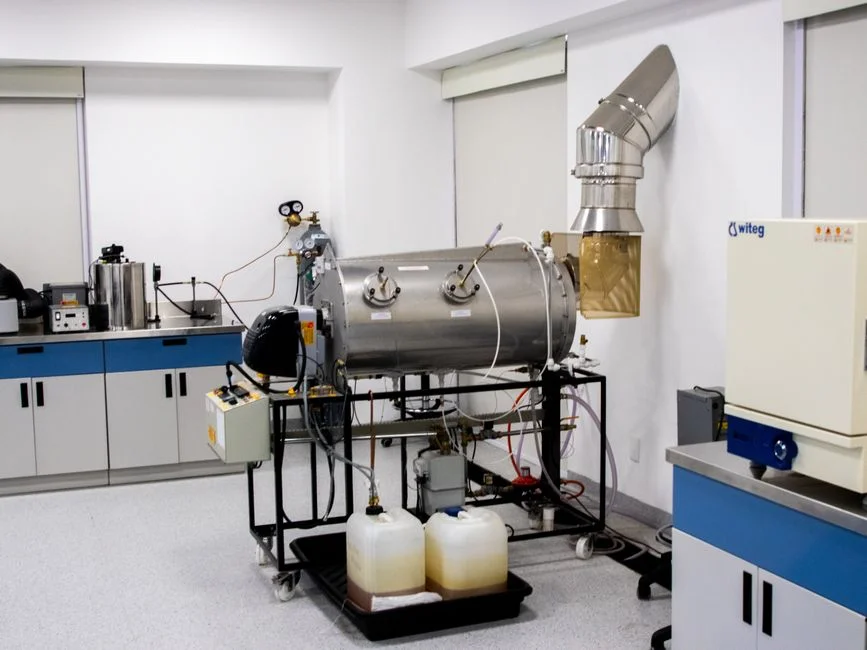
An EC reactor on its own does not make a plant. The four unit operations that surround the cell — pH and conductivity control ahead of the cell, floc polishing after it, sludge dewatering at the back end, and (optionally) a resource-recovery loop — are what turn a bench result into a defensible specification. Final pH should land in the 6–8 band, where Al(OH)₃ floc is most available for fluoride binding (Emamjomeh et al. 2008). That band is set by the electrochemistry itself at moderate current densities, but industrial influents with strong buffers or co-existing anions often need active trim, which is why the front of the skid should be a PLC-controlled chemical dosing system capable of dosing acid, caustic, and supporting electrolyte on feedback from inline pH and conductivity probes.
After the cell, the floated and settled floc both need to be captured. A lamella clarifier handles the denser settled fraction efficiently in a small footprint, while a dissolved air flotation system polishes the floated fraction and any residual colloidal floc that escapes the cell. The combined liquor then goes to a plate-and-frame filter press for sludge dewatering, which is mandatory rather than optional: the metal-hydroxide sludge from fluoride-bearing wastewater is commonly classified as a hazardous waste in many jurisdictions, so reducing its volume and stabilizing it for disposal is a compliance and a cost issue (Emamjomeh et al. 2008).
For high-strength streams — the 3,000 mg/L F⁻ photovoltaic case in particular — there is a resource-recovery upside that changes the economics. The 2026 EC-crystallization study introduced commercial Na₃AlF₆ seed crystals at 0.75 g via stepwise addition over 0–20 min and produced cryolite with 97.5% phase content, turning a waste stream into a saleable product for the photovoltaic and aluminum-smelter markets (Environ Technol 2026). For a buyer already running a fluoride-bearing process, that recovery line can offset a meaningful share of the sludge-disposal OPEX and is worth specifying in the RFP.
Sizing and Energy Economics for an Industrial EC Skid
The documented specific-energy band for fluoride-targeted EC is wide — 0.79 kWh/m³ on the low end (with supporting electrolyte added to lift conductivity to 1 mS/cm) up to 12.5 kWh/m³ on the high end (long-HRT, high-current-density batch operation with 30 min residence time at 3 mA/cm²) (MDPI 2021 review). The 2026 batch optimum at 5.97 kWh/m³ for 98.25% removal sits in the middle and is the most defensible single point for back-of-envelope sizing (Environ Sci Pollut Res 2026). Continuous operation then trims that further, with documented energy savings of up to 40% versus matched batch (Environ Sci Pollut Res 2026).
The cost drivers that move the OPEX line are: anode material and replacement frequency (a function of charge throughput and influent chloride), rectifier sizing, supporting-electrolyte dose, sludge disposal, and downstream polishing. Of these, supporting electrolyte is the single biggest swing factor for low-TDS industrial effluents — the conductivity jump from 0.2 to 1 mS/cm cut specific energy from 3.7 to 0.79 kWh/m³ while still improving removal (MDPI 2021 review). For high-strength streams in the thousands of mg/L F⁻, the 97.5% cryolite recovery from the 2026 seed-induced EC-crystallization route is the offset that can flip the OPEX sign for photovoltaic and aluminum-smelter buyers (Environ Technol 2026). Any defensible capex/opex band the buyer requests from a vendor should be tied to a specific influent F⁻, target residual, current density, HRT, and electrolyte assumption — not a generic kWh/m³ multiplier.
Frequently Asked Questions
What removal efficiency can I realistically expect from an electrocoagulation system for fluoride wastewater?
Peer-reviewed EC defluoridation studies report removal efficiencies from 85% to over 99% depending on electrode material, current density, HRT, and influent concentration, with the cleanest low-strength benchmark being 98.25% removal at 10 mg/L F⁻ in the 2026 batch study at 13.06 A/m² and 6 min HRT, and 0.29 mg/L residual F⁻ with aluminum electrodes in the MDPI 2021 review (Environ Sci Pollut Res 2026; MDPI 2021 review). Buyers should ask vendors to guarantee a residual F⁻ value at their specific influent concentration, not a generic removal percentage.
Should I specify aluminum or iron electrodes for fluoride removal?
Specify aluminum as the default. In a direct head-to-head at identical conditions the MDPI 2021 review reports 94.2% removal and 0.29 mg/L residual with aluminum versus 83.6% and 0.82 mg/L with iron, because the Al(OH)₃ floc pathway produces insoluble Al_nF_m(OH)₃₋ₙ₋ₘ complexes that bind fluoride more strongly than Fe(OH)₂/Fe(OH)₃ (MDPI 2021 review; Emamjomeh et al. 2008). Iron remains a defensible choice only where aluminum is incompatible with downstream water chemistry or where iron-based infrastructure already exists upstream.
What energy consumption should I budget for an industrial EC defluoridation skid?
Use 0.79 to 12.5 kWh/m³ as the documented band, with 5.97 kWh/m³ as a defensible midpoint for low-strength influents at 98.25% removal (MDPI 2021 review; Environ Sci Pollut Res 2026). The single biggest OPEX lever is influent conductivity: raising it from 0.2 to 1 mS/cm with a supporting electrolyte cut specific energy from 3.7 to 0.79 kWh/m³ in the MDPI 2021 dataset. Request a vendor energy guarantee tied to your actual conductivity, not a generic kWh/m³ figure.
What should be on my supplier and specification checklist before requesting quotes?
Require vendors to commit in writing to specific numbers, not ranges: influent F⁻ envelope (mg/L), target residual F⁻ (mg/L), current density (A/m²), HRT or flow rate (min or m³/h), electrode material and spacing (cm), supporting electrolyte (type, molarity, dose), specific energy (kWh/m³), anode replacement interval, and sludge production rate (kg dry solids/m³ treated) (Environ Sci Pollut Res 2026; MDPI 2021 review; Environ Technol 2026). Also require documentation of RTD or D/uL for continuous units, and confirmation that downstream lamella, DAF, and filter-press skids are sized to the same hydraulic and solids basis. Ask for reference installations at a comparable F⁻ concentration and flow rate, plus lead time and commissioning scope, before shortlisting — a process guarantee without those three documents is not enforceable.