
What a Containerized MBR STP Actually Delivers
A membrane bioreactor (MBR) is a wastewater treatment process that combines biological treatment with membrane filtration, replacing the secondary sedimentation tank of a conventional activated-sludge plant with an ultrafiltration (UF) barrier that physically retains activated-sludge flocs, suspended solids, and viruses (huber-se.com). The "containerized" form, sold by vendors such as Pure Aqua under the MBR-C name, packs the entire plant into a single insulated 20' or 40' ISO high-cube (HC) seaworthy enclosure with a drum screen pre-treatment (1.5 mm perforation), an aeration tank with fine-bubble diffusers, submerged hollow-fiber UF modules with coarse-bubble air scouring, and a built-in membrane cleaning system plus PLC controls (pureaqua.com).
The hollow-fiber UF modules carry a nominal pore size of 0.04 µm, well inside the general UF range of 2–100 nm (pureaqua.com; huber-se.com). MENA-Water, a parallel product line, reports that the MBR UF stage achieves a 99.9999% reduction in virus and bacteria counts, and that more than 1,200 m³/day can be filtered in one 40' ISO container at the upper end of its product class (mena-water.com). The membrane's physical retention eliminates the need for a secondary clarifier, allowing the MBR package to fit inside one shipping container instead of a concrete tank farm.
Step-by-Step Sizing Method for a Harare Project
The Pure Aqua MBR-C data sheet is anchored on a 50 gpd per capita basis, allowing a defensible Harare design flow to be built in six steps before vendor discussions begin.
- Establish design population. For a residential block, count units × declared occupancy; for a camp, use peak headcount including staff; add any on-site commercial load (kitchen, laundry, offices) that will be co-treated (pureaqua.com data sheet).
- Convert to average daily flow. Multiply design population by 50 gpd. A 300-person camp gives 15,000 gpd, roughly 57 m³/day before losses (pureaqua.com data sheet).
- Apply a peak factor. Residential developments typically use 1.5–2.0; short-duration camp events and shift-change surges sit higher. The peak flow, not the average, is what the membrane tank must hydraulically pass.
- Match peak flow to an MBR-C class. From the published model table, 20' HC units cover up to 50 m³/day and 40' HC units cover 100–190 m³/day (pureaqua.com data sheet).
- Add a Harare-specific safety margin. Since published research does not provide Zimbabwe-specific peaking data, the margin for seasonal load swings, laundry blocks, and kitchen greywater must be agreed with the supplier at the quotation stage.
- Re-check hydraulic retention time. Confirm the selected container's daily throughput comfortably exceeds both average and peak flow, with HRT inside the aeration and membrane tanks sufficient for the design BOD load on the integrated MBR system.
Matching Flow to a Container Footprint
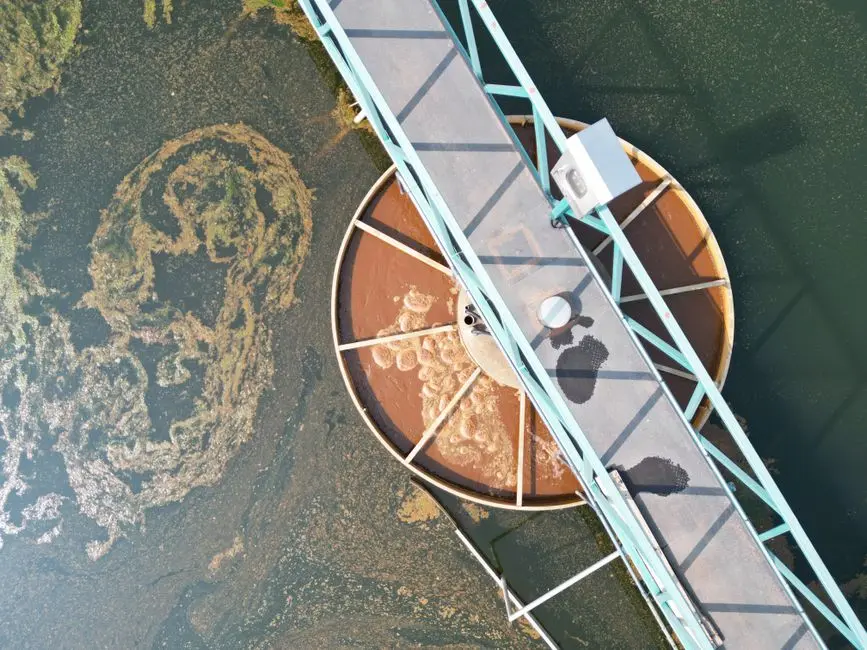
The MBR-C model table acts as the reference for matching project flow requirements to specific hardware configurations.
| Model | Flow (gpd) | Flow (m³/day) | Approx. Population (50 gpd/cap) | Skids × Modules | Container |
|---|---|---|---|---|---|
| MBR-C-13.2K-06 | 13,211 | 50 | ~265 | 2 skids × 3 modules | 1 × 20' HC |
| MBR-C-26.4K-10 | 26,421 | 100 | ~529 | 2 skids × 5 modules | 1 × 40' HC |
| MBR-C-39.6K-16 | 39,631 | 150 | ~793 | 2 skids × 8 modules | 1 × 40' HC |
| MBR-C-50.2K-20 | 50,198 | 190 | ~1,004 | 2 skids × 10 modules | 1 × 40' HC |
All four models ship as insulated, zero-leakage, seaworthy ISO enclosures with enhanced structure, which simplifies road transport into Harare and on-site plug-and-play placement (pureaqua.com data sheet; mena-water.com). For projects that fall between the listed flows — for example, a 250-person camp producing roughly 38 m³/day — the engineering decision involves choosing between the next 40' HC model or running two 20' HC units in parallel; this trade-off depends on footprint, redundancy preference, and road access, and should be discussed with the supplier of the DF series flat sheet MBR modules before the PO is cut.
Harare-Specific Adjustments Before You Order
The MBR-C operating envelope is 20–30°C with a design temperature of 20°C (pureaqua.com data sheet). Harare sits at roughly 1,490 m elevation with a cool dry season that can pull mixed-liquor temperature toward the lower edge of that band; this must be flagged at quotation so the supplier confirms biological activity stays acceptable. The standard electrical supply is 460V/3Ph/60Hz, and Pure Aqua notes that solar-powered builds are feasible; a generator or solar buffer should be specified alongside the container to account for variable grid reliability (pureaqua.com).
Intermittent occupancy in camps drives highly variable diurnal flow. A buffering or equalisation step in the feed well ahead of the container inlet serves as standard mitigation; however, as the supplied research does not quantify Zimbabwe camp load patterns, the equalisation volume should be sized from the designer's own peak-to-average ratio. Discharge requirements must be confirmed with the Environmental Management Agency (EMA) before final sizing, as MBR permeate must meet local irrigation or stream-discharge limits. Camps with food service should add an upstream rotary mechanical bar screen or grease trap to protect the drum screen and aeration tank from fats, oils, and grease.
Effluent Quality You Can Plan Around
The MBR-C data sheet provides a paired feed and permeate envelope for regulatory and client discussions.
| Parameter | Feed (Design) | Expected Permeate |
|---|---|---|
| pH | 6.5–7.5 | 6.5–7.5 |
| Alkalinity (as CaCO₃) | 125 mg/L | ≥100 mg/L |
| TSS | 200 mg/L | <5 mg/L |
| BOD | 250 mg/L | <10 mg/L |
| COD | 400 mg/L | <50 mg/L |
| NH₄-N | 30 mg/L | <2 mg/L |
The membrane physically retains sludge flocs and most viruses, removing the need for a secondary clarifier (huber-se.com). Permeate values are not guarantees and must be re-checked against actual Harare influent characterisation (pureaqua.com data sheet).
Pre-Order Site and Feed-Water Checklist
Gather the following inputs before signing a purchase order to ensure the quoted container meets site requirements.
- Design population or peak-occupancy figure, plus any industrial or commercial wastewater component that will be co-treated.
- Influent characterisation: pH, BOD, COD, TSS, NH₄-N, alkalinity, and temperature range, compared against the MBR-C design feed of pH 6.5–7.5, BOD 250 mg/L, COD 400 mg/L, TSS 200 mg/L, NH₄-N 30 mg/L, and alkalinity 125 mg/L as CaCO₃ (pureaqua.com data sheet).
- Available footprint, access road geometry for an ISO container delivery, and crane or truck reach at the Harare site.
- Power supply specification and any standby generation or solar buffer for the 460V/3Ph/60Hz MBR-C electrical spec (pureaqua.com data sheet).
- Discharge route — irrigation reuse, stream discharge, or sewer — as MBR may act as a pretreatment step for RO, meaning the permeate might not be the final effluent (pureaqua.com data sheet).
- Required effluent parameters versus the MBR-C permeate envelope, with a flag for any parameter that would need polishing with UV, chlorine dioxide, or RO. An automatic chemical dosing system is typically paired where polishing is required.
Frequently Asked Questions
Which MBR-C container footprint should I order for a 250-person camp near Harare?
A 250-person camp at 50 gpd per capita produces about 9,500 gpd or 36 m³/day average, which sits inside the 20' HC MBR-C-13.2K-06 envelope of 50 m³/day (pureaqua.com data sheet). The decision between a single 20' HC unit and a 40' HC for redundancy depends on the peak-to-average ratio and confirmation that HRT remains adequate for your specific BOD load.
How should I frame the budget conversation with a Harare supplier before requesting a quote?
Send the supplier your design flow (m³/day), influent characterisation, footprint constraints, and discharge target as one enquiry package. This allows them to quote a single line item against the closest catalog model rather than pricing around an underspecified brief.
What supplier qualifications should I verify before selecting a containerized MBR vendor?
Confirm that the vendor builds the unit in-house, supports remote monitoring, and can supply the RO/UF membrane filter elements as spares on a defined lead time. Cross-reference the electrical spec (460V/3Ph/60Hz) and operating envelope (20–30°C) against your Harare site conditions, and ask for a reference project at a similar altitude or with a similar seasonal temperature swing (pureaqua.com data sheet).
What compliance risk should I brief procurement on for a Harare discharge?
Brief procurement to request current irrigation and stream-discharge thresholds from the EMA before the PO is cut. The MBR permeate envelope of BOD <10 mg/L, TSS <5 mg/L, and NH₄-N <2 mg/L is a defensible starting point (pureaqua.com data sheet), but the final reuse path — and whether polishing with UV, chlorine dioxide, or RO is required — must be confirmed against the EMA position. For context on how a nearby African market is approaching similar cost and compliance questions, see the industrial wastewater cost data from a nearby African market, and for a parallel high-altitude sizing case, see the containerized MBR sizing methodology in a high-altitude market.