What "Commissioning" Actually Means in a Water or Wastewater Project
Commissioning is the structured testing, calibration, and adjustment of installed water and wastewater treatment equipment that sits between mechanical completion and owner takeover. It is not construction, and it is not yet operations — it is the bridge where design intent gets verified against running equipment. For most water treatment projects, SAMCO notes that commissioning and startup activities account for about 20% of the total project timeline, with training and O&M documentation adding another roughly 5%.
The phase has to be distinguished from startup and from beneficial occupancy. Startup is the act of energising equipment and bringing systems online; beneficial occupancy is when the owner takes possession of the asset. Commissioning wraps both, and also wraps the documentation, training, and proof-of-performance work that gives the owner a defensible handover. For water and wastewater projects, commissioning activities frequently overlap with the tail end of construction, which is part of why they are routinely under-scheduled. Factory acceptance testing at the fabricator's shop, for instance, happens before shipment but is counted as a commissioning activity, not a construction activity.
Four sub-phases carry the work from planning to handover: pre-commissioning planning and factory acceptance testing (FAT), mechanical completion and site acceptance testing (SAT), wet commissioning and biological startup, and proof of performance and handover. The rest of this article walks through each one in order.
How Commissioning Fits Into the Overall Project Timeline
Commissioning is a fixed share of the total project, not a final-week formality. Per SAMCO, a typical water treatment system allocates about 30% of the timeline to planning, roughly 25% to engineering and design, around 25% to construction, about 20% to commissioning and startup, and around 5% to training and O&M documentation. That spread is the most-cited breakdown in the industry and it holds up reasonably well across both small packaged plants and large custom builds.
Per TrueLook's 2025 reporting, most water treatment plant construction projects run 24 to 48 months from groundbreaking to commissioning, with larger regional wastewater projects running longer. SAMCO's own range for high-purity, multi-stage plants extends to 2–7 years from inception to completion when permitting and pre-construction are included.
The practical implication for a project manager is that if construction is roughly 25% of a 30-month overall schedule, the commissioning window is realistically a multi-month activity, not a last-pass checkbox. Planning and permitting can take 12 to 24 months before groundbreaking (TrueLook, 2025), so commissioning typically lands two to four years after project sanction for most municipal plant builds. When the schedule is compressed, commissioning is the buffer that gets squeezed first — and the buffer that hurts most when it breaks.
The Four Sub-Phases of a Water and Wastewater Commissioning Timeline
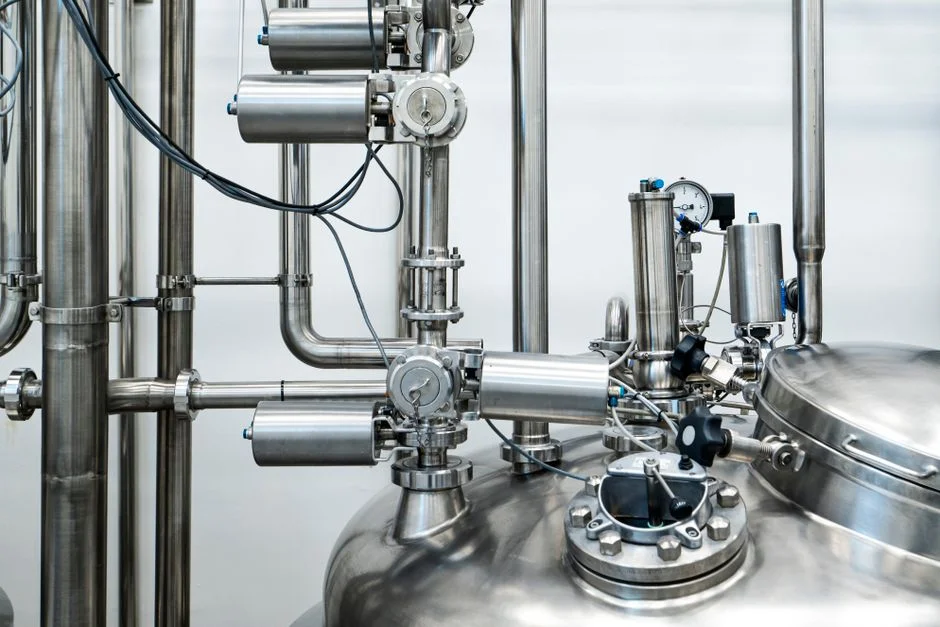
Each commissioning sub-phase has a defined purpose, a defined set of activities, and a defined trigger to start. The four map cleanly onto a Gantt chart if you keep the dependencies in the right order.
Sub-phase 1 — Pre-commissioning planning and FAT. The owner, EPC, and OEM agree the Commissioning Plan, freeze the test scripts, and run Factory Acceptance Testing at the fabricator's shop to confirm equipment meets design specifications before it ships. FAT is the last clean opportunity to reject a non-conformance without site rework cost, so the test scripts need to be locked during planning, not during shipment.
Sub-phase 2 — Mechanical completion and SAT. Punch-list items are closed out, then Site Acceptance Testing is performed prior to and during installation to verify functionality, check for leaks, and confirm the equipment is free of defects. SAT is also where control narratives get bench-tested against the actual I/O list and where instrument loop checks are run before any process fluid enters the system. For a packaged WSZ underground integrated sewage treatment plant this is the point at which tank integrity, pipework, and embedded instrumentation are all verified against the approved submittals.
Sub-phase 3 — Wet commissioning and biological startup. Feed water is introduced, instruments are calibrated, and dosing, aeration, mixing, and flow setpoints are adjusted to design values. For biological wastewater treatment, this is the schedule-variable activity: SAMCO notes that biological systems may require up to several additional weeks during commissioning to establish biomass before the system is fully operational, and that this can be shortened by seeding the new system with sludge from an existing facility. A containerized MBR sizing guide is a useful cross-check here, because seeding volumes and seeding timing scale with the reactor volume being commissioned.
Sub-phase 4 — Proof of performance and handover. The system runs against real influent, samples are collected at a defined interval (e.g., daily or weekly), and results are analysed to confirm the plant is meeting target water quality specifications. SAMCO notes that most projects allow several weeks for final quality testing so operational variability is captured and resolved. Once the PoPT report is signed and the O&M manuals are accepted, the owner takes beneficial occupancy.
| Sub-phase | Primary purpose | Key activities | Typical trigger to start |
|---|---|---|---|
| 1. Pre-commissioning & FAT | Validate equipment at the shop before shipment | Commissioning Plan, test scripts, FAT at OEM facility | Approved engineering submittals |
| 2. Mechanical completion & SAT | Validate installed equipment before process fluid | Punch-list closure, SAT, leak checks, instrument loop checks | Mechanical completion sign-off |
| 3. Wet commissioning & biological startup | Bring system to operating condition | Calibration, setpoint adjustment, biomass establishment, optional seeding | SAT pass and utilities available |
| 4. Proof of performance & handover | Verify permitted performance and transfer to owner | Sampling campaigns, PoPT report, training, O&M manuals, handover | Stable operation against design setpoints |
Phase-by-Phase Duration Reference
The table below is a structural template rather than a fixed week count. The only firm numeric durations in the supplied research are the ~20% commissioning share, the ~5% training/O&M share, the 24–48 month overall range, the 12–24 month pre-construction permitting range, and SAMCO's "several additional weeks" for biological commissioning. The remaining cells should be filled with vendor- and project-specific data before the schedule is baselined.
| Project phase | Typical share of total timeline | Source | Owner-visible deliverable |
|---|---|---|---|
| Planning | ~30% | SAMCO | Approved basis of design, permitting record |
| Engineering & design | ~25% | SAMCO | Issued-for-construction drawings, specifications |
| Construction | ~25% | SAMCO | Mechanical completion certificate, punch list |
| Commissioning & startup | ~20% | SAMCO | PoPT report, calibrated asset register |
| Training & O&M | ~5% | SAMCO | O&M manuals, training records, handover |
| Biological startup (within commissioning) | Up to several additional weeks | SAMCO | Biomass establishment log, seeding record |
Pre-construction permitting sits ahead of the table and is reported at 12–24 months by TrueLook (2025). For a defensible schedule, ask each OEM for a vendor-specific commissioning schedule with day-by-day milestones and a separate line for biomass establishment, rather than relying on the industry-average share.
Commissioning Deliverables and the Punch List
Commissioning is documented work, and the deliverable list is what lets the owner enforce accountability on the EPC and the OEMs. The standard set includes an approved Commissioning Plan, an FAT report, an SAT report, calibrated instrument loop sheets, the Punch List with status, signed commissioning test scripts, the Proof of Performance Test report, and as-built drawings. Per SAMCO, the project should also produce operations and maintenance manuals and run training programs for the owner's staff, which it puts at roughly 5% of the overall project timeline.
For biological wastewater treatment, two additional records belong on the list: a biomass establishment log that tracks mixed-liquor suspended solids, food-to-microorganism ratio, and dissolved oxygen over the startup window, and a seeding record that documents the source facility, volume transferred, and transport conditions when sludge from an existing plant is used to accelerate startup. A reference on AAO process design parameters is a useful sanity check for the target MLSS and F/M values that the biomass log should be benchmarked against.
| Deliverable | Produced during | Owner sign-off needed |
|---|---|---|
| Commissioning Plan | Sub-phase 1 | Yes, before FAT |
| FAT report | Sub-phase 1 | Yes, before shipment |
| SAT report & Punch List | Sub-phase 2 | Yes, before wet commissioning |
| Calibrated instrument loop sheets | Sub-phase 2–3 | Yes, before PoPT |
| Biomass establishment log & seeding record | Sub-phase 3 | Yes, for biological systems |
| Proof of Performance Test report | Sub-phase 4 | Yes, before beneficial occupancy |
| O&M manuals and training records | Sub-phase 4 | Yes, at handover |
| As-built drawings | Sub-phase 4 | Yes, at handover |
What Most Often Blows Up a Commissioning Schedule
TrueLook's 2025 piece specifically calls out Phase 4 — mechanical, electrical, and controls installation — and the commissioning phase that follows it as the most common origin of delay on water and wastewater builds. The same source names undocumented change orders and missed regulatory inspection windows, alongside cross-trade coordination, as more frequent causes of delay than the core civil or process engineering work itself. The civil and structural work is rarely what blows up the schedule; it is everything happening around it.
SAMCO adds a second failure mode: errors and oversights in planning and design "can quickly lead to delays and cost overruns once crews break ground," and commissioning is the phase where those late errors surface because it is the first time the system runs as designed. A pump curve that was never reconciled against the head-loss calculation, an I/O tag that was missed in the SAT, or a control narrative that does not match the as-wired panel all show up here, and all of them push the PoPT window to the right.
The third risk is biological, and it is the one that gets the least attention in generic timelines. For biological wastewater systems, the need to establish biomass before the system is fully operational is the single most schedule-variable commissioning activity SAMCO identifies. If seed sludge is not pre-arranged, if the seed source is far from the new plant, or if the receiving mixed liquor is not at the right temperature and pH, the several-week estimate stretches. The fix is contractual: name seeding in the Commissioning Plan, identify the seed source in the bid, and put the seeding record on the deliverables list.
Frequently Asked Questions
How long does commissioning take on a typical water or wastewater project?
Per SAMCO, commissioning and startup typically account for about 20% of the total project timeline, with training and O&M documentation adding another ~5%. Per TrueLook (2025), most plants run 24–48 months from groundbreaking to commissioning, which puts the commissioning envelope in the multi-month range for a typical build. The exact week count depends on plant size, process complexity, and whether biological startup is required, so the defensible move is to ask each OEM for a vendor-specific commissioning schedule rather than relying on the industry average.
How should a contingency budget be sized for commissioning?
The supplied research does not publish a contingency percentage, so the right input to request is a vendor-specific commissioning schedule with a line-item float for punch-list closure, loop checks, and biological startup, plus a separate reserve for the "several additional weeks" that biological wastewater systems may need per SAMCO. Until those numbers are in hand, treat any quoted contingency as unverified and require the OEM to back it with activity-level durations.
How do I pick a commissioning-capable EPC or OEM?
Weight three things: a documented Commissioning Plan with named test scripts, evidence of completed FAT and SAT reports on similar plants, and a written approach to biological startup that names seeding sources, volumes, and a biomass establishment log. A supplier that can show a recent Proof of Performance Test report against permitted effluent targets is materially lower risk than one that cannot. For a packaged HydropureWater MBR membrane bioreactor system or a HydropureWater automatic chemical dosing system, ask for the OEM's standard SAT protocol and a sample PoPT report before signing.
What is the single biggest schedule risk during commissioning?
TrueLook (2025) puts it as cross-trade coordination, undocumented change orders, and missed inspection windows during the mechanical, electrical, and controls phase that feeds into commissioning. For biological systems, SAMCO adds biomass establishment, which can run up to several additional weeks and is the most variable activity on the commissioning Gantt. Plan float against both and ask the EPC to show, in writing, how each one is being de-risked in the baseline schedule.
Related Equipment
- UV sterilizer for water treatment — specifications, capacity range, and technical data