Why Industrial Engineers Specify Ion Exchange in 2026
Process engineers specify ion exchange for one of two reasons: polishing or decontamination. The first involves pushing conductivity, silica, hardness, or trace anions below process-critical limits for boiler feed, RO permeate polishing, pharmaceutical water, or semiconductor ultrapure loops. The second is resource recovery: pulling a dissolved ion out of an effluent stream and concentrating it into a small regenerant volume that can be returned to the process or sold.
According to Springer Netherlands (Bolto & Pawlowski, 1985), about 0.3% of ammonia produced is discharged as a pollutant, and nitric acid losses reach 1.3%; heavy-metal losses in metal finishing exceed these nitrogen figures, making recovery economically viable at industrial scales. Magnetic ion-exchange resins improve recovery economics through superior kinetic properties that minimize equipment size. Crystal Quest notes that while residential softeners are sized for comfort and scale prevention, industrial systems are sized for breakthrough capacity, effluent quality, and regenerant consumption—three distinct design targets.
The Working Principle: Resin, Selectivity, and the Exchange Reaction
An ion exchange system works by passing water through a bed of charged resin beads that swap dissolved target ions for benign counter-ions held on the resin. The cycle has four phases: service (ions are exchanged as water flows through), backwash (the bed is loosened and debris flushed), regeneration (concentrated acid, caustic, or brine displaces captured ions and recharges the resin), and rinse (residual regenerant is flushed out before service resumes). Industrial systems use stronger regenerants than residential softeners, run on flow- or sensor-triggered cycles, and often feature dual-bed cation/anion trains or mixed-bed polishers to meet stringent quality targets.
Resins are porous polymer beads, usually styrenic or acrylic, with surfaces functionalized to carry a fixed electrical charge. Cation resins carry fixed negative sites and release hydrogen or sodium; anion resins carry fixed positive sites and release hydroxide or chloride (Crystal Quest). Selectivity follows ionic charge, size, and concentration: a softener resin grabs calcium and magnesium before lighter sodium ions, allowing a single cation bed to remove hardness. This principle explains why a PFAS-selective anion resin can isolate PFOA from a stream containing other anions, and why specialized boron-selective resin captures boron even at ordinary pH. The exchange is reversible and stoichiometric—regenerant concentration, contact time, and bed depth determine how completely the equilibrium is driven forward during service or reversed during regeneration.
The Four-Phase Cycle: Service, Backwash, Regeneration, Rinse
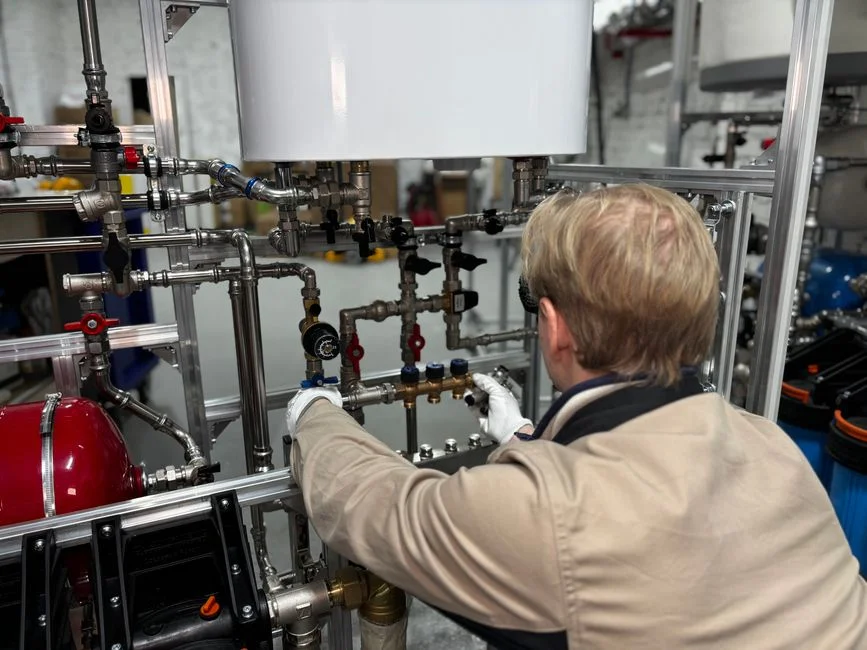
The service phase occurs as feed water enters the vessel, target ions diffuse into the bead and are exchanged onto the resin sites, and treated water leaves at the outlet. As the bed loads, the working zone moves down the vessel and the outlet ion concentration remains low until breakthrough.
The backwash phase reverses flow to fluidize the bed, flush out suspended solids, and reclassify the beads before the next chemical step. Crystal Quest describes this as the step that loosens the bed and prepares the resin for regeneration.
During regeneration, a concentrated regenerant displaces captured ions and recharges the resin with its stored ions. Sodium chloride is the standard regenerant for softeners; hydrochloric or sulfuric acid regenerates cation resin in hydrogen form for demineralization; sodium hydroxide regenerates anion resin (Crystal Quest). The choice of regenerant, dose, and contact time dictates operating costs, allowing vendors to optimize chemistry rather than over-dosing.
The rinse phase displaces residual regenerant with a slow then fast rinse, ensuring the first service water after regeneration is not contaminated by carryover. Residential softeners typically regenerate every 3 to 7 days, controlled by a meter or timer; industrial systems run on flow-based or sensor-triggered cycles tuned to feed water and process demand (Crystal Quest). A useful mass-balance sanity check for sodium-cycle softening: a typical softener adds roughly 7.5 mg of sodium per quart of water for every grain per gallon of hardness removed (Crystal Quest). On an industrial system, the equivalent number should be requested in units matching the engineer's mass balance.
Resin Types and What Each One Targets
Resin selection dictates long-term performance and chemical efficiency. The table below maps standard industrial resin families to their target ions, typical regenerant, and placement in a treatment train.
| Resin Family | Target Ions | Typical Regenerant | Industrial Use |
|---|---|---|---|
| Strong-acid cation (SAC), sodium form | Hardness (Ca²⁺, Mg²⁺) | NaCl | Softening, boiler feed pretreatment |
| Strong-acid cation (SAC), hydrogen form | Total cation load | HCl or H₂SO₄ | Demineralization, first stage of dual-bed |
| Weak-base anion (WBA) | Strong mineral acids (Cl⁻, SO₄²⁻) | NaOH (lower dose) | Acid reduction in dual-bed trains |
| Strong-base anion (SBA) | Weakly ionized species (SiO₂, CO₂) | NaOH (higher dose) | Silica and CO₂ removal, final anion polish |
| Mixed-bed (cation + anion blend) | Trace ions, conductivity reduction | Acid + caustic, separated for regen | Ultrapure polishing for pharma, semiconductor, power |
| Specialty anion (PFAS, fluoride, nitrate, tannin) | Specific target anions | NaCl or tailored brine | Targeted contaminant removal |
According to Crystal Quest, standard cation-only resins do not target PFAS even though PFAS are anions; purpose-built anion exchange resins are required. A typical residential softener resin bed lasts 10 to 15 years, but iron, chlorine, and organic fouling shorten that duration, making pre-treatment for iron and chlorine essential to extending resin life.
Bed Configurations: Single, Dual, and Mixed Bed
Bed configuration represents a critical architectural decision in the process flow diagram. Single-bed units handle one ion class—softening, dealkalization, or a single-stage polishing task. Dual-bed trains place a cation vessel followed by an anion vessel, often with a degasser between them, and serve as the workhorse of industrial demineralization where throughput is high.
Mixed-bed polishers deliver the lowest conductivity and silica leakage because cation and anion sites are intimately mixed; Crystal Quest notes that these beds combine cation and anion exchange in a single tank to deliver ultrapure water for electronics, medical labs, and pharmaceutical production. They are typically placed downstream of a dual-bed or RO system for final polishing.
Regeneration mode influences performance as much as bed type. Co-current regeneration results in higher leakage of the wrong ion, while counter-current regeneration provides sharper separation, lower regenerant consumption, and better effluent quality at the cost of more complex internals. The table summarizes the configuration trade-offs to weigh before selecting a vendor.
| Configuration | Effluent Quality | Regenerant Use | Capital & Complexity | Typical Application |
|---|---|---|---|---|
| Single bed (co-current) | Moderate | Higher | Lowest | Softening, single-stage polish |
| Dual bed (co-current) | Good | Moderate | Moderate | Industrial demineralization, power |
| Dual bed (counter-current) | Better, lower leakage | Lower | Higher (nozzle/plate internals) | High-throughput demineralization |
| Mixed bed polisher | Best (lowest conductivity, silica) | High per unit, but small volume | Highest (separation step) | Pharma, semiconductor, power condensate |
Operating Parameters and the Data You Should Request from a Vendor
Resin life is highly sensitive to feed water quality. The Crystal Quest residential guideline of 10 to 15 years assumes clean feed; iron, chlorine, and organics shorten it significantly. Standard softener resin tolerates dissolved iron only up to about 0.3 ppm; iron concentrations above that threshold require a dedicated upstream iron filter (Crystal Quest). For a sodium-cycle softener, the sodium added to the treated water is roughly 7.5 mg per quart per grain per gallon of hardness removed (Crystal Quest); on an industrial system, the equivalent mass-balance figure should be requested in units the process engineer will use.
Before a vendor meeting, the engineer should prepare a written request for the following items in addition to a feed-water analysis: operating capacity (eq/L), regenerant dose (g/L or lb/ft³), service flow versus backwash flow, bed depth, freeboard, and leakage specification at the end of the run. Industrial industrial water softener systems sized for boiler feed and process water will quote against this list; a vendor that cannot supply these numbers in the buyer's preferred units should be deprioritized.
Where Ion Exchange Fits in an Industrial Treatment Train
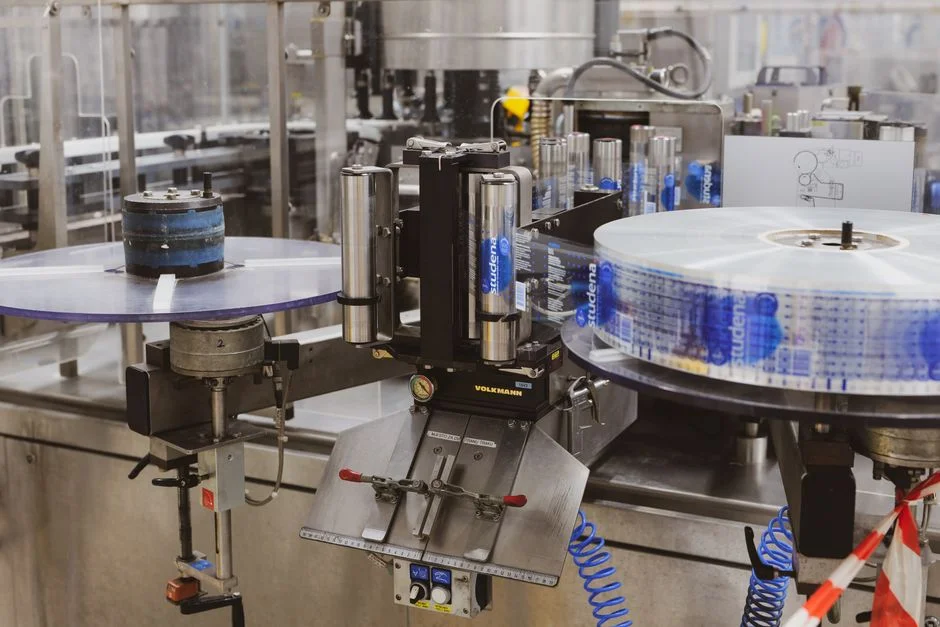
Ion exchange rarely functions as a stand-alone unit. Pretreatment is necessary because suspended solids, chlorine, iron, and oil foul the resin and reduce lifespan below the 10 to 15 year baseline (Crystal Quest). Multi-media pretreatment filters and RO and UF membrane elements handle bulk reduction upstream so the ion exchange stage only processes the contaminants it is designed to remove.
Downstream polishing architecture depends on the application. In boiler feed, ion exchange is often placed after multimedia filtration and before RO. In ultrapure trains, mixed-bed DI is the final stage before the process in many semiconductor and pharma loops, sitting after the RO and ahead of the point of use. In resource-recovery trains, ion exchange follows biological or physical-chemical treatment so the target ion ends up concentrated in a small regenerant volume (Springer Netherlands, Bolto & Pawlowski, 1985). The integration of ion exchange with biological stages is covered in the comparison of aerobic versus anaerobic biological treatment.
Brine handling represents a significant operating cost. Traditional regeneration produces a saline or acidic/caustic waste stream that must be neutralized or recovered (Crystal Quest). Continuous electrodeionization systems replace mixed-bed ion exchange in some ultrapure loops and eliminate regeneration wastewater, a relevant option for biopharma and electronics buyers weighing RO-EDI versus mixed-bed ion exchange for biopharma. For process trains combining membrane and ion-exchange stages, the placement of RO and UF membrane elements relative to the ion exchange vessels is the primary determinant of resin life. For a related membrane-driven separation, the forward osmosis working principle explainer serves as a parallel reference. Replacement resin and control valves should be budgeted as recurring spares, not one-time capital.
Frequently Asked Questions
What determines ion exchange system cost and how do I evaluate suppliers in 2026?
Capital cost is driven by vessel size, resin volume, internals (especially for counter-current regeneration), and the control package. Operating cost is dominated by regenerant consumption and brine disposal. When comparing suppliers, request operating capacity (eq/L), regenerant dose (g/L or lb/ft³), expected leakage at the end of the run, and a written guarantee on resin life under your specific feed-water analysis. A vendor that will not commit to numbers against your analysis should be deprioritized.
How do I size an industrial ion exchange system and what does a vendor need to quote accurately?
Size is determined by the flow rate, target ion concentration, the selectivity and capacity of the chosen resin, and the desired service cycle length. To obtain a defensible quote, provide the vendor with your feed-water analysis (full ionic balance), target effluent quality, peak and average flow rates, available floor area, regenerant preference (NaCl, HCl, H₂SO₄, NaOH), and any discharge limits on the regeneration waste. Providing these inputs prevents the vendor from defaulting to a budgetary estimate that may not suit your project constraints.
When should ion exchange be replaced by RO-EDI or another polishing technology?
RO-EDI becomes attractive when the regeneration waste stream presents a regulatory or cost burden, when low conductivity is required continuously rather than between regenerations, or when the plant aims to eliminate acid and caustic handling. For high-purity water in biopharma and electronics, EDI placed downstream of RO can replace a mixed-bed polisher and produce a continuous stream of ultrapure water without chemical regeneration. The trade-off is higher