
Why Lufkin petroleum plants need to choose between DAF and a clarifier in 2026
For Lufkin, Texas petroleum factories in 2026, a Dissolved Air Flotation (DAF) system is the correct primary treatment for emulsified oil, grease, and fine suspended solids in produced water, refinery effluent, and tank-farm runoff, while a gravity/lamella clarifier is only suitable as a downstream polisher. DAF achieves 85–95% oil and grease removal at ~3-minute retention and produces 2–3% thickened sludge that needs no further thickening (Lenox Institute/Krofta, 2022, doi:10.17613/zq0g-t311).
Lufkin sits inside the East Texas oilfield, where gathering systems pull Woodbine, Upper Jurassic, and Eagle Ford-sourced crude through Angelina County. That crude brings with it the wastewater stream a clarifier was never designed to handle: chemically emulsified oil, high-TDS brine, and seasonal temperature swings that move viscosity by a factor of two between winter and summer. A typical 2026 Lufkin refinery or upstream plant sees API separator effluent with free oil already below 50 mg/L but emulsified oil still at 200–2,000 mg/L, TSS 100–1,500 mg/L, and TDS between 30,000 and 150,000 mg/L; stream temperature runs 30–55 °C through the summer (HydropureWater field data, 2026). At those conditions, oil droplets smaller than ~60 µm carry near-neutral buoyancy and will not reach a clarifier floor in any realistic residence time.
Compliance is not optional. 40 CFR Part 435 (the oil and gas extraction point-source category) sets monthly-average O&G limits that drive the primary-treatment decision, and Texas Pollutant Discharge Elimination System (TPDES) permits administered by TCEQ enforce them locally. DAF is explicitly the established technology for produced water, refinery, and fracking flowback because "low-density particles and emulsified oils … are difficult to settle" (Ecologix, oil-and-gas DAF guide, 2026 update).
How DAF and a gravity clarifier actually work on petroleum wastewater
DAF and gravity clarification solve opposite problems: one floats light material, the other settles heavy material. On a Lufkin petroleum stream, that distinction decides the outcome before any chemistry is added.
A DAF unit takes a pressurized side-stream (typically 20–30% of the main flow), saturates it with air at 4–6 bar in a packed saturator, and releases it to atmospheric pressure inside a flotation tank. The pressure drop generates micro-bubbles in the 10–80 µm range that attach to oil droplets and polymer-conditioned floc, lifting them to the surface in roughly 3 minutes of hydraulic retention. Specific clarification capacity is 4–5 GPM/ft² (≈ 16–20 m³/m²·h), so a single 4 m × 8 m cell handles 100+ m³/h on a small footprint (Lenox Institute/Krofta, 2022, doi:10.17613/zq0g-t311). A surface scraper sweeps the floated layer into a sludge hopper; clarified effluent leaves from below the float blanket.
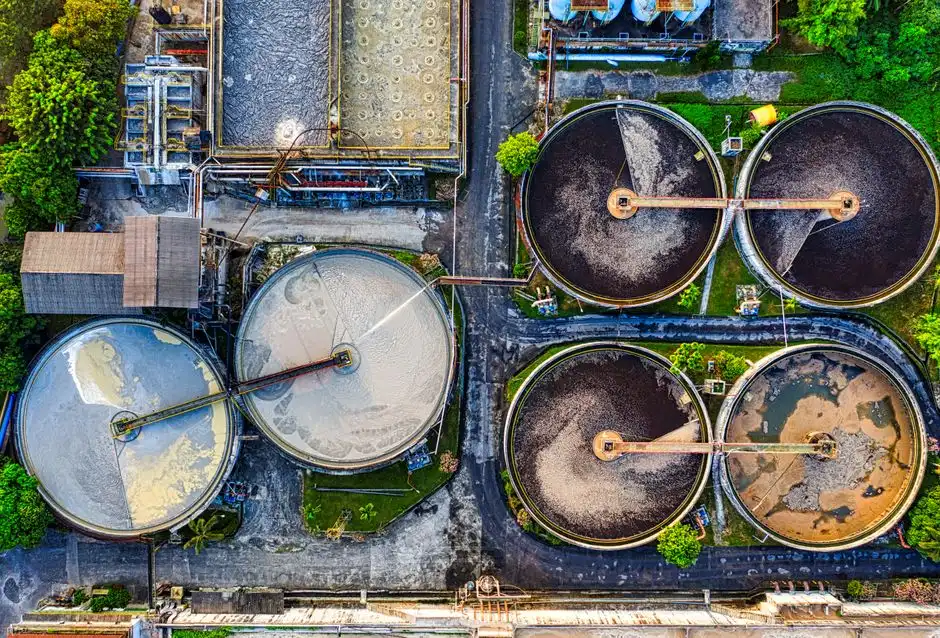
A gravity clarifier — circular or rectangular, with or without inclined lamella plates — relies on quiescent settling. Feed enters a center well, flow spreads radially (or down a rectangular basin), and particles with settling velocity greater than the surface overflow rate reach the floor. Lamella plates shorten the effective settling path and raise the equivalent surface loading to 20–40 m/h, but the physics does not change: only material heavier than water settles. The top is skimmed for floatables, the bottom is scraped to a sump, and what leaves the unit as underflow is typically 0.5–1.5% solids — too thin to haul without thickening.
For Lufkin petroleum streams, this matters because emulsified oil droplets below ~60 µm have near-neutral buoyancy. Their settling velocity is effectively zero. They will pass through a clarifier regardless of residence time or plate angle, which is why a clarifier-only train fails 40 CFR 435 O&G limits on produced water and desalter brine. The terms used throughout this article are: free oil (droplets ≥ 150 µm, recoverable by API separator), emulsified oil (droplets 1–150 µm, chemically stabilized, requires coagulation or air flotation), TSS (total suspended solids), FOG (fats, oils, and grease), API separator effluent (the post-API stream fed to the next treatment step), and polymer-conditioned floc (destabilized oil and solids bound by cationic or anionic polyacrylamide for removal).
DAF vs clarifier for petroleum wastewater: 2026 decision matrix
The single artifact a procurement engineer will screenshot is the side-by-side comparison. The numbers below are the operating envelope a Lufkin plant should plan against in 2026.
| Parameter | DAF (ZSQ series) | Lamella clarifier |
|---|---|---|
| Oil & grease removal (petroleum) | 80–95% (typ. 85%); effluent O&G 15–40 mg/L with proper coagulation | ~70% on free oil; near-zero on emulsified oil |
| TSS removal | 80–95%; effluent TSS 20–50 mg/L typical | 50–80% on settleable solids; poor on colloids |
| Free oil handling | Excellent | Good (skimmable) |
| Emulsified oil handling | Excellent (this is the reason to specify DAF) | Poor — does not remove emulsified oil |
| Footprint at 100 m³/h | ~25–35 m² (single cell, 3-min HRT) | ~60–120 m² (lamella at 20–40 m/h loading) |
| Sludge consistency out of unit | 2–3% thickened; no further thickening required | 0.5–1.5% underflow; needs thickener or filter press |
| 2026 packaged CAPEX (100–300 m³/h, installed) | US$180,000–US$420,000 | US$90,000–US$180,000 |
| 5-year OPEX driver | Polymer 5–25 mg/L; air-saturation power; low sludge hauling | Higher polymer on fine TSS; sludge hauling dominates |
Choose DAF if your Lufkin stream carries emulsified oil, FOG above ~100 mg/L, or TSS that must be polished below 50 mg/L to meet 40 CFR 435. Choose a clarifier only as a downstream TSS polisher, sludge thickener, or for grit/sand removal ahead of the DAF (Ecologix, 2026 update; Lenox Institute/Krofta, 2022). A packaged ZSQ series DAF system with an integrated automatic polymer and coagulant dosing system is the typical 2026 Lufkin specification for the primary step.
CAPEX and 5-year OPEX for a Lufkin petroleum plant in 2026
CAPEX is the number procurement wants first; OPEX is the number that decides the project five years later. A Lufkin plant comparing DAF to a clarifier on dollars alone will pick the clarifier and then spend the savings on sludge hauling for the next decade.
| Cost line (200 m³/h Lufkin refinery, 2026) | DAF only | DAF + lamella polish | Lamella clarifier only + thickener |
|---|---|---|---|
| Packaged equipment | US$220,000–US$320,000 | US$310,000–US$460,000 | US$110,000–US$180,000 |
| Installation, civil, instrumentation (TCEQ-permitted) | US$80,000–US$120,000 | US$100,000–US$150,000 | US$60,000–US$100,000 |
| Polymer dose (5-yr) | US$60,000–US$110,000 | US$75,000–US$140,000 | US$120,000–US$210,000 (higher dose on fine TSS) |
| Air compressor power (5-yr) | US$25,000–US$45,000 | US$25,000–US$45,000 | — |
| Sludge hauling (East Texas, 5-yr) | US$40,000–US$80,000 (2–3% cake, 30–60% less volume) | US$30,000–US$60,000 (combined thickening) | US$150,000–US$280,000 (1% underflow → plate and frame filter press required) |
| 40 CFR 435 monitoring, sampling, reporting (5-yr) | ~US$30,000 (same for all options) | ~US$30,000 | ~US$30,000 |
| Total 5-yr TCO (200 m³/h) | US$455,000–US$705,000 | US$570,000–US$885,000 | US$500,000–US$860,000 |
DAF loses on first cost and wins on 5-year total cost of ownership at any Lufkin flowrate above ~50 m³/h, because DAF sludge at 2–3% solids cuts hauling volume 30–60% versus 0.5–1.5% clarifier underflow (Lenox Institute/Krofta, 2022). Polymer dose for DAF on petroleum typically runs 5–25 mg/L, which is lower than the polymer load a clarifier needs to chase fine TSS and emulsified oil it cannot actually remove. The simple-payback window for a DAF over a clarifier-only train is typically 18–36 months at East Texas sludge-hauling rates, before any compliance-risk premium is added. For a cross-check on the sludge-disposal side of the budget, the plate vs belt filter press 2026 TCO guide shows how downstream dewatering choice feeds back into the primary unit's sludge concentration target.
When Lufkin plants should still pick a clarifier (and when to combine both)
A clarifier-only train is defensible in exactly two places on a Lufkin petroleum site, and neither is the primary O&G removal step.
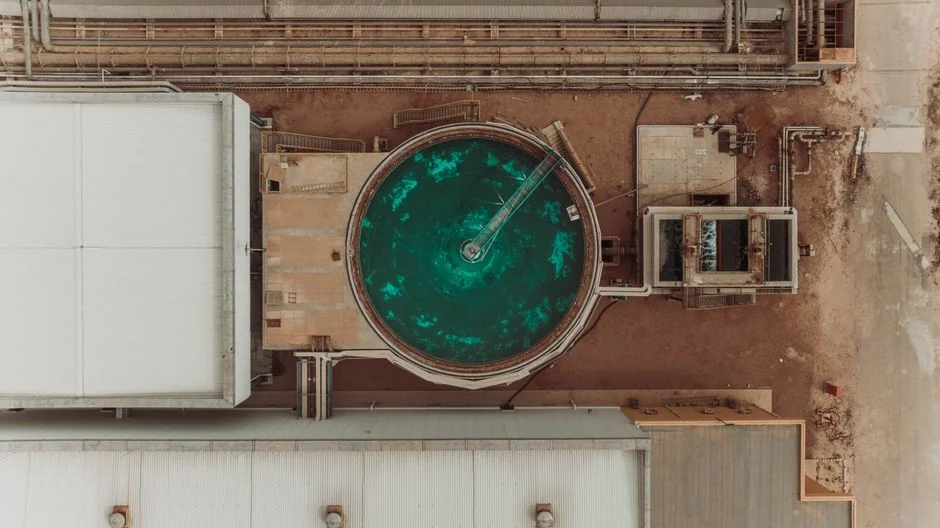
First, a clarifier is the right first stage for heavy grit, sand, and proppant from upstream separation — material that would otherwise abrade and plug a DAF nozzle and saturator. Second, a clarifier handles storm-water and tank-farm runoff with low emulsified oil and no thermal load, where the DAF polymer bill cannot be justified. Clarifier-only is not appropriate for produced water, refinery desalter brine, or any stream that must meet 40 CFR 435 monthly-average O&G limits on its own (per EPA 40 CFR 435).
The 2026 best-practice hybrid on East Texas midstream and refinery sites is DAF as the primary FOG and emulsified-oil step, followed by a lamella clarifier as the TSS polisher ahead of biological treatment, media filtration, or reuse. Ecologix frames the same logic generally: "hybrid systems can address complex wastewater streams, combining DAF's oil removal with clarifiers' sedimentation capabilities" (2026 update). For a Lufkin plant that already runs an API separator and an old circular clarifier, the typical 2026 retrofit adds a packaged DAF upstream of the clarifier and keeps the clarifier as a polishing and sludge-thickening step. A high-efficiency lamella clarifier is a tighter fit than a circular unit for this role because the inclined plates give the same TSS removal in a fraction of the footprint. Engineers evaluating this hybrid configuration on a similar East Texas crude stream can also reference the Nashville petroleum DAF vs clarifier guide and the Falkville petroleum DAF vs clarifier guide for parallel flowrate and influent envelope data.
Frequently Asked Questions
Is DAF or a clarifier better for petroleum wastewater?
DAF is better for the primary step because emulsified oil floats rather than settles. DAF removes 80–95% of FOG versus ~70% for a clarifier, and a clarifier effectively cannot remove chemically emulsified oil below ~60 µm regardless of residence time (Lenox Institute/Krofta, 2022; Ecologix, 2026 update).
What flow rate of DAF does a Lufkin refinery need?
Size the DAF at 1.25–1.5× peak hourly flow with 3–5 minutes of hydraulic retention. A 200 m³/h average plant should select a 250–300 m³/h DAF unit, which corresponds to a single 4–5 m × 8–10 m flotation cell at the 16–20 m³/m²·h specific clarification capacity typical of high-rate DAF (Lenox Institute/Krofta, 2022).
Does a DAF system meet 40 CFR 435 oil and grease limits?
A properly coagulated and flocculated DAF typically meets 40 CFR 435 monthly-average O&G limits for produced water and refinery wastewater when followed by a secondary treatment train (API separator upstream, biological or filtration polishing downstream). Always confirm with on-site jar tests using actual Lufkin crude and brine chemistry before final equipment selection (per EPA 40 CFR 435).
How much does a DAF cost in 2026?
Packaged 100–300 m³/h DAF units run US$180,000–US$420,000 installed in East Texas, including equipment, civil, and instrumentation. Full 5-year TCO depends primarily on polymer dose, air-system power, and sludge-hauling cost — which is where DAF's 2–3% thickened sludge (versus 0.5–1.5% clarifier underflow) drives the OPEX advantage.
Can a DAF and a lamella clarifier be used together?
Yes. A 2026 best-practice train is DAF for FOG and fine TSS, then a lamella clarifier for bulk TSS and sludge thickening before media filtration or biological treatment. On a Lufkin retrofit with an existing circular clarifier, the typical move is to add a packaged DAF upstream and keep the clarifier as a polishing and thickening step.
