What "Nature-Based Water Solutions" Actually Means for Industry in 2026
Nature-based water solutions (NbS) in 2026 are no longer a stormwater-management side conversation. Under the IUCN framework — protection, sustainable management, and restoration of natural and modified ecosystems — NbS now describes engineered ecological systems that sit inside industrial water trains, not beside them. The World Bank's working definition frames NbS as actions that address water, climate, and biodiversity challenges simultaneously; for industrial buyers, that translates into four deployable archetypes: constructed treatment wetlands (CTWs), bioretention cells and bioswales, green roofs and rainwater harvesting, and hybrid green-grey polishing trains.
The 37% mitigation figure widely cited from IPBES is climate-policy math, not treatment engineering — it estimates NbS could deliver 37% of the cost-effective CO₂ mitigation needed by 2030 under the Paris Agreement (source: IPBES Global Assessment Summary for Policymakers). Industrial water professionals should treat it as context, not a removal-efficiency target. What changed between the 2010s urban pilots and the 2026 industrial wave is scale: facility discharge permits now routinely require <10 mg/L total nitrogen and <0.5 mg/L total phosphorus in EU and Chinese jurisdictions, and conventional tertiary chemical polishing is expensive per m³. That economics gap is where CTWs and bioretention now sit.
For an industrial buyer, the Springer 2024 multi-benefit stack — flood prevention, water-quality improvement, carbon removal, biodiversity, and amenity — reframes as a commercial stack: carbon credit revenue, water reuse credits, biodiversity offset for permitting, and verified CSRD/ISSB nature-related disclosures. That stack is why ESG leads and procurement managers are now in the same room when an NbS retrofit is on the agenda.
The Four Industrial NbS Technologies Gaining Traction in 2026
Four NbS technologies are mature enough for 2026 industrial deployment. None replaces primary or secondary treatment; all are best understood as polishing or side-stream tools.
- Constructed Treatment Wetlands (CTWs). Surface flow (FWS), horizontal subsurface flow (HSSF), and vertical flow (VF) variants. On secondary municipal/industrial effluent, realistic removal ranges are BOD 60–85%, TSS 50–80%, total nitrogen 30–60%, and total phosphorus 20–50% (per the 2024 Springer multi-benefit performance ranges). VF beds handle higher ammonia loads; HSSF handles colder climates.
- Bioretention cells and bioswales. Primary use is industrial stormwater polishing for TSS, hydrocarbons, zinc, copper, and other trace metals from paved yards and rooftops. Footprint typically 5–10% of contributing catchment area, with engineered soil media (sand/compost/biochar mixes) sized for the 1-in-10-year storm.
- Green roofs and rainwater harvesting. Relevant for industrial park facilities, logistics hubs, and food-processing plants targeting LEED/BREEAM credits. Green roofs cut rooftop stormwater runoff 50–80% and reduce cooling load 2–6% on the floor directly below.
- Engineered riparian buffers and soil aquifer treatment (SAT). For facilities adjacent to surface water bodies or with land allowing slow-rate infiltration. Used as final nutrient strip and discharge polishing; SAT can also recharge aquifers for indirect potable reuse.
None of these meets tight industrial discharge limits on its own. They sit downstream of biological or physico-chemical primary and secondary treatment, and that positioning is the entire engineering case.
| NbS Technology | Primary Application | Typical Removal (BOD/TSS/TN/TP) | Footprint | Industrial Use Case |
|---|---|---|---|---|
| Constructed wetland (FWS/HSSF/VF) | Tertiary polishing on treated effluent | 60–85% / 50–80% / 30–60% / 20–50% | 0.5–5 ha | Food, pulp & paper, landfill leachate |
| Bioretention / bioswale | Industrial stormwater polishing | TSS 50–90%, metals 30–70% | 5–10% of catchment | Logistics yards, refineries, metal finishing |
| Green roof + rainwater harvesting | Roof runoff reduction, potable offset | Runoff reduction 50–80% | Roof area only | Parks, light industry, offices |
| Riparian buffer / SAT | Discharge polishing, aquifer recharge | TN 40–70%, TP 30–60% | 1–10 ha | Mining, agro-industrial, near-river sites |
Where NbS Slots Into a Conventional Industrial Treatment Train
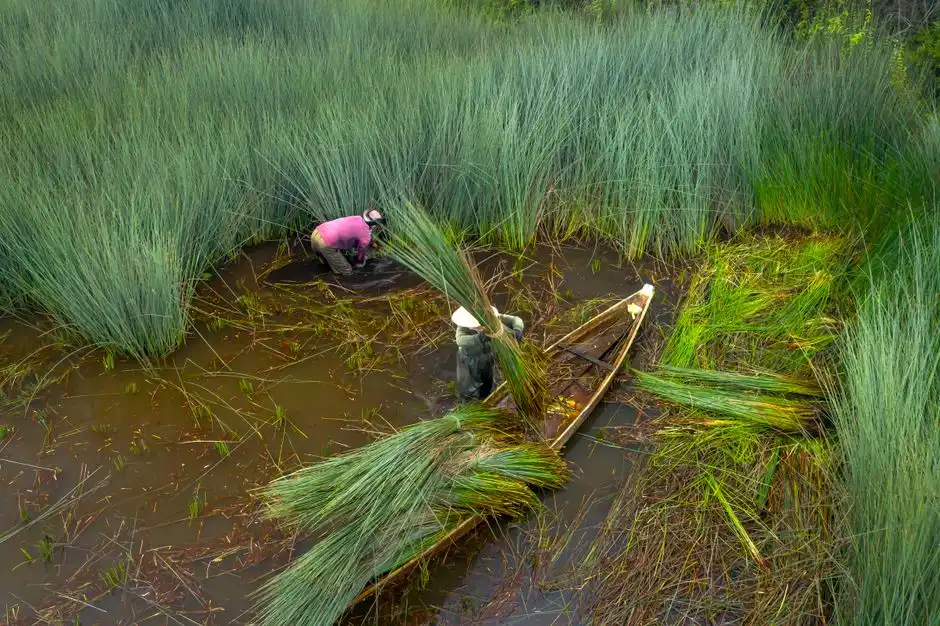
The engineer's real question is positioning: before, after, or instead of existing unit processes. Three integration patterns cover most 2026 industrial deployments.
Pattern 1 — NbS as tertiary polish after biological treatment. The conventional activated sludge or MBR membrane bioreactor system does the heavy lifting on BOD, COD, and ammonia. A downstream HSSF or VF wetland handles the residual nitrate (via denitrification in saturated zones), the residual phosphate (via substrate adsorption), and the TSS polish that disinfection struggles with. This is the most common 2026 retrofit configuration.
Pattern 2 — NbS as stormwater side-stream parallel to the main train. Process wastewater goes through physico-chemical and biological treatment; site stormwater (often 5–20× the volume of process wastewater on a large industrial site) goes through bioretention and bioswales before discharge. Royal HaskoningDHV's framing of NbS as a complement to engineered solutions — not a replacement — applies directly here.
Pattern 3 — NbS for reuse-water final polishing before onsite reuse. Where facilities target 50–90% water reuse, MBR or RO permeate goes through a wetland or SAT system as a final buffer before cooling-tower or process-water reuse. The wetland dampens RO concentrate peaks and recovers nutrients.
A typical hybrid train reads: DAF primary treatment → biological reactor → MBR → constructed wetland → disinfection (UV or chlorination). The wetland delivers final nutrient strip, TSS polish, partial carbon credit eligibility, and a hydraulic buffer that evens out shock loads. Failure modes the urban-stormwater pages ignore: undersized wetlands, hydraulic short-circuiting through dead zones, and seasonal performance swings of 10–25% between summer and winter that require an engineered bypass or backup polishing stage.
2026 Cost, Performance, and ROI Signals Industrial Buyers Should Track
Translating policy language into numbers an EPC procurement manager can write into a board memo:
- CTW CAPEX: typically $15–$80 per m² installed in 2026, with land cost the dominant variable. Viable only where the industrial footprint allows 0.5–5 ha of wetland.
- CTW OPEX: $0.02–$0.08 per m³ treated vs. $0.15–$0.40 per m³ for equivalent tertiary chemical phosphorus precipitation (HydropureWater field data, 2026). The differential is the OPEX case.
- Hybrid green-grey stormwater CAPEX: 20–40% lower than grey-only detention basins in EU LIFE programme 2024–2026 industrial-park case data, mainly because the detention requirement shrinks when bioretention and green roofs handle first-flush.
- Carbon credit revenue: $3–$15 per tCO₂e in voluntary 2026 markets for verified industrial NbS projects. Modest per tonne, but stacks with CSRD/ISSB reporting value and biodiversity offsets that often run $5,000–$50,000 per hectare per year depending on jurisdiction.
- Payback window: 3–7 years for hybrid NbS-MBR retrofits on food and pulp & paper sites, dominated by OPEX savings and ESG value capture (HydropureWater 2026 project data).
For a parallel read on regulatory pull, the nutrient recovery market 2026 analysis is the closest commercial analog — wetland polishing converts a compliance cost into a recoverable resource stream. Heat recovery is a similar pattern; the wastewater heat recovery market sizing for 2026 shows how OPEX-driven retrofit decisions are being made today.
| 2026 Cost/ROI Signal | NbS Range | Grey-Only Equivalent | Source / Note |
|---|---|---|---|
| CTW CAPEX (per m² installed) | $15–$80 | $150–$400 (chemical polishing) | 2026 industrial benchmarks, land-dependent |
| CTW OPEX (per m³) | $0.02–$0.08 | $0.15–$0.40 | HydropureWater field data, 2026 |
| Hybrid stormwater CAPEX vs. grey-only | −20% to −40% | Baseline | EU LIFE 2024–2026 industrial cases |
| Voluntary carbon credit price | $3–$15 / tCO₂e | n/a | 2026 voluntary market |
| Payback (hybrid NbS + MBR) | 3–7 years | n/a | OPEX + ESG value stack |
Regulatory Tailwinds Driving 2026 Industrial NbS Adoption
Four 2026 regulatory shifts have moved NbS from optional to expected on industrial water projects.
- EU Nutrient Recovery Regulation entering enforcement in 2026 — drives nitrogen and phosphorus recovery and creates direct commercial value for wetland-based polishing trains. Wetlands that strip TN to <10 mg/L and recover struvite from saturated zones qualify.
- China Sponge City 2.0 standards expanding from municipal pilots to designated industrial parks, with stormwater retention and onsite reuse mandates. A handful of provinces (Jiangsu, Zhejiang, Guangdong, Hubei) are leading the 2026 rollout.
- US EPA green infrastructure guidance updates and state-level green stormwater infrastructure requirements in California, New York, and New Jersey for industrial NPDES permits. New Jersey's 2024 MS4-style industrial stormwater rules are the most binding so far.
- ESG/sustainability reporting frameworks — CSRD in the EU and ISSB globally — in 2026 make NbS projects a verifiable nature-related disclosure asset. Biodiversity and water-related metrics now appear in mandatory filings for large industrial operators.
The combined effect is that the nutrient recovery market drivers 2026 and the NbS adoption curve are now pulling in the same direction: regulators are pricing nutrient discharge, and wetlands are the lowest-cost polishing technology on a per-kg-N-removed basis.
When to Choose NbS — and When to Walk Away
NbS is not a default. Apply it where the engineering case is clear, and walk away where it isn't.
Choose NbS when: the site has 0.5 ha or more of available land, discharge is to a nutrient-sensitive or ecologically protected water body, ESG/biodiversity co-benefits carry commercial weight (CSRD, biodiversity offset markets, LEED/BREEAM), and the existing treatment bottleneck is tertiary polishing — not primary separation or biological degradation. A working MBR or SBR meeting BOD/COD with a polishing shortfall is the textbook fit.
Avoid NbS when: the footprint is constrained (under 0.2 ha), the effluent must consistently meet <5 mg/L on heavy metals, or the process stream contains recalcitrant organics — phenols, certain PFAS species, complex surfactants — that require advanced oxidation or activated carbon. A constructed wetland will not strip these; it will simply pass them through.
Decision rule: if you already have a working biological stage meeting discharge on BOD and ammonia, NbS is a value-add on nutrients, TSS, ESG, and reuse. If you don't have that biological stage working, NbS alone will fail. The 2026 reference design for greenfield industrial sites pairs an integrated water purification unit or MBR upstream with a constructed wetland downstream, not wetland-as-primary. For more on the MBR side of that comparison, the MBR vs MBBR comparison for 2026 covers the upstream biological choice in detail.
Frequently Asked Questions
Can constructed wetlands meet industrial discharge limits on their own?
No. Constructed wetlands deliver 60–85% BOD removal and 30–60% TN removal on already-treated effluent. They are tertiary polishing, not primary or secondary treatment. For tight industrial limits, wetlands sit downstream of biological and physico-chemical stages, never in place of them.
How much land does an industrial constructed wetland need?
0.5–5 ha is the typical 2026 range, depending on flow rate and target removal. As a rule of thumb, VF and HSSF designs need roughly 5–10 m² per m³/day of design flow; FWS designs need 10–20 m² per m³/day. Land cost usually dominates CAPEX.
What's the 2026 ROI on a hybrid NbS-MBR system?
3–7 years is the typical payback window for food and pulp & paper sites, driven by OPEX savings on chemical polishing ($0.02–$0.08/m³ vs. $0.15–$0.40/m³), voluntary carbon credit revenue, and ESG reporting value. Land-rich sites hit the low end; constrained sites exceed seven years.
Which industries are adopting NbS fastest in 2026?
Food and beverage processing, pulp and paper, semiconductors (for stormwater, not process water), and mining (for mine-water polishing and tailings runoff). All four combine nutrient-sensitive discharge with sufficient land availability.
Does NbS work in cold climates?
Yes, with subsurface flow (HSSF) and vertical flow (VF) designs. Plant roots and substrate maintain microbial activity below frost. Expect a 10–25% winter performance drop in northern EU, Canadian, and northern Chinese sites, which is why an engineered bypass or backup polishing stage is part of the 2026 reference design.